A 40-gallon gas water heater will run more back-to-back showers than a 50-gallon electric, and the tank size has nothing to do with it. The reason is recovery rate: how fast the burner or element reheats water once you have drawn the tank down. Gas puts two to three times more heat into the water per hour than electric, so it refills faster, and on a busy morning that speed matters more than the ten extra gallons of storage.
Who actually needs fast recovery
Recovery rate is not a spec everyone should chase. It matters when your household stacks hot-water draws close together, and it barely registers when your draws are spread across the day. Match the fuel and the number to how your house actually uses water.
Big family, one shower window
Four people showering back to back before work is the classic case. A 50-gallon tank empties in three or four showers, and then everyone downstream depends on how fast it refills. A 40,000 to 50,000 BTU gas unit at 41 to 51 gph keeps the tank from ever bottoming out. An 18 gph electric will run cold on person four.
Two adults, spread-out draws
One shower in the morning, dishes at night, a bath on the weekend. Nothing stacks. Here a 50-gallon electric with a strong first-hour rating is fine, because you never draw faster than it can keep up over the day. Paying for gas-level recovery you never use is wasted money.
Large home, tubs and multiple baths
A soaking tub takes 40-plus gallons in one pull, and a second bathroom may run at the same time. You need both a high first-hour rating for the burst and strong recovery to be ready for the next one. This is where a 50,000 BTU gas tank or a tankless unit earns its keep.
Cold-climate winter demand
In January the incoming water can arrive near 40 degrees instead of 70, pushing the rise to 80 degrees and cutting every heater's recovery by more than a third. A unit that felt fine in summer falls behind in winter. If you live where the ground freezes, size for the winter rise, not the summer one.
Gas versus electric, by the numbers
The gap is not marketing. It comes straight from how much heat each fuel puts into the water per hour. A gas burner is rated in BTU of input; an electric element in watts. Convert both to usable BTU per hour and the difference is obvious before you ever divide by the temperature rise.
| Unit | Input | Usable BTU/hr | Recovery (gph) | Reheat 50 gal |
|---|---|---|---|---|
| 40,000 BTU gas | 40,000 BTU | ~24,800 | ~41 gph | ~73 min |
| 50,000 BTU gas | 50,000 BTU | ~31,000 | ~51 gph | ~59 min |
| 4500 W electric | 15,354 BTU | ~15,050 | ~26 gph | ~117 min |
| 5500 W electric | 18,766 BTU | ~18,390 | ~32 gph | ~95 min |
| Tankless gas | 150,000+ BTU | on demand | endless | n/a |
Two things stand out. First, even the strongest common electric element trails a modest gas burner, because 5500 watts is about 18,800 BTU per hour of input against 40,000 for the smallest typical gas unit. Second, tankless gas does not have a recovery rate in the storage sense at all: it heats water as it flows, so as long as the flow stays within its rated gallons per minute, it never runs out. The trade is that it needs a much larger gas line and vent than a 40,000 BTU tank.
Recovery rate
The number of gallons a water heater can raise to its setpoint in one hour at a stated temperature rise, usually 70 degrees on the spec sheet. It is a speed, not a capacity. The math is GPH = usable BTU/hr / (8.33 x rise), where 8.33 is the BTU needed to warm one gallon of water one degree Fahrenheit. Raise the temperature rise and the recovery rate falls in direct proportion, which is why the same heater recovers slower in winter than in summer.
A 40-gallon gas tank recovers faster than a 50-gallon electric, so it serves more back-to-back showers despite holding less water. Recovery speed beats storage volume when the draws come close together.
How the numbers stack up
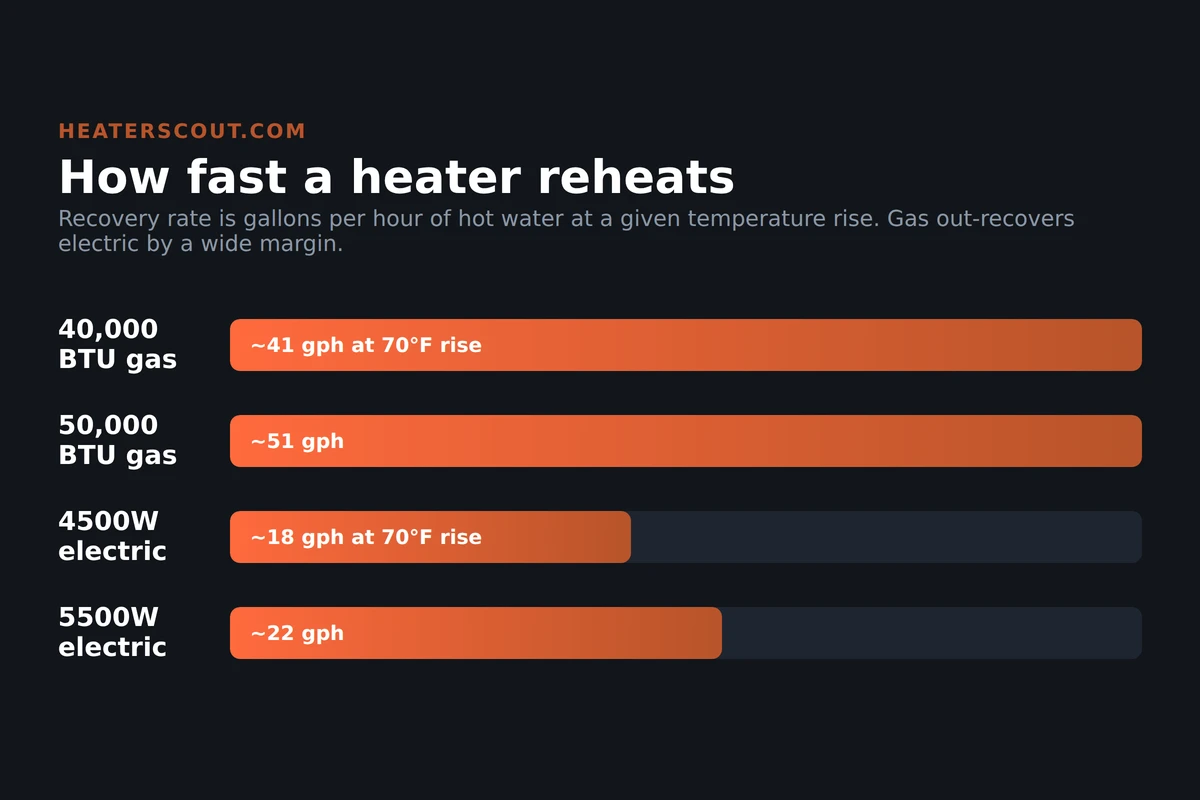
Normalized to a common 70-degree rise, the recovery gap between fuels is easy to see. The bars below rank common residential units by how fast each refills the tank. The gas units are close to the top; the electric elements sit well below, and no amount of extra tank volume moves them up, because volume is storage, not speed.
Run your own recovery numbers
The spec-sheet number assumes a 70-degree rise, which is a fair-weather figure. Your rise is your setpoint minus your incoming water temperature, and incoming water swings a lot by season. Set the fuel, the burner or element size, and your real temperature rise, and the tool gives the recovery rate in gallons per hour plus how long it takes to reheat a drained 50-gallon tank. Formula behind it: GPH = (BTU/hr x efficiency) / (8.33 x rise).
Recovery rate calculator
Pick a fuel, set the size and your temperature rise. Output is gallons per hour and minutes to reheat a cold 50-gallon tank. Rise = setpoint minus incoming water temp; use 80°F for a cold-climate winter.
Recovery rate
41.0 gph
Gallons reheated to setpoint per hour
Reheat 50 gal from cold
73 min
Time to bring a drained tank back
—
The temperature rise trap
Every recovery number you read is quoted at a 70-degree rise, and that hides the biggest variable in real life. Recovery is inversely proportional to the rise, so the exact same heater that recovers 41 gph in summer might only manage 30 in the dead of winter. Incoming water temperature is the culprit. In warm months a main or well can deliver water near 70 degrees; in cold months that drops toward 40 in northern climates. Your setpoint stays at 120, so the rise climbs from 50 degrees to 80, and the heater has to add 60 percent more heat to every gallon.
This is why a water heater that felt fine when it was installed in July can run cold the following January with no change to the household. Nothing broke. The rise got harder. If you live where the ground freezes, do the recovery math at your winter rise, not the summer one, and size the burner or the tank around the worst case.
Recovery rate versus first-hour rating
Recovery rate and first-hour rating get confused constantly, and they answer different questions. Recovery rate is pure refill speed, and it ignores whatever is already sitting hot in the tank. First-hour rating, the number on the yellow EnergyGuide label, is the storage volume plus one hour of recovery: how much hot water the unit can deliver in a busy first hour starting full.
A 50-gallon electric with slow recovery can still post a respectable first-hour rating because of its storage cushion. A 40-gallon gas unit posts a strong first-hour rating a different way, through fast recovery. Use first-hour rating to size for your peak-hour demand, add up the gallons your household draws in its busiest sixty minutes, and use recovery rate to understand how quickly you bounce back after that peak for the next round of draws. One tells you if you have enough for the rush; the other tells you how long until you are ready again.
Frequently asked
What is a water heater's recovery rate?
Recovery rate is how many gallons of water a heater can raise to the setpoint in one hour at a stated temperature rise, usually 70 degrees on a spec sheet. A 40,000 BTU gas heater recovers around 41 gallons per hour at that rise; a 4500-watt electric heater recovers about 18. It is a rate, not a quantity, so it tells you how fast hot water comes back after you draw the tank down, which is exactly what matters during a morning shower rush.
Why does gas recover so much faster than electric?
Raw power. A 40,000 BTU gas burner puts roughly 40,000 BTU per hour into the water; even after you subtract flue losses, about 25,000 usable BTU per hour reach the water. A 4500-watt electric element is 4500 times 3.412, about 15,300 BTU per hour, and almost all of it reaches the water, but it starts from a much smaller number. Gas burners are simply putting two to three times more heat into the tank per hour, so they refill it that much faster.
Does a bigger tank make up for slow recovery?
Up to a point. Storage buys you a head start: a 50-gallon electric tank holds more standing hot water than a 40-gallon gas tank, so it can serve a bigger single burst before it runs cold. But once that stored water is gone, you are back to the recovery rate, and an 18 gph electric refills slowly. For steady all-morning demand, recovery wins; for one big draw followed by a rest, storage wins. First-hour rating blends the two.
How does temperature rise change recovery?
Recovery is inversely proportional to the rise. The formula is usable BTU per hour divided by 8.33 times the rise in degrees. In summer, incoming water might be 70 degrees and your setpoint 120, a 50-degree rise. In winter that same well or main can arrive near 40 degrees, making a 80-degree rise. The heater has not changed, but it now has to add 60 percent more heat to every gallon, so its recovery rate drops by about the same fraction. Winter is when an undersized heater shows up.
What is the difference between recovery rate and first-hour rating?
Recovery rate is pure refill speed, gallons per hour at a rise, and it ignores what is already in the tank. First-hour rating, or FHR, is the number on the yellow EnergyGuide label, and it is the storage volume plus one hour of recovery: how much hot water the unit delivers in a busy first hour starting full. A 50-gallon electric with a low recovery can still post a decent FHR because of its storage. Use FHR to size for peak demand and recovery rate to understand how fast you bounce back after.
How do I calculate recovery rate myself?
Take the usable heat input in BTU per hour. For gas, multiply the input rating by about 0.62 to account for combustion and standby losses; a 40,000 BTU unit gives roughly 25,000 usable. For electric, take kilowatts times 3412 times 0.98. Then divide by 8.33 times your temperature rise. GPH equals usable BTU per hour divided by (8.33 times rise). The 8.33 is the BTU needed to raise one gallon one degree. The calculator on this page runs it both ways.
Is a high recovery rate worth paying for?
It depends on how your household draws water. If everyone showers back to back in the same 45-minute window, high recovery keeps the tank from ever emptying and is worth it. If your draws are spread out, or you take one long bath then nothing for hours, storage volume and a good first-hour rating matter more than raw recovery. Homes that switched from electric to gas usually notice recovery most in winter, when the rise is largest and the electric unit fell furthest behind.