The wait is the whole problem. Turn on a far bathroom faucet in a typical two-story house and you stand there for thirty seconds to two minutes while a slug of cold water that has been sitting in the pipe drains out before the hot arrives. That is water down the drain and time you do not get back. A hot water recirculation pump kills the wait by keeping hot water primed at the fixtures, and there are two ways to do it that could not be more different in cost. One needs a return pipe you may not have. The other reuses the pipe already in your wall for about the price of a nice faucet.
The two systems, and why the difference is the pipe
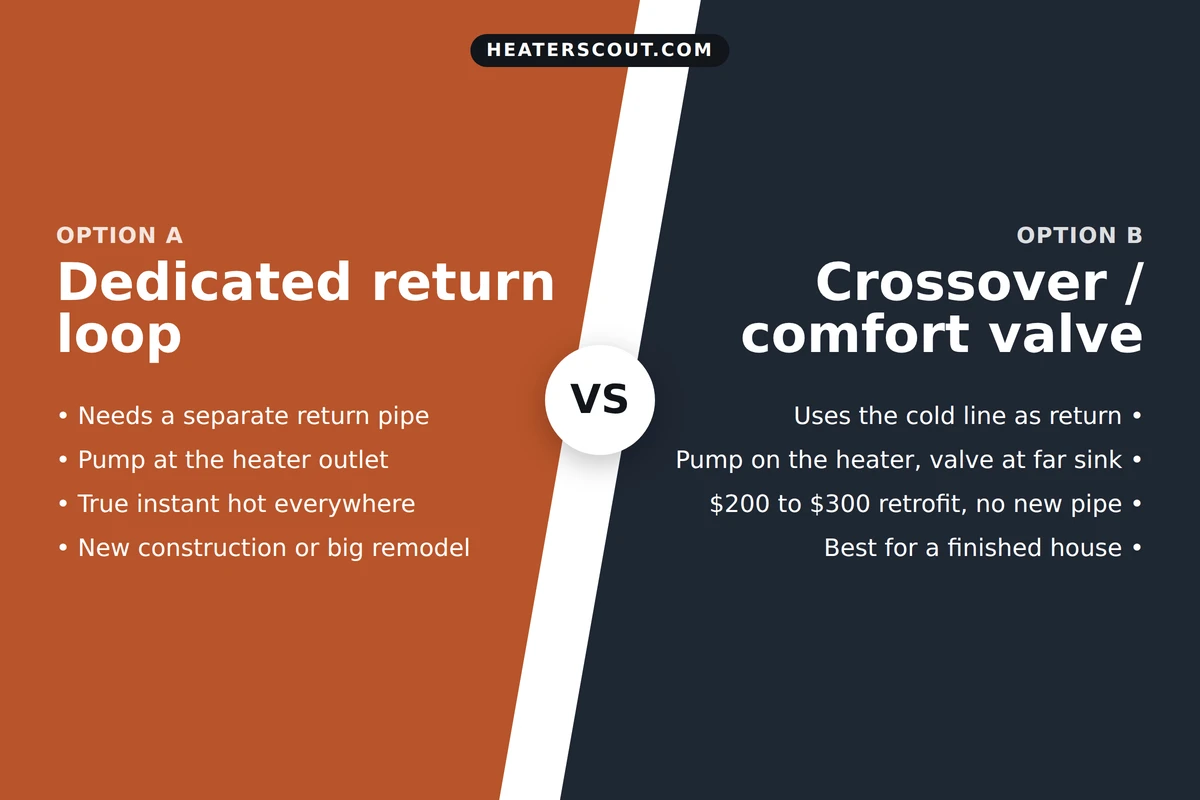
Every recirculation system is a loop: hot water leaves the heater, travels to the fixtures, and the cooled water gets pushed back so fresh hot can take its place. The only real question is what carries the water back. A dedicated system has a return pipe built for the job. A crossover system borrows the cold water line as the return. That single choice drives your cost, your install effort, and one small behavioral quirk you should know about before you commit.
| Factor | Dedicated return loop | Crossover / comfort valve |
|---|---|---|
| Return path | Separate return pipe back to the heater | Reuses the cold water line as the return |
| Pump location | On the return line at the tank | On the hot outlet at the top of the heater |
| Second component | Check valve in the loop | Thermostatic crossover valve at the far fixture |
| Install effort | Open walls unless a return already exists | Bolt-on, no new pipe, one afternoon |
| Typical cost | $150 to $300 with existing loop; $800 to $2,000 to add pipe | $200 to $300 in parts |
| Result at the tap | True instant hot, no side effect | Fast hot; cold line runs lukewarm briefly after a cycle |
| Best fit | New build or gut remodel | Retrofit in a finished house |
Read the last two rows together. The dedicated loop is cleaner in operation because the return water never touches your cold supply, so you never reach for cold and get lukewarm. The crossover trades that small quirk for the enormous advantage of never cutting into a wall. In a house that is already finished, that trade is almost always worth it, and the lukewarm cold clears in a few seconds anyway.
Where the real cost hides
The energy story is not the pump, it is the pipe. A 25 to 40 watt circulator costs a few dollars a year to run. But an always-on pump keeps the whole loop hot around the clock, and an uninsulated loop sheds that heat into the basement all day, adding hundreds of kilowatt-hours of extra water heating a year. Control the pump and insulate the hot line, and the standby penalty mostly disappears. Leave it running 24/7 on bare copper and you are heating your crawlspace.
The numbers that actually drive the design
You do not need a hydraulics course to spec a residential recirc system, but a few figures keep you from buying the wrong pump or expecting the wrong result. Recirculation is a low-flow job. You are keeping a loop warm, not filling a tub, so the pump does far less work than its shutoff rating suggests. Here is the shape of a typical single-family install.
| Pump power draw | 25 to 40 watts (small wet-rotor circulator) |
| Recirculation flow | 1 to 4 gallons per minute, well below shutoff |
| Pipe insulation | 1/2 inch foam sleeve on the hot loop, cheapest efficiency there is |
| Crossover retrofit cost | $200 to $300 in parts, one afternoon |
| Dedicated loop (existing return) | $150 to $300, pump plus check valve |
| Dedicated loop (new pipe) | $800 to $2,000 with labor, mostly the pipe |
| Always-on standby loss | 400 to 1,500 kWh/year on an uninsulated loop |
| On-demand control savings | Cuts that standby loss by 80 percent or more |
| Common pumps | Grundfos UP15-10 / Comfort, Taco 006, Watts kits |
| Rating to confirm | Potable, continuous duty, 140 degrees F or higher |
Two of those rows deserve a second look. The recirculation flow of 1 to 4 gpm is why a tiny circulator handles a two-story house; you are not moving shower volume, you are nudging a warm ring of water in a slow circle. And the standby-loss row is the one that separates a smart install from a wasteful one. The pump wattage barely registers on your bill. The heat the loop sheds when it runs needlessly is the whole ballgame, which is why the next section is about control before it is about hardware.
Retrofitting a crossover system in a finished house
This is the version most single-family homeowners actually install, because it needs no new pipe and no drywall. The pump goes on the water heater, the thermostatic valve goes under the farthest fixture, and the cold line does the returning. Work through it in order and the whole thing is an afternoon.
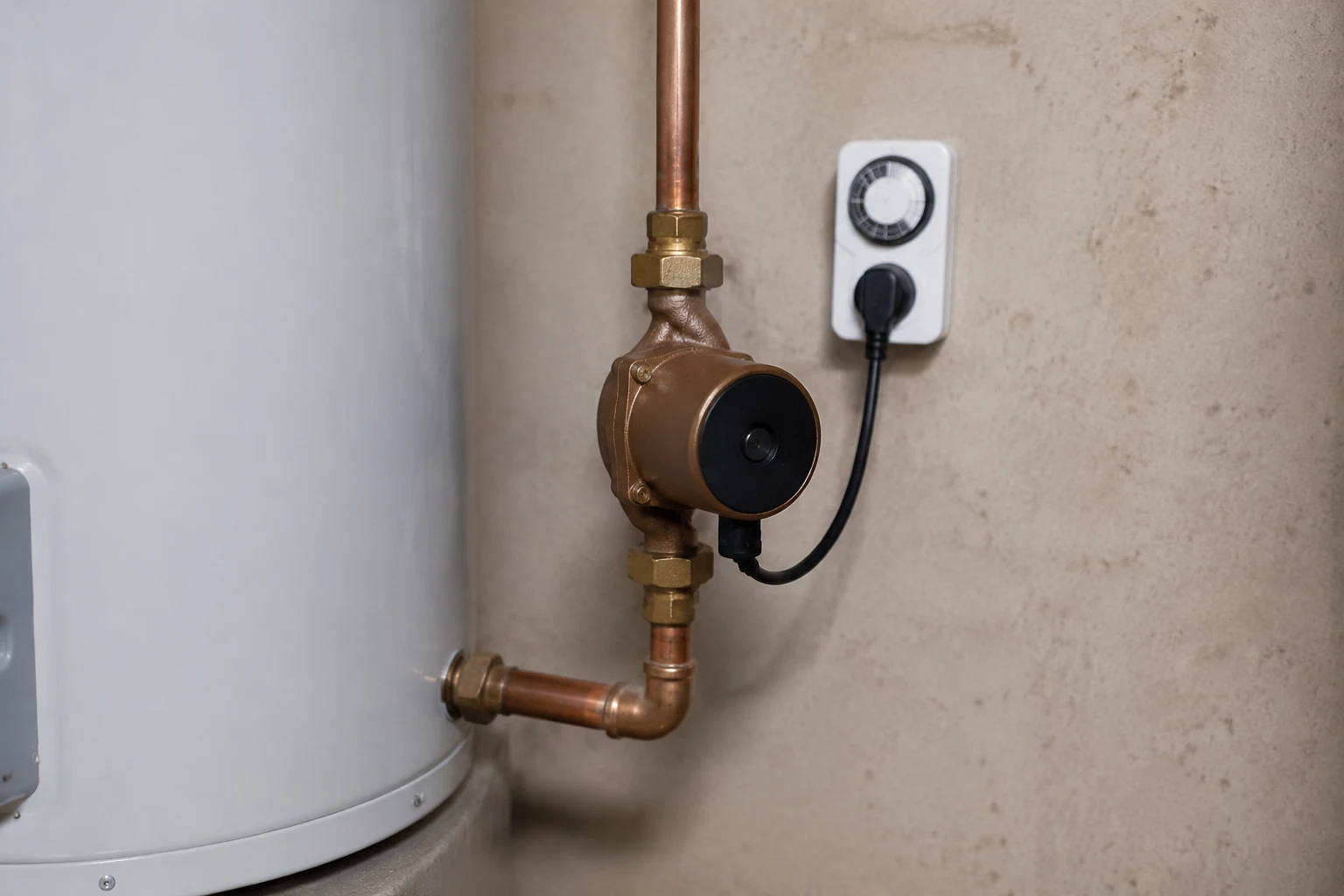
If you are running a dedicated loop instead, the field work is different in one spot. The pump mounts on the return line where it re-enters the tank rather than on the hot outlet, and you confirm a check valve is in the loop, either integral to the pump flange or added separately, to stop thermosiphon backflow when the pump is off. Everything about control and testing is the same. The dedicated loop just skips the crossover valve because it has a real return pipe doing that job.
The control decision, made plainly
Hardware aside, how you switch the pump on and off determines whether this project saves you time cheaply or quietly runs up your gas bill. There are three ways to control it, and one term worth pinning down because it shows up on the box and in the wiring.
Aquastat
A temperature switch clamped to the recirculation loop that turns the pump on when the pipe cools below a setpoint and off when it warms back up, holding the loop within a band such as 95 to 115 degrees Fahrenheit. It keeps water effectively instant because the loop never goes fully cold, but on its own it runs the pump any time the pipe cools, including hours nobody draws water. The efficient move is to pair an aquastat with a timer so it stays dormant overnight and midday, or to skip both and run the pump on demand, firing only when a button or sensor says someone actually wants hot water in the next minute.
Line them up and the choice is easy. On-demand is the efficient default: a button, a motion sensor, or an app fires the pump only when hot water is wanted, so the loop sits cold the rest of the day and standby loss nearly vanishes. You trade truly instant for a ten to thirty second wait most people never notice. A timer is the simple middle ground, running through your use windows and off otherwise. An aquastat keeps water instant but wants a timer beside it to blank out the dead hours. If you want one recommendation to start: on-demand button, or a smart pump that learns your schedule, plus foam sleeve on the hot line.
What breaks it, and what to check on tankless
Two failure modes account for most disappointing installs. The first is putting the crossover valve at the wrong fixture, so the last run of pipe never primes and the far bathroom still waits. Chase the true hydraulic dead end, not the easy cabinet. The second is leaving an always-on pump on a bare, uninsulated loop, which works fine but bleeds heat into the basement year round. Insulate the loop and control the pump, and neither problem shows up.
Tankless is its own case. Many tankless heaters have a minimum activation flow, roughly 0.4 to 0.75 gpm, and a low recirculation flow can fall below it and never light the burner. The clean answer is a tankless built for recirculation. Navien, Rinnai, and Noritz sell models with an internal recirc pump, a buffer tank, or a dedicated recirc port and the logic to handle low flow. Bolt a generic external pump onto a plain tankless and you risk short-cycling the unit and shortening its life. On a tank heater none of that applies, because the tank stores the hot water and the pump only has to move it in a circle.
Frequently asked
How much does it cost to add a hot water recirculation pump?
A crossover-valve retrofit runs about $200 to $300 in parts for a single-family house: roughly $150 to $220 for a Grundfos Comfort, Taco, or Watts pump kit and another $30 to $50 for the thermostatic crossover valve you mount under the farthest fixture. That is the price precisely because it reuses the cold water line as the return, so there is no new pipe to run. A dedicated return loop is a different animal. If the return line already exists (many homes built after the 1990s roughed one in), you are only buying the pump and a check valve, so $150 to $300. If you have to open walls and run a new return line back to the heater, plan on $800 to $2,000 with labor, and most of that is the pipe, not the pump. The pump itself is the cheap part in every version.
Does a recirculation pump waste a lot of energy?
The pump motor is small, 25 to 40 watts, so the electricity to run it is trivial, a few dollars a year even left on continuously. The real cost is standby heat loss. Every time you push hot water out to the fixtures and back, the pipe walls shed heat, and the heater has to make that up. A pump left running 24/7 on an uninsulated loop can add 400 to 1,500 kWh a year of extra water heating, which is why control matters more than the pump. Put it on a timer that matches your morning and evening use, or better, run it on demand with a button or motion sensor so it only fires when someone actually wants hot water. On-demand control cuts the standby penalty by 80 percent or more compared to always-on. Insulate the hot line too; foam sleeve on the loop is the cheapest efficiency you will ever buy.
What is the difference between a dedicated loop and a crossover valve system?
A dedicated loop has its own return pipe. Hot water leaves the heater, runs the fixtures, and a separate line carries the cooled water back to the tank. The pump lives at the heater and pushes water around that closed ring, so every tap is primed with hot water at all times. A crossover system has no return pipe. Instead a thermostatic bypass valve sits under the farthest sink and connects the hot line to the cold line. The pump pushes hot water out, the valve opens while the water is cool and dumps it into the cold line back toward the heater, then closes once hot water arrives. The tradeoff is that your cold line briefly runs lukewarm right after the pump cycles. For a retrofit in a finished house the crossover wins because you do not open a single wall. For new construction or a gut remodel, run the dedicated loop and get true instant hot with no warm-cold surprise.
Where does the pump and check valve go?
On a dedicated loop the pump mounts on the return line right where it re-enters the tank, at the cold inlet or a dedicated recirc port, pumping toward the heater. A check valve goes in the loop to stop thermosiphon backflow, which is hot water drifting the wrong way when the pump is off and quietly bleeding heat. Many recirc pumps have the check valve built into the flange, so read the spec before you add a second one. On a crossover retrofit the pump usually mounts on the hot outlet at the top of the water heater, and the check valve lives inside the pump body. The thermostatic crossover valve is the other half, and it goes under the sink or lav that is farthest from the heater, plumbed between the hot and cold stops. That is the spot that decides how far the primed water reaches, so pick the true hydraulic dead end, not just the most convenient cabinet.
On-demand, timer, or aquastat, which control is best?
On-demand is the efficient choice and the one to default to. A button by the shower, a motion sensor in the bathroom, or an app pushes hot water only when someone is about to use it, so the loop sits cold the rest of the day and standby loss nearly disappears. You wait ten to thirty seconds for the primed water instead of getting it truly instant, which most people never notice. A timer is the simple middle ground: set it to run through your morning and evening windows and shut off overnight and midday. It is better than always-on but still heats the loop during windows when no one draws water. An aquastat is a temperature switch on the loop that cycles the pump to hold the pipe within a band, say 95 to 115 degrees. It keeps water instant but runs whenever the pipe cools, so pair it with a timer to blank out the hours you are asleep or gone. Best combined setup: aquastat plus timer, or a smart on-demand pump that learns your schedule.
How do I size the pump and what flow do I need?
For a single-family house you do not need much. Recirculation flow is only 1 to 4 gallons per minute, far below the pump's shutoff rating, because you are just keeping the loop warm, not moving shower-volume water. The two numbers that matter are flow at your loop's head loss and the temperature the pump can survive. A small wet-rotor circulator like the Grundfos UP15-10 or a Taco 006 handles a typical two-story home with room to spare. Match the pump connections to your pipe, 1/2 or 3/4 inch, and confirm it is rated for potable hot water and continuous duty at 140 degrees or higher. Oversizing wastes energy and can make the crossover valve chatter; undersizing means the far fixtures never get primed. If the manufacturer publishes a pump curve, aim to land your loop's flow near the middle of it, not out at either end.
Will a recirculation pump work on a tankless water heater?
Yes, but check the specifics before you buy. Many tankless units have a minimum activation flow, roughly 0.4 to 0.75 gallons per minute, and a low recirc flow can sit below that and fail to fire the burner. The fix is a tankless designed for recirculation: Rinnai, Navien, and Noritz sell models with a built-in recirc pump and an internal bypass, or with a dedicated recirc port and logic that handles the low flow. Navien's models with a buffer tank and internal pump are made exactly for this. If you bolt a generic external pump onto a plain tankless, you can short-cycle the heater and shorten its life. On a tank heater none of this applies, since the tank stores the hot water and the pump just circulates it. For tankless, buy the recirc-ready unit or follow the maker's approved pump and bypass diagram to the letter.