Quick answer
A dripping temperature-and-pressure (T&P) valve is doing its job — it’s the tank’s last defense against exploding. It leaks for one of three reasons: thermal expansion, a worn valve, or genuine overpressure. Never plug, cap, or install a shutoff on it. Find out which of the three it is, fix the cause, and only then replace the valve. The tool below walks you through it.
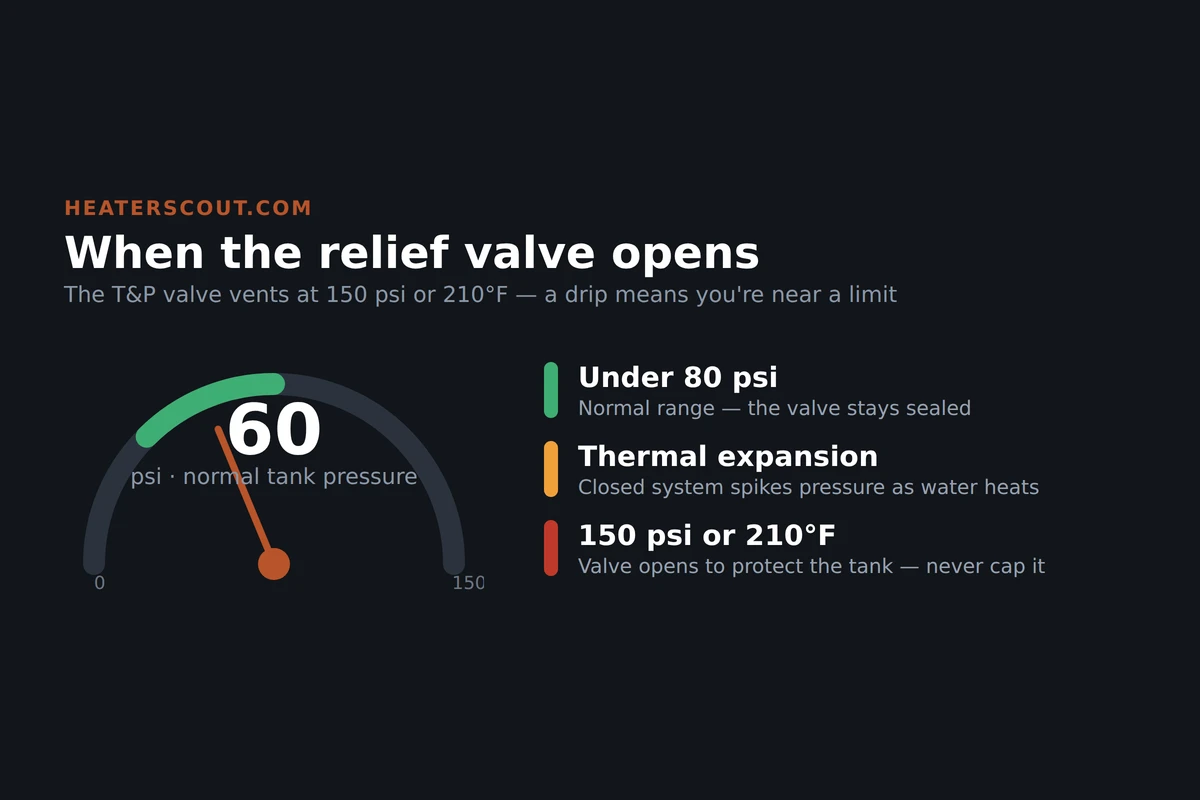
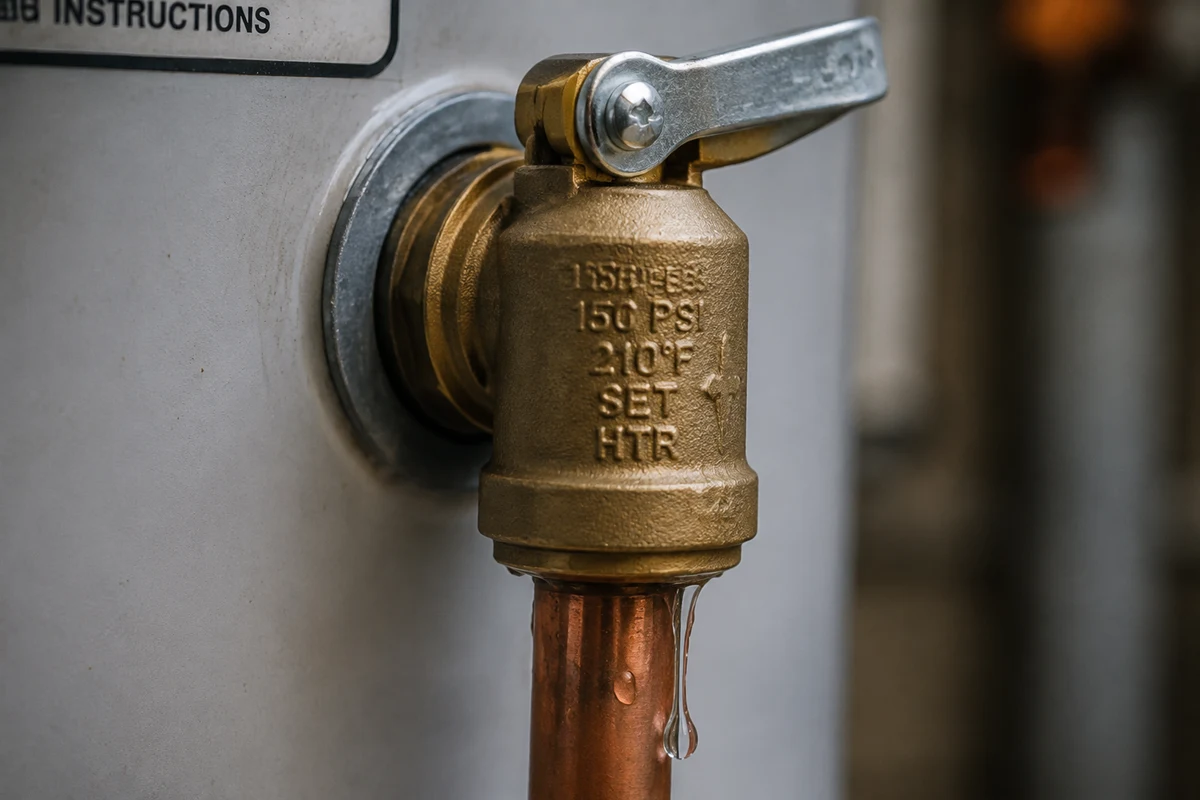
The valve on the side or top of your water heater with a little lever and a pipe running toward the floor is the single most important safety device on the whole unit. When it drips, the instinct is to swap it or stop the drip. Both can be dangerous if you skip the diagnosis, because a new valve on an overpressured tank just resumes leaking while the real hazard builds.
What this valve is actually guarding against
The T&P valve has two independent triggers built into one body. A spring opens it if pressure inside the tank climbs too high. A probe that reaches into the water opens it if the temperature climbs too high. Either one alone dumps water to relieve the tank.
The temperature number is the one that saves lives. Water boils at 212°F, and in a sealed tank a runaway thermostat can superheat the water well past that. The instant the valve opens or the tank cracks, that superheated water flashes to steam and expands roughly 1,600 times — enough to launch a water heater through a roof. The 210°F trigger exists to vent that energy before it ever gets there. That’s why capping the valve is never an option.
Which of the three is it? Work the tree
Almost every dripping T&P valve is one of three cases, and you can tell them apart by when it drips. Pick what you observe.
T&P valve diagnostic
When does the valve drip?
Most likely: thermal expansion
The tell: open any faucet and the drip stops
As water heats it expands. In a “closed” plumbing system — one with a check valve, backflow preventer, or pressure-reducing valve on the main — that extra volume has nowhere to go, so pressure spikes after each heating cycle and nudges the valve open. Run a tap and the pressure drops, so the drip stops. That’s the signature.
The fix: install a thermal expansion tank on the cold supply line, sized to your tank (roughly 1.5 gallons of expansion tank per 50 gallons stored) and pre-charged to match your incoming pressure. Replacing the T&P valve alone will not stop this — the pressure will just reopen the new one.
Most likely: a worn-out valve
The tell: it weeps regardless of use, or won’t reseat
T&P valves wear out. Mineral scale builds on the seat, the spring weakens, and after a few years — especially if it’s never been exercised — it stops sealing. A valve that drips constantly, drips right after you tested it and it won’t stop, or shows corrosion around the body is simply done.
The fix: replace it. It’s an inexpensive three-quarter-inch part. Shut off the cold supply, drain a few gallons to drop the level below the valve, unscrew the old one, and thread in a new rated valve with fresh thread sealant. It is not field-repairable — taking one apart voids its certification. If you’re unsure, this is a quick, cheap job for a plumber.
Warning: real overpressure or overtemperature
The tell: hot or forceful discharge during normal operation
This is the branch you can’t ignore. If the water is scalding, the discharge is forceful, or the valve opens while the heater runs normally, the valve is doing exactly what it was built for — venting a genuinely dangerous condition. The usual causes are house pressure that’s too high or a thermostat/element that’s stuck on and cooking the water.
What to do: screw a pressure gauge onto a hose bib and read your static pressure. Above 80 psi you need a pressure-reducing valve on the main. Then check the heater’s setting — lower it toward 120°F and see if the discharge stops. If the water is scalding, if pressure is normal but it still dumps, or if you’re at all unsure, shut the heater off and call a professional now. A stuck thermostat that keeps heating is a genuine explosion risk.
Why an expansion tank matters more than people think
Thermal expansion is the most common cause of a mystery drip, and it’s become more common as utilities add check valves and backflow preventers to water mains. Once your home is a closed system, every heating cycle has nowhere to put the extra volume, so pressure cycles up and down all day. That constant flexing is hard on the valve, the tank seams, and every washer in the house — the dripping T&P is just the first thing to complain. A $40 expansion tank absorbs the surge and quietly protects the whole plumbing system, not only the heater.
Test it once a year — the right way
A T&P valve that never moves is a valve that seizes. Once a year, with a bucket under the discharge pipe, lift the lever partway for a second or two and let a burst of water flush through, then snap it closed. You should hear and see water discharge, and it should stop cleanly when you release the lever. If it keeps dribbling afterward and won’t reseat, the valve is worn and it’s telling you to replace it — that’s the “bad valve” branch above. Do this test carefully: the water is hot, and on a very old valve the test itself can be the last straw, so have a replacement on hand if yours is aged.
The discharge pipe has rules too
The pipe running down from the valve isn’t decoration. Code requires it to be the same diameter as the valve outlet, to run downhill without traps, and to terminate within about six inches of the floor or a drain — never threaded, capped, or reduced. The point is simple: if the valve ever dumps scalding water or steam, that pipe aims it safely at the ground instead of at someone standing nearby. If yours is missing, kinked, or pointed upward, fixing it is part of doing this job properly.
The rule that keeps this valve safe
Never cap, plug, or put a shutoff valve between the T&P valve and the tank. Plumbing codes across the country prohibit it because it disables the tank’s only protection against rupture. And never replace a dripping valve without finding out why it drips — if the cause is overpressure, a fresh valve just leaks again while the danger keeps building. Diagnose, fix the cause, then replace the valve if it’s worn.
Frequently asked
Is a dripping T&P valve dangerous, or can I ignore it?
Don’t ignore it, but don’t panic either. Often it’s harmless thermal expansion or a worn valve. The dangerous case is a hot or forceful discharge during normal use, which means real overpressure or overtemperature. Diagnose which one you have — and never cap the valve, because it’s the tank’s last defense against exploding.
Why does my relief valve only leak after the water heats up?
That’s classic thermal expansion. Heated water expands, and in a closed plumbing system the pressure has nowhere to go, so it briefly pushes the valve open. The giveaway: open any faucet and the drip stops. The fix is a thermal expansion tank, not a new valve.
Can I just replace the T&P valve myself?
Yes, if the cause is a worn valve. Shut the cold supply, drain a few gallons, unscrew the old valve, and thread in a new rated one with sealant. It’s a cheap part. But confirm the drip isn’t overpressure first, or the new valve will leak too.
How do I know if I have a closed plumbing system?
If there’s a pressure-reducing valve, check valve, or backflow preventer where the main water line enters the house — common on newer systems and city water — you have a closed system and need an expansion tank. If pressure climbs only after the heater runs, that confirms it.
What water pressure is too high?
Normal household pressure is 40 to 60 psi, and code caps it at 80 psi. Above 80 you need a pressure-reducing valve on the main. Check it with an inexpensive gauge that screws onto any hose bib.
Why can’t I just cap or plug the leaking valve?
Because it’s the only thing preventing the tank from rupturing if pressure or temperature runs away. Capping it converts a minor drip into a potential explosion. Codes prohibit blocking it for exactly this reason — fix the cause of the leak instead.