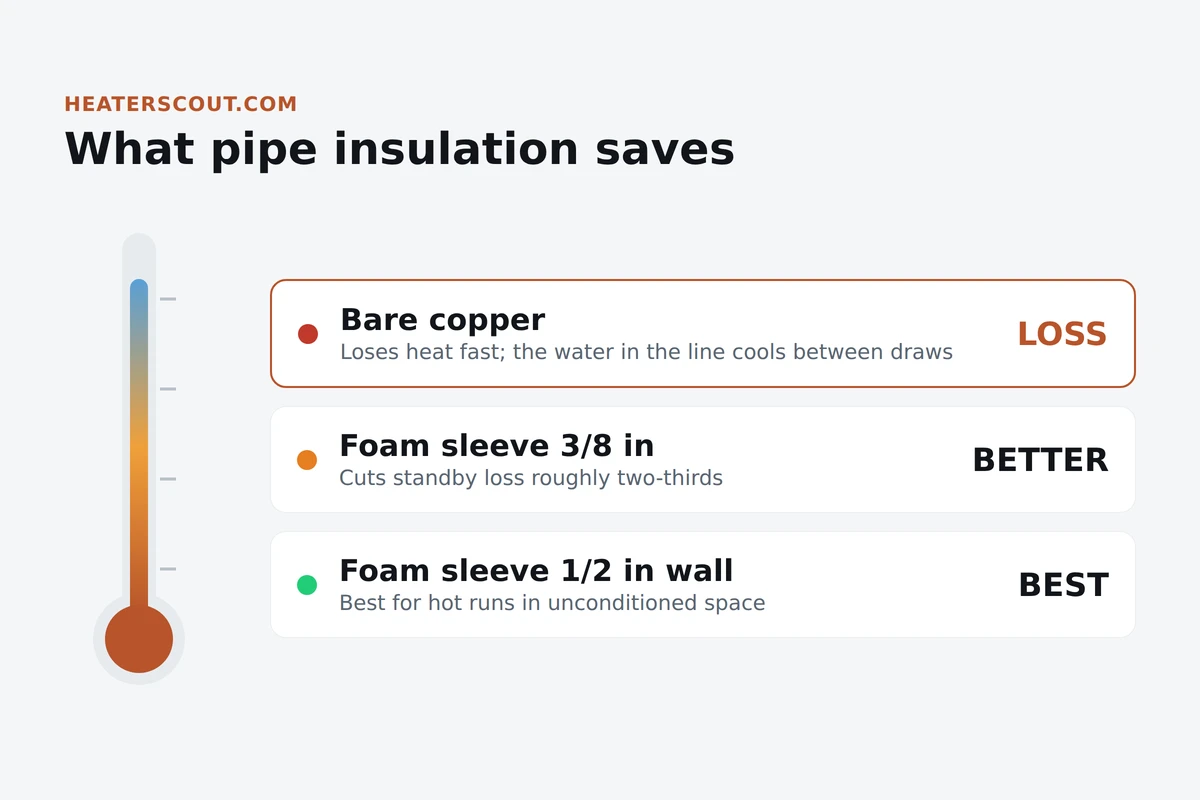
Foam pipe sleeves cost about $3 for a 6-foot length, and they are the single best return you will ever get on a water heater. Bare copper off a hot tank leaks heat into the room every hour of the day, whether or not anyone is using water. Wrap that pipe and the loss falls by roughly two thirds. Nothing else you can buy for the system pays back this fast, which is exactly why it is the first thing an energy audit writes down.
Where the heat actually goes
Standby loss is the heat a water heater bleeds off while it just sits there holding temperature. Most of it leaves through the tank wall, which is why tank blankets exist, but a real chunk walks out through the bare metal pipe attached to the top of the tank. Copper conducts heat well, so the first few feet of hot line act like a radiator fin sticking straight out of your tank. The water inside those pipes cools between draws, and the tank has to reheat to make up for what the pipe gave away.
| Pipe | Loss coefficient | What it means |
|---|---|---|
| Bare copper, half inch | ~0.50 BTU/hr per ft per °F | Water in the line cools fast; tank reheats to replace it |
| Foam sleeve, 3/8 in wall | ~0.16 BTU/hr per ft per °F | Roughly two thirds of the loss gone; fine for indoor runs |
| Foam sleeve, 1/2 in wall | lower still | Best for hot lines in a crawlspace, garage, or cold basement |
| Cold line near tank | sweats when bare | Insulate the first few feet to stop condensation and drips |
The number behind the savings
The loss follows a simple model: loss equals length times a coefficient times the temperature difference. Length is the feet of exposed pipe. The coefficient is a property of the pipe and whatever is wrapped around it, about 0.50 BTU per hour per foot per degree for bare half-inch copper and about 0.16 once a foam sleeve is on it. The temperature difference, deltaT, is the water temperature minus the temperature of the room the pipe runs through. A 125 degree line in a 60 degree basement has a 65 degree difference driving the loss.
Multiply it out for 30 feet of bare hot pipe at that 65 degree difference and you get about 30 times 0.50 times 65, near 975 BTU per hour of loss potential. Sleeve it and the coefficient drops to 0.16, so the loss falls to about 312, a saving of roughly 660 BTU per hour. That heat is not lost every hour of the year, because much of the time water is moving or the line has already cooled to room temperature. Figure an effective 8 hours a day of standby loss and you land at a realistic annual number. Convert BTU to kilowatt-hours by dividing by 3412, multiply by your energy rate, and you have dollars. The calculator does all of it live.
Run your own numbers
Set the sliders to your house. Measure the feet of exposed hot pipe you can reach, set the water temperature to your heater's setpoint, and set the ambient temperature to whatever the space around the pipe actually sits at. The rate is on your electric or gas bill in cents per kilowatt-hour. The tool multiplies length by the coefficient drop by the temperature difference, runs it over an 8-hour standby day for a year, and shows the annual dollars and the payback against roughly 50 cents a foot of foam.
Pipe insulation savings calculator
Enter exposed hot pipe length, setpoint, the temperature of the space, and your energy rate. Output is annual savings and payback against foam sleeve at about $0.50 a foot. A realistic estimate, not a utility rebate figure.
Annual savings
$0/yr
Standby loss removed, in dollars
Payback
—
Against foam at about $0.50 a foot
—
How to do it right
The work is fast and needs nothing shut off, but a few details separate a job that lasts from one that melts or falls off. Do these in order.
Keep foam 6 inches off the flue on a gas unit
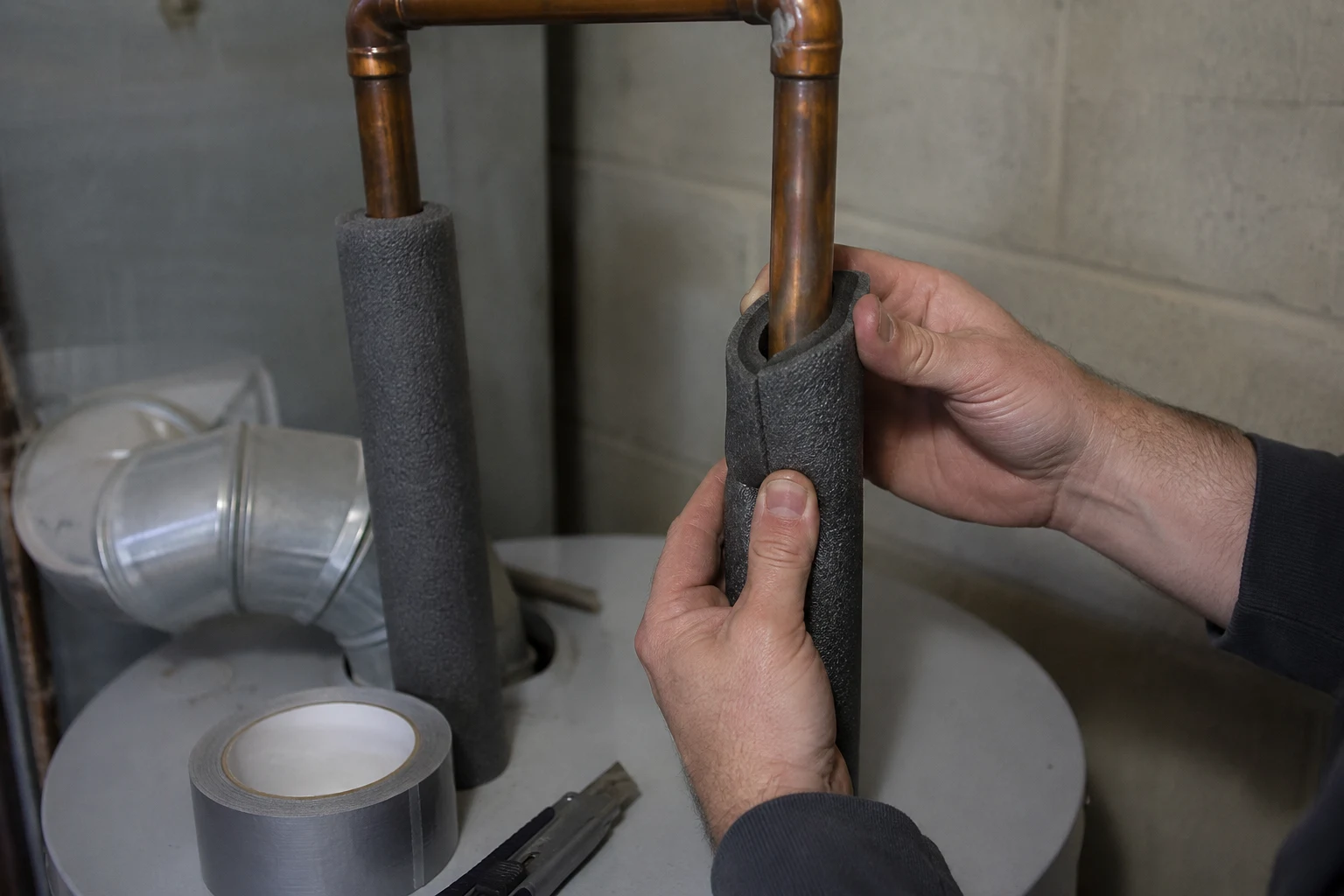
Foam pipe sleeves are polyethylene, and they melt. On a gas or propane water heater the flue pipe and draft hood get well over 300 degrees, so any sleeve slid up against them can soften, deform, or scorch. Keep the insulation a full 6 inches back from the flue and the top of the tank, and start the copper covering a hand's width past the hot outlet. This one clearance is the only real safety rule in the whole job.
Frequently asked
Does pipe insulation on a water heater actually save money?
Yes, though the dollars are modest and the payback is fast. Bare copper off a hot tank bleeds heat into the room the whole time the water sits still, roughly a half a BTU per hour per foot per degree of temperature difference. Sleeve it and that loss drops by about two thirds. On a house with 30 feet of exposed hot line at a 65 degree temperature difference, you save on the order of $15 to $30 a year, and the foam costs a few dollars. That makes it the cheapest energy fix on the whole system, which is why utility programs push it first.
How much foam pipe insulation do I need and what does it cost?
Measure the exposed hot pipe first, then the exposed cold pipe near the tank. Foam sleeves sell in 6-foot lengths for about $3 each, so roughly $0.50 a foot. At a minimum you want the first 3 to 6 feet of both the hot and the cold line off the tank; a full basement run of 30 feet of hot pipe is about $15 in foam. Buy sleeves sized to your pipe's outside diameter, half inch or three quarter inch copper being the common ones, and get the thicker half inch wall for anything running through an unconditioned space.
Why insulate the cold water pipe too?
Two reasons, and neither is about heat loss from the cold line itself. First, the cold pipe near the tank runs warm because heat migrates back up the connection and because standby cycling warms the nipple, so you lose a little there. Second, and more important, an uninsulated cold line in a humid basement sweats. That condensation drips onto the floor, the tank base, and the fittings, and over years it corrodes connections and feeds mold. A foam sleeve on the cold line for the first few feet stops the sweating.
How close to the flue can I put insulation on a gas water heater?
Keep foam pipe insulation at least 6 inches away from the draft hood and the flue pipe on a gas or propane unit. The flue and the top of the tank get hot enough to melt or scorch polyethylene foam, and a sleeve slid too close is a fire risk. Insulate the copper starting a hand's width past the hot outlet, not right at it. On an electric water heater there is no flue, so you can sleeve right up to the fitting.
What thickness of pipe insulation should I use?
For most indoor runs the standard 3/8 inch wall foam sleeve is fine and cuts loss by roughly two thirds. Step up to 1/2 inch wall foam for hot lines that run through unconditioned space like a crawlspace, a garage, or an uninsulated basement, where the temperature difference is larger and the heat loss is worth chasing. Thicker foam has a higher R-value and buys you a bit more, but past 1/2 inch the returns flatten out and the sleeve gets awkward to fit around fittings.
Can I do this myself, and how long does it take?
This is one of the easiest jobs on a water heater. The sleeves are pre-slit down one side, so you press them over the pipe, and the good ones have a self-sealing adhesive strip you peel and pinch shut. Cut them to length with scissors or a utility knife, miter the ends at elbows so they meet cleanly, and tape or zip-tie any gaps. A full basement run takes most people under an hour and needs no tools beyond a knife and a tape measure. Shut nothing off; the pipes stay live the whole time.
Will insulating the pipes give me hot water faster?
A little, but not the way people expect. Insulation does not push water down the pipe any faster, so the first draw after a long idle still runs cold until the tank water reaches you. What it does is keep the water already sitting in the line warm for longer between draws, so a second shower an hour later starts warm instead of running a slug of cooled water first. If instant hot water at the tap is the real goal, that is a recirculation pump, not a foam sleeve.