You light the pilot, hold the knob down like the label says, watch a steady blue flame, count to sixty, and let go. The flame dies. You do it again and get the same result. That single symptom, a pilot that burns only while you press the knob, has a short list of causes, and they run from a five-dollar part to a gas valve replacement. The trick is reading the flame and testing the sensor before you throw parts at it. Almost every case traces back to one question: is the thermocouple making enough millivolts to hold the safety magnet, or is something upstream, a dirty pilot, a starved FVIR screen, a soft lockout, keeping it from ever getting hot enough.
Key takeaways
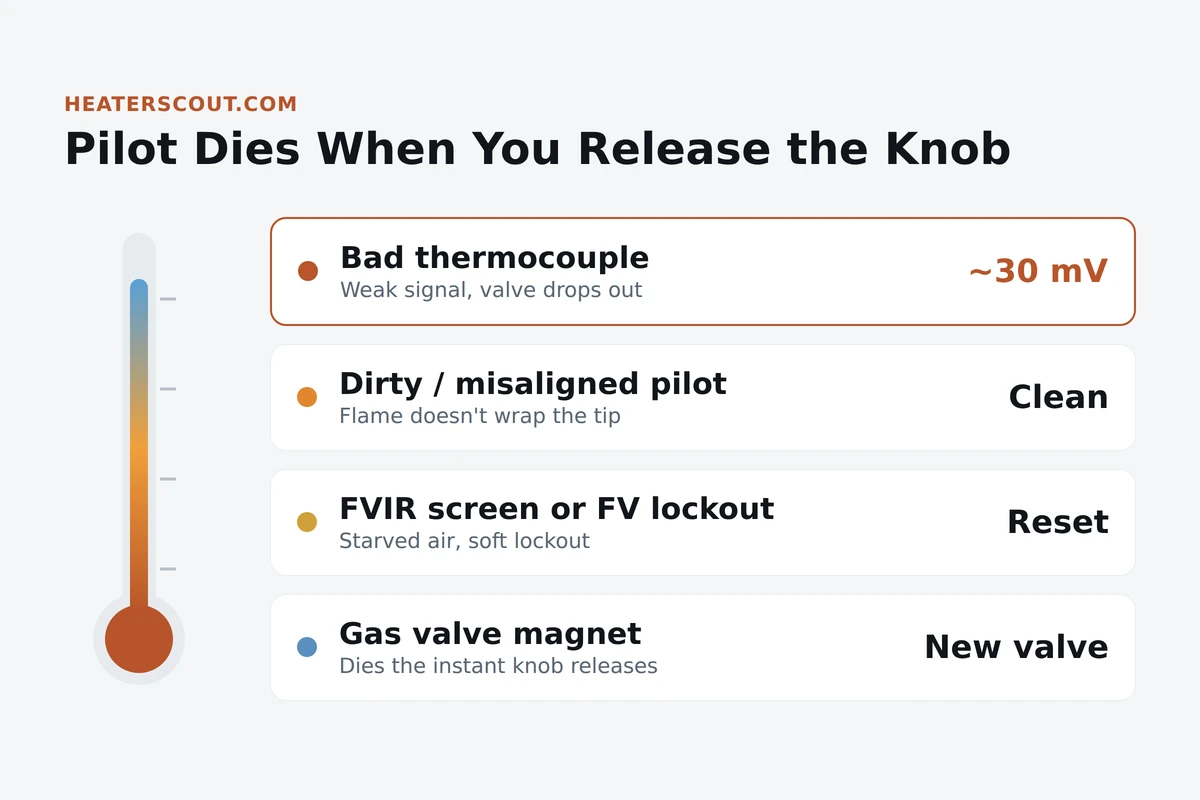
- A pilot that burns while you hold the knob but dies on release means the safety magnet never latched. The usual reason is a weak or misaligned thermocouple.
- A healthy thermocouple reads about 25 to 35 millivolts open-circuit. Near 20 mV or below, replace it. The valve magnet drops out around 2 to 5 mV under load.
- Newer electronic-ignition units use a thermopile (about 250 to 750 mV), not a thermocouple. They are not interchangeable, so identify yours before buying a part.
- FVIR heaters can soft-lock if the flame-arrestor screen is clogged or the vapor sensor trips. Clear vapors, clean the screen, then reset per your brand.
- If a brand new thermocouple still dies on release, the gas valve magnet has failed and the valve gets replaced as a unit by a pro.
How the safety chain actually works
Every standing-pilot gas water heater has the same fail-safe: no pilot flame, no gas. The pilot flame heats a thermocouple, a thin metal probe sitting right in the flame. The heated junction makes a small DC voltage, tens of millivolts, and that voltage runs down the copper lead to an electromagnet inside the gas control valve. That magnet, sometimes called the pilotstat, is what physically holds the pilot gas valve open. When you press the knob in during lighting, you are doing the magnet's job by hand, forcing the valve open so the pilot can burn. The 30 to 60 seconds you hold is the thermocouple warming up to full output. Let go, and the magnet has to hold the valve on its own. If the voltage is there, it holds. If not, the spring shuts the valve and the flame dies.
That is why the symptom is so specific and so useful. A pilot that will not even light points at gas supply, a clogged orifice, or an FVIR lockout. A pilot that lights, burns while held, and dies on release points squarely at the thermocouple-to-magnet circuit. Same flame, very different repair. Reading which one you have saves you from swapping parts blind.
Watch the pilot flame while it is lit
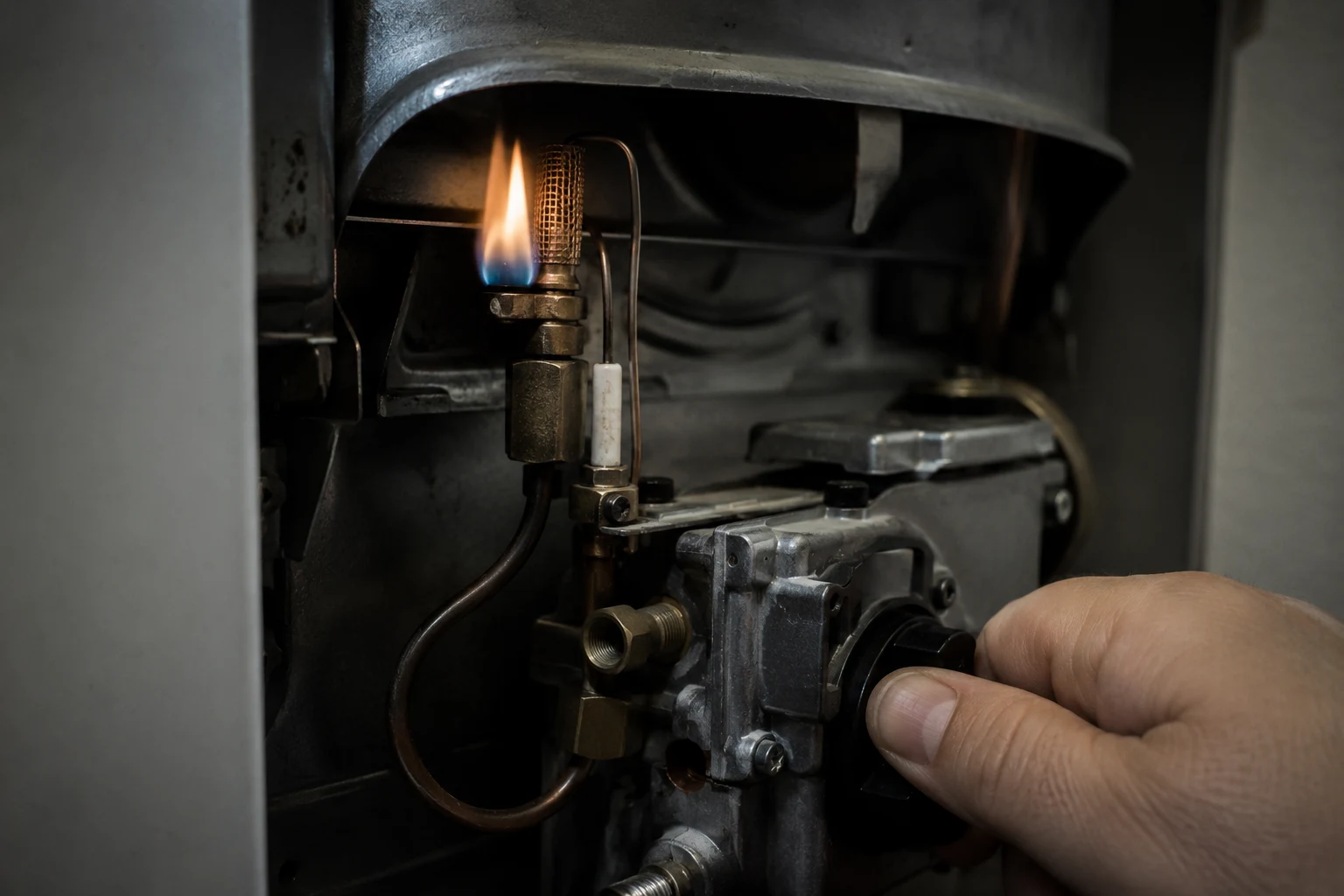
It should be a steady blue flame that fully engulfs the top half inch of the thermocouple tip. Small, orange, floppy, or lifting off means a dirty orifice, a fouled tube, or a draft. A flame that misses the tip cannot heat the sensor no matter how long you hold the knob.
Confirm you held the knob long enough
Relight and hold a full 60 seconds this time. A surprising share of no-hold complaints are just a knob released at 15 seconds before the thermocouple reached temperature. Rule this out first.
Test the thermocouple millivolts
With a multimeter on millivolts DC, a heated thermocouple reads about 25 to 35 mV open-circuit. Near 20 mV or below, replace it. Under load it should still hold above the roughly 2 to 5 mV drop-out point; a reading that collapses under load is a tired sensor or a weak flame.
Rule out an FVIR lockout
If the pilot will not stay lit and the flame looks starved or lazy, check the flame-arrestor screen at the base for dust and lint, and clear any solvents or gasoline from the room. A soft lockout ignores a good thermocouple entirely.
Suspect the valve magnet last
If you install a new thermocouple, the flame is perfect, and it still dies on release, the electromagnet in the gas valve has failed. That is a valve replacement, not a DIY part.
The thermocouple, the part that fails most
Nine times out of ten a pilot that will not stay lit is the thermocouple, and it fails in one of three ways: it is dirty, it is out of position, or it is simply worn out. Soot builds on the tip over years and insulates it from the flame, so the same pilot that used to make 30 millivolts now makes 15. The probe can also get bumped out of the flame during service, so the blue cone no longer wraps the tip. And metal fatigue is real; after a decade of heat cycles the junction just stops producing. Cleaning the tip with fine emery cloth and nudging it back into the flame fixes the first two. The third needs a new one, which is a cheap part and a common repair. A thermocouple runs a few dollars, threads onto the valve with a simple nut, and the swap takes about fifteen minutes once the burner assembly is out. There is no reason to pay a service call for the part itself; the labor is the only real cost, and it is small.
The way to know for sure is the millivolt test. Pull the thermocouple lead off the valve, put a multimeter on the DC millivolt range across the tip and the copper, and light the pilot. A good one climbs to about 25 to 35 millivolts within a minute. If it never gets past 20, or it reads fine open but crashes when you reconnect it under the load of the magnet, that sensor is the problem. The magnet needs the voltage to stay above roughly 2 to 5 millivolts to hold, so a sensor that sags below that under load will always drop the flame on release.
Thermocouple (standing pilot)
- Single junction, one probe in the pilot flame
- Output about 25 to 35 millivolts open-circuit
- Only holds one safety valve open, nothing more
- Found on older standing-pilot tanks
- Replace when it reads near 20 mV or below
Thermopile (millivolt / electronic)
- Many junctions stacked in series
- Output roughly 250 to 750 millivolts
- Powers the whole electronic gas control
- Found on newer millivolt and electronic-ignition units
- Not interchangeable with a thermocouple
When it is not the thermocouple
Before you decide the sensor is bad, look at what feeds the flame. A pilot orifice clogged with dust, lint, or a spider web makes a starved flame that cannot heat any thermocouple, and no amount of sensor swapping fixes it. Shut off the gas, let it cool, and blow the pilot tube and orifice clear with compressed air. Do not ream the orifice with wire; widening that hole changes the flame and you will chase it forever. Weak gas supply does the same thing from further upstream. A half-closed supply valve, a nearly empty LP tank, or a regulator problem all shrink the pilot. If several gas appliances act starved at once, the problem is supply, not the water heater.
FVIR: the modern lockout most people miss
Any gas water heater built since 2003 is FVIR, flammable vapor ignition resistant, and it adds a failure mode older tanks never had. The unit draws combustion air through a fine flame-arrestor screen at the base, and it carries a sensor that watches for flammable vapors so a spill of gasoline, solvent, or paint thinner nearby cannot flash back into the burner. When that system decides something is wrong it goes into a soft lockout, and the pilot will not stay lit no matter how perfect your thermocouple is. People replace two thermocouples chasing this before they realize the sensor, not the flame, is calling the shots.
Clean the screen first
A clogged flame-arrestor screen is the sneaky repeat offender. Dust and lint pack the screen, the burner starves for air, and the pilot goes out over and over. Vacuum the screen and the floor around the base of the heater, and keep laundry lint and sawdust away from it. If the unit is in a garage, keep gasoline and solvents in a different room.
Clearing the trigger comes before any reset. Get solvents, gasoline, and fresh paint out of the room, ventilate, and vacuum the arrestor screen. The reset itself depends entirely on the brand. Some units, like Bradford White's Defender, reset with a knob or button sequence and no new parts. Others use a one-time thermal cutoff switch or a vapor sensor that has to be replaced once it trips, especially if it got wet from a nearby water softener discharge. Read the label on your control and the manual for the exact procedure. Natural gas and LP units differ in orifice size and settings, so match every step to the manual for your specific model rather than a generic video.
My pilot lights fine but the burner never fires even after the pilot holds. Is that the same problem?
No, and that is a helpful clue. If the pilot stays lit on its own but the main burner never ignites when there is a call for heat, the pilot-to-magnet circuit is working, so the thermocouple is fine. That points at the temperature control, the main valve, or on an electronic unit a thermopile that makes enough voltage to hold the pilot but not enough to open the main valve. Test the thermopile under load; if it sags well below its rating, replace it or the gas valve. This is a different repair from a pilot that will not stay lit at all.
The gas valve magnet, and where you stop
The last suspect is the one you confirm by elimination. If the pilot flame is clean and blue and wraps the tip, a millivolt test shows the thermocouple making a healthy 30 or so, there is no FVIR lockout, and it still dies the instant you release the knob, the electromagnet inside the gas valve has failed. The magnet can no longer hold the valve open even with good voltage feeding it. There is no rebuild for it. The gas control valve gets replaced as a complete unit, and because that means breaking into the gas line, it is a job for a licensed plumber or gas tech, not a homeowner afternoon.
- You smell gas near the heater. Leave the building, then call the gas utility from outside. Do not flip switches, use a phone indoors, or light anything.
- A brand new thermocouple still dies on release, which means the gas valve magnet has failed.
- The FVIR reset needs a thermal cutoff switch or vapor sensor replaced on a brand that is not homeowner-resettable.
- The pilot orifice or valve body needs work that opens the gas line.
- Repeated lockouts keep coming back after you have cleaned the screen and cleared vapors.
- You are not comfortable shutting off the gas and following the burner-door lighting legend.
Everything above the gas line is fair homeowner territory with the control off and the legend open: holding the knob the full minute, cleaning the pilot and thermocouple, testing millivolts, vacuuming the FVIR screen, resetting a brand that allows it. Everything that opens the valve body or the gas supply is where a tech earns the call, because the failure mode is a gas leak or a combustion problem. When in doubt, read the flame first. It tells you more than any parts guess.
Frequently asked
Why does my water heater pilot light go out as soon as I let go of the knob?
Because the safety magnet inside the gas valve never got enough voltage to latch, or it can no longer latch at all. Here is the chain. The pilot flame heats a thermocouple, the thermocouple makes a tiny voltage, and that voltage energizes an electromagnet that physically holds the pilot gas valve open. While you press the knob you are holding that valve open by hand. When you release it, the magnet has to take over. If the thermocouple is weak, dirty, or bent out of the flame, it never makes enough millivolts and the magnet drops the valve the moment you let go. The two usual fixes are cleaning or re-aiming the pilot so the flame fully wraps the sensor tip, and replacing the thermocouple. If a brand new thermocouple still dies on release, the magnet in the gas valve itself has failed.
How many millivolts should a water heater thermocouple read?
On the bench, a healthy thermocouple heated by the pilot puts out about 25 to 35 millivolts with nothing connected, what techs call the open-circuit reading. Hooked up and under load from the valve magnet, that drops to roughly half, and the magnet keeps the valve open until the voltage sags to about 2 to 5 millivolts, the drop-out point. So the practical rule is simple: an open-circuit reading down near 20 millivolts or below means the thermocouple is done and should be replaced, and a reading that starts fine but collapses under load points at a weak flame or a tired sensor. If your unit has electronic ignition instead of a standing pilot, it uses a thermopile, not a thermocouple, and those read hundreds of millivolts.
What is the difference between a thermocouple and a thermopile on a water heater?
Both are flame sensors, but they do different jobs and are not interchangeable. A thermocouple is a single junction that makes only about 25 to 35 millivolts, just enough to hold one safety valve open. It is what older standing-pilot heaters use. A thermopile is many thermocouples stacked in series, and it puts out roughly 250 to 750 millivolts, enough to actually power an entire electronic gas control, not just hold a valve. Newer millivolt and electronic-ignition water heaters use a thermopile. Before you buy a part, figure out which one you have, because a thermocouple will not run a thermopile-powered valve and the two thread and connect differently.
What is a flammable vapor lockout and how do I reset it?
Most water heaters built after 2003 are FVIR, flammable vapor ignition resistant. They pull combustion air through a flame-arrestor screen at the base and watch for vapors so a spill of gasoline or solvent nearby cannot flash back into the burner. When that system trips it goes into a soft lockout and the pilot will not stay lit no matter what you do to the thermocouple. Two things cause it: real vapors, or a screen so clogged with dust and lint that the burner starves for air. Clear any solvents, gasoline, or fresh paint from the room and vacuum the screen and the area around the base. The reset itself depends on the brand. Some, like Bradford White's Defender, reset with a sequence on the control and no parts. Others need the thermal cutoff switch or the vapor sensor replaced, which is a job for a tech. Check the label and the manual for your exact model.
Should I clean the pilot orifice myself or call someone?
Cleaning the pilot assembly is reasonable homeowner work if you are comfortable shutting off the gas and following the burner-door legend. Turn the gas control to OFF, let everything cool, and pull or expose the pilot tube. A pilot flame that is small, orange, or floppy usually means a partly clogged orifice or a lint-fouled tube. Blow it out with compressed air; do not ream it with wire, which can widen the hole and change the flame. While you are in there, sand any soot off the thermocouple tip with fine emery cloth and make sure the flame will wrap the top half inch of it. What is not homeowner work is anything that opens the gas valve body or the gas line. A failed valve magnet, an FVIR sensor swap on some brands, or any gas smell means stop and call a licensed plumber or the gas utility.