Water hot enough to redden skin is not a comfort setting gone wrong, it is a symptom worth taking seriously. Set the dial to 150 degrees and a hand under the tap burns in about two seconds. A storage tank has three separate safety layers stacked against a runaway, and by the time you notice scalding water, the first of them may already have failed. This page walks the causes on gas and electric tanks, the safe number to set, how to test the parts that fail, and the signs that mean shut it off right now instead of troubleshooting.
Is this the same on gas and electric water heaters?
The danger and the safe setting are identical, but the parts differ. An electric tank has two thermostats and two elements you can test with a meter, plus a red ECO reset button on the upper thermostat. A gas tank keeps its temperature control and high-limit safety inside one sealed gas control valve, so there is less to test at home and a failed control usually means replacing the whole valve. The TPR relief valve, the 120 degree target, and the scald math are the same on both.
Key takeaways
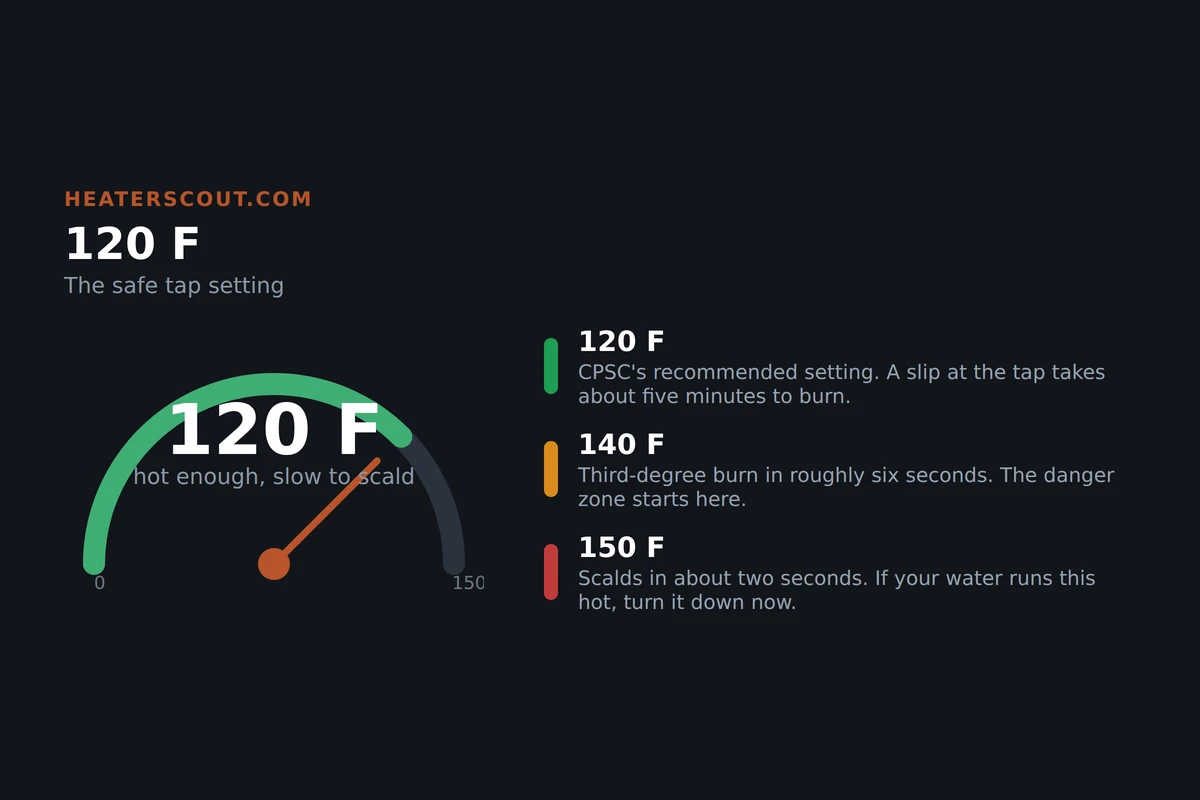
- Set the tank to 120 F. At 140 F a burn takes about six seconds, at 150 F about two.
- Scalding water is a symptom of a failed thermostat, shorted element, or bad gas control valve, not just a high dial.
- The ECO high-limit is a backup, not the primary control. A repeat trip means a real fault, stop resetting it.
- The TPR relief valve opens at 210 F or 150 psi. Never cap or plug it.
- Cut 240V power and verify with a tester before touching any element or thermostat terminal.
- Discharging steam, hard rumbling, or a tank too hot to touch means shut it down now.
ECO (energy cut-off)
A one-shot high-temperature safety switch that cuts the heat when tank water climbs past a safe ceiling, commonly around 170 to 190 degrees Fahrenheit depending on the maker. On an electric tank it is the red reset button on the upper thermostat; on a gas tank the same protection lives inside the gas control valve as a high-limit. It only trips because the normal thermostat already failed to shut the heat off, so a tripped ECO is a backup catching a primary failure, never the root cause. Reset it once with the breaker off. A second trip means find the fault, not press the button again.
Why the water gets too hot
Every one of these causes ends the same way: heat keeps going into the tank after the water is already at temperature. The tank overheats because the part that is supposed to say stop no longer does. Sort the causes by fuel type, because the fixes split there.
The setting itself
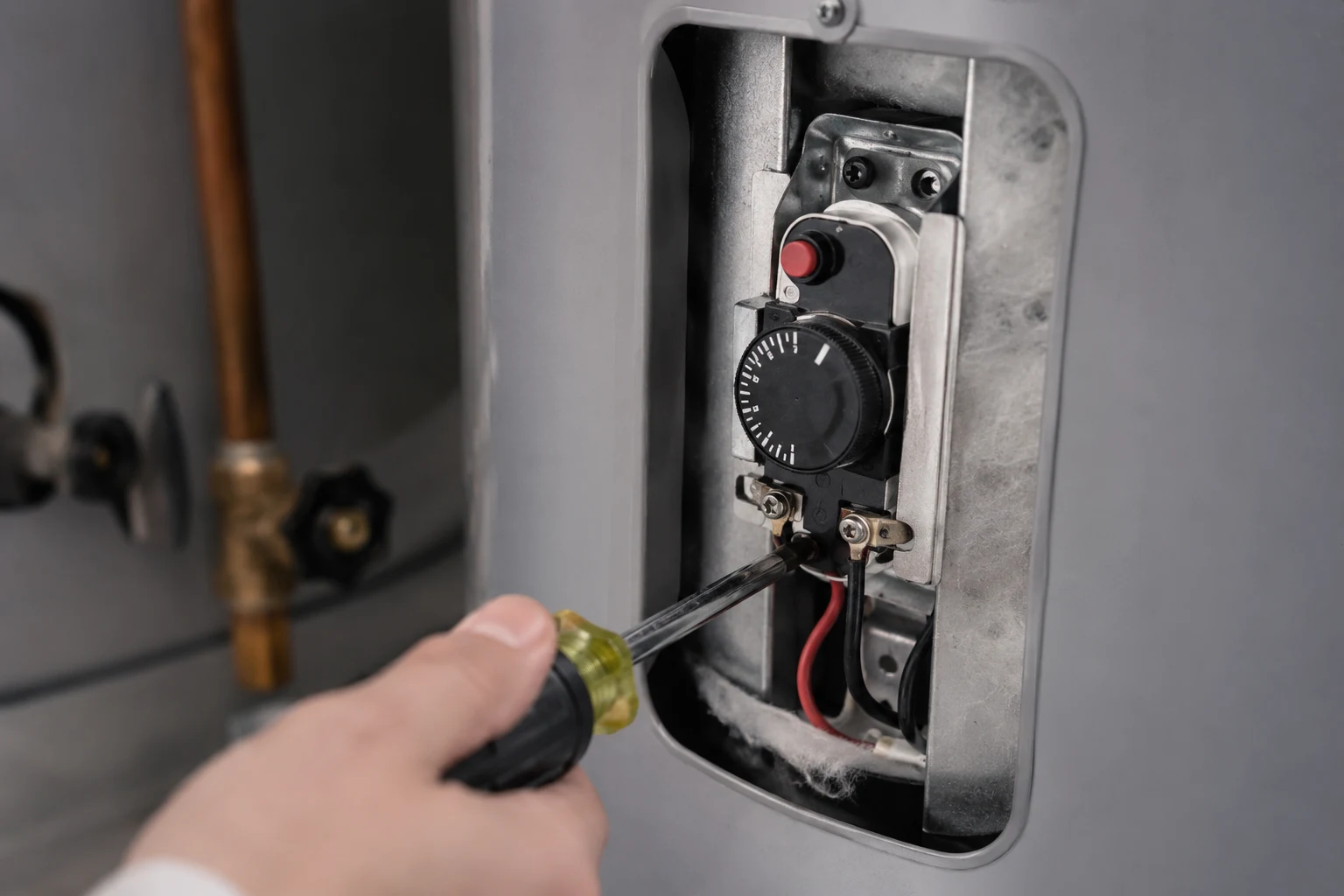
Check this first, because it costs nothing. On a gas tank the temperature knob sits on the gas control valve at the base. On an electric tank there are two thermostats, one behind each panel, and both have to be set to the same number with a small flat screwdriver, breaker off. People find one at 120 and the other cranked to 150. If the dial reads 120 and the water still scalds, the setting is not your problem.
A stuck or failed thermostat
The thermostat's whole job is to close its contacts when the water is cool and open them when the water is hot. When the contacts weld or stick closed, they never open, and the element or burner stays energized long past setpoint. On an electric tank this is a part you can measure and replace for a few dollars. On a gas tank the thermostat is inside the sealed gas control valve, so a stuck one usually means replacing the entire valve, a pro job with a live gas connection.
A grounded or shorted element (electric)
An electric element is a metal loop insulated from the tank by a ceramic or plastic seal. When that insulator cracks and the element shorts to the tank body, it can heat around the clock regardless of what the thermostat wants. It is a sneaky overheat cause because the thermostat can be perfectly good and the water still climbs. You catch it with the ground test below, and the fix is a new element.
The gas control valve (gas)
On a gas heater the temperature control and the high-limit safety both live inside one sealed gas control valve. When that valve's thermostat fails and holds the burner open, the water overheats and there is little to test from the outside. A gas control valve cooking the tank gets replaced as a unit by someone who works on gas, not adjusted.
Sediment hot spots
Years of calcium and magnesium settle into a hard crust on the tank floor. That layer insulates the water from the burner or lower element and traps a thin film of water against the hot steel underneath, which reaches temperatures far above what the thermostat sitting higher up ever reads. It flashes to steam and you get the popping and rumbling everyone recognizes. Sediment rarely scalds the whole tank, but it creates localized overheating, weakens the steel over time, and adds pressure spikes. A yearly flush is the fix.
Crossed hot and cold connections
This one fools people because the tap usually runs lukewarm, not scalding, yet it is worth knowing during an overheat hunt. If a plumber crossed the hot and cold lines, cold water feeds backward into the hot side and the heater runs constantly trying to satisfy a demand it can never meet, cycling the parts far more than they should. Shut the tank off for an hour: if a tap still delivers warm water, the lines are crossed.
It takes three separate safety failures to turn a water heater into a bomb: the thermostat, then the ECO, then a blocked relief valve. Defeat none of them, ever.The layered logic behind every code-compliant tank
The danger you are actually managing
Two hazards ride along with an overheating tank. The everyday one is scalding. Water at 120 degrees takes about five minutes of contact to cause a third-degree burn, which is why it is the recommended setting. At 130 that drops to roughly thirty seconds, at 140 to about six, and at 150 to around two. Two seconds is faster than a toddler in a tub or an older adult at a sink can react, and that is the whole argument for 120.
The rare one is rupture. Under pressure, water in a sealed tank can heat well past its normal boiling point and stay liquid. If the thermostat fails, the ECO fails, and the relief valve is blocked, that superheated water keeps climbing. When the tank finally splits, the pressure drops in an instant and the water flashes to steam all at once, expanding hundreds of times over. That is a BLEVE, violent enough to move a tank through a wall or a roof. The three stacked safeties exist precisely so this never happens, and the relief valve is the last of them. That is why capping a dripping TPR is one of the most dangerous shortcuts in the trade.
| Dial set too high | Water scalds, dial reads above 120 F. Turn down to 120; on electric set both thermostats the same. |
| Stuck thermostat (electric) | Water climbs past setpoint, element stays energized. Test for stuck-closed contacts; replace the thermostat. |
| Grounded / shorted element (electric) | Water overheats even with a good thermostat. Ground-test the element; replace if it shows continuity to the tank. |
| Failed gas control valve (gas) | Burner keeps firing past setpoint, little to test outside. Replace the gas control valve, a pro job. |
| ECO not tripping | Water is dangerously hot and the safety never cut in. The high-limit itself has failed; stop use, get it serviced. |
| Sediment hot spots | Popping or rumbling, localized overheating, pressure spikes. Drain and flush the tank yearly. |
| Crossed hot/cold lines | Tap runs lukewarm, heater runs nonstop. Confirm by shutting the tank off; re-pipe the connections. |
| TPR discharging | Hot water or steam from the relief valve. A symptom of overheating; find the cause, never cap the valve. |
How to test the thermostat, element, and ECO
This is electric-tank work, and it starts with the power. The terminals inside carry 240 volts. Do the sequence below in order and do not skip the tester step.
The short version
If your water is scalding, set the dial to 120 first, because that is free and fixes most cases. If it still overheats, a failed part is driving the heat: a stuck thermostat, a shorted element, or a bad gas control valve. Test the electric parts with the power off and verified dead, and reset a tripped ECO only once. If the tank is discharging steam, rumbling hard, or too hot to stand near, do not troubleshoot, shut it down and call a pro.
When to stop and shut it down
Most overheating gets sorted with a dial and a meter, but a few signs mean the tank may be running away and the right move is off, not diagnose. Shut it down immediately if the TPR valve is discharging steam or a steady stream of hot water, if the tank is knocking or rumbling hard, if it is bulging or creaking, or if it is too hot to stand near. On electric, flip the breaker. On gas, turn the control knob to OFF and close the gas shutoff if you can reach it safely. Then close the cold inlet to stop feeding pressure and open a hot tap to bleed pressure and let the tank cool. Do not crack the TPR by hand while the tank is superheated. A tank that overheated hard enough to trip those signs has earned a licensed plumber.
Frequently asked
Why is my water suddenly scalding hot?
Start with the setting, because that is the free fix and the most common cause. Someone may have bumped the dial up, or it was set high from install day. On a gas heater the knob is on the gas control valve at the base. On an electric heater there are two thermostats, one behind each access panel, and both need to read the same number. If the dial already sits at 120 and the water still scalds, a part is at fault: a thermostat with stuck contacts that never shuts the heat off, an electric element shorted to the tank so it heats around the clock, or on a gas unit a failing gas control valve. All three keep adding heat after the tank reaches temperature. Check the setting, then measure the parts.
What temperature should I set my water heater to?
120 degrees Fahrenheit. The U.S. Consumer Product Safety Commission recommends 120 for households, and it is the number most manufacturers ship the tank preset to. At 120 the water is hot enough for showers and dishes, and it takes about five minutes of contact to cause a third-degree burn, usually enough time to pull a hand back. Push it up and that margin collapses: at 130 a burn takes about thirty seconds, at 140 about six, and at 150 roughly two, faster than a child or an older adult can react. If you run 140 to knock back bacteria, add a thermostatic mixing valve on the outlet so the tank stays hot while the tap delivers a safe 120. Do not just crank the dial and hope.
Can a water heater explode from overheating?
It can, and the physics explains why the safeties are stacked the way they are. Water in a sealed tank under pressure can heat well past its normal boiling point without turning to steam, because the pressure holds it liquid. If the thermostat fails, then the energy cut-off fails, and the relief valve is blocked or capped, the water keeps superheating. The moment the tank ruptures, the pressure drops instantly and that superheated water flashes to steam all at once, expanding hundreds of times over. That is a BLEVE, a boiling liquid expanding vapor explosion, and it can launch a tank through a roof. It takes three separate safety failures to get there, which is exactly why you never defeat any one of them.
What is the ECO on a water heater and why does it trip?
The ECO, or energy cut-off, is a one-shot high-temperature safety switch. On an electric tank it is the red reset button on the upper thermostat; on a gas tank the same protection lives inside the gas control valve as a high-limit code. It cuts the heat when the water climbs past a safe ceiling, commonly between 170 and 190 degrees depending on the maker. It trips because the water genuinely got that hot, which means the normal thermostat already failed to shut the heat off. So a tripped ECO is never the root problem, it is the backup catching a primary failure. Reset it once, breaker off, but if it trips again within a day you have a real fault cooking the water. Find it, do not keep pressing the button.
How do I test a water heater element and thermostat for overheating?
Kill the breaker first, then verify the power is off with a non-contact voltage tester before your hands go near the 240 volt terminals. The breaker label is not proof. With the power confirmed dead, pull the panels and fold back the insulation. Set a multimeter to ohms and read across the element's two terminals: about 10 to 30 ohms is healthy, an infinite reading means it is dead. Then do the ground test, which matters most for overheating: one probe on an element terminal, the other on the bare metal tank or flange. Any continuity means the element is shorted to the tank and heating nonstop, and it has to be replaced. For the thermostat, a healthy one shows continuity when calling for heat and opens when satisfied. Contacts stuck closed leave the element on around the clock, a classic overheat cause.
My relief valve is dripping hot water, what does that mean?
The temperature and pressure relief valve, the TPR or T&P, is the tank's last-line safety, and it opens when the water hits 210 degrees or the pressure hits 150 psi, whichever comes first. A valve that dribbles a little during a heating cycle can be normal thermal expansion, but a TPR that discharges steadily or shoots out hot water is telling you the tank is running too hot or too high on pressure. Treat active discharge as a symptom of overheating: check the setting, then the parts. The one thing you must never do is cap, plug, or block that valve. Blocking it removes the only thing standing between a runaway tank and a rupture, and the discharge line should always run down to a drain so escaping water and steam go somewhere safe.
When should I shut my water heater down immediately?
Shut it down now if the water is scalding and climbing, if the TPR valve is discharging steam or a steady stream of hot water, if the tank is rumbling or knocking hard, or if it is bulging, creaking, or too hot to stand near. Any of those on top of an overheating symptom means the tank may be running away. On electric, flip the breaker; on gas, turn the control knob to OFF and close the gas shutoff. Then shut the cold inlet to stop feeding pressure and open a hot tap to bleed pressure and let the tank cool. Do not crack the TPR by hand while the tank is superheated, and call a licensed plumber before it goes back in service.