You drained the tank to flush it, or a plumber just set a new heater, or the water was off for a repair. Now the tank will not fill, or it is trickling in slow motion, and the hot taps give you nothing but a cough of air. Before you assume the heater is broken, know this: the fault is almost never the tank itself. It is a valve that got left closed, or air trapped inside with no way out. Both are five-minute fixes once you know where to look, and there is one safety rule that matters more than any of them.
I just installed it, is a slow fill normal at first?
A slow start with sputtering is normal for the first minute or two as the air inside a brand-new tank escapes through an open hot faucet. What is not normal is a fill that stays a trickle after several minutes or never finishes. On a fresh install the usual culprit is an inlet valve left only partly open, or a heat-trap nipple sticking. Open the inlet fully and a hot tap; if it still crawls, check the inlet.
Quick answer
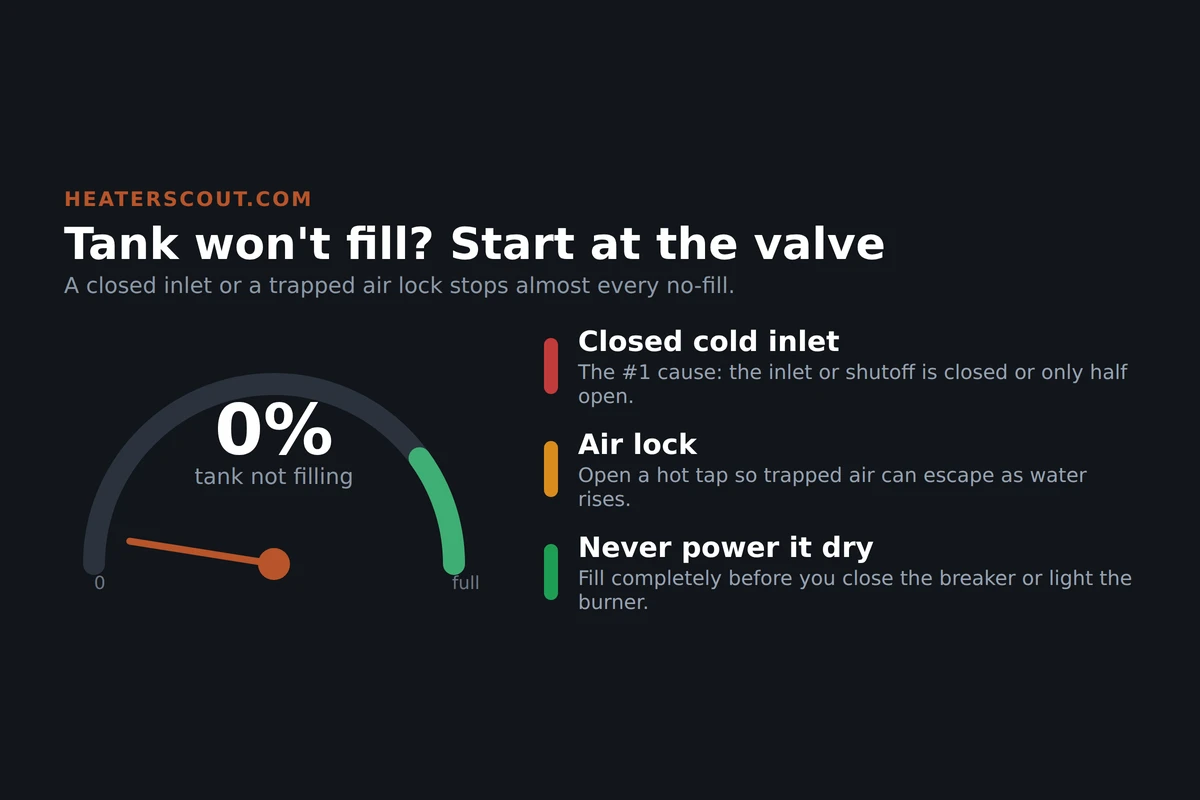
Nine times out of ten a tank that will not fill has one of two causes. Either the cold-water inlet valve at the top of the heater is still closed or only cracked open, or air is trapped inside and blocking the incoming water. The fix for both is the same first move: open the highest hot-water faucet in the house so trapped air has an escape path, then open the cold inlet valve all the way. Water will spit and sputter, then run steady when the tank is full. Do not restore power or light the burner until that hot tap runs a clean, air-free stream, because heating a tank that is not full destroys the element.
First, is it the heater or the whole house?
Before you chase valves on the tank, settle one question: does any water run in the house at all? Turn on a cold faucet at a sink. Cold flows normally but hot gives nothing means the problem is at or downstream of the heater, and the rest of this page is for you. Both cold and hot dead at every fixture means the supply to the whole house is off, and the heater is innocent. That happens more than you would think after a repair, because the main shutoff often gets closed for the work and never reopened. On a well system, check the pump and pressure tank too. There is no point filling a heater while the house main is still shut.
The cold inlet valve: the number one cause
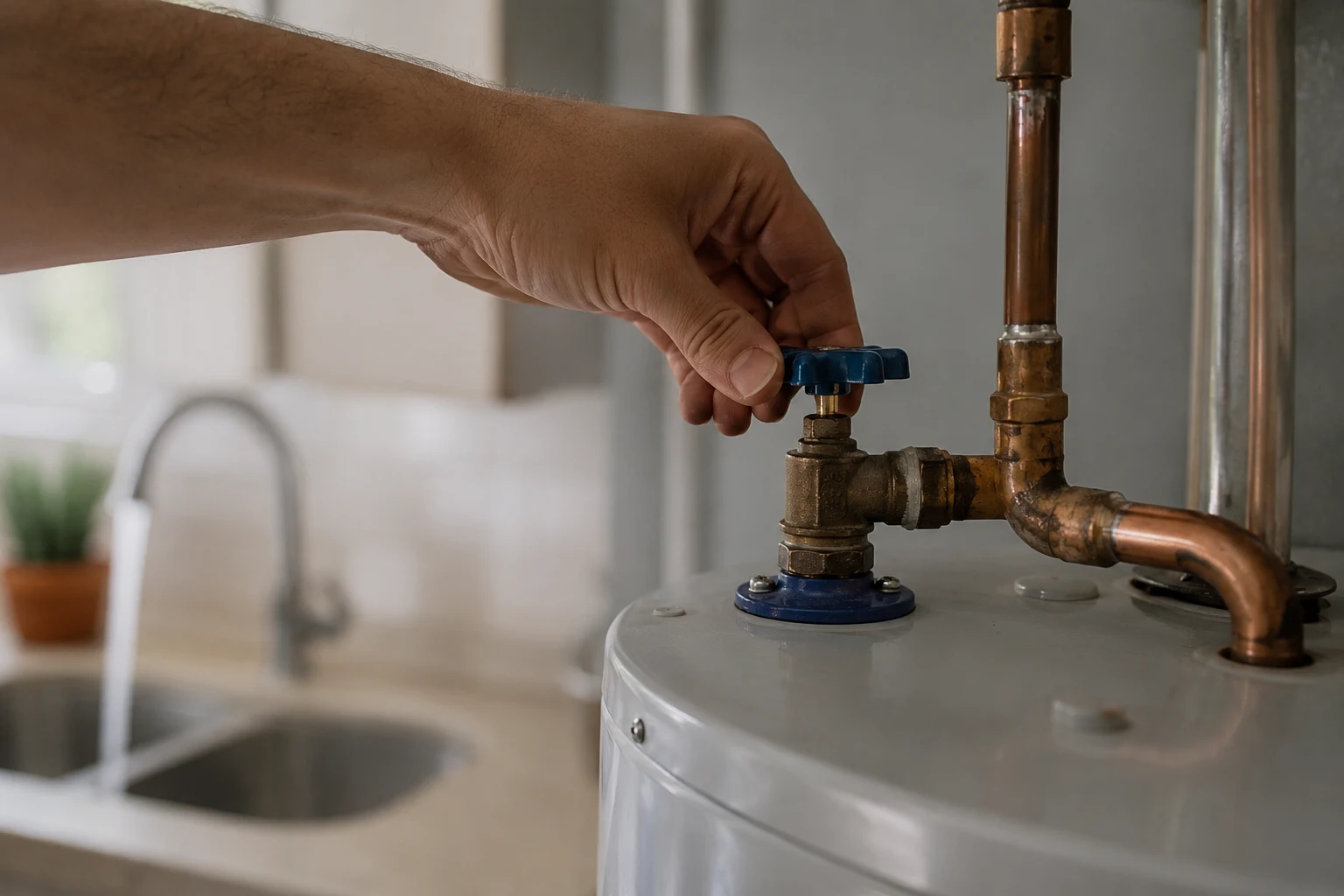
Every storage water heater has a cold-water inlet at the top with a shutoff valve, and a hot-water outlet next to it. When a tank was drained, someone closed that cold inlet to stop water coming in. The most common reason a tank will not refill is dead simple: that valve is still closed, or it got reopened only partway. A ball valve with a lever handle is open when the handle points along the pipe and closed when it points across it, so a lever sitting at an angle is a half-open valve choking the flow to a trickle. A round gate valve has to be spun all the way counterclockwise; backing it off just a turn from closed will feed water in slow motion. Open it fully and confirm.
While you are up there, check the hot-side shutoff if your setup has one, and any isolation valves your plumber installed. A closed valve on the hot outlet will not stop the tank from filling, but it will stop hot water from reaching your taps, which reads to a homeowner like the tank never filled at all.
Air lock: why the tank fills but nothing comes out
An empty tank is full of air. When water rushes in through the cold inlet, that air has to leave, and if every faucet in the house is closed the air gets trapped at the top of the tank and the top of the piping. Trapped air is springy, and it pushes back against the incoming water hard enough to stall or badly slow the fill. This is an air lock, sometimes called a pressure lock. The symptom is a tank that seems not to fill, or hot taps that cough out air and a few spurts of water and then quit. The cure is to give the air a door. Open the highest hot-water faucet in the house, because air rises and collects at the high point, and let it bleed out there while the tank fills.
There is a quick diagnostic if you are not sure air is the problem. With the cold inlet open and the drain closed, gently lift the lever on the T&P relief valve at the top of the tank for a moment. If you hear air hiss out and the tank suddenly starts filling faster, you had an air lock. Let the valve snap shut and let a hot faucet finish the job. Never wedge the T&P open as a permanent workaround, and never cap it. It is the tank's last-line defense against rupture.
When the valve is open and it still will not fill
If the inlet is truly wide open, the house has water, and you have bled the air, but the fill is still a slow trickle, the restriction is right at the tank. The cold inlet on most heaters uses a heat-trap nipple, a short fitting with a small plastic ball or flap that stops hot water creeping up the pipe. That ball can stick or get fouled with sediment and choke the flow to a dribble. Scale can also clog the inlet screen, and on an older tank, debris knocked loose during the drain can lodge in the inlet. A stuck check valve or backflow preventer on the supply behaves the same way.
Check that the house has water at all
Open a cold tap at a sink. Cold runs but hot does not means the problem is at the heater. Both dead means the house main or well system is off, so fix that first.
Open the cold-water inlet valve fully
At the top of the tank, the cold inlet shutoff must be all the way open. A lever handle points along the pipe when open; a round handle spins fully counterclockwise. Half open feeds a trickle.
Open the highest hot faucet to release the air
Open a hot-water tap at the highest fixture in the house so trapped air can escape as water rises. Expect sputtering and bursts of air first, then a steady stream when the tank is full.
Confirm no air lock with a quick T&P test
If it still will not fill, briefly lift the T&P relief lever. Air hissing out and a faster fill confirms an air lock. Let the valve close and let the hot tap finish. Never leave it propped or capped.
Look for a clog at the cold inlet
Valve wide open but flow is still a trickle points at the inlet: a stuck heat-trap ball, a fouled inlet screen, or sediment. Clean the screen, or replace the heat-trap nipple with a plastic-lined one.
Only after it runs full, restore power or light the burner
When a hot faucet runs a steady, air-free stream, the tank is full. Now close the breaker or light the burner. Not one second before.
How often each cause is really behind it
Across the no-fill calls after a drain, a new install, or a shutoff, the split lands like this. A closed or half-open valve and a trapped air lock account for the large majority of them, which is why the fix is usually free and takes minutes.
The right way to fill a tank, and the rule you cannot break
Do the fill in the right order and every problem above takes care of itself. Close the drain valve tight first, obvious but skipped often enough to matter. Open a hot faucet upstairs so air has an exit. Turn the cold inlet all the way on. Listen to the tank fill and watch the open tap go from spitting air to a clean, steady stream, which is your signal the tank is full and the lines are purged. Then, and only then, restore the power or light the burner.
That last step is not a suggestion. Energizing an electric element while the tank is still filling leaves the element sitting in air instead of water, with nothing to carry off the heat. It can blister, crack, or burn out in 30 to 45 seconds. Element makers say dry firing is the single most common reason a brand-new element fails, almost always because someone flipped the breaker before the tank was full. A gas burner under an unfilled tank overheats the bare steel the same way. Fill first, power second.
- Close the drain valve at the bottom of the tank until it is fully shut.
- Open the highest hot-water faucet in the house so trapped air can escape.
- Open the cold-water inlet valve at the top of the tank all the way.
- Let the tank fill; expect air, sputtering, and spitting at the open tap at first.
- Wait until that hot tap runs a steady, air-free stream. That means the tank is full.
- Briefly open the hot side at each other fixture to bleed air from the branch lines.
- SAFETY RULE: only after the tank is confirmed full, close the breaker or light the burner.
- Never energize an electric element or ignite a gas burner on a tank that is not full. Dry firing kills the element or overheats the tank in under a minute.
- Never cap or wedge the T&P relief valve open. It is a safety device, not a fill aid.
When to stop and call a plumber
Most no-fill situations end at an open valve and a bled air lock. Call a pro if cold taps have full pressure but the heater still will not fill after you opened the inlet fully and cleared the air, which points at a clog or a failed inlet fitting. Call if the T&P valve will not reseat and keeps weeping, or if you suspect a stuck check valve on the supply. And if you did dry fire the element before catching yourself, an electric heater that fills fine but never heats likely has a burned-out element to replace, a job done with the breaker off and the tank drained again.
Frequently asked
I just drained and refilled my tank and no hot water comes out. Is that normal at first?
For the first few minutes, yes, some sputtering is normal and expected. When you refill an empty tank the air that was inside has to go somewhere, and it leaves through whatever hot faucet you have open. You will hear spitting, coughing, and bursts of air mixed with water for a minute or two. That is the air lock clearing itself. What is not normal is a hot tap that gives nothing at all after several minutes, or a tank you can hear is still not filling. If that is where you are, the cold inlet valve is almost certainly still closed or only cracked open, or air is trapped and needs a higher faucet opened to bleed out. Give it a few minutes with a hot tap open, then go check the valve if nothing changes.
How long should it take a water heater to fill?
A standard 40 or 50 gallon residential tank fills in roughly 20 to 30 minutes on normal house pressure, sometimes faster on a strong supply. You do not have to stand there the whole time. Open a hot tap, turn the cold inlet fully on, and listen. The rushing sound of water entering the tank slows and then stops when it is full, and the open faucet switches from spitting air to a steady stream. If an hour goes by and it is still trickling, you have a real restriction: a half-open inlet valve, a clogged inlet or heat-trap nipple, or low pressure feeding the whole house. A fill that never finishes is not a patience problem, it is a flow problem.
Why does water only fill the tank when I hold the T&P relief valve open?
That is the classic signature of an air or pressure lock. The temperature and pressure relief valve, the T&P, is the lever near the top of the tank. If the tank fills while you hold it open and stops when you let go, air trapped inside had no way out and was blocking the incoming water, and holding the valve gave it an escape path. The better fix is to open the highest hot faucet in the house and let the air bleed out there while the tank fills, since air rises to the top of the piping. Do not leave the T&P propped open as a workaround, and do not cap it. It is a safety device. If the lock keeps coming back every time you refill, look at the inlet for a stuck heat-trap ball or a check valve holding pressure.
Can I turn the power or gas back on while the tank is still filling?
No, and this is the one rule on this page worth memorizing. On an electric heater the heating elements sit inside the tank and rely on being surrounded by water to carry heat away. Energize an element with air around it instead of water and it can blister, crack, or burn out in about 30 to 45 seconds. It is called dry firing, and it is the single most common way a brand-new element dies. On a gas heater, lighting the burner under a tank that is not full overheats the empty steel. Wait until a hot faucet runs a steady, air-free stream, which tells you the tank is full, then close the breaker or light the burner. Fill first, power second, every time.
The whole house has no water, not just the water heater. What now?
Then the water heater is not your problem, the supply to the house is. Check a cold tap at a sink. If cold runs fine but hot does not, the issue is at or after the heater: a closed cold inlet on the tank, a closed hot-side valve, or an air lock. If both cold and hot are dead everywhere, look upstream at the main shutoff for the house, which is often where the water was turned off for the work you just did and never turned back on. Well systems add a pump and pressure tank to check. Sort out house-wide no-water before you touch the heater, because refilling a tank with the main still closed is not going to happen.
Why is my water heater filling extremely slowly even though the valve is open?
A slow trickle into an otherwise healthy house usually traces to a restriction right at the tank. The most common is a cold-inlet shutoff that only looks open but is actually a quarter turn from closed, so open it fully and confirm the lever is in line with the pipe on a ball valve. Next is the cold inlet itself. Many tanks have a heat-trap nipple with a small ball or flap inside, and that ball can stick or get fouled with sediment and choke the flow. Scale and debris can also clog the inlet screen. If the valve is truly wide open and the fill is still a trickle, the inlet nipple or heat trap is the next suspect.
Do I need to bleed air from every faucet or just one?
Start with one, the highest hot faucet in the house, because air collects at the top of the plumbing and that is where it wants to leave. Open it and let the tank fill until that tap runs steady. After the tank is full, briefly open the hot side at each fixture, one at a time, to clear air pushed into the branch lines. You get a short burst of spitting, then a clean stream. Aerators catch grit knocked loose during all this, so if a tap stays weak afterward, unscrew and rinse the aerator screen.