A water heater that runs out of hot water splits into two very different problems, and telling them apart saves you from buying the wrong fix. One is a heater that never had enough capacity for the house, a sizing miss you solve with the first-hour rating, not the gallon number on the label. The other is a heater that used to be fine and suddenly quits mid-shower, which is a fault inside the tank: a dead lower element, a crumbled dip tube, a sediment layer, a drifted thermostat, or cold bleeding across your plumbing. The word sudden decides which road you are on. Start there, then work down the list.
It USED to be fine, now it quits (a fault)
- Short burst of hot, then cold: dead lower element on electric.
- Hot goes lukewarm, not cold, plus white plastic flakes: dip tube.
- Popping or rumble and slowly shrinking supply: sediment.
- Everything cooler than it was: thermostat drifted or bumped.
It NEVER had enough (sizing or plumbing)
- Runs out only when two draws overlap: FHR below peak demand.
- Cold showers everywhere at once: check for a crossover.
- Fine alone, short with the family home: undersized tank.
- Set to 120 and mixing little cold: turns over the tank fast.
Start with the word 'sudden'
Before you touch a wrench, answer one question. Did the hot water shrink all at once, or has it always come up short? A heater that ran fine for years and now dies halfway through a shower changed inside, so you are chasing a broken part. A heater that has never quite kept up, especially since the household grew, is a sizing problem, and no repair fixes a tank that is simply too small. Mixing these two up is how people spend a Saturday flushing a tank that needed a heating element, or how they buy an 80 gallon monster to paper over a five-dollar dip tube. Get the timeline first.
Second question: gas or electric. The failure modes barely overlap. Electric heaters run out fast because of a dead lower element far more than anything else. Gas heaters run short because of sediment burying the flame or a thermostat set low. Both can suffer a bad dip tube, sediment, a crossover, or plain undersizing. Nail down fuel type and the suddenness, and the list below sorts itself.
One more sanity check costs nothing: is the complaint the whole house, or one fixture? A single shower that runs cold while the kitchen tap stays hot is not the heater at all. That points at a bad shower cartridge or an anti-scald stop set wrong at that valve. The heater is in play only when the shortage shows up at every hot tap. And note whether the water was ever properly hot at the start of a draw. Hot then fast cold is a capacity or element story. Never hot to begin with is a thermostat, a dip tube, or a crossover. Those two branches send you to different parts, so it is worth thirty seconds of paying attention before you start pulling panels.
Electric: the lower element is usually the villain
An electric tank has two elements and two thermostats, and they take turns. When you open a hot tap, the upper element heats the top portion of the tank first so you get instant hot. Once that top water is up to temperature, control hands power down to the lower element, which heats the whole rest of the tank. That handoff is why a dead lower element has such a specific signature: a short run of genuinely hot water, maybe the first ten or fifteen gallons, then a fast slide to lukewarm and cold that no amount of waiting fixes. The upper element cannot heat the bottom of the tank, so once the hot top is gone, you are done.
Confirming it is a multimeter job with the power off. Kill the breaker, and I mean verify it with a non-contact tester at the terminals, because those screws carry 240 volts and that will hurt you. Pull the lower access panel, fold back the insulation and the plastic safety cover, and check the element two ways: continuity across its two terminals, and resistance from either terminal to the tank shell. A good element reads a sensible resistance, often in the ten to sixteen ohm range for a 4500 watt element, and infinite resistance to ground. Open circuit means it burned out. Any continuity to the tank means it shorted and is cooked. Replace like for like on wattage, and drain the tank before you unscrew the old one.
240 volts, no shortcuts
The two element terminals sit at 240 volts even with the thermostat 'off.' Breaker off first, then verify dead with a tester before a screwdriver goes near a terminal. This is the one step on the whole list where skipping the check can kill you.
The dip tube: lukewarm water and white flakes
The dip tube is a long plastic pipe that carries incoming cold water down to the bottom of the tank, so the cold does not dump straight into the hot water waiting at the top where the outlet draws from. When it cracks near the top, snaps off, or dissolves, incoming cold short-circuits into the hot draw and you get water that is lukewarm rather than cold, running short every time. That lukewarm quality is the tell that separates a dip tube from a dead element, which goes fully cold.
The 1993-1997 dip tube era
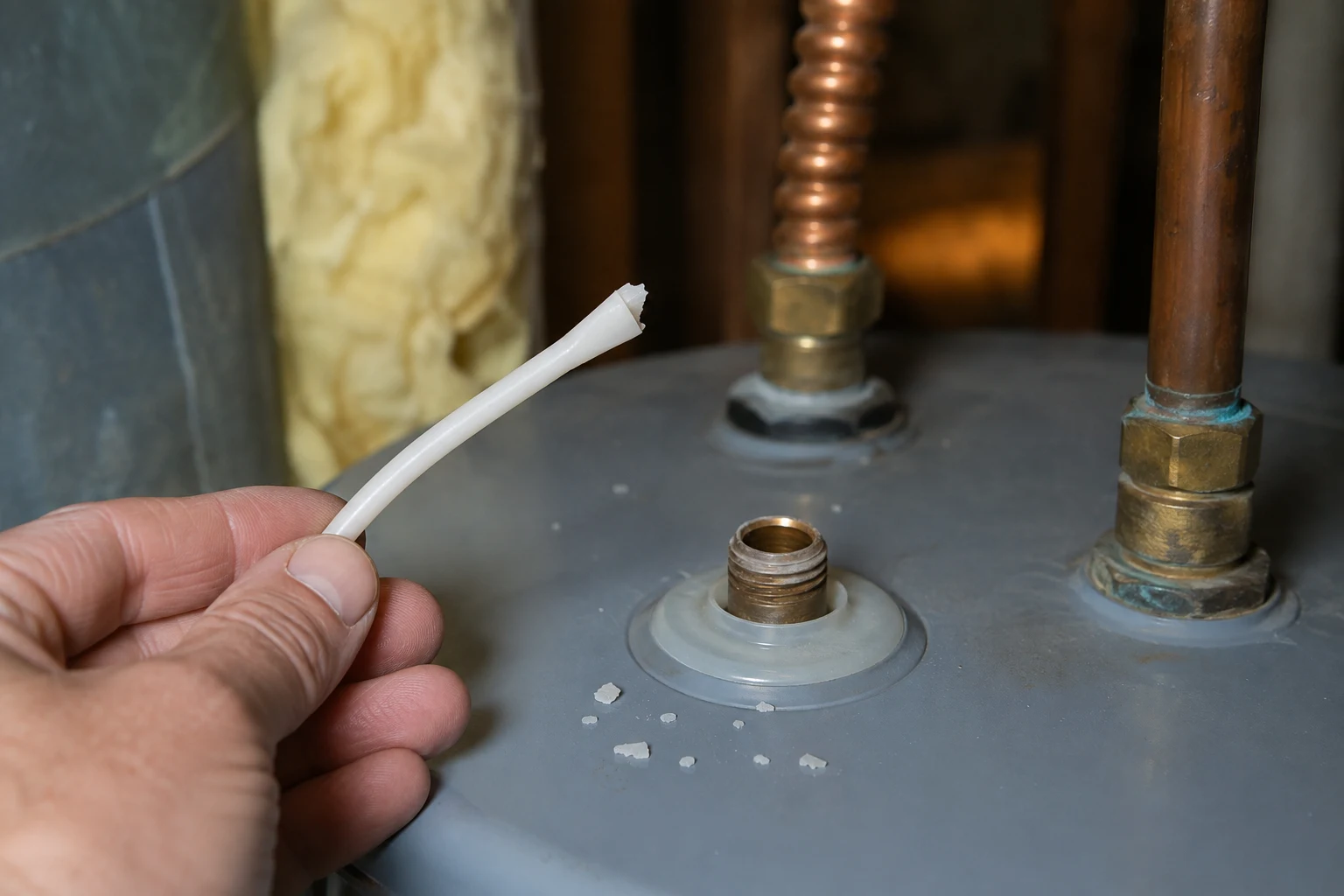
For a few years in the mid-1990s a major supplier shipped dip tubes made from a bad polypropylene batch, and heaters built with them saw the tubes crumble within two or three years instead of lasting the life of the tank. The debris shows up as small white or gray plastic flakes clogging faucet aerators, showerheads, and washer inlet screens, paired with a sudden loss of hot water. If your unit's serial number carries 93 through 97 in its fourth and fifth digits, that is the build year, and a disintegrated dip tube is a prime suspect. The part is cheap and threads in at the cold inlet.
| Symptom | Most likely cause | First check |
|---|---|---|
| Short hot, then cold, no warning | Dead lower element (electric) | Ohm both elements, breaker off |
| Lukewarm, never truly hot, plastic flakes | Broken or degraded dip tube | Serial year + aerator screens |
| Popping/rumble, slowly shrinking supply | Sediment layer | Drain and flush the tank |
| Everything cooler than it was | Thermostat low or drifted | Read the dial, both on electric |
| Runs out only during busy hour | FHR below peak demand | Compute FHR vs peak draw |
| Cold showers house-wide at once | Plumbing crossover / mixing valve | Shut hot at heater, open a tap |
Sediment quietly shrinks the tank
Every gallon of water that enters the tank carries a little dissolved mineral, and over years that scale settles on the floor as a hard crust. It costs you twice. It takes up space that used to hold water, so a 40 gallon heater starts acting like a 30, and it forms an insulating blanket between the gas flame and the water, dragging the recovery rate down so the tank refills its hot supply slower. On an electric unit the scale buries the lower element, makes it run hot, and burns it out early, which loops you right back to the element problem above.
You often hear sediment before you feel its effect. The popping, rumbling, or kettle-boiling sound while the burner runs is water trapped under the mineral crust flashing to steam and forcing its way out. That noise is your early warning that capacity and recovery are slipping. Catch it early and an annual drain and flush keeps the floor clear and the numbers close to spec. Ignore it for a decade and the scale bakes into a hard cake that a garden-hose flush will not budge, at which point the lost volume is permanent and you are weighing a new tank. Hard-water homes should flush yearly as routine maintenance, not as a repair, and an inlet softener slows the whole process down.
Thermostat, crossover, and honest sizing
Two easy things get blamed on the tank when they are not the tank. A thermostat set low is the first. The factory preset is the 120 degree mark, which is the sweet spot for scald safety, but a low setting also means you mix in less cold at the tap to get a usable temperature, so you draw the tank down faster and it feels small. If someone turned it down, or a gas dial drifted, nudging it back toward 120 can restore what felt like lost capacity. Do not chase more hot water by cranking it past 120, though. Water at 140 degrees burns skin in about six seconds, and 130 does it in thirty. If you need a hotter tank for other reasons, a thermostatic mixing valve at the outlet gives you scald safety at the fixtures.
A plumbing crossover is the sneaky one. Cold water bleeds into the hot line through a worn single-lever faucet cartridge, a failing mixing valve, or a stuck check valve on a recirculation loop, and it steals hot everywhere in the house at once. Test it in five minutes: shut the hot outlet valve on top of the heater, then open a hot tap somewhere. If water keeps flowing after the line drains, cold is crossing over somewhere, and the fix is finding the guilty faucet or valve, not the heater.
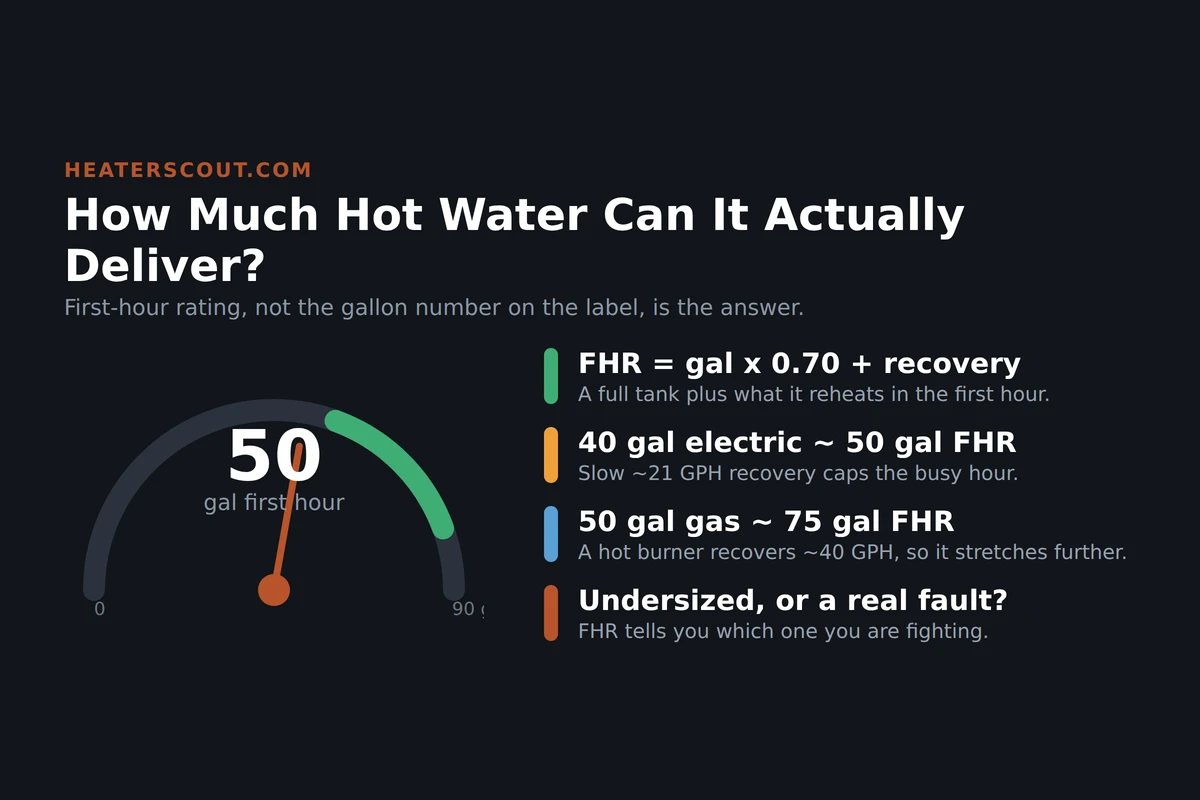
If the heater truly is too small, size by the busiest hour, not by gallons. Reckon on roughly 12 gallons of hot water per person during your peak hour, add up the household, and buy a unit whose first-hour rating covers that number. One or two people are usually fine on a 30 to 40 gallon tank, three or four on a 40 to 50, and five or more want a 50 to 80 gallon unit or a high-recovery model. The trap is buying by the gallon sticker and ignoring recovery. A 50 gallon electric with slow elements can deliver less in a busy hour than a 40 gallon gas unit with a strong burner. Read the yellow EnergyGuide label for the FHR and match it to your peak, and the cold showers stop being a monthly surprise.
Frequently asked
Why does my water heater run out of hot water so fast all of a sudden?
Sudden is the key word. A tank that was fine for years and now dies mid-shower changed inside, so this is a fault, not a sizing problem. On an electric heater the number one cause is a dead lower heating element. The upper element heats the top few gallons, then power hands off to the lower element to heat the rest of the tank, and when the lower one burns out you get a short burst of hot followed by cold. On a gas heater a sudden drop usually means a thick sediment layer finally buried the flame or the thermostat drifted low. A broken dip tube also fits, especially if the water went lukewarm rather than cold. Start by confirming the temperature dial has not been bumped, then, breaker off, test both elements on an electric unit.
What is a first-hour rating and why does it matter more than gallons?
First-hour rating, or FHR, is the number of gallons of hot water a heater can deliver in one busy hour starting from a full tank. It combines what the tank already holds with what the burner or elements can reheat during that hour, so it is the honest answer to how much hot water you actually get. The rough math is tank gallons times 0.70 plus the recovery rate in gallons per hour. A 40 gallon electric with a slow 21 gallon per hour recovery lands near a 50 gallon FHR. A 50 gallon gas unit with a 40 gallon per hour recovery can hit 75. That is why a 50 gallon electric can lose to a 40 gallon gas in a busy household. When you shop, match the FHR to your peak-hour draw, not the gallon number on the label.
How do I know if my dip tube is broken?
Two clues point at the dip tube. First, the hot water goes lukewarm rather than cold and runs short, because the tube is supposed to push incoming cold to the bottom of the tank and a cracked or missing one lets that cold mix straight into the hot you are drawing off the top. Second, you find small white or gray plastic flakes in faucet aerators, showerheads, or washer screens. Heaters built between 1993 and 1997 used a defective plastic batch and those dip tubes crumbled within a few years, which is the classic case. Check the fourth and fifth digits of the serial number for the build year. The tube itself is a cheap part that threads in at the cold inlet, so replacement is a reasonable homeowner job with the water and power off.
Can sediment really cause not enough hot water?
Yes, in two ways. Mineral scale settles on the floor of the tank and takes up space that used to hold water, so a 40 gallon heater slowly behaves like a 30. On a gas unit that same layer sits between the burner flame and the water and insulates it, which drags down the recovery rate, and on an electric unit it buries the lower element and makes it run hot and fail early. You often hear it before you feel it as popping or rumbling while the burner runs, which is trapped water flashing to steam under the scale. An annual drain and flush clears loose sediment and is the fix and the prevention. On a tank well past ten years the capacity loss can be permanent once the scale bakes hard, and that is a replacement conversation.
My tank is big enough but I still run out. What else could it be?
If the gallons are right for your household and you still run short, look past the tank. A plumbing crossover lets cold water bleed into the hot line, usually through a worn single-lever faucet cartridge, a failing thermostatic mixing valve, or a stuck check valve on a recirculation loop, and it quietly drains your hot supply everywhere at once. Test it by shutting the hot outlet valve at the top of the heater and opening a hot tap. If water keeps flowing, cold is crossing over somewhere in the house. A thermostat set too low also masquerades as a small tank, since less-hot water means you mix in less cold and empty the tank faster. And genuine peak demand matters. Two showers plus a dishwasher in the same hour can outrun a correctly sized tank on paper.
Should I just buy a bigger tank?
Only after you rule out a fault, because a bigger tank hides a broken dip tube or a dead element instead of fixing it. If the heater truly is too small, size by peak-hour demand rather than by gallons. Figure roughly 12 gallons of hot per person during your busiest hour, then buy a unit whose first-hour rating covers that number. As a rough guide, one or two people are served by a 30 to 40 gallon tank, three or four by a 40 to 50, and five or more by a 50 to 80 gallon or a high-recovery model. If you are electric and space limited, a higher-recovery gas unit or a heat-pump hybrid buys you more FHR without a taller tank. Match the rating to the busiest hour and the cold showers stop.