Quick answer
That popping or rumbling is water boiling underneath a crust of hardened mineral sediment on the tank bottom — plumbers call it kettling. It’s not an emergency, but it’s costing you energy and shortening the tank’s life. The fix is a flush; if the crust has set hard, a vinegar delime. Only one version of this noise is urgent, and it’s covered below.
Inside the tank
Why it pops
A water heater has no moving parts that should knock, so a popping or rumbling sound almost always means one thing: the water at the very bottom of the tank is boiling. Understanding why it boils tells you exactly what to do about it.
What the sound actually is
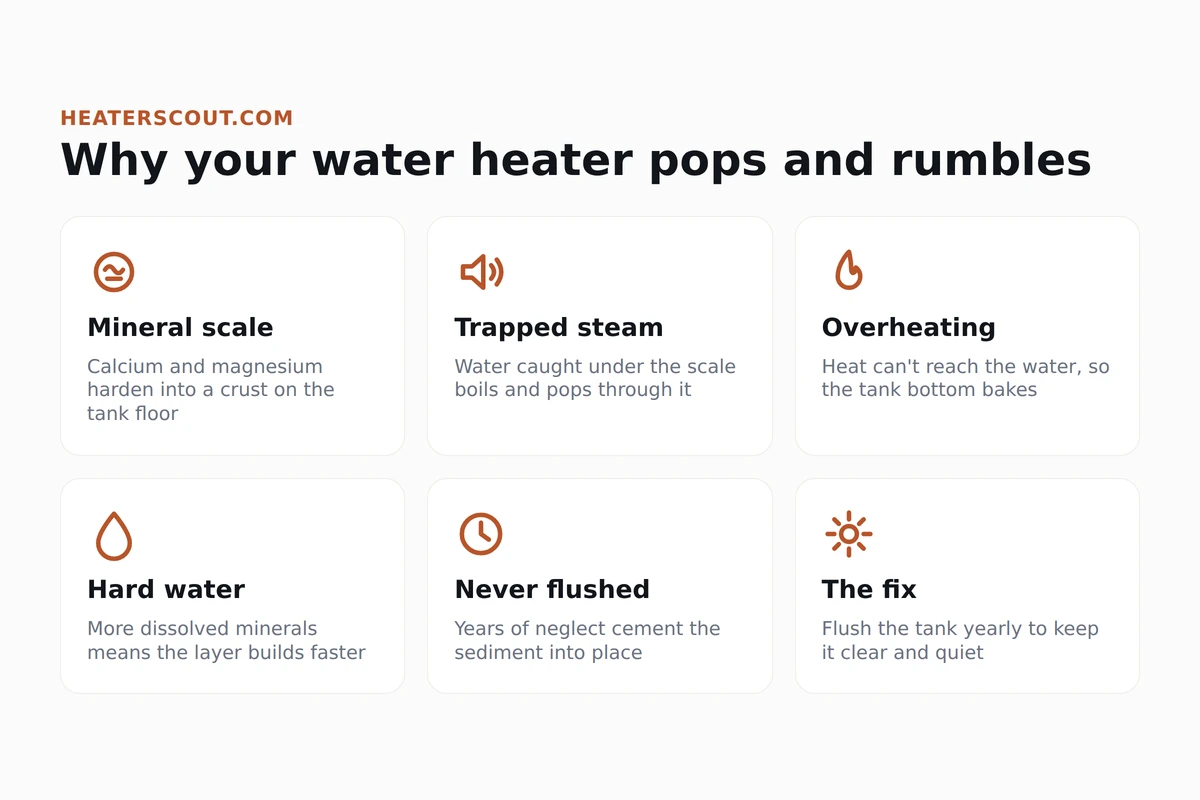
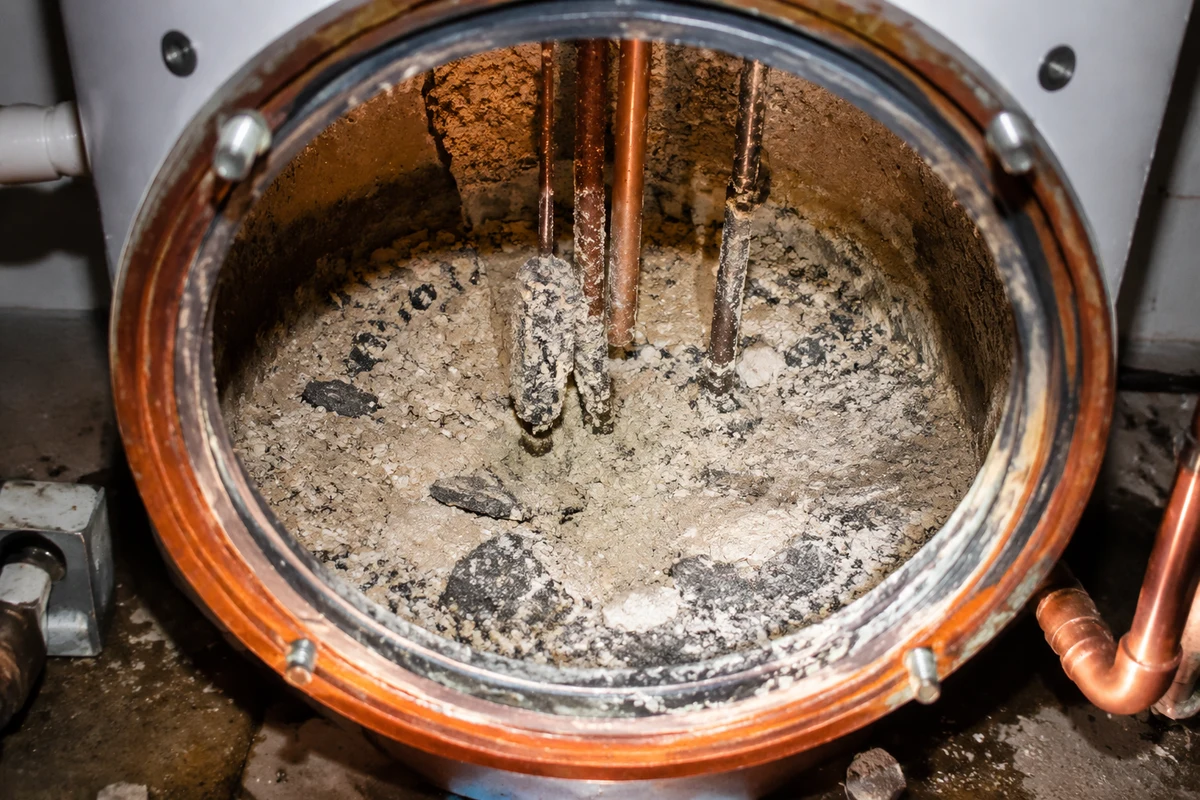
Hard water carries dissolved calcium and magnesium. When it heats, those minerals fall out of solution and settle as a gritty layer on the tank floor — right where a gas burner fires or an electric element sits. Over months that layer bakes into a hard crust. The chemistry is simple: heated calcium bicarbonate turns into solid calcium carbonate, the same scale you see in a kettle.
Here’s the mechanism. The crust insulates the water above it from the heat source below. The steel and the trapped water pockets keep climbing past 212°F, flash to steam, expand violently, then collapse as they push up through the sediment. Each burst is a pop. When the whole floor is caked, dozens of them overlap into a low rumble or a sound like a percolating coffee pot.
It helps to picture it as a kettle with a false bottom. In a clean tank, heat moves straight into the water and nothing boils locally — the whole tank warms evenly and quietly. Add a half-inch of hardened scale and you’ve built an insulating shelf that traps a thin film of water against metal that’s now running far hotter than it should. That film is what boils, and it has nowhere to go but up through the cracks in the crust. The more crust, the more trapped pockets, the louder and more constant the sound. Nothing is broken yet; the noise is the tank telling you the buildup has reached the heat source.
How the noise changes as it gets worse
The sound tells you roughly how far along the buildup is. This is the part most guides skip — the noise isn’t random, it’s a progress bar.
Occasional pops
Sharp, spaced-out ticks when the burner first fires. A flush now clears it easily.
Frequent popping
Crackling through most of a heating cycle. Flush still works, may need a second pass.
Steady rumble
Deep boiling sound, slower reheats, less hot water. Likely needs deliming, not just a flush.
Banging + overheating
Metal stress. The tank runs hot, efficiency craters, and rupture risk climbs. Act now.
That last stage is why the noise is worth acting on early. When the crust gets thick enough, the burner or element can no longer transfer heat cleanly into the water, so the steel floor itself overheats. Repeated overheating stresses the tank lining and the welds, which is how a heater that would have lasted twelve years starts leaking at eight. The sound is annoying; the hidden damage is the real cost.
Gas and electric make the same noise for different reasons
Gas tank
- Burner fires directly under the steel floor, so sediment sits right on the hottest spot.
- The crust traps water against the flame — classic kettling and rumble.
- Fix is almost always a flush or delime; the burner itself is rarely the noise.
Electric tank
- Elements sit inside the water. Scale coats them, and steam bubbles snap off the surface — a sizzling or hissing pop.
- A scaled element also runs hotter and burns out early.
- If a flush doesn’t quiet it, the element may need cleaning or replacing.
How fast this happens to you — and what it costs
How quickly the crust forms depends almost entirely on your water hardness, measured in grains per gallon. About 80% of US homes have hard water, and hardness is what sets your real flush schedule. Set the slider to your water and see the build rate, the interval, and how much a neglected tank can waste on your energy bill.
Water hardness → flush schedule
Hardness in grains per gallon (gpg). Not sure? A cheap test strip tells you, or ask your water utility. Well water usually runs hard.
ENERGY STAR notes a badly clogged tank can push water-heating costs up by 20% or more, and water heating is roughly 12% of a home’s energy use. The sediment forces the burner to fire longer to push heat through the crust, so you pay twice: once in wasted gas or electricity, and again when the overworked tank fails years early.
The fix, cheapest first
- Flush the tank. Turn off the gas or the breaker, let it cool, hose the drain valve to a drain, open a hot tap to break the vacuum, and drain until the water runs clear. This clears loose sediment and stops light popping.
- Delime with vinegar. If a plain flush doesn’t quiet it, the crust has hardened. Drain, add a few gallons of white vinegar or a commercial delimer, let it soak six to eight hours, then flush again.
- Clean or replace the element (electric only). Scale caked onto an element that still pops after a flush usually means the element comes out for a wire-brush clean, or a swap if it’s already failing.
- Replace the tank. A tank that’s eight to twelve years old, heavily caked, and banging has often been overheating for a while. If it’s also rusty or seeping, sediment removal can dislodge scale that was plugging pinhole leaks — at that point a new unit is the honest call.
Keeping it quiet for good
Flushing clears what’s there; prevention decides how fast it comes back. Four habits do most of the work, and none of them are expensive.
- Flush on a schedule, not on a sound. By the time you hear rumbling, the crust is already forming. Match the interval to your hardness (the tool above) and put it on the calendar. Twenty minutes once or twice a year beats a delime or an early replacement.
- Drop the thermostat to 120°F. Minerals fall out of solution faster the hotter the water, so a tank held at 140°F scales noticeably quicker than one at 120°F. Lower is also safer against scalds and cheaper to run.
- Check the anode rod. The sacrificial anode corrodes so the steel tank doesn’t, and a spent rod lets the tank itself start deteriorating. Inspect it every few years; replacing a $30 rod is far cheaper than a tank.
- Consider a softener above 7 grains per gallon. Removing the calcium and magnesium before they enter the tank stops the crust at the source. It’s the one fix that changes the math permanently in a hard-water home.
A tank that’s flushed yearly, run at 120°F, and fed reasonably soft water can stay quiet for its entire service life. Most of the heaters that bang themselves to an early death simply never got that first flush.
The one version that’s actually urgent
A pop or rumble is a maintenance issue. A high-pitched whistle or screech is not — that’s the temperature-and-pressure relief valve venting because pressure or temperature inside the tank is climbing toward dangerous. Shut the heater off and call a professional. Heavy sediment can drive the tank to overheat, which is exactly what leads to that whistle.
Frequently asked
Is the popping noise dangerous?
On its own, no — it’s trapped water boiling under sediment, a sign the tank needs a flush. It becomes a concern only if it’s ignored for years, because the trapped heat overworks the tank. A high-pitched whistle (the relief valve) is the urgent sound; a pop or rumble is a maintenance one.
How often should I flush my water heater?
Once a year for soft or slightly hard water, every six months for hard water, and every three to four months for very hard or well water. Use the slider above with your hardness in grains per gallon to get your interval.
Does sediment affect electric and gas heaters the same way?
Both build the same crust, but the noise differs. Gas tanks rumble because water boils against the floor over the burner. Electric tanks sizzle or pop because scale coats the submerged elements. Electric elements also burn out early when caked, so a scaled electric unit may need the element cleaned or replaced.
What if flushing doesn’t stop the noise?
The crust has hardened beyond what water alone removes. Drain the tank, add white vinegar or a commercial delimer, soak it six to eight hours, and flush again. On electric units, also pull and clean the elements. If it still rumbles and the tank is old, it may be near the end of its life.
Will a water softener stop the buildup?
Largely, yes. A softener removes most of the calcium and magnesium before they reach the tank, which is why it’s worth considering above about 7 grains per gallon. It won’t remove a crust that’s already there — flush or delime first, then soften to keep it from coming back.
How much is sediment really costing me?
ENERGY STAR estimates a badly clogged tank can raise water-heating costs by 20% or more. Since water heating is around 12% of a typical home’s energy bill, a caked tank quietly adds up — and it also shortens the heater’s life, so you replace it sooner.