You still get hot water, but only for a minute. The shower runs warm, then cools, then goes cold while you are still standing in it. Nothing about your household changed. On a standard electric tank that pattern, a short burst of hot that turns cold fast, points almost every time at the lower heating element. An electric water heater has two 240V elements, an upper and a lower, and the lower one does the bulk of the heating. When it dies, the upper element keeps heating the top few gallons, so you get a small slug of hot water before the cold underneath reaches the tap. This page shows how to confirm the lower element is the culprit, how to rule out the lower thermostat and the upper thermostat that feeds it, and how to swap the element without dry-firing the new one.
Diagnose it: element, thermostat, or handoff
The signature symptom narrows it fast, but you still confirm with a meter before you spend money. Shut the breaker off before you open anything. Then walk this path, because a dead element and a thermostat that never energizes it produce the exact same short-burst symptom, and only a meter tells them apart.
Confirm the symptom points at the lower half
A short burst of hot water that turns cold fast means the top of the tank is hot and the bottom is not. The upper element heats only the top few gallons; the lower element heats the rest. So a small amount of hot water is the lower half never getting heated, which is the lower element or its thermostat.
Ohm the lower element cold
With the breaker off, pull the lower access panel and fold back the insulation. Set a multimeter to ohms and read across the two element terminals. Resistance depends on the element's stamped wattage: R equals 240 squared divided by watts, so a common 4500-watt element reads about 12 to 13 ohms. An open or infinite reading means it is burned out. A near-zero reading means it is shorted internally.
Check the element for a ground fault
Keep the meter on continuity and touch one probe to an element terminal and the other to the tank or a bare metal spot on the heater. Any continuity to ground means the element is shorted to the tank, a grounded element, and it needs replacing even if the resistance looked reasonable.
If the element is good, check for 240V
An element that ohms out fine is not the problem. Restore power carefully and, with the tank calling for heat, look for 240V at the lower thermostat and element. No voltage with a good element means the lower thermostat is not passing power, or the upper thermostat has not handed off.
Confirm the upper thermostat is handing off
The upper thermostat must satisfy the top of the tank before it passes power down to the lower thermostat and element. If the upper thermostat is bad and never satisfies, the lower element never runs even though it is perfectly good. Rule this out before you condemn a healthy lower element.
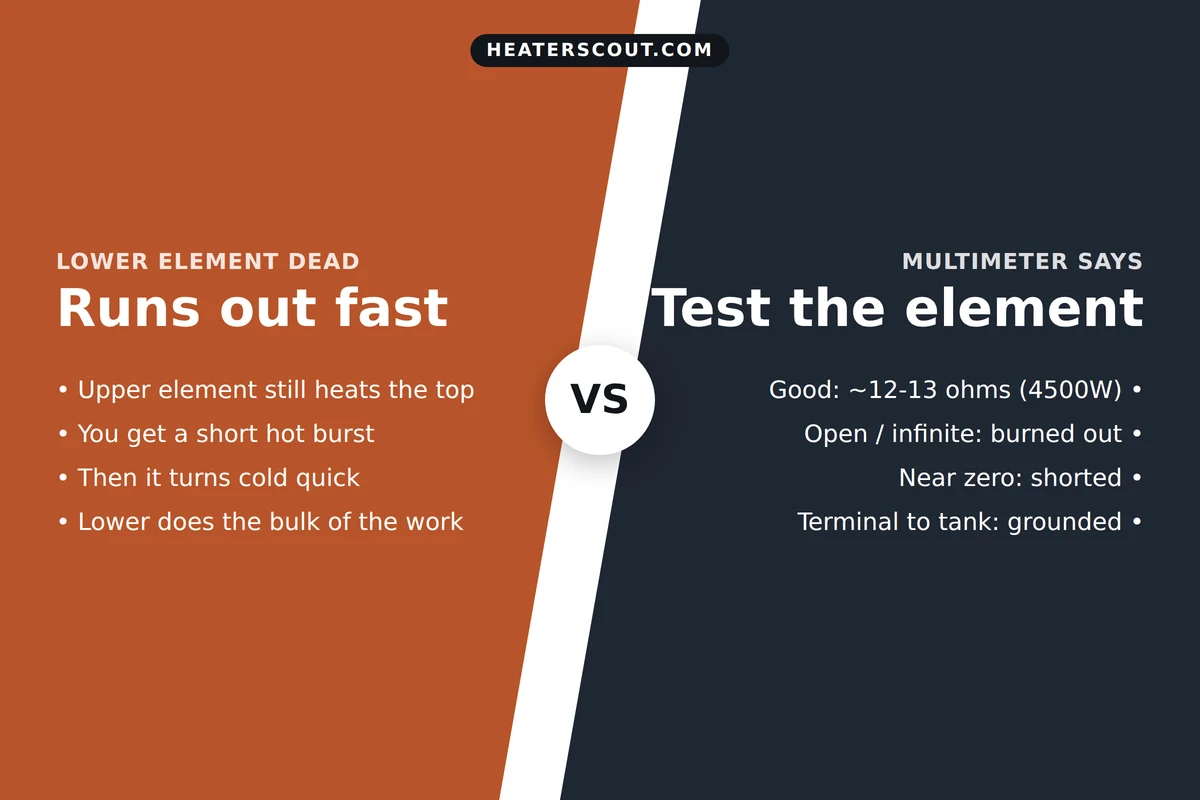
Symptom to cause to fix
Match what your meter and your tap are telling you in the left column and read across. The one thread running through all of it: a short hot burst is the top of the tank heating while the bottom stays cold, and the fix depends on whether the element, the lower thermostat, or the upper handoff is the break.
| Element reads open or infinite ohms | Burned-out lower element, an open circuit. Drain the tank and replace the element |
| Element reads near zero ohms | Shorted lower element. Replace it; a near-zero reading means the internal winding has failed |
| Continuity from a terminal to the tank | Grounded (shorted) element. Replace it even if resistance looked normal |
| Element ohms out good but the lower half never heats | Lower thermostat not energizing the element. Test the thermostat and its voltage |
| Lower never runs and the upper never satisfies | Bad upper thermostat starving a good lower element. Replace the upper thermostat |
| Lower element burns out repeatedly on hard water | Sediment burying and overheating it. Flush the tank; fit a low-watt-density element |
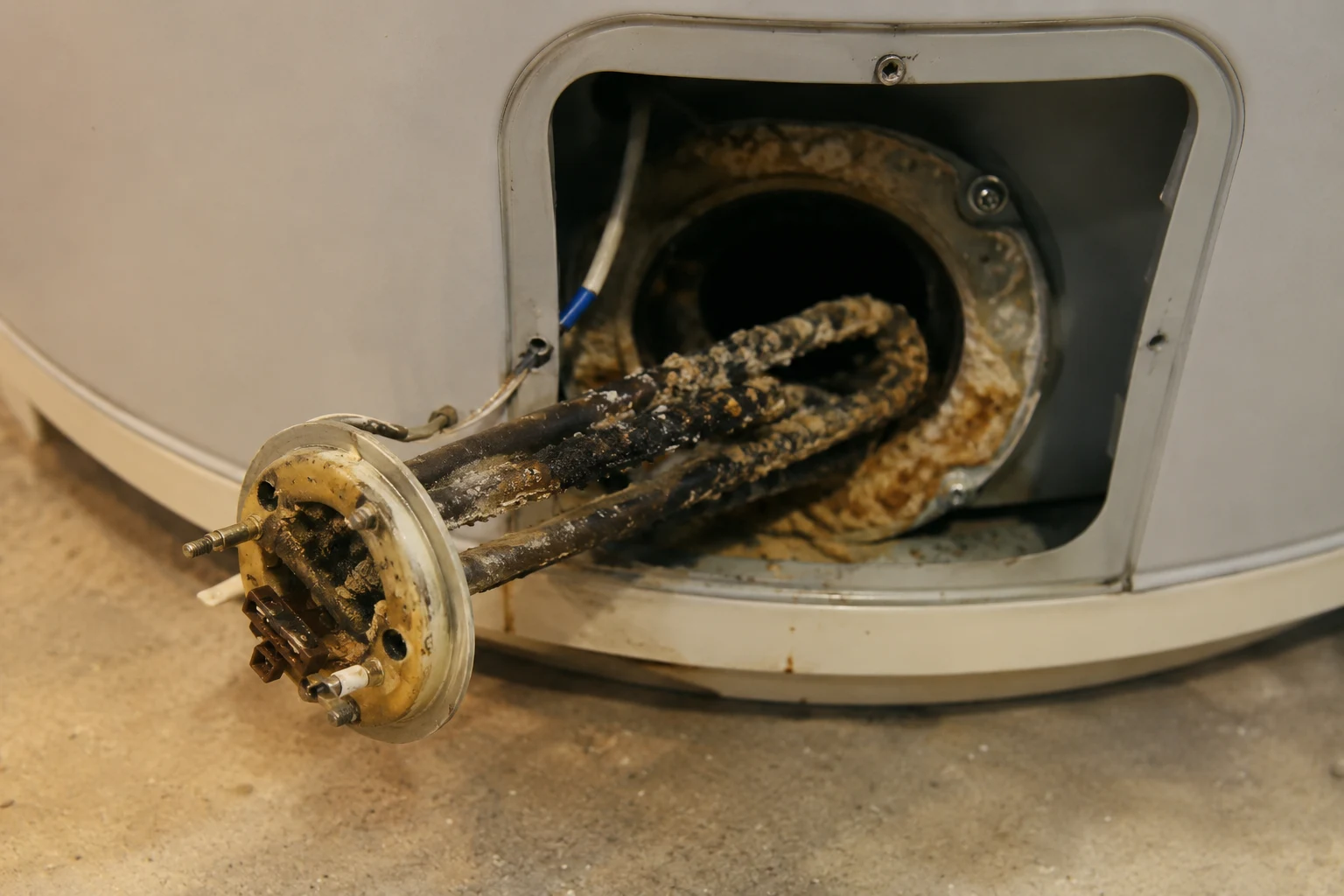
Before you touch it: the safety checklist
An electric water heater runs on 240V and the tank is full of scalding water. Run this list before you open a panel and before you power anything back up. The dry-firing rule at the bottom is the one that ruins brand-new elements when people rush the refill.
- Shut the breaker OFF at the panel before removing any access cover. Do not trust the thermostat alone.
- Verify the power is dead at the element with your meter before you touch a terminal.
- Drain the tank fully for the lower element: close the cold inlet, open a hot tap, then run the drain hose.
- Use an element wrench, not pliers, so you do not chew up the element flange or the seat.
- Set the new element with a fresh gasket and clean the seat so it seals without weeping.
- Refill the tank and bleed all air out with a hot tap open before restoring power. A dry-fired element dies in seconds.
What it looks like in real life
Plenty of hot water yesterday, a two-minute shower today
The tank heated fine, then almost overnight you get only a short burst of hot water. Ohm the lower element and it reads open. That is a burned-out lower element, an open circuit. The upper element is still heating the top few gallons, which is the little bit of hot you still get. Drain the tank and replace the element.
Third lower element in a few years on well water
You keep replacing the lower element and it keeps failing while the upper one lasts. The tank is on hard water and sediment has buried the lower element, so it overheats and cracks. Flush the tank, and when you fit the new element choose a low-watt-density or lifetime element that stands up to scale.
Only a little hot water, but the element tests fine
The lower element ohms out at a healthy 12 ohms, yet the tank only makes a little hot water. The upper thermostat is not satisfying and never hands off power to the lower thermostat, so a good lower element never runs. Replace the upper thermostat, not the element.
How to replace the lower element
Once the meter confirms a bad lower element, the swap itself is straightforward. The whole job is drain, unscrew, replace, refill, and only then power up. The refill-before-power step is not optional. An element energized in air, called dry-firing, burns out in seconds, so the order below is the part to respect.
Frequently asked
Why do I run out of hot water so fast all of a sudden?
On a standard electric tank the sudden drop from plenty of hot water to a short burst almost always points at the lower heating element. An electric tank has two elements, an upper and a lower, each 240V, and the lower one does the bulk of the heating. It sits low in the tank and keeps the whole tank hot. The upper element only heats the top few gallons. When the lower element dies, the upper keeps heating that top layer, so you still get hot water, but only for a minute or two before the cold water underneath reaches the tap. That signature, a short slug of hot that turns cold fast, is the classic sign of a failed lower element or a lower thermostat that stopped energizing it. Nothing about your usage changed. The tank just went from heating top to bottom to heating only the top.
How do I know if it is the lower element or the lower thermostat?
You test both, and the order matters. Shut the breaker off first, then pull the lower access panel and fold back the insulation. Set a multimeter to ohms and read across the two element terminals: resistance depends on the element's stamped wattage, so R equals 240 squared divided by watts and a common 4500-watt element reads about 12 to 13 ohms, an open or infinite reading means the element is burned out, and a near-zero reading means it is shorted. If the element ohms out fine, the problem is upstream. Restore power carefully and, with the tank calling for heat, check for 240V at the lower thermostat and element. No voltage there with a good element means the lower thermostat is not passing power, or the upper thermostat never handed off. So the sequence is: ohm the element cold, and only if it reads good do you go looking at the thermostat and the voltage feeding it.
What does the upper thermostat have to do with a dead lower element?
More than most people expect. On a standard electric tank the two elements never run at the same time, and the upper thermostat is the traffic cop. When the tank cools, the upper thermostat energizes the upper element first to heat the top of the tank. Only after the top is satisfied does the upper thermostat hand power down to the lower thermostat, which then runs the lower element to heat the rest of the tank. That handoff is the catch. If the upper thermostat is faulty and never satisfies, it never passes power down, so the lower element never runs even though the element itself is perfectly good. That is why a tank that only makes a little hot water can have a healthy lower element and still fail: the upper thermostat is starving it. Always confirm the upper thermostat is handing off before you condemn the lower element.
Can sediment kill the lower heating element?
Yes, and it is one of the most common ways a lower element dies on hard water. Sediment, mostly calcium and mineral scale, settles to the bottom of the tank over time, and the lower element sits right in it. As the layer builds, it buries the element. Buried in sediment, the element cannot shed its heat into the water, so it runs hotter than it should, and that overheating cracks or burns it out early. Scale that bakes onto the element does the same thing by insulating it. That is why a tank on hard water can go through lower elements while the upper one lasts for years. Flushing the tank on a schedule keeps the sediment down, and when you replace a burned lower element it is worth switching to a low-watt-density or lifetime element, which spreads its heat over more surface and stands up better to hard water.
Do I need to drain the tank to replace the lower element?
For the lower element, yes, all the way. The lower element sits near the bottom of the tank, so the water level is above it and it will pour out the moment you unscrew it if you have not drained down. Shut the breaker off, close the cold inlet, open a hot tap somewhere in the house to break the vacuum, then run the drain valve to a hose until the tank is empty. Once it is drained you back the old element out with an element wrench, clean the seat, set the new element with a fresh gasket, and snug it down. The step people skip and regret is refilling and bleeding the air out before restoring power. If you energize an element that is not fully submerged, it dry-fires and destroys itself in seconds. Fill the tank with a hot tap open until water runs steady with no air, then and only then flip the breaker back on.
Why does the water get hot but only a little?
A little hot water that runs cold fast is the top of the tank being heated while the bottom stays cold. On a two-element electric tank the upper element heats only the top few gallons, and the lower element heats everything below it. When you get just a small amount of hot water, the upper element is doing its job but the lower half of the tank is never getting heated. Two things cause that: the lower element is dead, or the lower thermostat is not energizing it, which includes the case where the upper thermostat never hands off. Test the lower element for resistance first. Compute the expected value from the element's stamped wattage (R = 240 squared / watts, about 12 to 13 ohms for a 4500-watt element). If it reads healthy, move to the lower thermostat and the voltage feeding it, and confirm the upper thermostat is satisfying and passing power down the line.
How much does a lower heating element cost to replace?
The part itself is cheap. A standard screw-in 240V element runs roughly 15 to 25 dollars, and a low-watt-density or lifetime element for hard water is a little more. A new gasket comes with it. The tools are a multimeter and an element wrench, both inexpensive, so a homeowner doing the job pays little more than the part. If you bring in a plumber, most of the bill is labor to drain the tank, swap the element, and refill, which commonly lands in the 150 to 350 dollar range depending on your area. Since draining and swapping an element is straightforward once the power is off, this is a job many owners do themselves, with the one firm rule being to refill and bleed the air before restoring power so the new element does not dry-fire.