There is water around the base of your water heater, and your gut says the tank is dying. Maybe, but roughly half the time that water never touched the inside of the tank at all.
- An even film of fine beads over the whole tank exterior, top to bottom.
- Clears within a day; often dripping at 7 a.m. and bone dry by noon.
- Worse in humid summer, on a new tank, or right after a big cold-water refill.
- Disappears once the stored water heats past about 110°F.
- A puddle that grows and keeps returning after you dry the floor.
- Drips from one spot: a nipple, the T&P valve, the drain valve, or the tank seam.
- Does not dry up; if anything it runs faster as the tank gets hot and full.
- Rust-stained water means the steel tank is corroding through — replace it.
Leak-or-condensation decider
Three yes/no questions, one at a time. The verdict points you at the right next step; the paper-towel test below confirms it.
QUESTION 1 OF 3
You dried the tank and floor completely. Does a puddle come back after you dry it?
QUESTION 2 OF 3
Is the tank fairly new, or is the setpoint low (under about 110°F), or is the room cold and humid?
QUESTION 3 OF 3
Is the water rusty or clearly welling up from underneath the tank bottom?
Quick answer
Condensation and a real leak look the same for about five minutes, then split apart. Condensation is a fine, even film of small droplets over the whole tank, shows up on cold incoming water or a chilly basement, is worse in summer humidity, and dries up as the water heats past about 110°F. A real leak is a persistent puddle you can trace to one spot: a fitting, the T&P valve, the drain valve, or the tank seam. It gets worse, not better, and rusty water means the tank is corroding. The paper-towel test settles it in ten minutes.
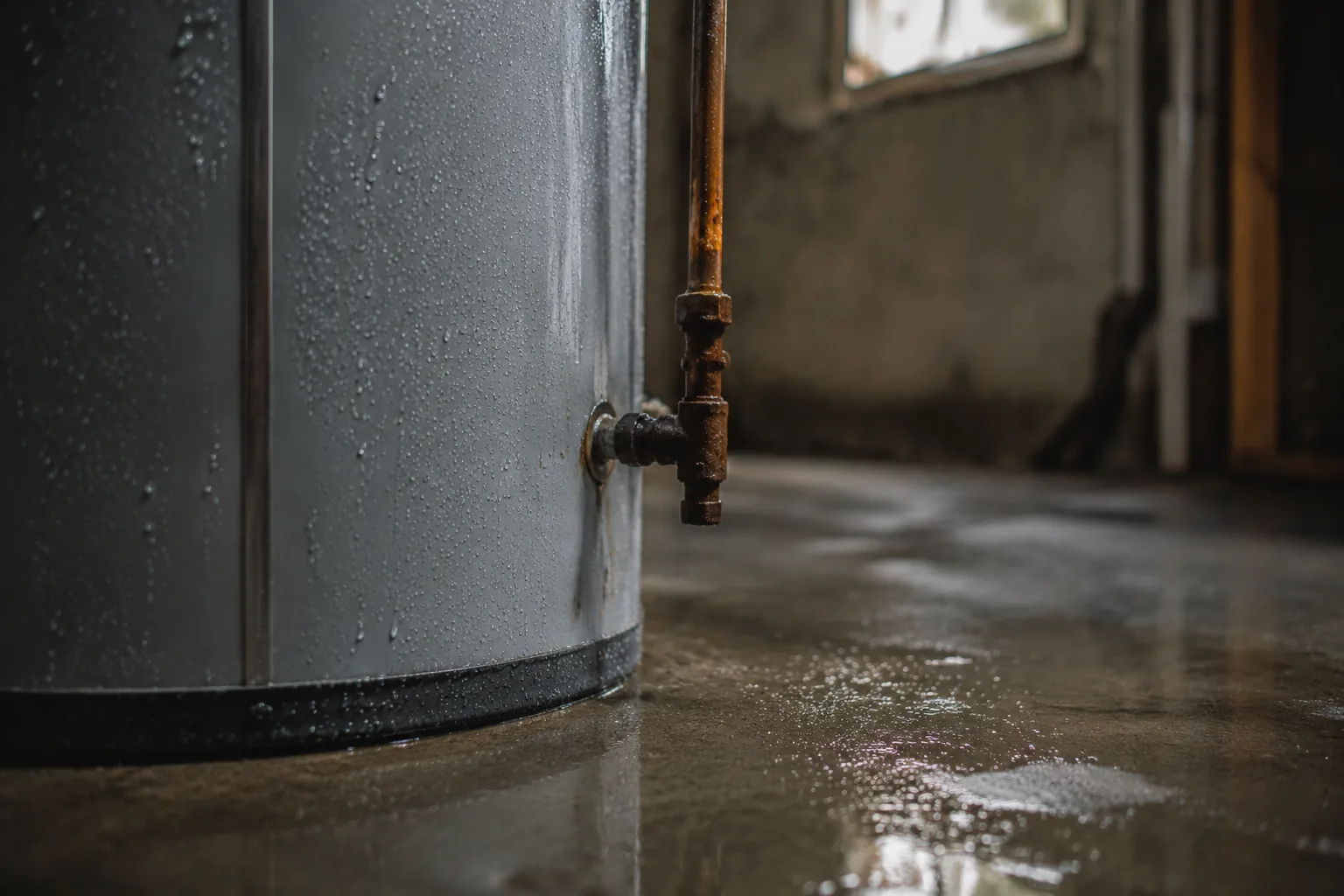
That water often condensed out of the air onto a cold steel surface, the same way a glass of iced tea sweats on a July afternoon. Telling those two apart is the whole job, because one costs a towel and the other costs a new heater. The clues are specific, and once you know them you rarely have to guess. And there is a third source people forget: if a high-efficiency furnace shares the mechanical room, its condensate line can drip several gallons a day onto the same slab, then run over to pool under the heater, where it gets blamed on the wrong appliance.
Why a water heater sweats in the first place
Condensation is physics, not a fault. Cold water from the street or a well flows into the tank and cools the steel shell. Warm, moist room air touches that cold surface, drops below its dew point, and gives up its water as a film of tiny beads. You see it most when the gap between the room and the tank is largest: a brand-new tank still full of cold water, a big draw of hot water that pulls in a slug of cold refill, a cold basement in a humid climate, or the muggy stretch of summer when the air is loaded with moisture.
The tell is that it is temporary. As the burner or elements heat the water, the tank shell warms up, climbs back above the dew point, and the beads evaporate. Once the stored water passes about 110°F the sweating stops on its own, which is one reason a heater set below that, or a brand-new unit still filling with cold water, sweats the hardest. Condensation that was dripping at 7 a.m. is often bone dry by noon. It is also spread out: sweating coats the whole tank in an even haze of fine droplets, top to bottom, rather than running from one seam or fitting. And the total volume is small, usually well under a cup a day, enough to dampen the floor but not to form a spreading puddle.
Two everyday fixes cut condensation without touching the tank itself. Nudging the thermostat up toward the recommended 120°F keeps the shell warmer between draws so it beads less. Insulating the cold-water inlet line and, in a chronically damp basement, running a dehumidifier lowers the moisture in the room air that feeds the sweat. None of that applies to a real leak, which is exactly why the distinction is worth ten minutes of your time.
Gas heaters add a wrinkle. During the first minutes of a burn on a tank full of cold water, combustion can drip condensate off the flue and burner area, which sizzles on the hot metal. That is normal on startup and stops once the tank is hot. Homeowners often mistake this startup sizzle for a leak in the burner chamber, when it is just the same dew-point effect happening inside a hot box.
What a real leak looks like
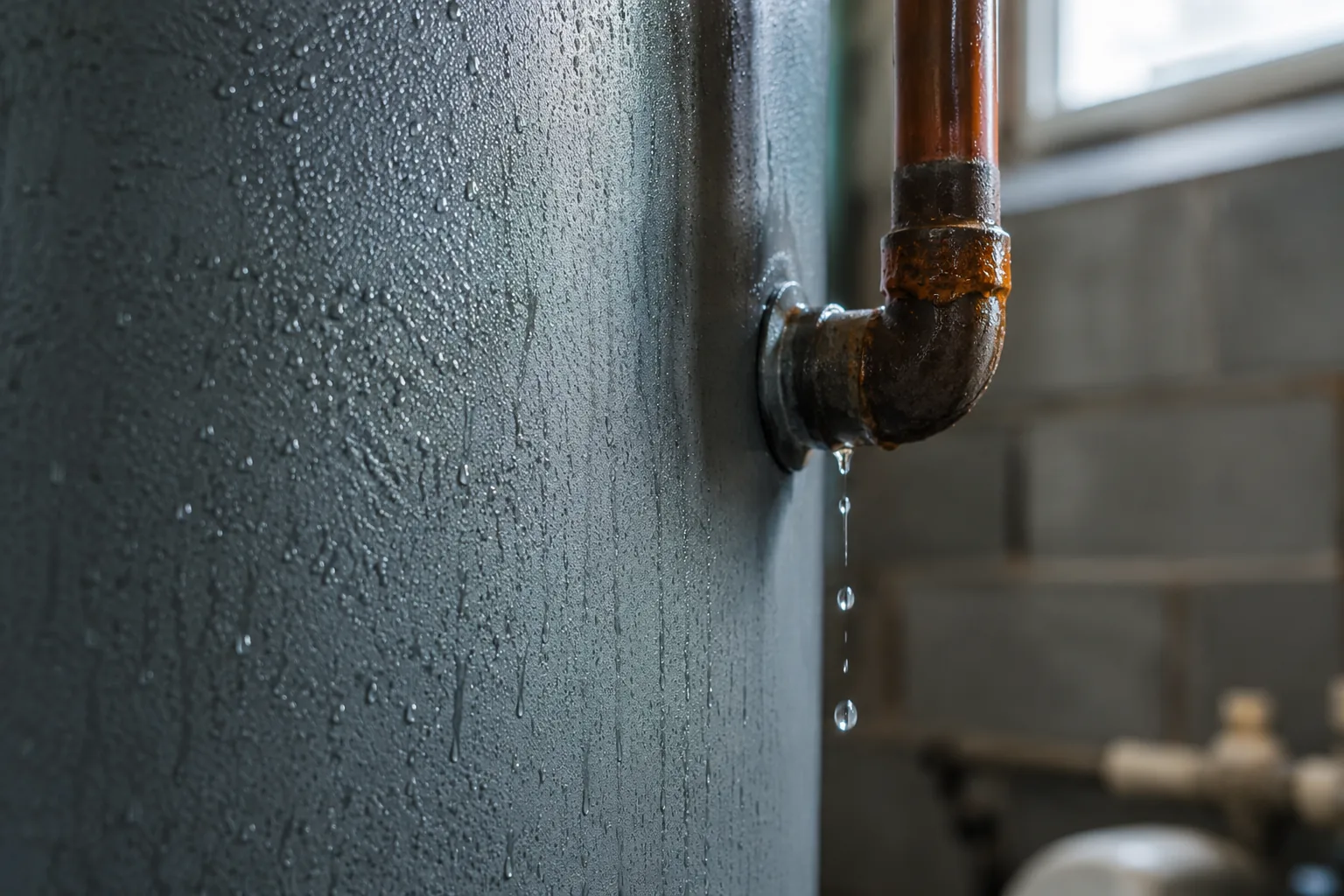
A leak behaves in the opposite way on every count. It does not dry up as the water heats; if anything it runs faster, because a hot, full tank puts more pressure on a failing joint or a corroded wall. It is not evenly spread; it traces back to a single source you can point at. And it does not stay small: a real leak grows, so a puddle that is bigger today than yesterday is a leak, not sweat.
The color of the water tells you a lot. Clear water from a fitting or a valve is usually a mechanical problem you can fix. Rusty, brown, or sediment-laden water coming from the body of the tank is the bad one. That rust is the inside of the tank corroding through, and there is no patch for it; once the steel is perforating, the tank is finished. If you wipe up the water and it leaves a reddish stain, treat that as a serious sign, not a nuisance.
The ten-minute test that settles it
Guessing from a wet floor is unreliable, so do not. Run a simple test instead. First, dry everything: wipe the entire tank down with a rag, top to bottom, and mop the floor completely dry. Second, lay a dry paper towel or two on the floor under the spot where water was pooling, and tuck a folded paper towel around any suspect fitting. Third, leave it alone through one full heating cycle, an hour or two, and come back.
Now read the result. If the tank films over again with an even haze of fine droplets and the paper towels stay dry, you are looking at condensation. If a paper towel under one specific point soaks through while the rest stay dry, you have found a leak and its source. Watching where the water returns first is the key move: condensation returns everywhere at once, a leak returns from one place. Do this before you touch a wrench, because it turns a vague worry into a specific address. If the towels stay dry but the floor keeps getting wet from the side of the room, follow the trail of water back; it may lead to a furnace condensate line, a floor drain backing up, or a sweating cold-water pipe overhead rather than the heater at all.
Where real leaks actually come from
Once the test says leak, the source narrows to a short list, and where it is decides whether you fix it or replace the heater. Work top to bottom.
The inlet and outlet nipples. The two threaded connections on top of the tank, where the cold-in and hot-out pipes join, loosen and corrode over the years. A small drip here runs down the outside of the tank and pools at the base, which fools people into thinking the bottom is leaking. Snugging the fitting or replacing a corroded nipple usually clears it. Look for water tracking down from the top before you condemn the tank.
The T&P valve. The temperature-and-pressure relief valve, with its little lever, sits on the top or upper side and has a discharge tube running down toward the floor. If water drips from that tube, the valve is either doing its job, relieving genuine excess pressure, or it has failed and is weeping. A valve that dribbles constantly needs replacing, but do not just cap it; if the tank is actually overpressured, that valve is your safety device. Persistent T&P discharge can point at thermal expansion and a missing or failed expansion tank.
The drain valve. Near the bottom, the drain valve, used to flush sediment, can weep if it is not fully closed or if its washer has aged. Try closing it firmly by hand first. A cheap brass hose cap threaded onto the outlet stops a slow drip while you plan a proper valve swap. This is a genuinely minor repair and no reason to replace a heater.
The tank bottom and seam. This is the verdict nobody wants. When water is genuinely welling up from underneath the tank, and especially when it comes rusty, the inner steel tank has corroded through at the bottom or along a welded seam. There is no repair. Sealants, epoxy, and clamps do not hold on a pressurized tank, and a bottom that is leaking today will split wider tomorrow. A leaking tank bottom means order a new water heater and shut this one down before it fails all at once and floods the floor.
What to do while you decide
If the test points at a leak and you are not sure how fast it is moving, take the pressure off. Shut the cold-water supply valve at the top of the heater to stop feeding the tank. For an electric unit, switch off its breaker; for gas, turn the control knob to pilot or off. That halts the heating and drops the internal pressure, which slows most leaks and buys you time to line up a repair or a replacement without a surprise flood.
For condensation, the fix is comfort, not urgency. Wipe the tank, dry the floor, and address the room if it is damp: better ventilation, a dehumidifier in a wet basement, or insulating the cold-water line so it does not sweat can all cut down the beading. A tank blanket on the cold shell reduces surface condensation too. None of this is an emergency; it is housekeeping around a heater that is working fine.
The line that decides repair versus replace
Everything comes back to one question the test answers for you: is water coming out of a fitting, or out of the tank? A fitting, a valve, or a nipple is a bounded, cheap repair, and plenty of heaters run for years after one. Water coming from the body of the tank, welling up from the bottom, or running rusty is the tank itself giving up, and that is terminal. Age tips the call: if a leaking tank is past ten or twelve years, replace it rather than chase small repairs, because the corrosion that opened one hole is already working on the next. When the paper towel soaks through at the seam, you are not troubleshooting anymore; you are shopping.
Frequently asked
How do I tell if my water heater is leaking or just condensating?
Dry the whole tank and the floor, then put a dry paper towel under the wet spot and wait through a heating cycle. Condensation comes back as an even film of fine droplets over the whole tank and dries up as the water heats. A leak returns from one specific point, a fitting, valve, or the tank bottom, and gets worse, not better. Where the water reappears first is the answer.
Is it normal for a water heater to sweat?
Yes. Cold incoming water cools the steel shell, and warm, humid room air condenses on it as small beads, exactly like a cold glass sweating in summer. It is most common on a new tank, right after a big hot-water draw pulls in cold refill, in a cold basement, and during humid weather. It dries up once the tank warms, and the total is usually well under a cup a day.
Why is my water heater leaking only in summer?
That pattern almost always means condensation, not a leak. Summer air holds far more moisture, so it condenses heavily on the cold tank surface and drips to the floor, then vanishes when the season cools or the water heats. A true leak does not care about the season and keeps growing. Run the paper-towel test to confirm, and consider a dehumidifier if the basement is damp.
My water heater is leaking rusty water. Is that bad?
Yes, that is the serious one. Clear water from a fitting or valve is usually a fixable mechanical problem. Rusty, brown water coming from the body of the tank means the inner steel is corroding through, and there is no repair for a perforating tank. Plan on replacing the heater, and shut off its water and power to limit the mess while you arrange it.
Where do water heater leaks usually come from?
Top to bottom: the inlet and outlet nipples where the pipes connect, the temperature-and-pressure (T&P) relief valve and its discharge tube, and the drain valve near the base. Those three are bounded, inexpensive repairs. The one that is not fixable is the tank bottom or a welded seam, where water wells up from underneath. That means the tank has corroded through and needs replacing.
Can I fix a leaking water heater tank myself?
It depends on where it leaks. A loose nipple, a weeping T&P valve, or a dripping drain valve are all real DIY repairs with a wrench and a cheap part. But a leak from the tank body or bottom cannot be fixed; sealants and clamps do not hold on a pressurized tank, and it will only get worse. If the water is welling up from underneath, especially rusty, replace the heater rather than patch it.