The water heater in the ad and the water heater on your invoice are rarely the same number. Across the 2026 cost guides the unit itself is only about 30 to 50 percent of what you pay, and the rest is labor plus the quieter line items: a bigger gas pipe, a fresh vent, a dedicated circuit or a whole new panel, a permit and an inspection. That is why a gas tankless can quietly double the cost of the gas tank it replaces, and why the cheapest box on the shelf, an electric tank, is also the cheapest day of work. This page prices each of the five common types the way a good installer would: unit, labor, and the modifications the switch actually triggers.
Cheaper to install
- Electric tank: about $600-$2,000 installed. No gas, no flue, usually a same-spot swap.
- Gas tank: about $900-$3,000 installed. Adds a gas connection and a vent; 40-50 gal jobs often land near $1,650-$2,000.
- Both are like-for-like swaps, which is why they run short and predictable.
More to install
- Electric tankless: about $1,200-$3,000, before any panel upgrade.
- Heat pump (hybrid): about $2,500-$6,500 installed; needs air volume and a condensate drain.
- Gas tankless: about $2,100-$5,600, and $5,500-$8,000 when the gas line has to grow.
The verdict
A like-for-like electric or gas tank is the cheapest install, roughly $600 to $3,000 all in. Tankless and heat pump units cost more not because the box is dramatically pricier but because of what they demand behind the wall: a fatter gas line, new venting, or a bigger electrical panel. Price the modifications, not just the unit, and get itemized quotes, because labor at $45 to $200 an hour is where two bids for the same heater diverge.
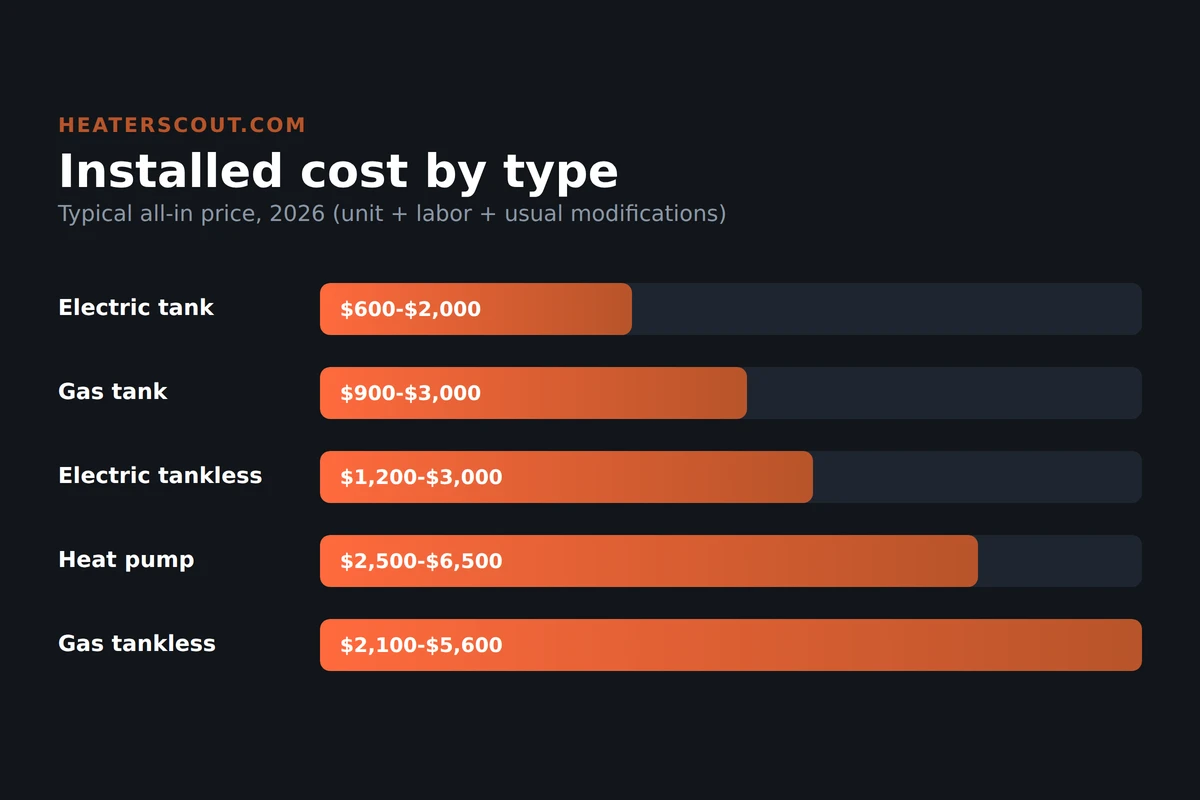
The five types, priced the way an installer quotes them
Every quote is really three numbers stacked together: the unit, the labor, and the modifications the switch forces. A like-for-like swap keeps the third number near zero, which is why tanks are cheap. Change fuel, change technology, or move the heater, and that third number is where the money goes. Here is each type with its own stack.
Electric tank: the floor
An electric storage tank is the least expensive water heater to install, roughly $600 to $2,000 all in, with the unit itself around $400 to $900. There is no gas line to feed and no combustion vent to route, so a replacement usually drops into the same spot on the same water and power connections. Labor is short, two to three hours for a clean swap. The only common add-ons are an expansion tank where local code requires one and a drain pan if the heater sits where a leak would do damage. It is the cheapest to install and, notably, usually the most expensive to run, which is the whole reason heat pump units exist.
Gas tank: a little more for the flue and the gas
A gas storage tank runs about $900 to $3,000 installed, with common 40 and 50 gallon jobs landing near $1,650 to $2,000. The unit is roughly $400 to $1,200. The extra over an electric tank buys the gas connection and the venting: an atmospheric gas heater vents its exhaust up a flue, and if that flue is fine, the swap stays cheap. Power-vent models cost more because they add a blower and PVC venting, but they let you put the heater where a natural draft flue cannot reach. Labor is typically two to four hours. This is still a like-for-like swap in most homes, so the modifications stay small.
Electric tankless: cheap unit, sometimes expensive panel
An electric tankless installs for about $1,200 to $3,000 on its own, which makes it look like a bargain against gas. The catch is amperage. A whole-house electric tankless can draw 80 to 150 amps, and many older homes simply do not have the panel capacity for that. Adding a dedicated circuit is $250 to $900; upgrading the service from 100 to 200 amps is $850 to $1,700, and some whole-house jobs push the electrical work to $1,000 to $2,500. Once the panel is priced in, the cheap electric unit can cost as much as a gas one. It shines in point-of-use roles and in homes that already have the electrical headroom.
Gas tankless: the ceiling, driven by gas and venting
A gas tankless is the most variable install on the list, roughly $2,100 to $5,600, and higher when the infrastructure fights it. A like-for-like gas swap where the existing line and vent already suit the unit runs about $3,500 to $5,500. But a tankless burner fires far harder than a tank burner, so it often needs the gas line upsized to three-quarter or one inch, which adds $350 to $2,000 and can push the whole job to $5,500 to $8,000. It needs its own venting too, category-appropriate stainless or PVC, at $100 to $600, plus $200 to $600 if that vent has to cross a finished wall. Add a recirculation loop or a condensing unit and premium installs reach $7,000 to $10,000.
Hybrid heat pump: mid-to-high, but chasing rebates
A hybrid heat pump water heater installs for about $2,500 to $6,500, with the average landing near $3,000 to $4,200. It is an electric unit, so no gas or flue, but it has its own site demands: it pulls heat from the surrounding air, so it wants a spot with enough air volume, and it produces condensate, so it needs a drain or a pump. Some installs need an electrical tweak, another $600 to $2,000 depending on the panel. The offset is real: federal and utility rebates frequently cut a large slice off the total, and the unit runs on roughly half the energy of a resistance tank, so the higher install is a bet on lower bills.
| Type | Unit only | Installed total | What drives the extra |
|---|---|---|---|
| Electric tank | $400-$900 | $600-$2,000 | Little; same-spot swap |
| Gas tank | $400-$1,200 | $900-$3,000 | Gas connection, flue vent |
| Electric tankless | $500-$1,500 | $1,200-$3,000 | Dedicated circuit or panel upgrade |
| Heat pump (hybrid) | $1,200-$3,500 | $2,500-$6,500 | Condensate drain, air volume, wiring |
| Gas tankless | $600-$1,800 | $2,100-$5,600 | Gas line upsize, dedicated venting |
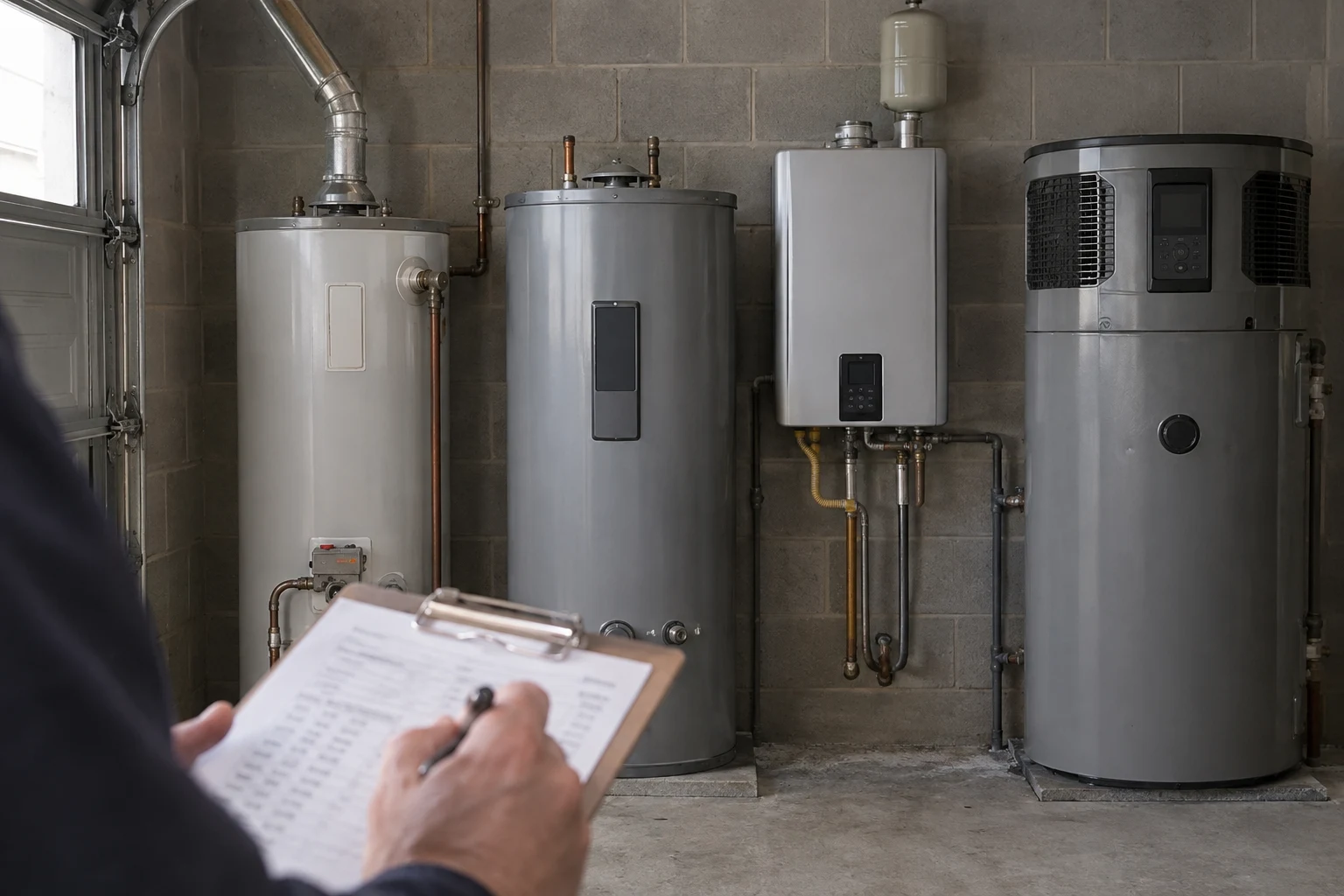
The cost drivers, priced separately
When two quotes for the identical heater differ by a thousand dollars, one of these line items is usually the reason. None of them is optional if your install triggers it, and each one is a place a lowball quote may be quietly hiding a corner it plans to cut. The bar below shows how much each common driver can add.
Venting is the one people forget on gas jobs. A same-fuel tank swap usually reuses the existing flue, but a switch to power-vent or to a tankless means new, category-appropriate pipe, $100 to $600, and more if it has to penetrate a finished wall. The gas line is the tankless surprise: a tank burner and a tankless burner do not draw the same volume of gas, so the pipe that fed the tank often cannot feed the tankless, and upsizing it runs $350 to $2,000. On the electric side, the mirror image is the panel: a resistance tankless or, less often, a heat pump can need a dedicated circuit at $250 to $900 or a full service upgrade at $850 to $1,700. The permit, $25 to $300, is the cheapest line on the list and the one worth keeping, because it buys the inspection that catches a bad vent or an undersized line.
Which one to buy for the money
Cheapest to install and cheapest to own are not the same heater, and the right pick depends on your fuel, your install spot, and how long you plan to stay. Here is the short version by situation.
Like-for-like tank
Replacing a gas tank with a gas tank, or electric with electric, is the cheapest honest path: $600 to $3,000, no new venting, gas line, or panel work, and a two-to-four-hour job.
Tankless, if the utilities fit
A tankless frees up floor space and never runs out. Worth it when your gas line and vent already suit it, or your panel has headroom. If they do not, the modifications can outweigh the benefit.
Hybrid heat pump
Higher install, $2,500 to $6,500, but roughly half the running cost of a resistance tank, and rebates often close the gap. Best in a roomy, warm garage or basement with a drain.
One habit protects you across all of these: get two or three itemized quotes, and read the line items, not just the bottom number. A quote that lists the permit, the expansion tank, the correct venting, and the labor hours is a quote you can trust. A round number with no breakdown is a quote that might be planning to skip the permit or reuse a vent it should replace. The unit is the easy 30 to 50 percent. The rest of the invoice is where a good installer earns the difference, and where a cheap one hides the shortcut you will pay for later.
Frequently asked
How much does it cost to install a water heater in 2026?
It depends almost entirely on the type and on whether your existing gas, electric, and venting can carry the new unit. Across the 2026 cost guides, a like-for-like tank swap is the cheapest path: an electric tank runs roughly $600 to $2,000 installed and a gas tank about $900 to $3,000, with most 40 to 50 gallon jobs landing near $1,650 to $2,000. Tankless and heat pump units cost more because of the extra work behind them. An electric tankless is about $1,200 to $3,000 before any panel upgrade, a gas tankless runs $2,100 to $5,600 and higher if the gas line has to grow, and a hybrid heat pump is roughly $2,500 to $6,500 installed. The single biggest reason two quotes for the same unit differ is labor, which ranges from about $45 to $200 an hour by region.
Why does a tankless water heater cost so much more to install than a tank?
Because the unit price is only part of the story, and often the smaller part. A gas tankless usually needs a larger gas supply line to feed its high burner rate, and upsizing that line to three-quarter or one inch runs $350 to $2,000 on its own. It also needs its own stainless or PVC venting, which adds $100 to $600, and more if it has to run through a finished wall, another $200 to $600. An electric tankless draws so much current that many older homes need a dedicated circuit or a full panel upgrade first, which adds $1,000 to $2,500. Stack those on top of the unit and four to eight hours of skilled labor and the reason the total climbs becomes clear: you are not just swapping a box, you are rebuilding the utilities that feed it.
Is a heat pump water heater worth the higher install cost?
For many homes, yes, but the math is about operating cost and rebates, not the sticker. A hybrid heat pump water heater installs for roughly $2,500 to $6,500, noticeably more than a plain electric tank, and it needs a spot with enough air volume, a condensate drain, and sometimes an electrical tweak. What you get back is efficiency: a heat pump moves heat instead of making it, so it can cut water heating energy use by half or more against a resistance tank. Federal and utility rebates often knock a large chunk off the install, which is what closes the gap. If you have a warm, roomy install spot like a garage or basement and you plan to stay in the home several years, the payback usually lands. In a tiny cold closet with no drain, the premium is harder to justify.
What does a permit cost for a water heater install, and do I need one?
Most jurisdictions require a plumbing or mechanical permit to replace a water heater, and skipping it can bite you at resale or if an insurance claim ever hinges on the work being to code. The fee is modest compared to the job: figure $25 to $300, often a flat amount set by your city or county. A licensed installer normally pulls the permit and folds it into the quote, and the permit buys you an inspection that checks the gas connection, the temperature and pressure relief line, the venting, and the seismic strapping where that applies. On gas and tankless jobs especially, that inspection is worth having, because a bad vent or an undersized gas line is a safety issue, not just a code note.
How much of the bill is labor versus the unit itself?
Across the 2026 guides the unit is commonly 30 to 50 percent of the total, and labor plus the modifications make up the rest. Plumbers charge somewhere between $45 and $200 an hour depending on region, with high-cost states like California and New York at the top of that band. A straight tank swap takes about two to four hours, so labor alone often runs $150 to $450 on a simple job. A tankless or heat pump install takes longer, four to eight hours, and pulls in trades you might not expect, like an electrician for a panel upgrade. That is why the cheap-looking unit is not always the cheap job: an electric tankless can cost as much as a gas one once the panel work is priced in.
Can I lower the installed cost, and where should I not cut corners?
You can trim the total honestly in a few places and you should never trim it in others. Fair savings: replace like for like so no new venting, gas line, or panel work is triggered; keep the same location so the plumbing and gas runs do not move; and get two or three itemized quotes, since labor is where the spread lives. Chase rebates on heat pump units, which can be substantial. Where not to cut: the permit and inspection, the temperature and pressure relief valve and its discharge line, the expansion tank where code requires one, and correct venting on any gas unit. Those are the parts that keep the appliance from becoming a hazard, and they are a small share of the bill.
Which water heater type is cheapest to install?
A standard electric tank, replaced like for like. It has no gas line to feed, no combustion venting to route, and it typically drops into the same spot with the same connections, so the labor is short and the modifications are few. That is why its installed range, about $600 to $2,000, sits below every other type. A gas tank is next, a little more because of the gas connection and the flue, at roughly $900 to $3,000. The catch is that cheapest to install is not the same as cheapest to own: an electric resistance tank is usually the most expensive to run, which is exactly the gap a heat pump unit is built to close over its life.