The red button behind your water heater's upper panel only pops when tank water has climbed past about 180 degrees. That is the whole story in one sentence: the high-limit, the ECO, the energy cutoff, whatever the label calls it, is a thermal switch that yanks power the instant the water gets dangerously hot. So when it trips, the question is never the button. It is what heated the water that far in the first place. Push it back in blindly and you re-arm a safety that will fire again in an hour, because a grounded element or a stuck thermostat is still doing exactly what tripped it.
Read this before you touch the button
The high-limit is the last safeguard between you and scalding water at real pressure. It earns one reset to rule out a one-time fluke. After that, a repeat trip is a diagnosis, not a nuisance. Here is the short list of what is actually behind it, and what to check before you spend a dime.
- Confirm the trip: no hot water at all (the ECO cuts both elements), red button popped out on the upper thermostat.
- Kill the breaker first. The wiring behind the panel is live at 240 volts, verify dead with a non-contact tester.
- Suspect a grounded or shorted heating element first, it is the most common repeat cause.
- Check the thermostat for stuck-closed contacts, it never tells the element to quit.
- Look at the easy stuff: setpoint dialed too high, heavy sediment, loose or burnt wiring.
- On gas, the equivalent is the TCO on the burner door, and airflow (flame arrestor, venting) is the usual cause.
- Reset only ONCE. If it trips again, leave it off and test with a meter or call a pro.
Quick answer
A tripped high-limit switch means tank water passed roughly 180 degrees and the ECO cut power to protect you. On an electric heater, reset it once by shutting the breaker, opening the upper access panel, confirming no voltage, and pressing the red button on the upper thermostat until it clicks. If it trips again, the real cause is almost always a grounded heating element or a thermostat stuck closed, which you diagnose with a multimeter, not by resetting. On a gas heater the analogous part is the thermal cutoff (TCO) on the burner manifold door, and a trip there points at starved combustion air, not the elements.
The cause split, most likely first
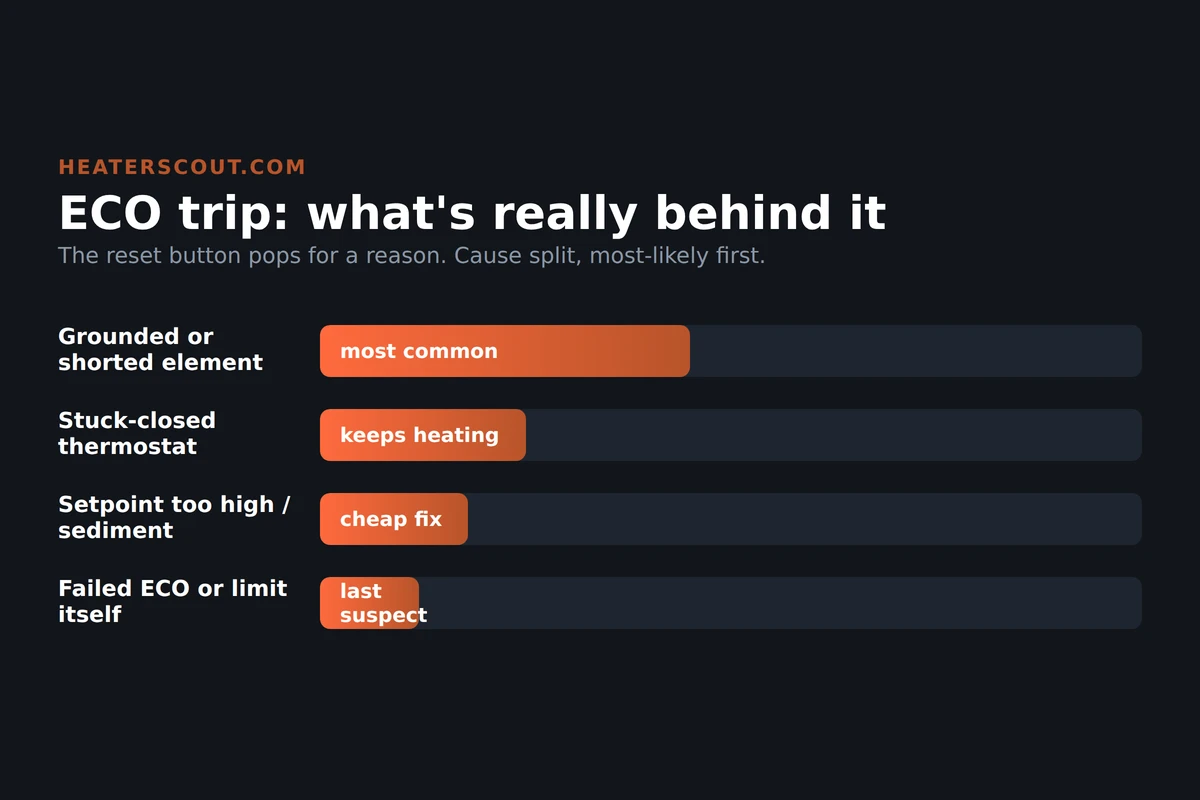
Every repeat trip comes down to something making heat after the thermostat should have said stop. The chart below is the order a service tech works through, and it is worth internalizing because it saves you from replacing a good thermostat when the element is the culprit.
Reset it right, once
Done correctly the reset takes five minutes and tells you a lot. If heat comes back and stays, you had a one-time event. If it trips again within the hour, you have confirmed a real fault and it is time for the meter. Follow the sequence exactly, and do not skip the voltage check.
Reset once, never override
Never reset a high-limit more than once to force the heater back on, and never jumper it, replace it with a higher-rated part, or bypass a gas TCO. The ECO is the last line before scalding water and dangerous pressure. A button that keeps popping is protecting you from a grounded element that is still cooking the tank. Reset once to confirm a repair worked, never as the repair itself.
Electric ECO versus gas TCO
People carry the electric mental model onto a gas heater and go hunting for a red button that is not there. The two safeties do the same job, cut the heat when things overheat, but they sense different things. The electric ECO rides on the upper thermostat and watches water temperature, opening near 180 degrees and cutting the 240-volt feed to both elements. It has a reset button. The gas thermal cutoff, the TCO, sits on the burner manifold door and is really a combustion-air safety. It opens when the burner area overheats, and the usual reason is starved air: a flame arrestor screen at the base of the tank clogged with lint and dust, a blocked draft hood, or side vents choked with debris. Clear that airflow cause first. Many one-shot TCOs are not resettable and must be swapped, and a new one will trip again in minutes if the screen is still plugged.
One more gas wrinkle worth knowing: on power-vent and electronic gas models a tripped TCO or pressure switch often shows up as a specific status-light behavior, such as three flashes or no status light at all, rather than a mechanical button. Read the flash count off the burner-door chart before you assume the TCO, because a blocked vent and a failed blower can present the same way.
When to replace what, and when to replace the heater
The tests point to one of three parts. A grounded or shorted element gets replaced, which means draining the tank, pulling the old element with an element wrench, and seating a new one with a fresh gasket, a 10 to 20 dollar part. A thermostat stuck closed or a failed ECO gets a new upper thermostat, the T-O-D style with the reset button built in, about 18 to 27 dollars, and no tank draining needed. A gas TCO is a 20 to 40 dollar kit on the manifold door. If you hand the whole job to a plumber, budget 150 to 350 dollars with labor, higher when a grounded element forces a full drain.
Weigh that against the tank's age. An element grounds out most often because the tank is corroding from the inside, and on a heater past 10 or 12 years that is a sign the tank itself is near the end. Sinking 300 dollars of labor into a heater that will leak next winter is money you would rather put toward the replacement. If the unit is young and the fix is a cheap thermostat, repair it and move on.
Key takeaways
- The high-limit (ECO on electric, TCO on gas) trips when water or the burner passes its safety limit near 180F.
- The button is never the problem, something heated the water that far. A grounded or shorted element is the top repeat cause.
- Reset ONCE to rule out a fluke. A second trip is a diagnosis: leave it off and test.
- Test with a multimeter: continuity from any element terminal to bare tank metal means a grounded element, replace it.
- Electric ECO points at elements, thermostats, wiring. Gas TCO points at starved combustion air and venting.
- Parts are cheap ($10-40); pro labor runs $150-350. On a 10-plus-year tank, weigh repair against replacement.
Frequently asked
Where is the reset button on my water heater?
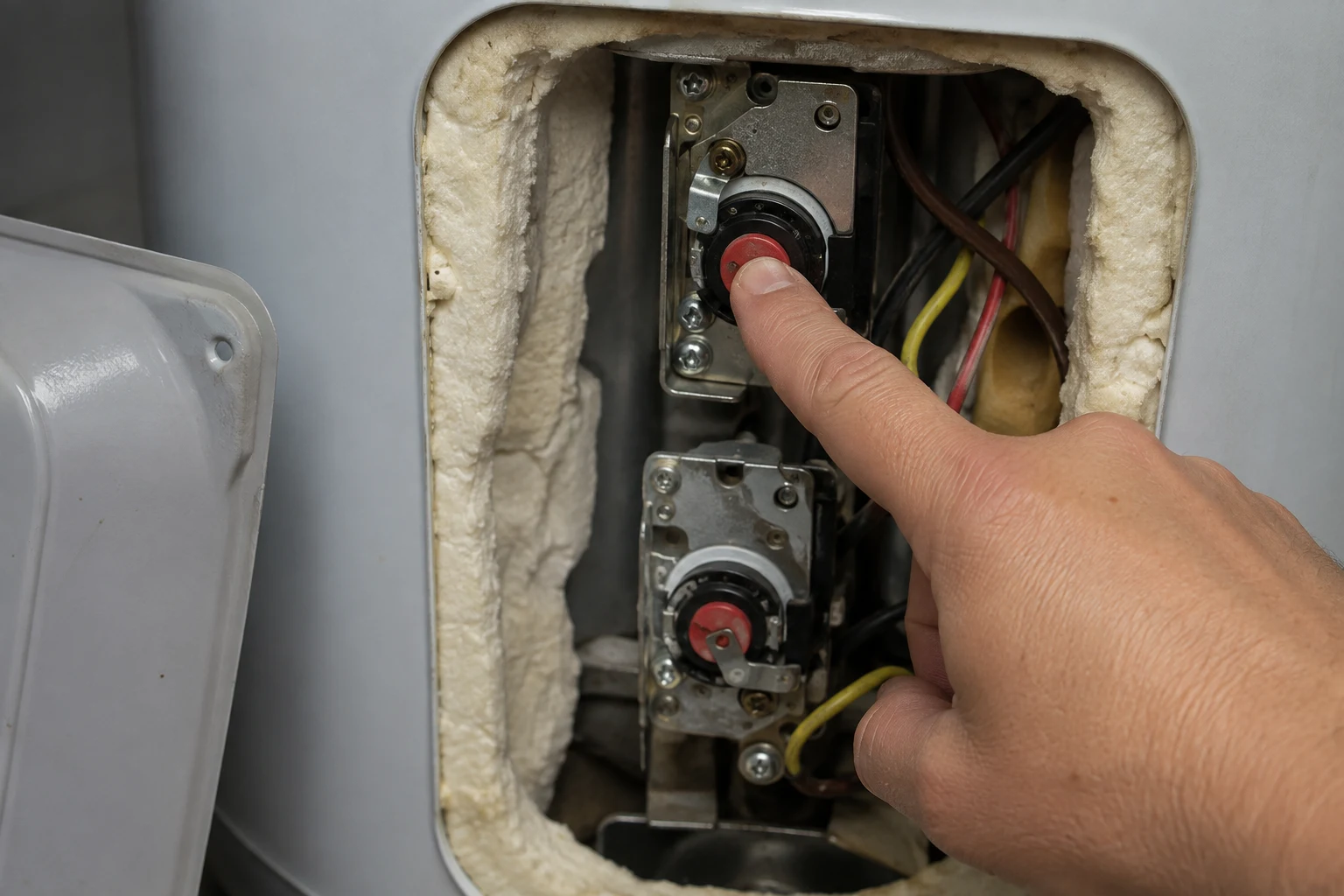
On an electric tank it is a small red button on the upper thermostat, hidden behind the upper access panel and a layer of insulation. Pop the panel with a nut driver, fold the insulation and the plastic safety cover out of the way, and you will see the thermostat with the red button at the top. That button is the ECO, also called the high-limit or energy cutoff. On a gas water heater there is no red ECO button of that kind. The equivalent safety is the thermal cutoff, or TCO, on the burner manifold door, and depending on the model it either has a small reset button in the middle of it or is a one-shot part that gets replaced rather than reset. Before you open any electric panel, shut the breaker off and confirm it is dead with a non-contact tester. The wiring behind that cover is live at 240 volts when the breaker is on.
Why does my water heater reset button keep tripping?
The ECO only opens when the water actually gets past about 180 degrees, so a repeat trip means something is heating the tank when it should have stopped. The most common cause is a heating element that has grounded or shorted, meaning current leaks to the tank steel and the element keeps making heat even after the thermostat opens its contacts. Second is a thermostat stuck closed, which never tells the element to stop. After those come a setpoint dialed too high, a thick sediment layer that traps heat and confuses the sensor, loose or burnt wiring, and, less often, hot and cold lines crossed at the top of the tank so hot water feeds back through the cold inlet. A failed ECO that trips on its own is the last thing to suspect, not the first. Resetting again and again does not fix any of these, it just re-arms the safety until the next overheat.
Can I reset a tripped high-limit switch myself?
Yes, resetting it once is fine and is a normal homeowner step. Kill the breaker, open the upper panel, confirm no voltage, move the insulation and cover aside, and press the red button firmly until you feel or hear a click. Restore power and give it 30 to 60 minutes to reheat. What you should not do is reset it a second and third time when it trips again. The high-limit is the last safety before scalding water and excess pressure, so a repeat trip is the heater telling you a real fault is present. At that point the correct move is to leave it off and test the elements and thermostat with a multimeter, or call a plumber, rather than keep pushing the button. On a gas unit, do not defeat or jumper a tripped TCO to force the burner to run.
How do I test whether the element or the thermostat is the problem?
You need a multimeter and the breaker off. First test each element for a ground fault: set the meter to ohms, put one probe on an element terminal screw and the other on the bare metal of the tank or a mounting bolt. A healthy element reads open, no continuity, to ground. Any low resistance or a beep on continuity means the element is grounded and must be replaced. Next read across the two terminals of each element: a typical 4500-watt, 240-volt element reads around 12 to 16 ohms. Infinite reading means it is burnt out and open, a near-zero reading means it is internally shorted. For the thermostat, with power off you can check that its contacts open and close as the temperature dial moves and that it is not welded closed. If the element grounds to the tank, that is your answer and no amount of thermostat swapping will fix it.
How much does it cost to fix a water heater that keeps tripping the ECO?
The parts are cheap, the labor is where the money goes. An upper thermostat with the built-in ECO, the T-O-D style that fits most residential electric tanks, runs about 18 to 27 dollars at a home center. A heating element is roughly 10 to 20 dollars. A gas thermal cutoff kit is usually 20 to 40 dollars. If you do the work yourself the whole repair is often under 40 dollars in parts. Bringing in a plumber to diagnose and replace a thermostat or element typically lands in the 150 to 350 dollar range including labor, and a grounded element that means draining the tank sits at the higher end. Compare that against the age of the heater: if the tank is past 10 or 12 years and the element grounded because the tank is corroding, the repair money is often better spent toward a replacement.
Is it dangerous when the high-limit switch trips?
The trip itself is protection working correctly, not the danger. The high-limit exists because an unchecked element or a stuck thermostat can drive tank water well past 180 degrees, which scalds in seconds and raises internal pressure against the T&P relief valve. When the ECO opens, it has caught exactly that condition and shut the heat off. The dangerous behavior is a person overriding it: resetting repeatedly, jumpering the switch, or replacing an ECO with one rated higher to make the trips stop. Doing that removes the last safeguard while the real fault, usually a grounded element, is still cooking the water. If you ever get water noticeably hotter than your setpoint, hear rumbling, or see the T&P valve weeping, treat it as urgent and leave the heater off until the cause is found.
What is the difference between the ECO on an electric heater and the TCO on a gas heater?
They do the same job, cut the heater off when things get too hot, but they watch different things and live in different places. The electric ECO is a temperature limit riding on the upper thermostat, sensing water that has gotten too hot, usually around 180 degrees, and it cuts the 240-volt power to both elements. It has a red reset button. The gas thermal cutoff, or TCO, sits on the burner manifold door and is really an air-and-combustion safety: it opens when the burner area overheats because combustion air is starved, often from a clogged flame arrestor screen at the base, a blocked draft hood, or vents choked with lint. So an electric ECO trip points you at elements, thermostats and wiring, while a gas TCO trip points you at airflow and venting first. Clear the airflow cause before you replace a TCO, or the new one trips too.
Why is there no hot water at all after the reset button tripped?
Because the ECO cuts power to both elements at once, not just the one nearest it. The upper thermostat carries the high-limit and it feeds the rest of the circuit, so when it opens the whole heater goes cold, not lukewarm. That is why a tripped ECO gives you a tank of cool water rather than a half-hot one. It is also how you can tell an ECO trip from a single dead lower element, which usually leaves you with a short burst of hot water that runs cold fast. If you have zero hot water and you find the red button popped out, resetting it once should restore heat within an hour. If heat does not come back, the element or thermostat is the fault and the meter tests above are the next step.