Put your ear near the top of a gas or electric tank on a quiet night and you may hear a faint tick, tick, tick. It is not the burner and it is not sediment popping. It is a loose plastic ball rattling inside a heat-trap nipple, one of two fittings screwed into the cold inlet and hot outlet ports on top of the tank. They exist to stop hot water from silently creeping up your pipes and throwing away heat around the clock, and they are why modern tanks post better efficiency numbers than the ones your parents owned. The ticking is the price a lot of tanks pay for the savings.
What a heat-trap nipple is doing up there
Hot water rises. That single fact drives the whole problem. In a tank with plain open nipples, the warm water in the hot outlet pipe drifts up into the house piping while cooler water slides down to take its place. The tank reheats it, the warm water drifts up again, and the cycle never stops. Plumbers call it thermosiphoning or the chimney effect. No tap is running, but the tank is quietly shipping heat up both lines and radiating it into the room. Over a month that convective standby loss adds up.
A heat-trap nipple kills the loop with a one-way checker. Inside the short steel nipple sits a small plastic or stainless ball, or on newer designs a hinged flapper, resting on a seat. Open a faucet and the moving water shoves the ball off its seat, passing through with almost no restriction. Close the tap and the ball settles back to block the upward creep convection drives. The cold-side and hot-side nipples pass flow in opposite directions, which is why orientation matters and why they are color coded.
| Trap type | How it works | Noise | Cost and effort | Best when |
|---|---|---|---|---|
| Ball-check nipple (factory) | Loose ball drops on a seat to block upward flow | Ticks as the ball shifts with pressure | Ships free on the tank; nothing to do | You do not mind the faint click |
| Flapper-style nipple | Hinged disc swings open on flow, falls shut at rest | Quiet, no loose ball to rattle | $8 to $20 a pair; swap both nipples | You want savings without the ticking |
| DIY piped loop | Pipe bends up, over, and down so convection cannot climb | Silent, no moving parts | Plain nipples plus fittings and an hour of pipe work | You have vertical room and insulate the loop |
The factory ball-check nipple is the default on most tanks built in the last twenty years, because it is cheap and it helped manufacturers pass the federal efficiency test. The trade-off is the noise. For a heater that already ticks, the choice is really between a quieter mechanical nipple and a piped loop with no mechanism at all.
Factory nipple versus a piped loop
Both stop convection. They differ in whether anything can wear out or rattle, and in how much room and effort they demand.
Factory heat-trap nipple
- Comes installed on nearly every modern Rheem, AO Smith, and Bradford White tank, so there is nothing to buy or build.
- Ball-check version can tick as pressure shifts the loose ball on its seat.
- Flapper version trades the ball for a hinged disc and is much quieter, and it drops in as a direct swap.
- Compact: the whole trap fits inside a short nipple, so it works even with no room above the tank.
- Many are dielectric lined to stop galvanic corrosion where copper meets the steel port.
DIY heat-trap loop
- No moving parts, so nothing rattles, wears out, or sticks open with scale.
- Uses gravity: the pipe climbs, crosses, and drops so warm water cannot convect over the hump.
- Needs roughly a foot of vertical clearance above the tank for the up-over-down bend.
- Must be insulated, or the extra pipe surface radiates back some of the heat the loop just saved.
- Pairs well with a plain dielectric nipple for a silent trap that outlives the tank.

Does your tank even have heat traps? Diagnose it first
Before you buy anything, figure out what is on the tank. Almost every unit made this century has factory heat traps, but the style varies and an older heater may have none. Run this quick check.
- Look for color-coded rings or plastic collars at the tank ports. Blue marks the cold-side nipple, red the hot-side, and that coding almost always means factory heat traps are fitted.
- Read the rating plate. If it lists an Energy Factor or Uniform Energy Factor and the tank is newer than the mid-2000s, it shipped with heat traps to meet that number.
- Listen on a quiet night. A faint tick or tap near the top ports points straight at a ball-check nipple doing its job.
- Feel the connecting pipes about a foot above the tank after an hour of no hot-water use. Warm pipe suggests convection is getting through; cool pipe suggests the trap is holding.
- Look for an up-over-down bend in the pipe at the tank. That is a piped heat-trap loop, and if it is there you likely have plain nipples underneath.
- Check the model number against the maker's spec. Bradford White, AO Smith, and Rheem publish whether a model uses ball-check or flapper nipples and whether they are dielectric lined.
Plain nipples and no loop means you are giving away that half-therm to therm a month. If you found ball-check nipples and the ticking is what sent you looking, the next section is the swap that quiets it.
Replacing a noisy heat-trap nipple
The ports sit at the very top of the tank, so you do not have to drain forty gallons to reach them. You do have to shut the water and relieve pressure, because the ports are full to the brim and dribble the moment a nipple breaks loose. Plan on an hour, most of it care rather than muscle, with both nipples in hand and oriented first.
Blue is cold in, red is hot out
Orientation is the one thing people get wrong. Heat-trap nipples are directional: the cold-inlet nipple lets water fall into the tank and blocks it from rising back out, and the hot-outlet nipple is the mirror image. That is why one is banded blue and the other red, and why many have a stamped arrow. Thread the hot nipple into the cold port and you can strangle your flow or defeat the trap entirely. Before you seal anything, confirm blue goes to the cold inlet and red to the hot outlet, arrows pointing the way water moves.
The savings, in real numbers
The reason any of this matters is standby loss. A tank keeps forty or fifty gallons hot around the clock, and every path that lets heat escape while nobody draws water is pure waste. Convection up the pipes is one of the bigger uninsulated paths. Blocking it saves roughly half a therm to a full therm a month on a gas tank, around $15 to $30 a year at typical residential gas rates, and a comparable figure in kilowatt-hours on electric. On its own that is modest. Stacked with a tank blanket, insulated pipe, and a sane thermostat setting, it is part of why a modern tank's Uniform Energy Factor beats a 1990s unit by a wide margin.
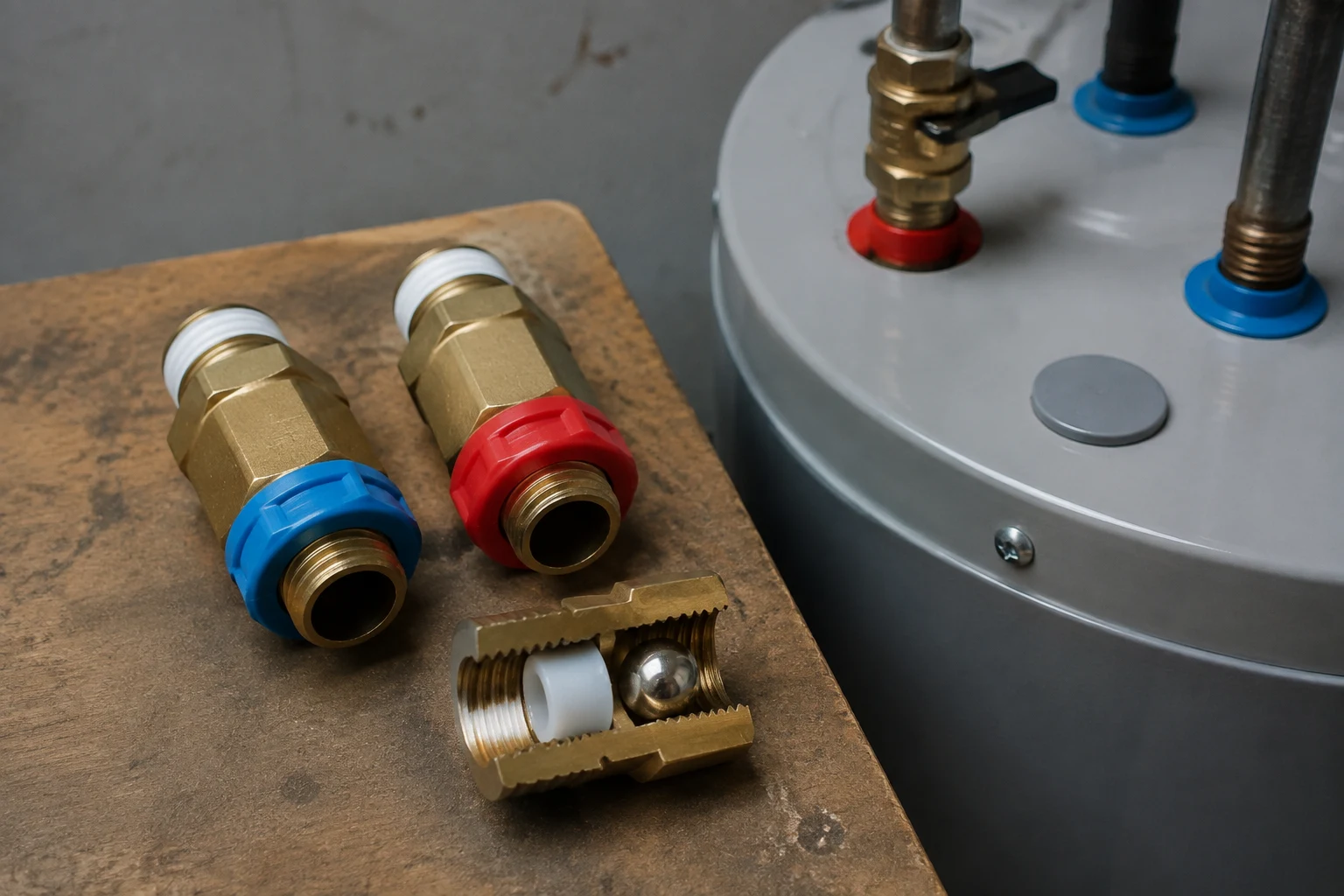
That is also why manufacturers standardized on them. Rheem, AO Smith, and Bradford White all fit factory heat-trap nipples, because the federal efficiency test measures this standby loss and the nipples are the cheapest way to shave it. The ticking is a known side effect of the ball-check design, and a flapper nipple or a piped loop buys the same savings without the sound. What you should not do is yank the traps and run plain nipples, because then you are paying that therm a month for silence you could have bought cheaply.
Frequently asked
What is a heat-trap nipple on a water heater?
It is a short threaded steel nipple that screws into the cold inlet and hot outlet ports on top of the tank, with a small plastic ball or a hinged flap sealed inside. Water flows through it normally when you open a tap, because the flow pushes the ball off its seat. The rest of the time the checker drops onto its seat and blocks water from drifting the wrong way up the pipe. The two nipples are color coded, blue for the cold inlet and red for the hot outlet, so you install each one facing the right way.
How much energy do heat traps actually save?
The convective loss they stop is worth roughly 0.5 to 1 therm per month on a typical gas storage tank, more on a tall tank in a cold basement with long uninsulated risers. Over a year that is on the order of $15 to $30, and a similar range in kWh on electric. It sounds small, but it runs every hour with nothing drawing hot water, which is exactly the standby loss that federal Energy Factor and the newer Uniform Energy Factor ratings measure. Manufacturers added factory heat traps largely to hit those numbers, so nearly every tank of the last couple decades has them.
Why does my water heater make a ticking or tapping noise?
The usual culprit is the ball inside a heat-trap nipple. Every time house pressure shifts or thermal expansion nudges the water column, the loose ball taps against its seat or the walls of the nipple. You hear a faint tick-tick or click near the top of the heater, where the pipes connect. It is harmless: not the tank, not the burner, not sediment. If it bothers you, swap the ball-check nipples for flapper-style traps, or for a plain dielectric nipple plus a DIY heat-trap loop. Owners of Rheem, AO Smith, and Bradford White tanks all report this ticking, because they all used similar ball-check nipples.
Can I remove heat-trap nipples to stop the noise?
You can, but do not just leave plain nipples with nothing to stop convection, or you give back the standby savings. The better move is to replace the noisy ball-check nipples with quieter flapper-style ones, or to fit plain dielectric nipples and form heat-trap loops in the connecting pipe. To swap them you shut off the cold supply, relieve pressure, kill power or set gas to Pilot, then unthread the old nipples and thread in the new ones with the correct orientation and fresh sealant. The tank does not need draining, but water sits right at the port, so keep a towel handy.
What is a DIY heat-trap loop and does it work?
A heat-trap loop is a bend in the connecting pipe that routes the water up, over, and back down before it heads to the fixtures, so any warm water trying to convect upward has to climb over a hump and then fall, which convection cannot do on its own. Gravity does the blocking instead of a mechanical ball, so there is nothing to tick or wear out. It works, and it is the old-school method plumbers used before factory nipples existed. The catch is you need about a foot of vertical room above the tank and the discipline to insulate that loop, or the extra pipe surface radiates some of the heat you just saved. Many pros pair a plain dielectric nipple with a piped loop for a silent, long-lived trap.
Do heat-trap nipples cause dielectric corrosion?
Plain steel nipples can, if you connect copper pipe straight to them, because dissimilar metals in water set up galvanic corrosion that eats the nipple and the tank threads. That is why many heat-trap nipples are dielectric lined, with a plastic sleeve inside that keeps water from bridging steel to copper. If your nipples are the plain kind and you have copper supply lines, add dielectric unions or use dielectric-lined nipples when you replace them. On PEX or CPVC it is a non-issue, since plastic pipe does not set up a galvanic cell. Bradford White and AO Smith both offer dielectric heat-trap nipples as standard on many models.
Are heat traps the same as the anti-convection loops in tankless units?
No, they solve a related problem in a different place. A storage tank loses standby heat through the pipes by convection, so heat-trap nipples or piped loops sit at the tank ports to stop that upward drift. A tankless unit has no stored tank to bleed off, so it does not use heat-trap nipples. What tankless installs sometimes add is a check on a recirculation line, to keep a recirc pump from thermosiphoning heat when it is off. Shop a tankless Rinnai, Navien, or Noritz and you will not find heat-trap nipples in the box, because the loss they fight is not there without a tank.