A water heater connector is a foot and a half of corrugated stainless or braided steel, and it is the part most likely to weep six months after a tank swap. Not because the connector is bad, but because it got reused, kinked into a tight loop, or cranked down until the sealing washer split. The connectors themselves are cheap and reliable when you size them, bend them, and torque them the way they were designed to be used. Get those three things right and the flexible link between your tank and the house piping outlasts the anode rod.
Installing the supply connectors in order
The supply connectors go on after the tank is set and level and before you fill it. Two connectors, cold in and hot out, plus the gas connector if it is a gas unit. The sequence matters because you want to dry-fit and set the arc of each connector before you commit a wrench to it, and you want to leak-test with the tank under pressure before you walk away. Work each connector the same way.
Connector types and where each one belongs
Not every flexible connector is interchangeable. The corrugated stainless line that carries your hot water is a different animal from the corrugated tube that carries gas, even though they look similar on the shelf. The difference is the listing standard, the fittings, and what the tube is rated to hold. This table sorts them by job so you buy the right one and never cross a water connector onto a gas line.
| Connector | Use | Typical size | Listed to / rated for |
|---|---|---|---|
| Corrugated stainless water connector (Watts, BrassCraft) | Cold inlet and hot outlet on the tank | 3/4 in bore, 18 to 24 in long | Potable hot water connector standard; rated for tank temp and pressure |
| Braided stainless water connector | Same supply job in tight spaces; flexes freely | 3/4 in, 18 to 24 in | Potable water connector listing; watch the min bend radius |
| Dielectric water connector or nipple | Break copper-to-steel to stop galvanic corrosion | 3/4 in | Listed dielectric break; avoid old lined unions that clog |
| Flex gas connector (Dormont) | Rigid gas stub to the heater's gas valve, short and visible | 1/2 in ID typical for 40k BTU | ANSI Z21.24; sized for BTU input at that length |
| CSST for concealment | Concealed gas runs through walls or floors, not the final link | Per BTU and run length | CSST listing with bonding; not a substitute for the connector |
| Rigid copper (with dielectric breaks) | Exposed permanent supply you plan to keep 15 years | 3/4 in | No aging washer; better flow, more labor |
Gas connector: never through a wall, never reused
A flexible gas connector must never pass through a wall, floor, ceiling, or partition, and it must never be concealed. It is a short, visible, accessible link only. Hidden in a cavity it can chafe on a stud or nail plate and leak gas where nobody can see or smell it. If gas has to cross a wall, run black iron or listed CSST through the wall to an accessible shutoff, then use the flex connector from there to the heater. And never reuse an old connector, water or gas: the sealing washers and the work-hardened tube are one-shot parts, and a reused connector weeps behind a full tank where you cannot reach it.
When a connector leaks or restricts flow
Two failures cover almost every connector complaint: a weep at the swivel nut, and a slow hot tap because the line kinked or was sized too small. Both are avoidable, and both are fixable without replacing the whole tank. Here is how to read what the connector is telling you.
Drip or bubble at the swivel nut
The captive washer inside the female swivel is not sealing. Usual causes: it got overtightened and the washer split, it got undertightened and never seated, or grit landed on the washer face during install. Shut the water, back the nut off, inspect and reseat the washer flat, then retighten to hand-tight plus a quarter turn while backing up the nipple. If the washer is cracked, replace the connector; you do not reuse it.
Weep where copper meets the steel nipple
A connector or nipple with no dielectric break is corroding at the copper-to-steel joint, and the rust eventually opens a pinhole. Cut in a listed dielectric connector or a stainless connector that separates the two metals. Do not just wrap it; galvanic corrosion works from the inside where tape cannot reach.
Slow hot water at the taps
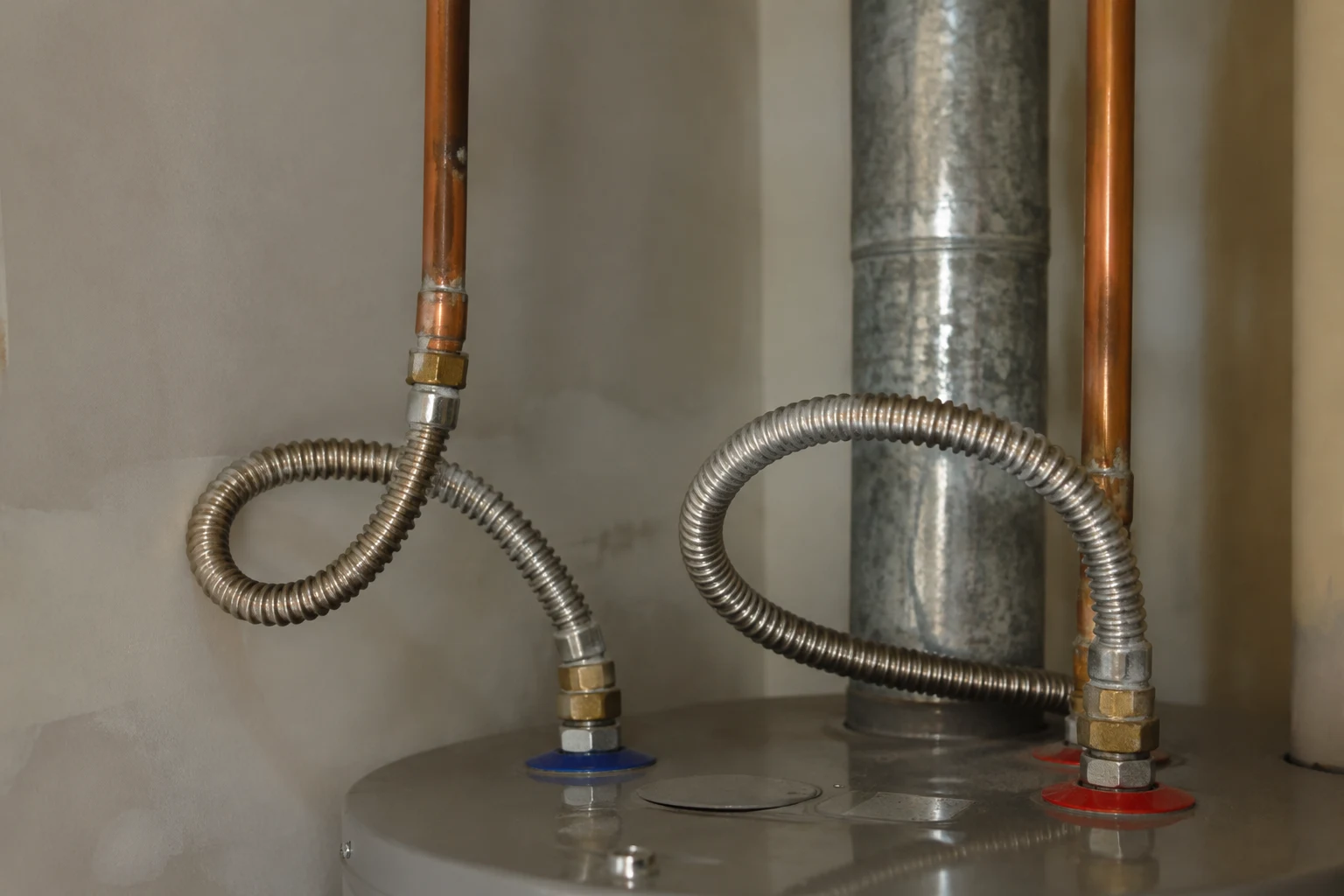
A kinked corrugated connector or one bent tighter than its minimum radius pinches the bore to a slit, and flow drops at every hot fixture. Straighten it into a gentle arc at least five diameters wide, or replace a connector that took a hard crease, because a kinked tube stays weak there. A connector stepped down to 1/2 inch on a 3/4 inch tank does the same thing; size it back up.
Gas heater burner starves or short-cycles
A gas connector too small for the BTU input, or run too long, drops the gas pressure the burner sees. Check the connector's rating against the heater's input and the actual length. Undersized or overlong, swap it for one rated for that BTU at that length. Never solve it by removing the connector and hard-piping in a way that hides a joint.
Final leak-test checklist
Before you call the job done and turn the burner or the breaker on, walk the connectors one more time with the tank full and pressurized. A connector that passes this list will not surprise you in a month. The soap test is the one step people skip and the one that catches the slow leaks a visual check misses.
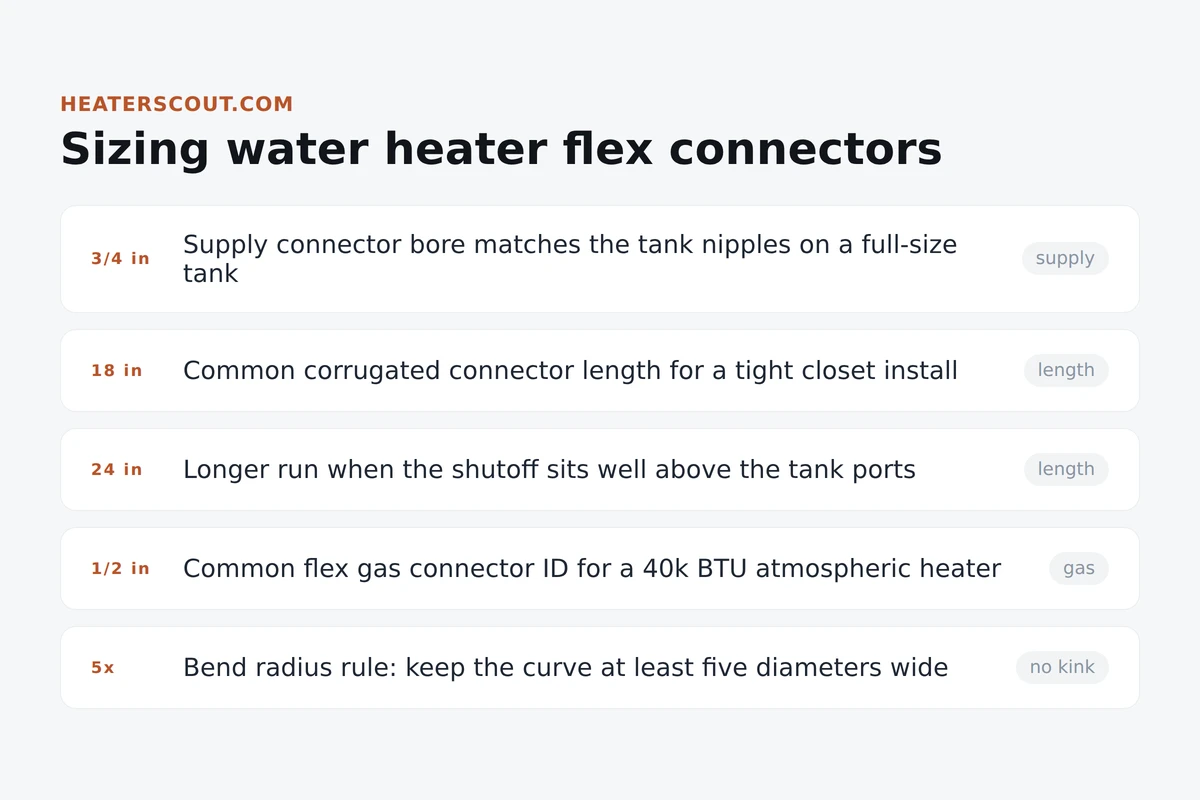
- Both supply connectors are 3/4 inch bore to match the tank nipples, not stepped down to 1/2 inch.
- Each connector arcs in a gentle curve with slack, no kinks and nothing bent tighter than its minimum radius.
- Every swivel nut is hand-tight plus a quarter turn, torqued with the tank nipple backed up by a second wrench.
- The connectors are new, not carried over from the old tank, so no washer has a compression set on it.
- A dielectric break separates copper or brass from the steel tank nipples on both supply ports.
- The gas connector is short, visible, and accessible, with no part of it passing through or hidden in a wall.
- The gas connector is listed to ANSI Z21.24 and rated for the heater's BTU input at the length installed.
- Soapy water brushed on every connector nut and gas fitting shows no growing bubbles under full pressure.
- Thread sealant for gas is on the male pipe threads only, never on the connector's flare nut or swivel.
Frequently asked
What size flex connectors do I need for a water heater?
Match the connector bore to the tank ports, which on a standard 40 or 50 gallon residential tank are 3/4 inch. A 3/4 inch corrugated stainless or braided connector keeps the full flow of the tank; step down to 1/2 inch and you throttle every hot tap in the house. For length, measure from the tank inlet and outlet nipples up to the shutoff and the house piping, then buy a connector that spans the gap with a gentle arc, not one stretched bar tight and not one so long it loops and kinks. An 18 inch connector handles most closet installs; a 24 inch reaches when the cold shutoff sits high on the wall. Tank-side end fittings are usually 3/4 inch FIP to thread onto the male tank nipple, so check whether your connector ends are FIP, sweat, or push-fit before you buy.
Can I reuse an old flex connector on a new water heater?
No. Buy new connectors every time you swap a tank. The corrugated or braided body work-hardens where it flexes, the rubber or fiber washers inside the female fittings take a compression set and go stiff, and the threads may have been overtightened once already. A used connector that looked fine on the bench will weep at the washer a week after you reinstall it, and now it is buried behind a full tank. Connectors are a few dollars each. The labor to drain the tank and chase a slow drip later is not. This is the same logic as never reusing a supply line under a sink: the sealing washer is a one-shot part.
Do I need dielectric connectors on a water heater?
You need something to separate copper or brass from the steel tank nipples, and a connector does that cleanly. When copper touches steel with water and dissolved minerals between them, you get galvanic corrosion: the steel gives up metal to the copper and the nipple rots from the inside. Old dielectric unions with a plastic liner are notorious for clogging with scale and restricting flow. A better modern answer is a stainless corrugated connector or a braided line with a brass fitting on one end and a plated steel or stainless body, which breaks the direct copper-to-steel path without a choke point. Many code officials accept a listed water heater connector as the dielectric break. Brass is far up the galvanic series from steel, so a brass-to-steel joint corrodes much slower than copper-to-steel.
Why can't a flex gas connector pass through a wall or floor?
Because the codes that list them, ANSI Z21.24 for connectors and the fuel gas code, prohibit running a flexible gas appliance connector through any wall, floor, ceiling, or partition, and prohibit concealing it. The thin corrugated tube is meant to be a short, visible, accessible link between a rigid gas stub and the appliance, not a substitute for pipe. Hidden inside a wall it can chafe against a stud or a nail plate, or get crushed, and nobody sees the wear until gas is leaking into a cavity. If the gas supply has to cross a wall, run black iron pipe or listed CSST rated for concealment through the wall, bring it out to an accessible shutoff, and then use the short flex connector from there to the heater. One appliance, one connector, no splices.
How tight should I make the connector fittings?
Hand-tight, then a quarter turn with a wrench, and no more. The female swivel ends on a braided or corrugated connector seal on a captive washer or a machined cone, not on thread engagement, so gorilla torque does not make them seal better. It crushes the washer, distorts the cone, or cracks the flare, and then it weeps. Snug the nut by hand until it stops turning easily, then take it a quarter turn past that with a wrench while you back up the tank nipple with a second wrench so you do not spin the whole nipple in the tank. For the gas connector, use two wrenches the same way and thread sealant rated for gas on the male pipe threads only, never on the connector's flare nut.
Is a flex connector or rigid copper better for a water heater?
Flex wins on speed and vibration; rigid copper wins on longevity and flow in an exposed run. A corrugated stainless connector absorbs the expansion and slight movement of a tank without stressing a soldered joint, and it lets you set a heavy tank without lining up hard pipe to the millimeter. That is why they are standard on replacements. Rigid copper, sweated with proper dielectric breaks, has no rubber washer to age out and a smoother bore, so a long copper run flows a hair better and lasts without a connector to weep. On a seismic install, code often wants the flexibility of a connector anyway. For most closet swaps, a good 3/4 inch stainless connector is the right tool; for a clean, permanent, exposed run you plan to keep 15 years, hard copper is worth the extra work.
What does a flex connector need to be listed to?
Water connectors should be listed to a recognized standard for corrugated stainless or braided water connectors and be rated for potable hot water at the tank's temperature and pressure. Gas connectors must be listed to ANSI Z21.24 (or the combined Z21.24/CSA 6.10 standard) and sized for the appliance's BTU input at the length you are using, because a connector that is too small or too long starves the burner. The listing is stamped or tagged on the connector. Do not use a connector sold for a dryer or a range on a water heater if the BTU rating or length does not cover it, and never use a water connector on a gas line. Match the label to the job.