Around 2003, residential gas water heaters in the US quietly gained a new organ: a small sensor at the burner whose only job is to smell trouble before it ignites. Gasoline vapor, paint thinner, and solvent fumes are heavier than air and settle along the floor, which happens to be right where a floor-standing tank heater breathes. Before the redesign, a spilled can of gas in the garage could flash across the room to the pilot flame. The flammable vapor sensor, and the sealed-chamber system it belongs to, is the reason that scenario is now rare. When it trips, it does exactly what it was built to do, and the trick is telling a real vapor event from a clogged screen faking one.
Flammable vapor sensor (FVS) / FVIR
The flammable vapor sensor is a heat-sensitive probe near the burner of a gas water heater that detects the temperature spike from igniting gasoline or solvent fumes at floor level and signals the gas control to shut off. It is one component of the FVIR system, short for Flammable Vapor Ignition Resistant, a design standard that also includes a sealed combustion chamber, a flame-arrestor screen at the air inlet, and a one-time thermal cutoff. Together they keep a stray flame contained inside the heater instead of flashing out into the room. FVIR has been required on residential atmospheric gas tank heaters built for the US market since roughly 2003.
Four parts working as one safety system
People say flammable vapor sensor as if it were a single gadget, but the protection comes from four pieces acting together. Drop any one of them and the design falls apart, which is why you cannot just swap or bypass a part in isolation. Here is how each maker packages the same idea, and what to call the parts when you order service kits.
| Brand | System name | Screen / arrestor | Reset part |
|---|---|---|---|
| Rheem / Ruud / Richmond | Guardian System | Air-intake flame arrestor screen | Combustion shutoff / service kit |
| A. O. Smith | Sealed combustion FVIR design | Flame arrestor plate at base | Thermal cutoff replacement kit |
| Bradford White Defender | Defender Safety System | ScreenLok flame arrestor | One-time thermal switch kit |
| State | FVIR sealed-chamber system | Base flame arrestor screen | Thermal cutoff service kit |
The naming is marketing, the engineering is nearly identical. Every one of these tanks pulls combustion air through a fine metal screen that will stop a flame front, burns inside a chamber sealed off from the room, watches the burner zone with a vapor sensor, and carries a thermal cutoff that latches the gas off if things go past a set temperature. When you call for parts, use the brand's own name for the kit so you get the right screen and cutoff for your model.
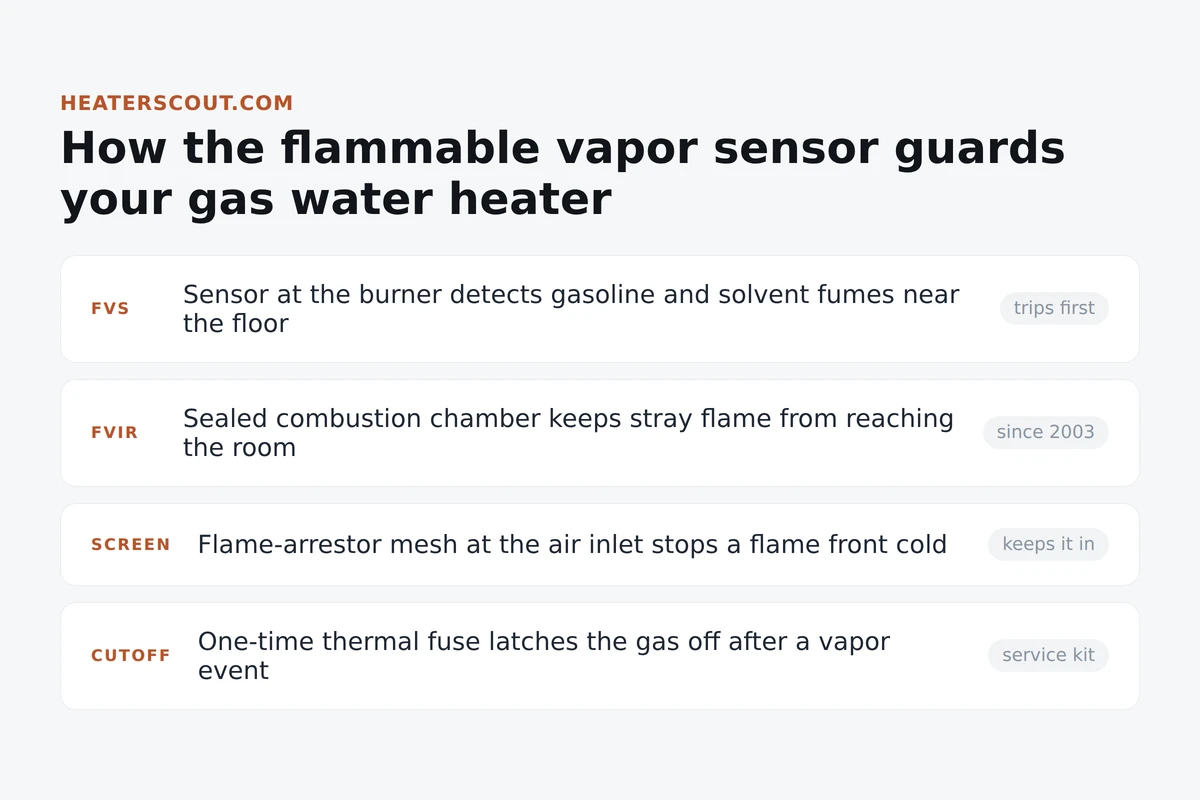
What each component actually does
It helps to see the parts as a chain, each covering a different failure mode. The screen stops a flame physically. The sealed chamber keeps combustion away from room air. The sensor watches for the chemistry of a vapor event. The cutoff is the last resort that ends the whole thing if the first three are overwhelmed. This is the map to keep in your head when a heater locks out and you are trying to figure out which link reacted.
| Flammable vapor sensor | A heat-sensitive probe near the burner that detects the temperature spike when floor-level fumes start to ignite, then signals the gas control to shut off before flame escapes the chamber. |
| Sealed combustion chamber | An enclosed firebox that isolates the burner flame from the room, so a flash cannot propagate out into the surrounding space. Access requires opening it correctly, which is why cutoff service is a pro job. |
| Flame-arrestor screen | A fine metal mesh at the air inlet under the tank. It lets combustion air through but quenches a flame front trying to travel back out. This is also the part that clogs with lint and dust and causes nuisance lockouts. |
| One-time thermal cutoff | A fuse-like device that physically and permanently opens the gas path after a real over-temperature event. It does not reset. It must be replaced with the manufacturer's service kit, along with a fresh screen on many models. |
| Gas control / lockout logic | The valve and controller that read the sensor and cutoff and refuse to relight until the fault clears. A resettable lockout clears after you fix the cause and cycle the control; a latched cutoff does not. |
Why it trips, and how to read the trip
A lockout is not always an emergency, and it is not always a false alarm either. Three things trip these systems, and they call for very different responses. A real vapor event means you have a fuel or solvent problem to clear before anything else. A clogged screen is a maintenance issue that mimics a lockout and is the single most common reason for a nuisance trip. A blown thermal cutoff means the system already did its final job and now needs a service kit. Work down this list before you touch the gas control.
- Sniff for fuel or solvent. If you smell gasoline, paint thinner, lacquer, or any strong chemical near the heater, stop and ventilate the space before doing anything else. A real vapor event is why the system tripped.
- Look for open or spilled containers. Gas cans, mowers, paint, adhesives, and small engines stored or run in the same closed room can release enough vapor to set off the sensor. Move them out and air the space.
- Inspect the flame-arrestor screen and base. A screen caked with lint, dust, or pet hair starves the burner and fakes a lockout. This is the most common nuisance cause. Vacuum the base and skirt and clear anything blocking airflow.
- Check for clutter tight against the heater. Boxes, laundry, or storage pressed against the base blocks the air intake and can trigger a lockout with no vapor present at all.
- Read the status light or code on the gas control. Many units blink a diagnostic pattern that tells you whether it is a resettable lockout or a latched cutoff. Match the blinks to the label on the tank.
- Attempt a reset only after the cause is fixed. If the unit uses a resettable lockout, cycle the gas control off, wait, and relight per the tank label. If it will not relight, suspect a one-time thermal cutoff that needs replacement.
- Call a licensed gas technician for a tripped cutoff. Replacing a latched thermal cutoff means opening the sealed chamber and often fitting a new screen. That is service-kit work, not a homeowner reset.
Resetting versus replacing, and why it matters
The reset question trips people up because two different things can look like a lockout. If the sensor reacted to fumes that have since cleared, and your model has a resettable lockout, the fix can be as simple as clearing the air, cleaning the screen, cycling the gas control, and relighting by the label. That reset holds because nothing physical failed; the system just paused. But if the one-time thermal cutoff opened, there is no reset. It is a fuse that has blown, and it stays blown until a technician installs the manufacturer's service kit. Trying to relight a unit with a latched cutoff will only fail, and forcing the issue by bridging the cutoff is exactly the kind of shortcut that gets houses burned.
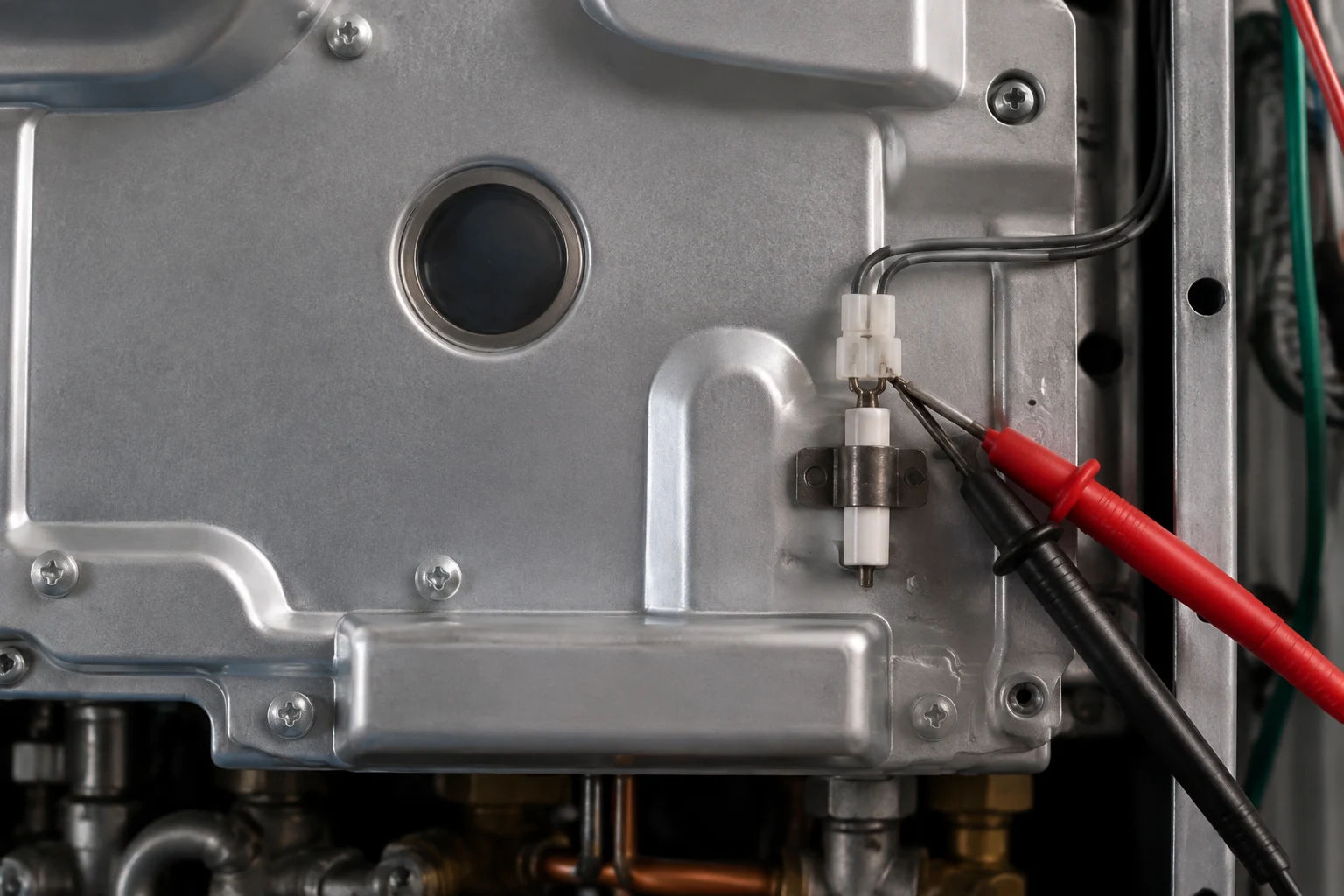
The reason the cutoff is a pro job is not gatekeeping. Getting to it means opening the sealed combustion chamber, and that chamber only does its job if it is resealed correctly with the right gaskets and screen. A sloppy reassembly leaves you with a heater that looks fine and no longer contains a flame front. On many models the service kit bundles the thermal cutoff and a new flame-arrestor screen together for exactly this reason, so the whole intake path gets refreshed at once.
Never defeat the sensor
It is tempting, when a heater keeps locking out on a busy morning, to look for a way around the safety. Do not. The FVIR standard exists because people were hurt, and the sensor is the one thing watching the floor where gasoline vapor pools. Bypassing it, jumpering the cutoff, or reusing a blown thermal fuse removes the protection and leaves a live ignition source over a fuel-collecting zone. It also voids the warranty and puts the install out of code. If the heater will not stay lit, the honest fix is to find the cause. Clear any fumes, clean or replace the screen, and if the cutoff has latched, get the right kit installed by someone licensed to open a sealed gas appliance.
The better long game is prevention. Store gasoline, solvents, and paint away from the water heater, ideally not in the same closed room. Keep the base clear and vacuum the screen on a schedule. A floor-standing gas tank that breathes clean air and never meets a fuel vapor will almost never trip its sensor, which is the whole point of a system you should be glad you rarely notice.
Frequently asked
What is the flammable vapor sensor on my water heater?
It is a small heat-sensitive probe mounted low inside the burner area of a modern gas water heater, part of what the industry calls the FVIR system, short for Flammable Vapor Ignition Resistant. Gasoline, paint thinner, and solvent fumes are heavier than air, so they pool along the floor exactly where a floor-standing water heater draws its combustion air. The sensor watches for the sudden temperature spike those vapors make when they start to burn near the intake, and it signals the control to shut the gas off before the flame can flash out into the room. On most units it works together with a sealed combustion chamber, a flame-arrestor screen at the air inlet, and a thermal cutoff that latches the burner off. The whole package has been standard on residential gas tanks built for the US market since 2003.
Why did my water heater lock out and stop lighting?
The most common cause is a clogged flame-arrestor screen. That fine metal mesh under the tank pulls in combustion air, and over a few years lint, pet hair, and dust cake onto it until the burner starves for air. A starved burner runs hot and erratic, the sensor sees it, and the unit locks out even though no real vapor was ever present. The second cause is an actual vapor event: someone spilled gasoline, opened a can of lacquer thinner, or ran a small engine in the same closed garage, and the sensor did its job. The third, rarer, cause is a genuinely failed sensor or a tripped one-time thermal cutoff. Before you assume the worst, look for a dirty screen and check whether anything flammable was open nearby.
Can I reset the flammable vapor sensor myself?
It depends on which part tripped. Many units have a resettable lockout that clears once you fix the cause and cycle the gas control off, wait a minute, and relight per the label on the tank. If the sensor simply reacted to fumes and the fumes are gone, that reset often holds. But a large number of these systems use a one-time thermal cutoff, a fuse-like device that physically opens after a real over-temperature event and cannot be reset. It has to be replaced with the manufacturer's service kit, and on many models that also means installing a fresh flame-arrestor screen. Replacing a latched cutoff is a job for a licensed gas technician, not a homeowner, because it requires opening the sealed combustion chamber correctly.
Is it safe to bypass or disable the flammable vapor sensor?
No. The sensor and its cutoff exist because gasoline vapor near a pilot flame is one of the classic causes of garage fires and explosions. The FVIR standard was written after years of injuries from exactly that scenario. Jumping the sensor, wiring around the cutoff, or reusing a blown thermal fuse defeats the one device standing between a fuel spill and an ignition source at floor level. It also voids the warranty and puts the installation out of code. If the heater keeps tripping, the answer is to find and fix the cause, clean or replace the arrestor screen, and if needed install the proper service kit, never to disable the safety.
How do I keep the arrestor screen from clogging?
Keep the area under and around the water heater clean and clear. Vacuum the base and the louvered skirt a couple of times a year, more often if the heater sits in a dusty garage, a laundry room with lint in the air, or a house with shedding pets. Do not store boxes, laundry, or anything else tight against the base where it blocks airflow to the intake. Some manufacturers sell a maintenance kit with a replacement screen for units that have run long enough to cake up. A clean screen is the single cheapest thing you can do to avoid a nuisance lockout, and it keeps the burner getting the air it needs to run cleanly.
Which brands use a flammable vapor sensor?
Effectively all of them on floor-standing atmospheric gas tanks sold in the US, because the FVIR design is a code and standard requirement, not an option. Rheem and its Ruud and Richmond lines use their Guardian system. Bradford White calls its version the Defender Safety System with a screen it markets as ScreenLok. A. O. Smith and its State, Reliance, and American brands build the same protection into their tanks under their own naming. The engineering is similar across all of them: a sealed chamber, a flame-arrestor screen, a vapor sensor, and a thermal cutoff. The service parts and reset steps differ by brand, so always match the kit and the relight instructions to your specific model and its rating-plate label.
Do power-vent and tankless heaters have the same sensor?
Not in the same form. The FVIR flammable vapor sensor is aimed at standard atmospheric-vent tank heaters that sit on the floor and pull combustion air from the room around them. Sealed-combustion and direct-vent units pull air from outside through a dedicated pipe, so floor-level vapors are far less of a threat and the design handles the risk differently. Tankless gas heaters mount on a wall and use their own combustion and flame-sensing controls rather than a floor-level vapor sensor. If your unit is one of these, the troubleshooting for a no-light or lockout condition follows that model's error codes, not the FVIR reset steps for a floor-standing tank.