Two families buy the same 50-gallon water heater on the same day. One runs out of hot water halfway through the third morning shower; the other never notices a dip. The tank held the same 50 gallons for both. What separated them is a spec printed on the yellow EnergyGuide sticker and ignored by almost everyone: the first hour rating. It is the number that actually decides whether your shower goes cold, and it often has little to do with the gallon figure stamped on the front.
Two to three people, one bathroom
Peak demand lands near 40 to 55 gallons in the busy hour. A 40 or 50-gallon gas heater with an FHR in the low 70s covers it with margin, and even a 50-gallon electric at 62 usually holds if the showers are not stacked right on top of each other.
Four-plus people, back-to-back showers
This is where FHR earns its keep. A morning of four or five showers plus a dishwasher can push past 90 gallons in one hour. Look for an FHR of 80 to 100-plus: a 50-gallon high-input gas unit or a 75-gallon tank, not a slow-recovery electric.
One or two people, tight space
Demand is modest and space is short. A compact 30 or 40-gallon heater with an FHR in the 40s to low 60s is plenty. Here the tank size and the recovery are close together, so the sticker number and the gallon number tell nearly the same story.
Why the sticker number matters more than the tank
Walk into any home center and the water heaters are shelved by gallons: 40, 50, 75. That number feels like it should tell you how much hot water you get, and people size their whole house around it. It does not tell the whole story, and here is the reason. A storage heater does two jobs at once during a busy morning. It hands you the hot water already sitting in the tank, and it reheats cold water as fast as it can to keep the supply going. The gallon figure only describes the first job. The first hour rating describes both, rolled into one number you can actually shop by.
Think of it as a fuel tank plus a refill hose. A big tank with a thin hose empties and struggles to keep up. A modest tank with a fat hose runs low but keeps topping off. FHR is the total volume that comes out the end of the hose in sixty minutes, which is exactly what you care about when four people need showers before work. The federal test that produces the number starts the heater full and fully hot, then draws water in realistic bursts and adds up everything delivered until the hour is done or the water goes cold, whichever comes first.
The rough shape of the math is simple. You can safely draw somewhere between 60 and 70 percent of a tank's rated gallons before the cold water flooding in from the bottom mixes the outgoing supply down to lukewarm. Add to that one hour's worth of recovery, and you have the first hour rating. Written out: FHR is about 0.6 to 0.7 times the tank gallons, plus the gallons per hour the heater can reheat. The stored part is fixed by the tank. The recovery part is where fuel type changes everything.
Recovery is set by fuel, and it is not close
Recovery is the gallons per hour a heater can bring from cold up to your set temperature while you draw. It is governed by how much energy the heater can dump into the water, and that varies wildly between fuels. This is why two heaters with identical tanks can behave like different appliances.
The formula for a gas or oil heater is worth keeping in your head. Recovery in gallons per hour equals the burner input in BTU per hour, times the efficiency, divided by 8.33 times the temperature rise in Fahrenheit. The 8.33 is the number of BTU it takes to lift one gallon of water one degree. Most homes run a 90-degree rise, taking 50-degree groundwater up to a 140-degree tank. Drop a 40,000 BTU burner at 80 percent efficiency into that, and you get (40,000 times 0.8) divided by (8.33 times 90), which lands around 43 gallons an hour. Step up to a 65,000 BTU high-input burner and recovery climbs past 60 GPH.
Electric heaters use the same math with one conversion: multiply watts by 3.412 to get BTU per hour. A single 4,500-watt element makes about 15,350 BTU, and across a 90-degree rise that works out to roughly 20 to 22 gallons an hour. Residential electric tanks run two elements, but they fire one at a time, not together, so you do not get to add them. That single-element ceiling is why electric recovery stays stuck around 20 GPH no matter how big the tank is. Heat pumps are slower still in their efficient mode, pulling heat from room air with a compressor that recovers only 15 to 20 GPH, which is why they carry large tanks and switch to backup elements when demand spikes.
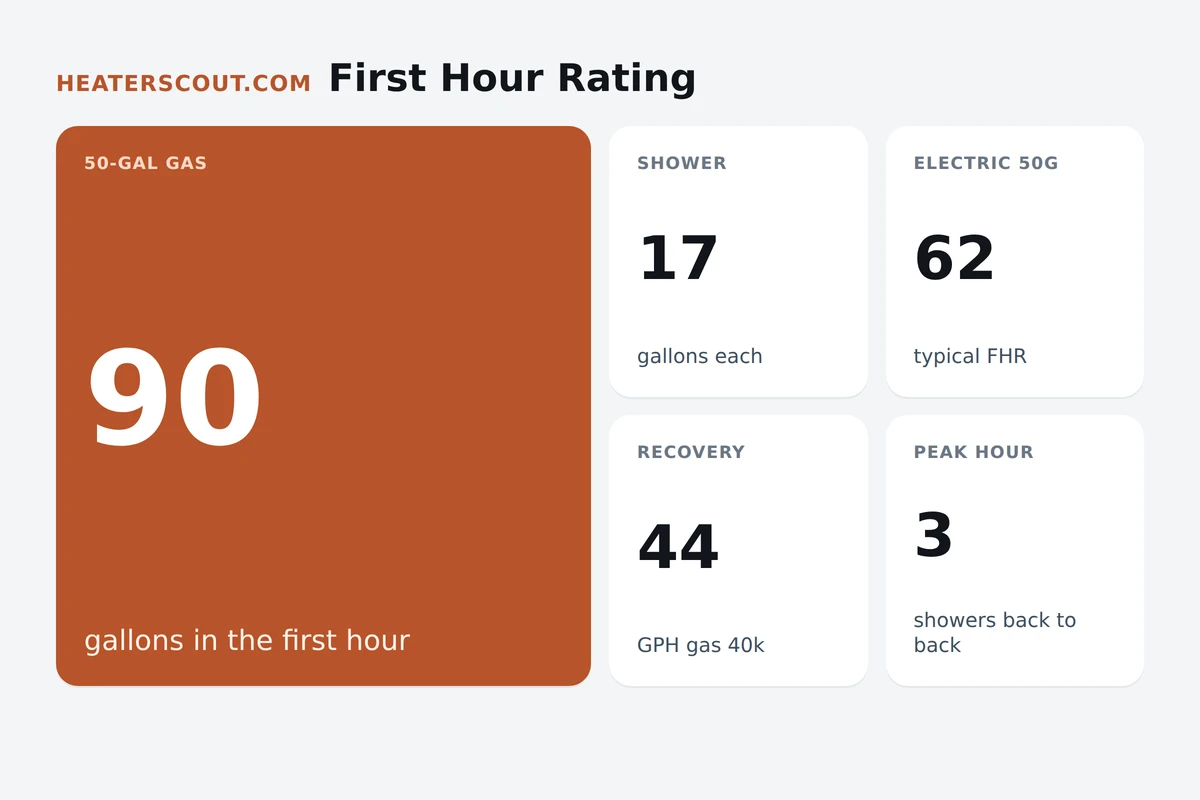
Put those recovery numbers back into the FHR math and the gap is stark. A 50-gallon tank gives you roughly 32 usable stored gallons either way. Add electric recovery and you reach the low 60s. Add gas recovery and you clear 90. Same tank, same footprint, same day one out of hot water, and a 30-gallon difference in what the heater actually delivers when the house wakes up.
| Fuel and input | Recovery (GPH) | Usable stored | Typical FHR | Back-to-back showers |
|---|---|---|---|---|
| Electric, 4,500 W element | 20 to 22 | ~31 gal | 62 gal | 3 |
| Heat pump, hybrid mode | 15 to 20 alone, more with elements | ~31 gal | 67 gal | 3 to 4 |
| Gas, 40,000 BTU | 40 to 45 | ~34 gal | 88 to 90 gal | 5 |
| High-input gas, 65,000 BTU | 60+ | ~35 gal | 95 to 100+ gal | 5 to 6 |
Estimate your own first hour rating
Set the tank size to the heater you own or are shopping for, then pick the fuel. The tool estimates the first hour rating from usable stored gallons plus one hour of recovery, then translates it into back-to-back showers at 17 gallons each and a rough headcount for the morning peak. Switch the fuel selector with the tank size held steady, and watch how much the same tank changes hands depending on how fast it reheats.
First hour rating estimator
Pick a tank size and a fuel. FHR is roughly two-thirds of the tank plus one hour of recovery. Estimates only; the maker's EnergyGuide sticker has the tested number.
First Hour Rating (FHR)
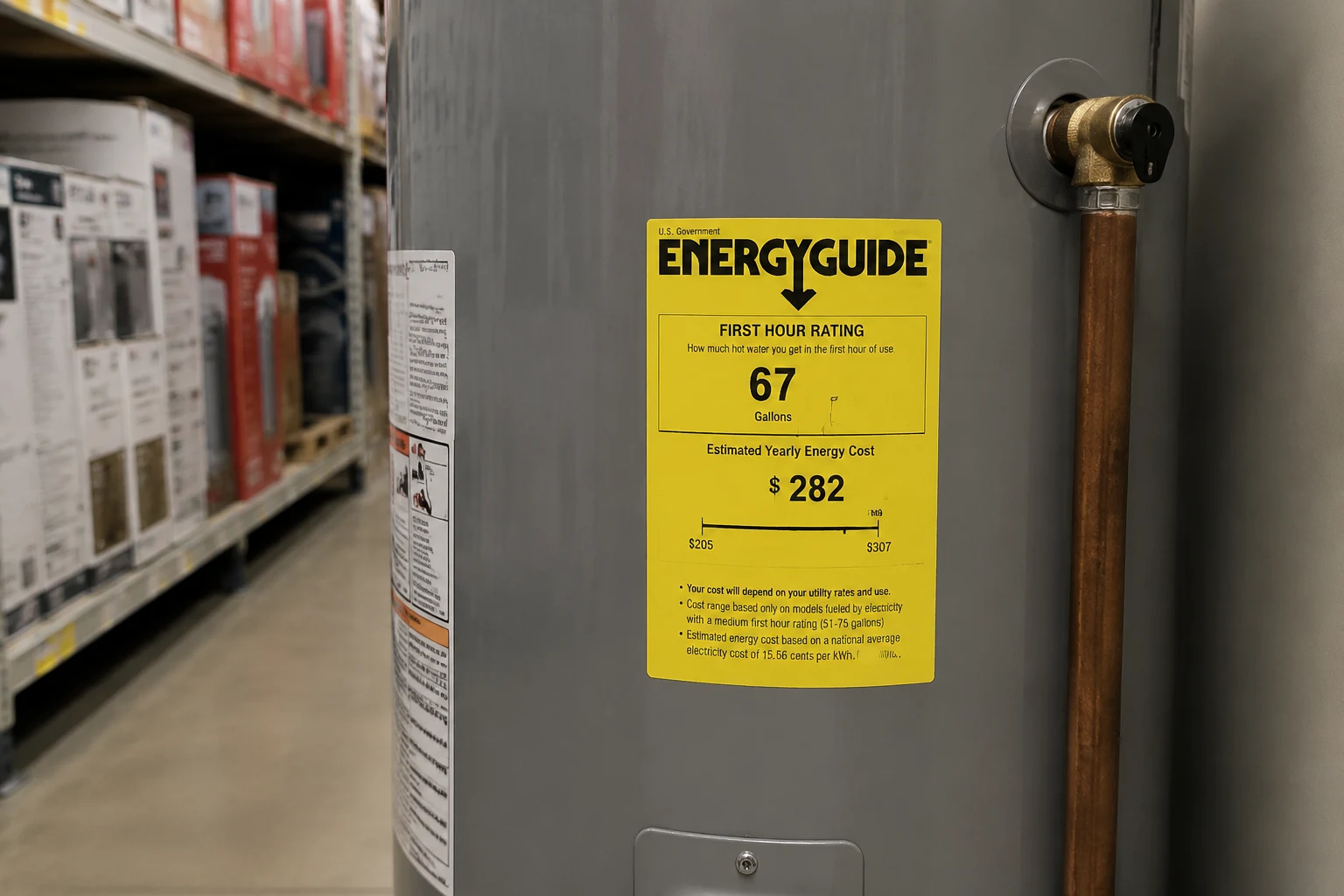
The maximum gallons of hot water a storage water heater can deliver in one hour, starting from a full and fully heated tank. It is a tested federal figure that adds the usable hot water already in the tank to the gallons the heater can reheat during that hour. FHR is expressed in gallons per hour and is the primary sizing spec for storage heaters, printed on the EnergyGuide label. Tankless units use a gallons-per-minute flow rating instead, because they have no stored volume to draw from.
Match FHR to your busiest hour
Size to your peak hour, not your daily total. Add up the hot water your household pulls in its single busiest sixty minutes: about 17 gallons per shower, 4 to 6 for shaving or hand washing, roughly 14 for a dishwasher cycle, and around 20 for a warm laundry load. Buy a heater whose FHR meets or slightly beats that peak number. Undersize it and you run cold in the morning rush; oversize it by a lot and you pay to keep extra water hot around the clock.
Frequently asked
What is a water heater's first hour rating?
First hour rating, or FHR, is the number of gallons of hot water a storage heater can supply in one busy hour when it starts full and fully heated. It is measured under a federal test that draws water in bursts, lets the burner or element recover, and totals what comes out over sixty minutes. FHR combines two things: the usable hot water already sitting in the tank, and how fast the heater reheats incoming cold water during that hour. Because it captures both storage and recovery, FHR is a truer sizing number than the tank's gallon capacity alone.
How is first hour rating different from tank size?
Tank size is only the storage half of the picture. FHR adds recovery, which is the gallons per hour the heater can reheat while you draw. Two 50-gallon heaters can post very different FHRs: a 50-gallon gas unit with a 40,000 BTU burner might rate around 88 to 90 gallons in the first hour, while a 50-gallon electric with two 4,500-watt elements might rate closer to 62, because electric recovery is much slower. So when you shop, compare FHR against your peak demand, not raw tank gallons. A smaller tank with strong recovery can out-serve a bigger tank that reheats slowly.
How do I calculate recovery in gallons per hour?
For a gas or oil heater, recovery GPH equals the burner input in BTU per hour times its efficiency, divided by 8.33 times the temperature rise in Fahrenheit. The 8.33 is the BTU needed to raise one pound of water one degree, near enough for a gallon. A 40,000 BTU burner at 0.80 efficiency across a 90-degree rise gives about 43 GPH. For electric, convert watts to BTU by multiplying by 3.412, so a 4,500-watt element at a 90-degree rise makes roughly 20 to 22 GPH. Heat pumps are a special case; in efficient mode they recover slowly, around 15 to 20 GPH, and lean on their tank.
How many showers can my water heater handle in a row?
A typical shower uses about 17 gallons of hot water, mixed with cold at the valve. Divide your heater's first hour rating by 17 for a rough count of back-to-back showers before the hot water thins out. A 90-gallon FHR gas heater handles about five showers in that first busy hour; a 62-gallon FHR electric handles about three. Longer or hotter showers pull more, and a rain-style showerhead can double the draw, so treat the number as a ceiling for a busy morning rather than a promise.
What first hour rating do I need for my household?
Size FHR to your peak hour, not your daily total. Add up the hot water your household draws in its busiest sixty minutes: figure roughly 17 gallons per shower, 4 to 6 for shaving or hand washing, about 14 for a dishwasher cycle, and 20 or so for a load of warm laundry. A couple often peaks near 40 to 50 gallons, a family of four near 70 to 90, and a big household with back-to-back morning showers can top 100. Pick a heater whose FHR meets or slightly beats that number.
Does a heat pump water heater have a low first hour rating?
In its most efficient heat-pump-only mode, yes, because the compressor recovers slowly, often 15 to 20 GPH. To keep FHR competitive, hybrid heat pump models switch on backup electric elements during heavy demand, which pushes the rated FHR of a 50-gallon unit into the high 60s. If you run one in economy mode to save energy, you lean harder on stored hot water and the real first-hour delivery drops. A larger tank or a hybrid mode that allows element assist keeps a heat pump usable for a busy family.
Can a smaller tank with fast recovery beat a bigger slow one?
It can, over the span of an hour. FHR rewards recovery, so a 40-gallon high-input gas heater that reheats 60-plus gallons an hour can post a higher first hour rating than a 50-gallon electric that only recovers around 20. If your demand comes in one concentrated burst, the bigger tank might still win because it starts with more hot water on hand. But if draws are spread across the hour, the fast-recovery unit keeps making hot water while the slow one falls behind. Match the heater's strength to the shape of your demand.