The relief valve on your water heater has been leaving a puddle in the drain pan for a month. You already replaced the valve once, watched it stay dry for four days, then found the same wet spot underneath it. The valve is not the problem. A dead expansion tank is letting pressure spike every time the burner fires, and the relief valve is doing exactly what it was built to do.
Failed or waterlogged?
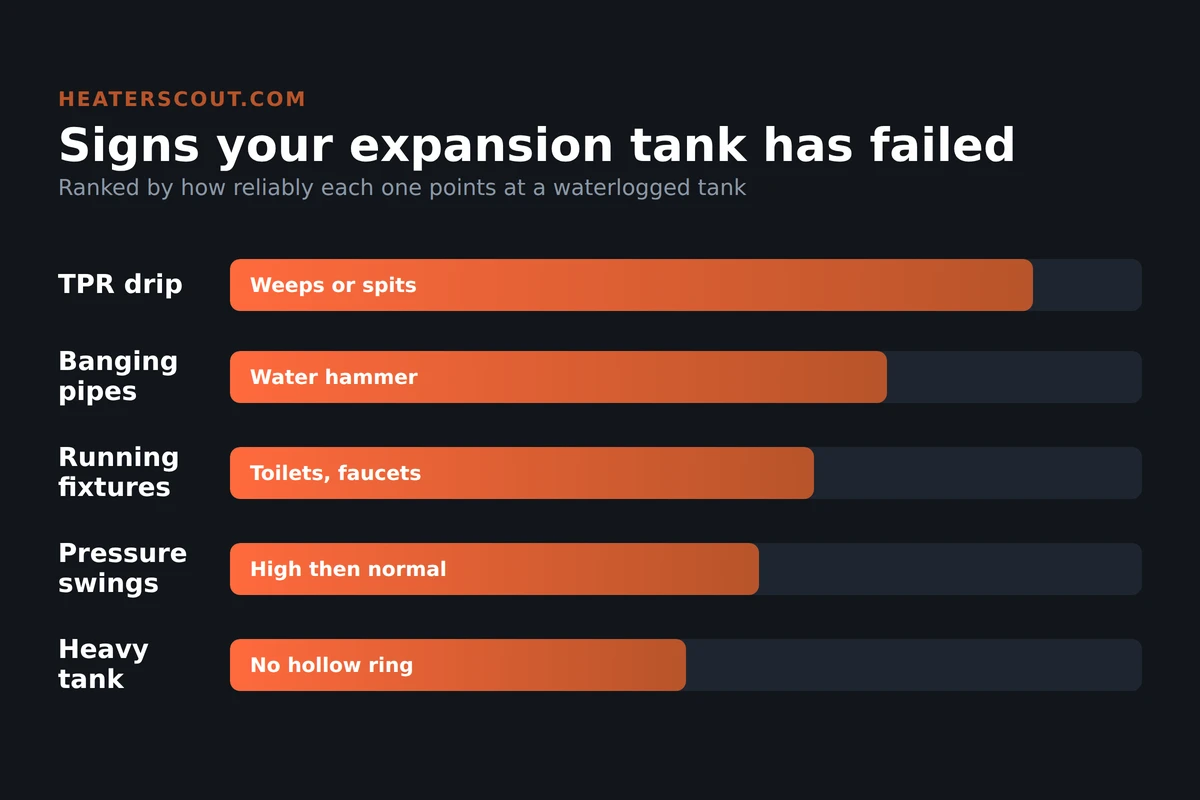
A waterlogged expansion tank shows up first as a relief valve that weeps or spits, usually alongside banging pipes and fixtures that seem to run on their own. Two moves settle it. Tap the tank: a hollow ring on the upper half and a solid thud on the lower half is healthy, while a dull thud everywhere means it is full of water. Press the air valve on top: air is good, water spitting out means the bladder is blown. A good tank lasts five to ten years, and its air precharge should match your house pressure of 40 to 60 psi.
Why the tank exists, and the one part that breaks
Water expands when you heat it, and it does not compress on the way back. Warm a full 50-gallon heater from 50 degrees up to 120 and the water inside grows by roughly half a gallon. On an old open plumbing system that extra half gallon simply pushed back up the street main and nobody ever noticed. Most homes today do not work that way. There is a check valve, a pressure reducing valve (a PRV), or a backflow preventer sitting on the incoming supply, and any one of those turns the house into a closed system where water cannot flow backward out to the street. Now the expanding half gallon is trapped, and because water will not squeeze down, the pressure climbs fast on every recovery cycle.
That rising pressure is the job the expansion tank absorbs. Inside a small steel tank plumbed into the cold supply near the heater, a rubber bladder splits the space into a water side and an air side. The air side carries a precharge set to match your house pressure. When the burner fires and pressure tries to spike, the expanding water pushes into the tank, compresses that air cushion a little, and the spike vanishes into it like a shock absorber taking a bump. A healthy tank makes the pressure swing invisible. You never watch a gauge climb because the air took the hit before it could reach the pipes.
The failure is almost always the bladder, not the shell. That diaphragm flexes on every heating cycle, thousands of cycles a year, and rubber does not tolerate that forever. Eventually it stretches out, cracks, or tears, and it stops holding the air charge. Once the air escapes or crosses to the water side, the tank fills completely and becomes a plain steel can full of water with no cushion left. Plumbers call that waterlogged. From that moment your closed system runs with no protection at all, exactly as though the tank were never installed, and the pressure spikes come roaring back. This is why an Amtrol Therm-X-Trol or a Watts tank can quit while the Rheem or A. O. Smith heater beside it keeps running for years: the moving rubber part wears out long before the glass-lined steel does.
What you actually see when it goes
A failed expansion tank never announces itself directly. It shows up in the parts downstream that suddenly have to swallow pressure the tank used to eat. Some of these signs point almost straight at the tank, and a couple are softer and share the blame with other faults. Run down the list and count how many you have, because two or three together on a closed system make the tank the first thing to check.
- The temperature and pressure relief (TPR) valve on the water heater drips into the drain pan or spits during a heating cycle, then reseals and looks fine again.
- Pipes bang or hammer when a faucet shuts or the washing machine or dishwasher solenoid snaps closed.
- Fixtures run on their own: a toilet that keeps refilling, a faucet that weeps a thread of water at the aerator.
- Water pressure swings, reading high right after the heater recovers and settling back to normal an hour later.
- The tank feels heavy in the hand and gives no hollow ring anywhere when you knock on it.
- You already replaced the relief valve and the leak came right back within days.
The dripping relief valve sits at the top of that list for a concrete reason. A TPR valve is calibrated to open around 150 psi, and on a healthy closed system the pressure never gets close because the tank absorbs the spikes long before they reach that number. Once the tank is waterlogged, those spikes sail right past 150 psi during recovery, the valve cracks open to relieve the excess, and you get a few tablespoons in the drain pan. It reseals the second pressure settles back down, so the drip looks intermittent and random. That intermittence is precisely why people misread it as a tired valve and swap it instead of chasing the pressure.
Banging pipes trace back to the same missing cushion. With no air to soften a shock, closing a valve sends a pressure wave straight down rigid copper with nothing to absorb it, and you hear the pipe slam a joist. Toilets that refill on their own and faucets that weep are high static pressure quietly forcing past fill valves and cartridges that would seal fine at 55 psi but not at 90. None of these alone proves a dead tank, but the relief-valve drip on a closed system is close to a smoking gun.
The two field tests that settle it
You do not have to guess and you do not have to call anyone yet. A waterlogged tank fails two dead-simple checks that take about two minutes and need nothing but your knuckle and a screwdriver. Do them in this order.
Tap the tank, high and low
Knock on the tank with a knuckle, once up near the air valve and once down low near the pipe. A healthy tank rings hollow on the upper half where the air sits, then changes to a solid, dull sound on the lower half where the water is, with a clear line between the two somewhere in the middle. That change is the sound of a working air cushion. If the whole tank gives the same dull thud from top to bottom with no hollow ring anywhere, there is no air pocket left. It is full of water, and that is a waterlogged tank.
Press the Schrader air valve
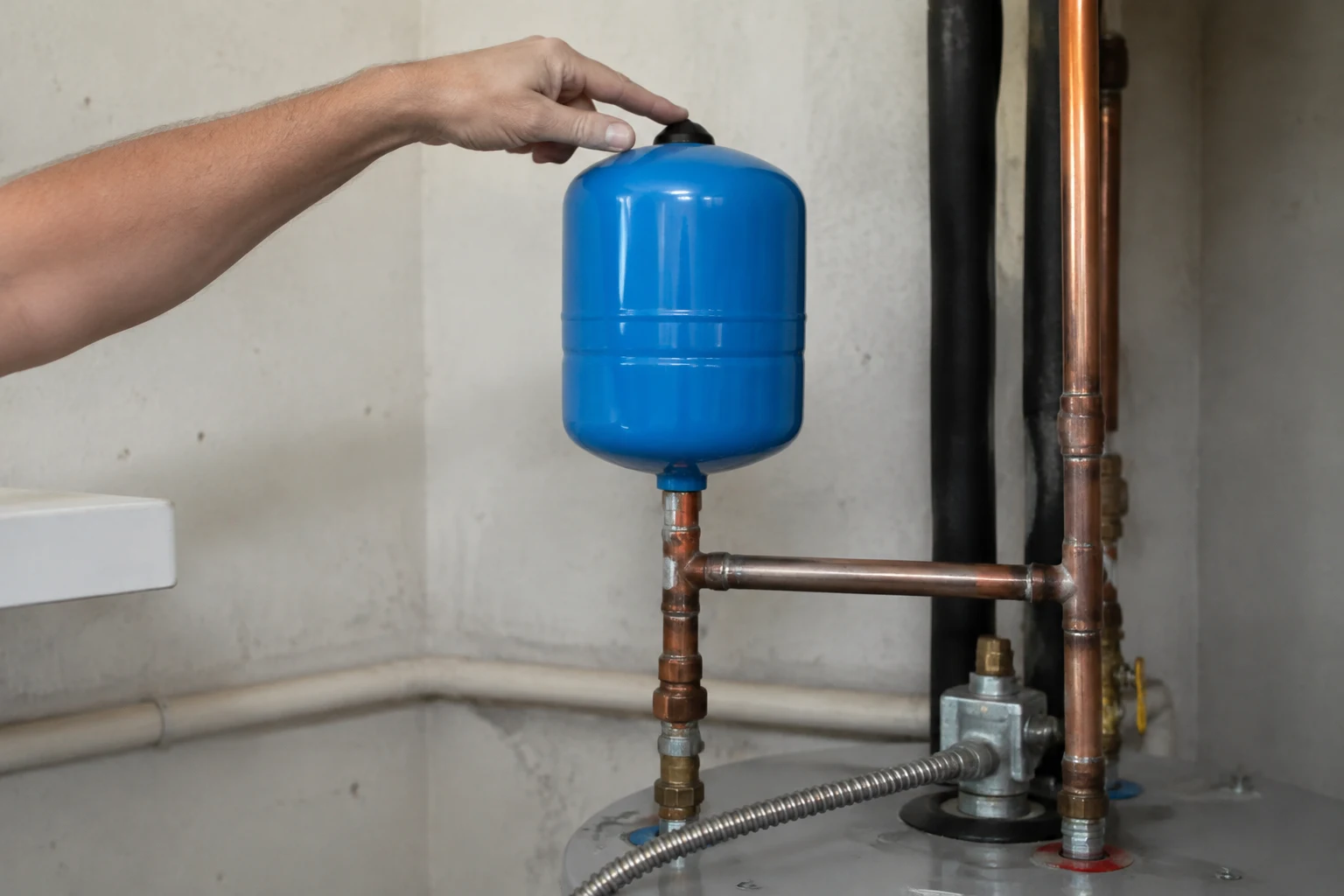
There is a tire-style air valve, a Schrader, capped on the top or end of the tank. Push the pin in for a second with the tip of a screwdriver or a key. Air hissing out is the good result: the bladder is intact and holding its charge, so a soft tank here can be recharged. Water spitting, spraying, or dribbling out is the diagnosis, plain as day. It means water has crossed to the air side because the bladder is torn, and a ruptured bladder cannot be recharged, only replaced. While you are there, a follow-up is worth the extra minute: shut off the water, open a faucet to drop system pressure to zero, and read the precharge on that same valve with a tire gauge. It should match your house static pressure of 40 to 60 psi. A reading well under that, or nothing at all, means the cushion has leaked down even if the bladder is technically still intact.
What repair means, and when there is no repair
Which way you go depends entirely on what came out of the Schrader valve. If air hissed out and the precharge simply read low, the bladder is fine and you can recharge the tank and buy real years. Depressurize the system, put a tire gauge on the valve, and add air with a bike or tire pump until it matches your house pressure, overshooting a hair and bleeding back down to the exact number. Restore pressure, let the heater cycle once, and watch the relief valve: the drip should stop and stay stopped.
If water came out of the valve, there is no repair. A torn bladder means water and air have mixed inside a sealed steel shell, and nothing you add to the air side will separate them again or rebuild the cushion. The tank is done. Support its full weight before the last thread lets go, because a waterlogged tank is heavy and you do not want it hanging on the copper. Then set the replacement's precharge to your house pressure while it is still empty and light, before it ever sees water, and thread it on. A tank installed at the factory's 40 psi on a 60 psi house starts life undercharged and will not protect the system properly. Precharge is not optional and it is easiest to get right on an empty tank.
Here is the side-by-side so you can line up what you are seeing against what each result means. Match your tap, your air valve, and your gauge to a column and the answer usually lands inside a minute.
| Healthy tank | Failed/waterlogged | |
|---|---|---|
| Sound when tapped | Hollow ring on the upper half, solid thud on the lower half | Dull thud everywhere, no hollow ring |
| Schrader air valve | Hisses air when the pin is pressed | Spits or dribbles water |
| Weight and feel | Upper half feels light and empty | Heavy all over, full of water |
| Air precharge (system off) | Matches house pressure, 40 to 60 psi | Reads low or reads nothing |
| Relief valve behavior | Stays dry and never opens on recovery | Weeps or spits every recovery cycle |
| The fix | None needed, or a quick air top-up | Replace the tank, precharged before install |
One caveat on judging by weight
The weight test carries a caveat worth knowing before you lean on it. The small two-gallon tanks that hang off a tee near the heater are light enough that a waterlogged one and a healthy one can feel about the same in a quick heft, especially mounted high on a wall. Trust the tap and the air valve as your primary checks. Weight is a solid confirmation on the bigger 4.5-gallon and larger tanks and a tiebreaker on the small ones, but it is not a test to hang the whole diagnosis on by itself.
My relief valve passed and the tank checks out. What now?
If the expansion tank rings hollow up top, hisses air, and reads the right precharge, the pressure problem lives somewhere else on the closed system. The two usual suspects are a pressure reducing valve that has failed high and is feeding the house 90 or 100 psi, and a relief valve that has corroded and no longer seats. Put a gauge on a hose bib and read the static pressure directly. If it sits above 80 psi with the tank healthy, the PRV is the next part to check, not the tank.
Frequently asked
How do I know if my expansion tank is bad?
Tap it and press the air valve. The upper half of a healthy tank rings hollow like an empty can because that side holds air, and the lower half sounds solid because it holds water. If the whole tank thuds dull and dead top to bottom, it is waterlogged. Then push the pin on the Schrader air valve on top: a hiss of air means the bladder is holding, and water spitting out means the bladder has ruptured and the tank is finished.
Can a bad expansion tank cause the TPR valve to leak?
Yes, and on a closed system it is the leading cause of a temperature and pressure relief valve that weeps or spits. When the tank loses its air cushion, heated water has nowhere to expand, so pressure climbs past the valve's 150 psi setpoint on every recovery cycle and pushes it open a crack. Homeowners swap the relief valve, the drip returns within a week, and the dead expansion tank was the real culprit the entire time.
How long does a water heater expansion tank last?
Roughly five to ten years. The rubber bladder inside flexes on every heating cycle, thousands of times a year, and eventually it stretches, cracks, or tears and stops holding its air charge. That is about half the service life of the water heater it protects, so most heaters outlast at least one tank. High house pressure, water hammer, and aggressive well water all shorten the window toward the five-year end.
What pressure should my expansion tank be set to?
Precharge the air side to match your home's static water pressure, which for most houses runs 40 to 60 psi. Many tanks ship set at 40 psi from the factory, so a house running 55 psi gets an undercharged tank out of the box. Check the precharge with a tire gauge on the Schrader valve while the system is depressurized, then add air with a bike or tire pump until the gauge matches the number you read at a hose bib.
Is a waterlogged expansion tank an emergency?
It is not an emergency, but it should not wait either. A waterlogged tank leaves your closed system with no cushion, so pressure spikes each time the burner or element runs. Those spikes stress the relief valve, supply lines, fixture cartridges, and the water heater tank itself, and a dripping relief valve is the signal that pressure is topping 150 psi. Recharge or replace the expansion tank before the spikes start finding a weaker part to break.
Can I recharge an expansion tank instead of replacing it?
Sometimes, and it depends entirely on the air-valve test. If the bladder is intact and the tank simply bled off some air over the years, depressurize the system and pump the precharge back up to house pressure to restore the cushion. But if water sprays out of the Schrader valve, the bladder is torn and no amount of air will hold. A ruptured bladder cannot be repaired, so the only fix is a new tank precharged before install.
Why does a Watts or Amtrol tank fail while the water heater is still fine?
Because the bladder is the moving part and the steel shell is not. Brands like Amtrol Therm-X-Trol, Watts, and the store-brand tanks from Rheem or A. O. Smith all rely on that rubber diaphragm, and rubber fatigues long before the water heater's glass-lined tank does. The heater cycles the same water in and out, but the expansion tank's bladder actually deforms under every pressure change, so five to ten years of flexing wears it out first.