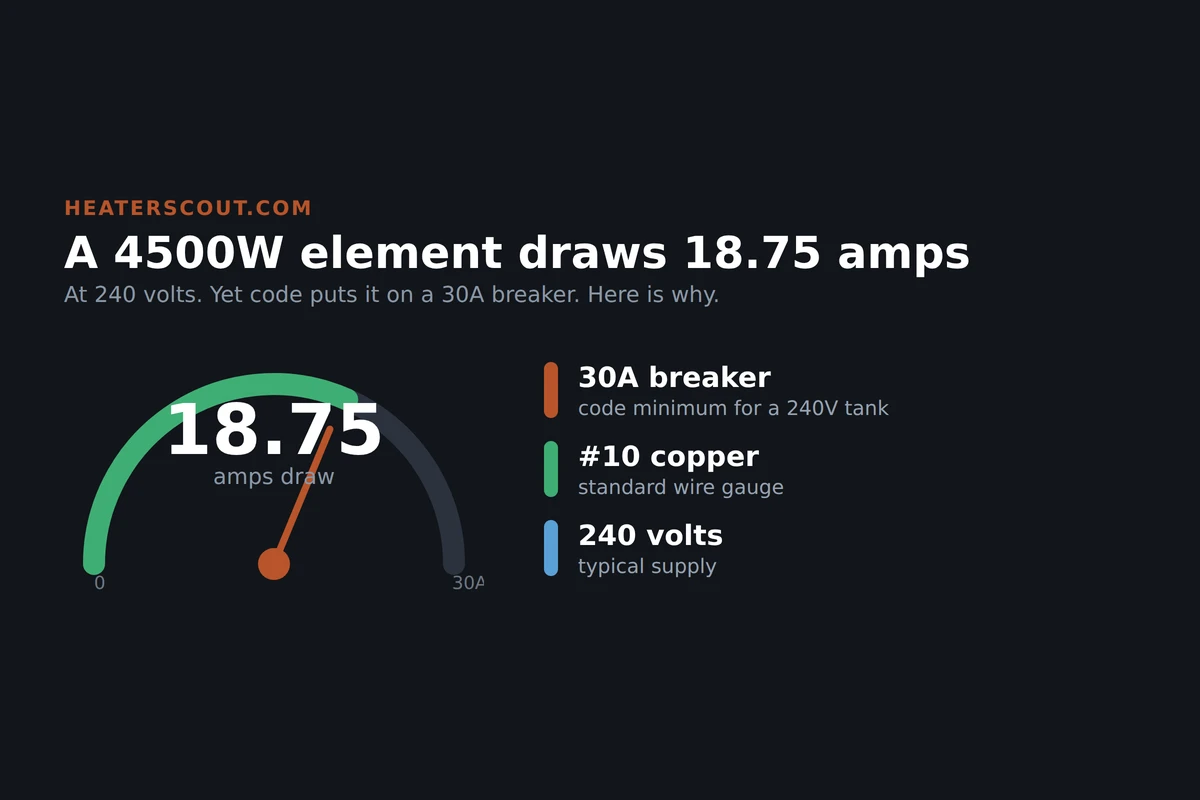
A 4500-watt element sounds like it should need a big, angry circuit. It draws 18.75 amps. Yet the wire feeding it is number 10 copper on a 30-amp double-pole breaker, sized for a load it never reaches. That gap between what the element pulls and what the code demands is the whole story of water-heater wiring, and it comes down to one multiplier and one wiring quirk most homeowners have never heard of.
Find the rating plate
Look on the side label of the heater and on the stamp of the element itself behind the access panel. It reads something like 4500W 240V.
Read the wattage
The watts number tells you how much heat the element makes. Common residential values are 3500, 4500, and 5500 watts.
Read the voltage
Almost every whole-house element is 240V. Point-of-use and compact tanks use 120V. The voltage changes the amp draw, so never skip it.
Do the math
Amps equal watts divided by volts. 4500 divided by 240 is 18.75 amps. That is the running current the rest of the sizing is built on.
The formula, and the chart it produces
Everything starts with one equation you learned and forgot: amps equal watts divided by volts. Plug in the voltage the element actually runs on, and the current falls out. The tricky part is not the arithmetic, it is remembering that residential tank elements are almost always 240 volts, not the 120 you get at a wall outlet. Split a 4500-watt element across 240 volts and it pulls 18.75 amps. Split the same wattage across 120 volts and it would pull 37.5 amps, which is why nobody runs a big element on 120. Here is the reference chart for the wattages you will actually meet, at 240 volts, with the continuous-load factor and the wire that goes with each.
| 1500 W @ 120V | 12.5 A draw → 20A breaker → #12 copper |
| 2000 W @ 120V | 16.7 A draw → 20A breaker → #12 copper |
| 3500 W @ 240V | 14.6 A draw → 30A breaker → #10 copper |
| 4500 W @ 240V | 18.75 A draw → 30A breaker → #10 copper |
| 5500 W @ 240V | 22.9 A draw → 30A breaker → #10 copper |
| The 1.25 rule | Continuous load: size breaker/wire to amps × 1.25 |
| Read the plate | Match the heater rating plate before buying wire |
Notice what the chart does and does not say. Every 240-volt element from 3500 to 5500 watts lands on the same 30-amp breaker and the same number 10 copper, even though their draws range from 14.6 to 22.9 amps. That is deliberate. Number 10 copper is good for 30 amps, and 22.9 amps times the 1.25 continuous factor is 28.6 amps, which still fits under 30. So the standard water-heater circuit covers the entire common wattage range with one setup. The 120-volt entries are a different world: small elements, smaller draws, and a 20-amp circuit on number 12 wire.
Why 18.75 amps needs a 30-amp breaker
This is the part that trips people up. If an element draws 18.75 amps, why not put it on a 20-amp breaker, which is rated well above that? Because the National Electrical Code treats a water heater as a continuous load. A continuous load is one that can run for three hours or more without stopping, and a tank recovering after a long shower or a load of laundry easily does that. For continuous loads, code section 210.20 requires the overcurrent device and the conductors to be rated for 125 percent of the load. So you do not size to 18.75 amps. You size to 18.75 times 1.25, which is 23.4 amps.
Now the breaker rounding kicks in. Breakers come in standard sizes: 15, 20, 25, 30, 40, and so on. You cannot buy a 23.4-amp breaker, and you are not allowed to size below the calculated value, so you round up to the next standard size. The next size above 23.4 amps is 30 amps. The wire has to match the breaker, and number 10 copper is the standard conductor for a 30-amp circuit. That single chain of reasoning is why a 4500-watt element that never pulls more than 19 amps ends up on 30-amp protection with number 10 wire. It is not overkill; it is the code doing arithmetic.
Non-simultaneous versus simultaneous: size to one element
A second quirk decides whether you size to one element or two. Pull the covers off a typical household tank and you will find two elements, an upper and a lower, each with its own thermostat. It would seem you should add their draws together. You do not, because standard tanks are wired non-simultaneous. A mechanical interlock in the upper thermostat means power goes to the top element first, and only when the top of the tank is satisfied does it hand power down to the bottom element. The two never energize at the same instant, so the circuit only ever carries the current of one element.
| Setup | Amp draw | Circuit |
|---|---|---|
| 1500W @ 120V | 12.5 A | 20A breaker, #12 |
| 4500W @ 240V (non-simultaneous) | 18.75 A (one element) | 30A breaker, #10 |
| 4500W + 4500W @ 240V (simultaneous) | 37.5 A (both at once) | 50A breaker, #8/#6 |
| 5500W @ 240V (non-simultaneous) | 22.9 A (one element) | 30A breaker, #10 |
The takeaway is in the third row. A simultaneous-operation heater, built to run both elements at once for fast recovery in a busy household or a light commercial job, doubles the draw and needs a much bigger breaker and heavier wire. Those are the exception. If you are looking at an ordinary residential tank with two elements and one 30-amp circuit, it is non-simultaneous, and you size to one element every time. Confirm it on the rating plate, which will state the maximum current draw; a non-simultaneous tank lists the single-element figure, a simultaneous one lists the combined figure.
Run your own element
Set the slider to your element wattage and flip the voltage toggle to match the rating plate. The tool divides watts by volts for the amp draw, applies the 1.25 continuous factor, rounds up to the next standard breaker, and hands you the matching copper wire gauge with a plain-language note. It sizes to one element, the way a non-simultaneous tank is wired.
Element wattage to breaker and wire
Amps = watts / volts, then breaker and wire per the NEC 125% continuous-load rule. Non-simultaneous tank (sizes to one element). Not a substitute for a licensed electrician.
Amp draw
18.8ABreaker
30ACopper wire
#10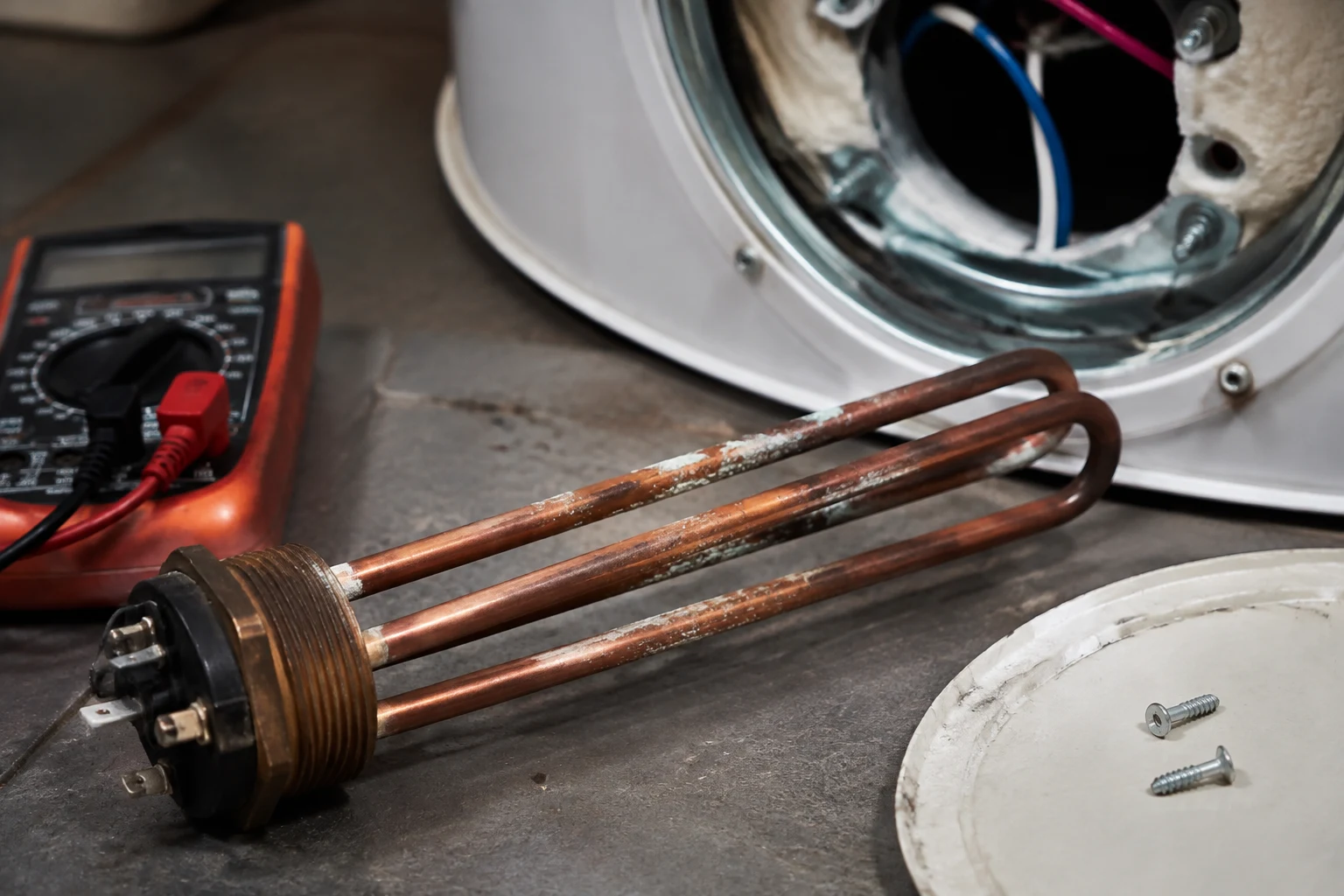
Before you touch the wiring
Sizing on paper is the easy half. Confirming what is actually in your panel and at your heater is the half that keeps you safe and to code. Walk this list before you decide the circuit is right or before you swap an element.
- Read the wattage AND voltage off the rating plate, not just the watts. A 4500W element behaves very differently at 240V than at 120V.
- Confirm the breaker is double-pole for a 240V circuit. Two poles, two hot legs, one handle.
- Verify the wire gauge matches the breaker: #12 copper for 20A, #10 for 30A, #8 for 40A. Undersized wire on an oversized breaker is a fire risk.
- Check whether the tank is non-simultaneous (single-element draw) or simultaneous (both at once) on the rating plate before assuming 30A is enough.
- Make sure a replacement element matches the original wattage and voltage. A mismatch runs cool, trips protection, or dry-fires.
- Look for aluminum branch wiring in older homes; it needs rated connectors and is best left to a licensed electrician.
Power off, and know your limits
Any work on the branch circuit, the breaker, or the element terminals has to be done with the power off at the breaker, and confirmed dead with a meter, before you open anything. A water heater circuit is 240 volts and will injure or kill you. Follow your local code, which can differ from the NEC, and pull a permit where one is required. If you are not certain about breaker sizing, wire gauge, or how your tank is wired, hire a licensed electrician. This chart is for understanding the numbers, not a license to rewire your panel.
Frequently asked
How many amps does a 4500-watt water heater element draw?
At 240 volts a 4500-watt element draws 18.75 amps, from the formula amps equals watts divided by volts (4500 / 240). That is the running current of one element. Because a storage water heater is treated as a continuous load, the National Electrical Code makes you size the circuit to 125 percent of that draw, which is 23.4 amps. The next standard breaker above 23.4 is 30 amps, so a 4500-watt element ends up on a 30-amp double-pole breaker fed with number 10 copper, even though it never pulls more than about 19 amps in use.
Why is a 30-amp breaker used when the element only draws 18.75 amps?
Two rules stack up. First, a water heater is a continuous load, meaning it can run three hours or more at a stretch, so code requires the circuit to be rated for 125 percent of the actual draw. Second, breakers only come in standard sizes, and you round up to the next one. 18.75 amps times 1.25 is 23.4 amps, and the next standard breaker above that is 30 amps. Number 10 copper is the matching wire for a 30-amp circuit. That is why nearly every 240-volt residential tank lands on a 30-amp double-pole breaker and number 10 wire regardless of the fact that the element itself stays under 19 amps.
Do I add both elements together when sizing the wire?
No, not on a standard residential tank. Almost all two-element water heaters are non-simultaneous, wired so the upper and lower elements can never energize at the same time. A thermostat interlock hands power from the top element to the bottom one; only one is ever drawing current. So you size the breaker and wire to a single element, not the sum of both. The exception is a simultaneous-operation heater, which is built to run both elements at once. Those exist for high-demand or commercial use, and they need a larger breaker and heavier wire because the total draw is roughly double.
What size wire does a 5500-watt element need?
A 5500-watt element on 240 volts draws 22.9 amps. Apply the 125 percent continuous-load factor and you get 28.6 amps, which still fits under a 30-amp breaker, so number 10 copper is correct for a non-simultaneous tank. It is close to the ceiling, though. If the same 5500-watt element were part of a simultaneous-operation heater drawing both elements at once, or if the run is long enough that voltage drop matters, you step up to a 40-amp breaker on number 8 copper. Always confirm against the rating plate and your local code.
Can a water heater element run on 120 volts?
Yes, but only small ones. Point-of-use heaters, under-sink units, and some compact tanks use a 120-volt element, usually in the 1500 to 2000 watt range. A 1500-watt element on 120 volts draws 12.5 amps, and a 2000-watt element draws 16.7 amps. With the 125 percent continuous factor those land on a 20-amp breaker with number 12 copper. Running a large 4500 or 5500 watt element on 120 volts is not practical because the amp draw would be far too high for a normal branch circuit. That is why full-size household tanks are wired for 240 volts.
What breaker does a 3500-watt element need?
A 3500-watt element on 240 volts draws 14.6 amps. Times the 1.25 continuous factor that is 18.2 amps, which would technically fit a 20-amp breaker on number 12 wire. In practice most electricians still put it on a 30-amp double-pole breaker with number 10 copper, because that is the standard water-heater circuit and it leaves room if the tank is ever swapped for a higher-wattage unit. Match whatever the heater rating plate calls for, and when in doubt the 30-amp, number 10 setup is the common residential default.
How do I find my element's wattage and voltage?
Read the rating plate on the side of the heater, or the stamp on the element itself once the access panel is off. Elements are marked with both a wattage and a voltage, such as 4500W 240V. The voltage matters as much as the watts, because the same element produces different heat and draws different current at a lower voltage. If a plate is missing or unreadable, you can measure element resistance with a multimeter and calculate wattage, but the plate is the reliable source. Never assume; a mismatched replacement element runs cool and can trip protection or dry-fire.