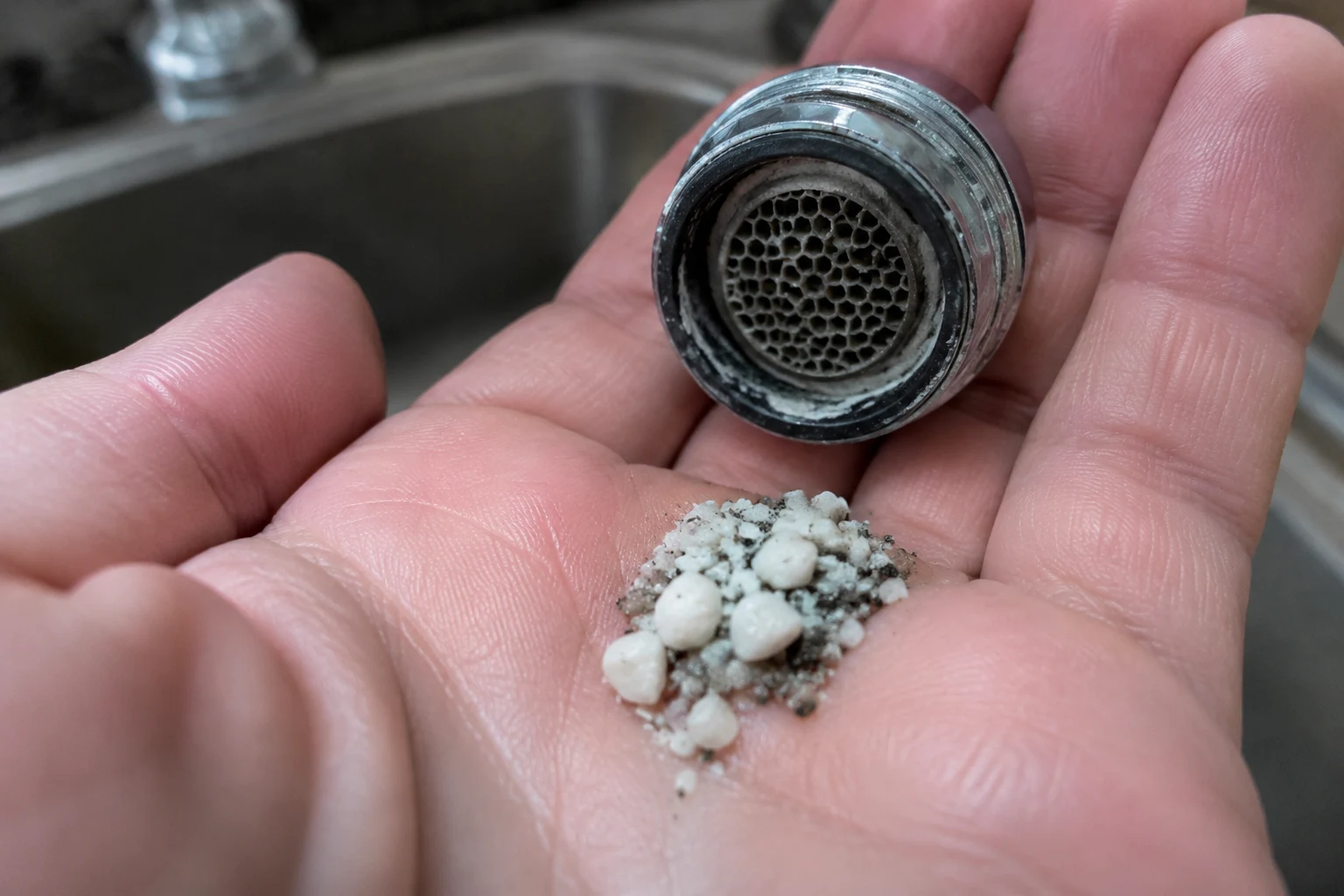
You unscrew a faucet aerator to clean it and out fall little white plastic chips, like confetti. At the same time your showers have gone lukewarm and short, even though the heater hums along and the burner or element clearly still works. Those two clues together point at one cheap part almost nobody thinks about: the dip tube.
Quick answer
Small white or gray plastic flecks in your aerators plus lukewarm water is the dip-tube signature. The tube feeds cold water to the bottom of the tank. When it breaks, cold water mixes into the hot outlet and the tank sheds plastic. Replacing the tube runs about 15 dollars in parts.

Dip tube
the plastic pipe that runs from the cold-water inlet down to near the bottom of the tank. It forces incoming cold water to the bottom so it heats on the way up, keeping the hot outlet at the top fed with the hottest water. A broken tube short-circuits that path.
Why a small plastic pipe matters this much
A tank water heater works because of one simple trick: hot water floats. Cold water is denser, so it sinks. The manufacturer uses that to keep hot and cold from mixing. Cold water comes in through the top of the tank, but instead of dumping in right next to the hot outlet, it is piped all the way down to the bottom through the dip tube. There it sits at the bottom, gets heated by the element or burner, and rises slowly. By the time water reaches the outlet at the top, it is the hottest water in the tank.
Take the dip tube away, or break it near the top, and that whole layered arrangement collapses. Now incoming cold water enters at the top, inches from the hot outlet, and gets pulled straight into your hot line before it ever has a chance to heat. The tank might be full of perfectly hot water lower down, but you never taste it, because the outlet is drinking cold. That is why a broken dip tube makes water lukewarm even when the heating parts are flawless. You are not short on hot water; you are short-circuiting the path to it.
The plastic itself is the second half of the story. Dip tubes are made of plastic so they resist corrosion, but plastic ages. When a tube gets brittle and starts to crumble, it does not vanish. It sheds. Small white or gray flakes break off and ride the water out to every fixture in the house, where they lodge in aerators, showerhead screens, and the inlet filters of dishwashers and washing machines. No other failure inside a water heater produces plastic, which is exactly what makes it such a reliable fingerprint.
How telling is each symptom
Plenty of faults make water lukewarm. Only a dip tube also fills your fixtures with plastic. Here is how much weight to give each sign when you are pointing the finger.
Dip tube, or something else?
Before you drain the tank, rule out the cheaper-to-check causes. Lukewarm water has half a dozen possible sources, and most are faster to check than pulling a dip tube. The plastic is what separates a dip tube from the rest; if your aerators are clean, the odds swing hard toward one of the other causes in this table.
| Cause | Plastic in water? | Giveaway |
|---|---|---|
| Broken dip tube | Yes | Flecks in aerators, sudden loss of capacity |
| Crossed hot and cold plumbing | No | Started right after plumbing work |
| Bad lower element (electric) | No | Some hot at first, then quickly cold |
| Thermostat set too low | No | Never was very hot, dial reads low |
| Undersized tank for the household | No | Only lukewarm during heavy back-to-back use |
The crossed-plumbing case is worth a special note because it mimics a dip tube almost perfectly except for the plastic. If a hot and cold line got connected backward somewhere, usually right after a faucet, valve, or fixture was replaced, cold water bleeds into the hot side and you get the same lukewarm result. The tell is timing: crossed plumbing starts the day after someone did work on the pipes, while a dip tube fails on its own schedule with no trigger. A quick test is to shut off the cold supply to the water heater entirely and open a hot tap; if water still flows, cold is getting into the hot side somewhere other than the tank, and you are chasing a crossed line, not a tube.
The 1990s batch that made this famous
Dip tubes fail on any tank eventually, but there is a reason plumbers reach for this diagnosis so quickly. Between roughly 1993 and 1997, a single supplier produced a huge run of defective dip tubes that were installed across many major water heater brands. The plastic formulation was wrong, and the tubes disintegrated years earlier than they should have, sometimes within a few years of install. It turned into one of the largest quiet defects in the appliance world, and it is why any tank built in that window with plastic in the water is almost self-diagnosing.
You do not have a 1990s tank, so does this matter? Yes, in two ways. First, plenty of those tanks are still in service, or were replaced with a unit that is itself now old enough to shed its own tube. Second, it tells you how to read the serial number. The date code stamped on the rating plate, usually the first four digits of the serial in a week-and-year or month-and-year format, tells you the tank's true age. A tube that fails is far more likely on a tank pushing ten or fifteen years than on a two-year-old unit, so the age is a real part of the diagnosis, not a footnote.
Confirm it in three checks
You do not want to drain a tank on a hunch. Three checks, in order, take it from a guess to a near-certainty before you touch a wrench.
Check the aerators
Unscrew a couple of faucet aerators and the showerhead screen. White or gray plastic bits are close to a diagnosis on their own.
Read the tank's age
Find the build date in the serial number on the rating plate. A mid-1990s tank with these symptoms is a prime suspect for the defective-tube era, and any tank over ten is a fair candidate.
Pull and inspect the tube
With power or gas off and the tank drained, remove the cold-water nipple on top and lift the dip tube out. A good one is a straight, intact pipe. A failed one is cracked, curled, or comes up in pieces.
Shut it down before you open it
Cut the power at the breaker or turn a gas dial to Off before you open the tank. Then close the cold-water inlet, open a hot tap to break the vacuum, and drain from the bottom valve before removing anything on top.
Replacing the dip tube
Cleaning up after the tube is out
Swapping the tube is only half the job. The plastic that already broke off is scattered through the tank and the whole hot-water side of your plumbing, and if you skip the cleanup it keeps clogging fixtures for weeks. This is the part people cut short and then wonder why the showerhead still trickles.
Before you refill, flush the tank hard from the drain valve with the cold inlet open in short bursts, so a strong flow carries loose flakes out rather than letting them settle. Then work through the house fixture by fixture. Unscrew every aerator and rinse the screen, pull and clean the showerhead screens, and check the inlet filter screens on the dishwasher and washing machine hoses, which are the two appliances most likely to be quietly choking on plastic. It is tedious, but a couple of flakes left in an aerator will drop your flow to a dribble and send you back to square one.
One judgment call sits on top of all this. If the tank is already old, and especially if it is near or past the ten-to-twelve-year mark where tanks tend to rust through, spending an afternoon on a dip tube may be throwing good time after a unit that is close to failing anyway. The tube itself is a fifteen-dollar fix, but the labor is real. On a sound, middle-aged tank the repair is well worth it. On a tank that is rusty, weeping at the base, or long past its warranty, put that same effort toward a replacement instead.
Frequently asked
What are the white plastic flakes in my hot water?
They are pieces of a disintegrating dip tube. The tube is the plastic pipe that carries incoming cold water to the bottom of the tank. When it degrades it sheds white or gray flecks that clog aerators, showerheads, and appliance screens.
Can a broken dip tube cause lukewarm water?
Yes, and it is the classic sign. If the tube cracks or breaks near the top, cold water dumps in right beside the hot outlet and mixes straight into your hot line, so the water leaves the tank lukewarm even though the heater is working.
How much does a dip tube cost to replace?
The part is cheap, usually 8 to 20 dollars. A replacement dip tube is a length of PEX or plastic pipe that drops in through the cold inlet. Most of the job is your time draining and flushing the tank.
Which water heaters had bad dip tubes?
Tanks built roughly between 1993 and 1997 were fitted with a batch of defective dip tubes that crumbled early. Any tank of any age can still fail a tube eventually, but that era is the notorious one.
Do I need to replace the whole water heater?
Not for a dip tube alone. If the tank itself is sound and not leaking, swapping the tube and flushing the debris fixes it. Weigh a full replacement only if the tank is already near the end of its life.
Lukewarm water but no plastic in sight?
If your fixtures are clean, the dip tube probably is not the problem. The full lukewarm-water guide walks the other causes, from crossed pipes to a failing lower element.