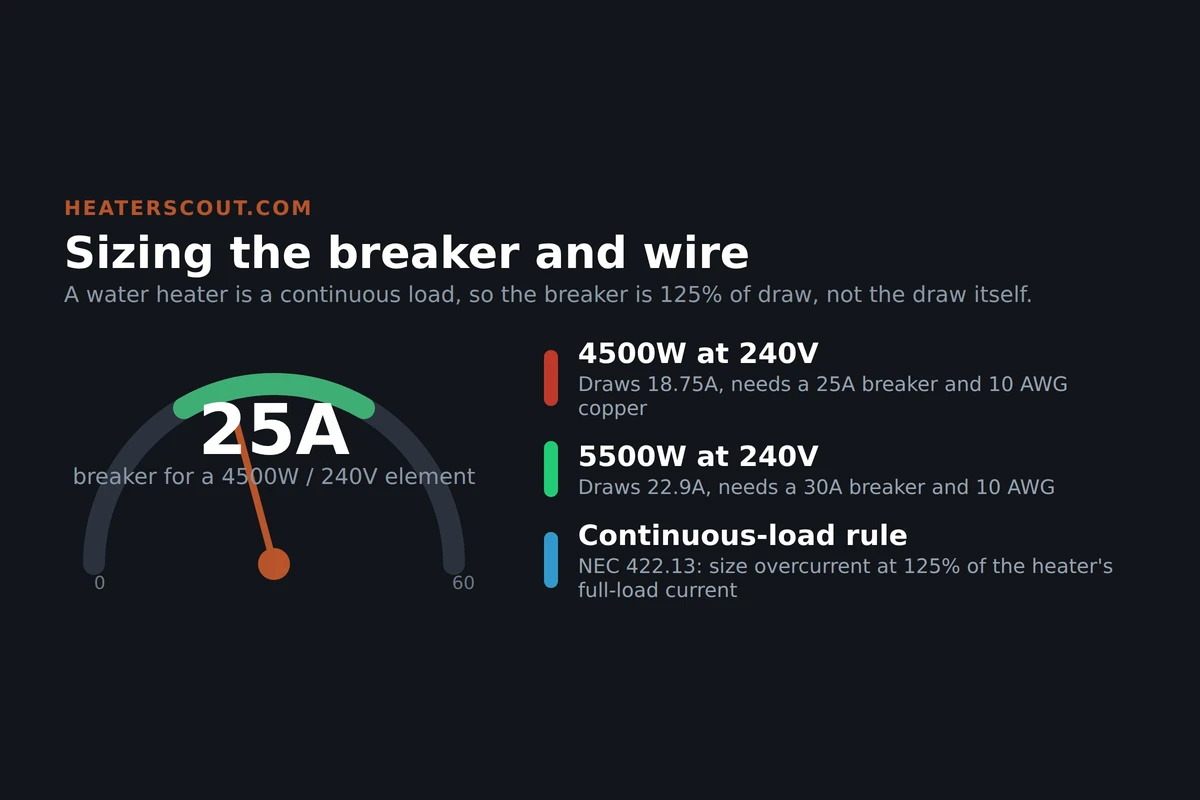
A 4500-watt element on a 240-volt tank pulls 18.75 amps when it fires. That number alone would fit on a 20-amp breaker, and that is exactly where people go wrong. The code does not let you size a water heater off its raw draw, because a storage tank can run for hours during recovery. It counts as a continuous load, so the breaker and the wire both get bumped 25% above the draw. Get that one factor wrong and the breaker either nuisance-trips or, worse, runs hot on wire that is too small.
What you actually need to size the circuit
Everything about a water-heater circuit comes off three facts you can read in five minutes. There is no guessing and no rule of thumb that beats the arithmetic. Pull these before you touch the panel.
- The element wattage, printed on the rating plate and stamped on the element itself (commonly 3800, 4500, or 5500 watts).
- The supply voltage, which is 240V in almost every house and 208V in apartments or commercial buildings on three-phase power.
- Whether the tank is single-element or dual-element non-simultaneous (residential tanks are non-simultaneous, so only one element runs at a time).
- That the circuit is dedicated, one home run from the panel to the heater with nothing else on it.
- Whether the conductors are copper or aluminum, because they size off different columns of the NEC ampacity table.
The math: amps, then 125%
Two formulas carry the whole job. The first is Ohm's law for a resistive load: current equals watts divided by volts. A 4500W element on 240V draws 4500 / 240, which is 18.75 amps. A 5500W element on the same 240V draws 5500 / 240, or 22.9 amps. That is the full-load current, the actual draw when the element is energized.
The second formula is the one the code forces on you. NEC 422.13 calls a fixed storage water heater a continuous load, and NEC 210.20 says the overcurrent device and the conductors have to be rated for 125% of a continuous load. So you multiply the draw by 1.25. The 18.75-amp element needs 18.75 times 1.25, which is 23.4 amps of breaker. The 22.9-amp element needs 28.6 amps. Then you round up to the next standard breaker size, because breakers only come in fixed values. 23.4 rounds up to a 25A breaker; 28.6 rounds up to a 30A. The wire follows the breaker, not the raw draw.
Read the draw
Watts divided by volts. 4500 / 240 = 18.75 A. This is the full-load current, the number a clamp meter would read on the element leg when it fires.
Apply the 125% continuous factor
Multiply by 1.25. 18.75 x 1.25 = 23.4 A. This is the minimum ampacity the breaker and the wire both have to carry without overheating during a long recovery.
Round up to a standard breaker
Standard sizes are 15, 20, 25, 30, 40, 50, 60. The smallest that covers 23.4 A is 25 A. Never round down to fit a breaker you happen to have.
Match the copper wire to that breaker
Under the NEC 60-degree copper column, a 25 or 30A breaker takes 10 AWG. Never let the wire lag the breaker, or the breaker will let the wire overheat before it trips.
Confirm the circuit is dedicated and 2-pole
240V means a two-pole breaker feeding both hot legs. Nothing else shares the circuit, no receptacles, no lights, no splices to other loads.
The numbers that cover almost every house
Residential electric tanks are boring in the best way. The overwhelming majority are 240V with a single 4500W or 5500W element, which is why one circuit spec shows up over and over.
A 30A two-pole breaker on 10 AWG copper is the default water-heater circuit in the country. It covers a 4500W element (which technically only needs 25A) and a 5500W element (which needs 30A) with one wiring standard, so plumbers and electricians stock it and stop thinking about it. The only time you drop below that is a small 3800W or lower element, which can sit on a 20A breaker with 12 AWG, and the only time you go above it is a commercial or oversized element past 5500W.
Run your own element
Set the wattage slider to your element and flip the voltage to match your building. The tool does watts over volts for the draw, multiplies by 1.25 for the continuous factor, rounds up to a standard breaker, and reads the matching copper wire off the 60-degree column. Watch what the 208V toggle does: the amps stay in the same ballpark, but a 240V element delivers only about three-quarters of its heat, so recovery slows even though the wiring is sized off nameplate watts.
Water heater breaker and wire calculator
Pick the element wattage and the supply voltage. Output is the full-load draw, the minimum standard breaker at 125%, and the minimum copper wire. This is a planning tool, not a substitute for a licensed electrician or your local inspector.
Full-load draw
18.8 A
Amps = watts / volts
Minimum breaker
25 A
125% of draw, rounded up
Minimum copper
10 AWG
NEC 60°C column
—
Continuous load
A load that runs for three hours or more at a stretch. NEC 422.13 puts a fixed storage water heater in this bucket, and NEC 210.20 then requires the breaker and the conductors to carry 125% of the load's current. The point is heat: a breaker sitting at its full rating for hours drifts warm and can nuisance-trip, so the extra 25% keeps it and the wire cool during a long recovery cycle. This one classification is the entire reason a 18.75-amp heater lives on a 25 or 30A breaker instead of a 20A.
Dual-element tanks and the shared-circuit trap
Two things confuse people at this point. The first is dual-element tanks. A standard residential tank has an upper and a lower element, and it looks like it should draw double. It does not. Residential tanks are wired non-simultaneous: the upper thermostat energizes the top element, and when that zone is up to temperature it drops out and passes control to the lower element. Only one element is ever hot at a time. So you size the circuit for the larger single element, not the sum, and two 4500W elements still ride on the same 25 or 30A breaker as a single-element heater.
The second is sharing. A water heater has to be on its own dedicated circuit with nothing else on it. It is a continuous, high-current load, and the 125% sizing math assumes the whole circuit belongs to the heater. Splice an outlet or a light onto that home run and you have overloaded the breaker and defeated the reason it was sized the way it was. One home run, one heater, no exceptions.
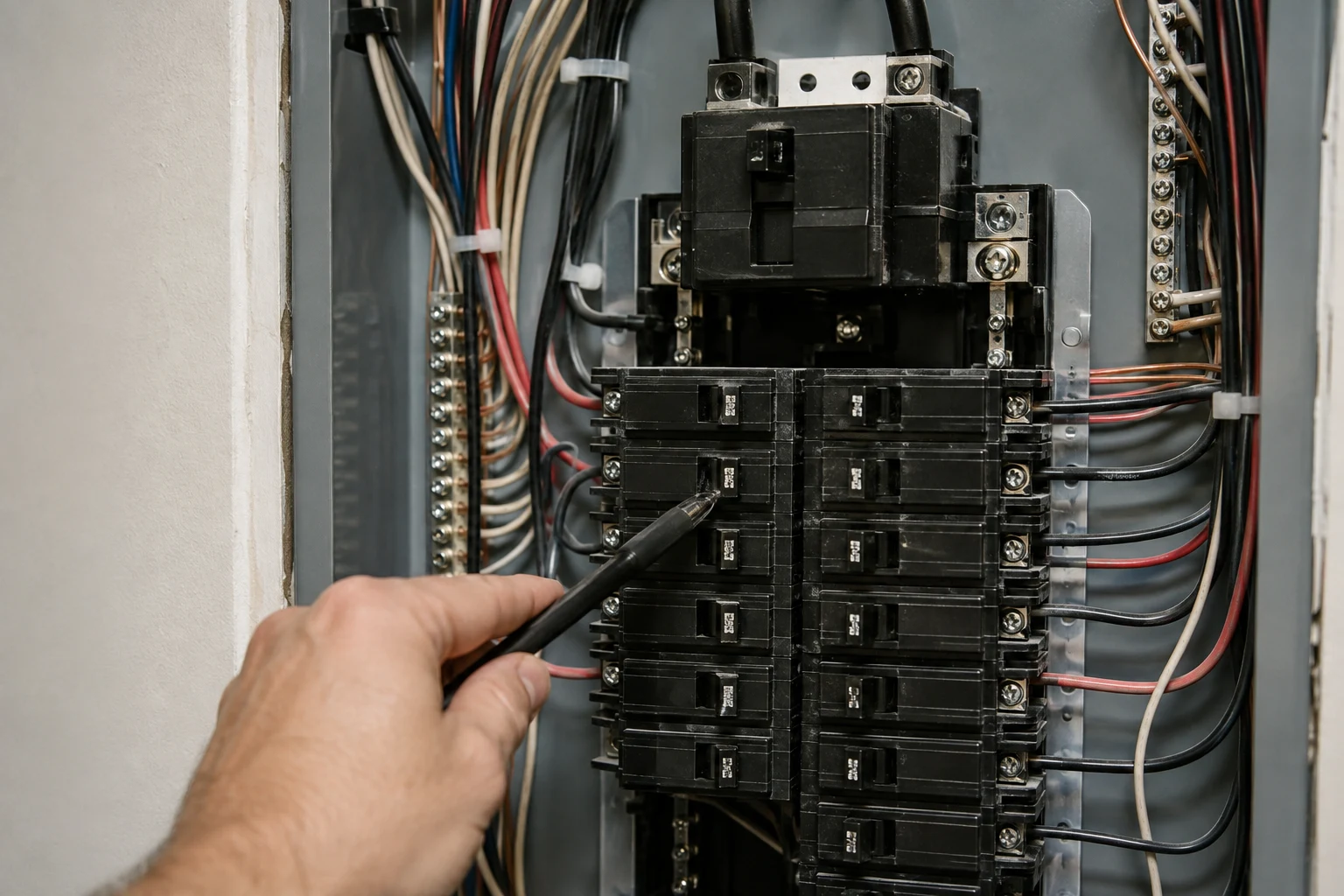
This is line-voltage work inside a live panel, and the penalty for a wrong wire gauge is a fire, not an inconvenience. Sizing the breaker is arithmetic you can trust, but landing conductors on panel lugs and torquing them to spec is a licensed electrician's job in most jurisdictions and a permit item in many. Use the numbers here to know what should be on the circuit, then have it done or inspected by someone who does it for a living.
Frequently asked
What size breaker does a 4500-watt water heater need?
A 4500W element on 240V pulls 18.75 amps (4500 divided by 240). A storage water heater is a continuous load, so the code makes you size the breaker at 125% of that draw, which is 23.4 amps. The smallest standard breaker that covers 23.4 is 25 amps, so a 25A two-pole breaker is the minimum. Many installers jump straight to a 30A breaker because it is the more common size on the shelf and still legal, but 25A is the true minimum. The wire that goes with either is 10 AWG copper.
What size breaker for a 5500-watt water heater?
5500W on 240V draws 22.9 amps. At 125% for a continuous load that is 28.6 amps, so you round up to a 30A two-pole breaker. The conductor is 10 AWG copper, same as the 4500W heater, because 10 AWG copper is good for the 30A breaker under the 60-degree column. This is why 30A and 10 AWG is the most common water-heater circuit in the country: it covers every single-element tank up to 5500W with margin to spare.
Why is a water heater sized at 125% of its draw?
NEC 422.13 classifies a fixed storage water heater as a continuous load, and NEC 210.20 requires the branch-circuit overcurrent device and the conductors to be rated for 125% of a continuous load. The heater can run for hours during a long recovery, and running an appliance near a breaker's full rating for hours makes the breaker heat up and nuisance-trip. The 125% cushion keeps the breaker and wire cool during sustained operation. Skip the factor and you undersize the whole circuit.
Does a dual-element water heater need a bigger breaker?
No, and this trips people up. A residential dual-element tank is wired non-simultaneous, meaning only one element is energized at a time. The upper thermostat fires the top element, and when that section is satisfied it hands off to the lower element. Both elements never draw at once, so you size the circuit for the larger single element, not the sum. Two 4500W elements still run on a 25 or 30A breaker with 10 AWG, exactly like a single-element heater.
Can a water heater share a circuit with something else?
No. A fixed storage water heater has to be on its own dedicated circuit with nothing else connected. It is a continuous, high-current load, and sharing it with outlets or lights would overload the breaker and violate the dedicated-circuit intent behind the 125% sizing rule. Run one home run from the panel to the heater with no receptacles, junctions to other loads, or splices feeding anything else on that circuit.
What happens on 208V instead of 240V?
208V shows up in apartments and commercial buildings fed from three-phase power. A resistance element rated at 240V still draws current at 208V, but it delivers less heat, roughly 75% of its nameplate wattage, because heat output falls with the square of the voltage ratio. A 4500W/240V element makes about 3380W at 208V. You still size the breaker and wire off the amps at 208V, but recovery is slower, which is why you sometimes see higher-wattage elements or 208V-rated elements specified in those buildings.
Should I use 10 AWG or 12 AWG for my water heater?
For any standard single-element residential tank, 10 AWG copper on a 25 or 30A breaker is the answer. 12 AWG copper is only rated to 20A under the 60-degree column, which covers a small 3800W or smaller element but leaves no room, and most water heaters exceed that. When you are between the two, 10 AWG is the safe default because it matches the 30A breaker almost every tank ends up on. Aluminum is a different sizing table entirely, so if you inherited aluminum feeders, size those off the aluminum column.