You start the washing machine, it clunks over to the next fill, and the whole wall bangs like someone hit a pipe with a hammer. It seems to come from around the water heater, so the heater gets the blame. The heater is usually just the setting. What you are hearing is water hammer: a fast-closing valve stops a moving column of water dead, and because water barely compresses, the sudden stop throws a pressure shockwave back through the supply lines. A single spike can briefly top 500 psi against pipes that normally run 40 to 80. This page sorts water hammer from the slow pressure creep of thermal expansion, which people confuse with it, and walks the fixes a homeowner can actually do: arrestors at the quick-closing valves, a pressure-reducing valve if your pressure is high, an expansion tank on a closed system, and strapping down loose pipe so the shockwave stops rattling the runs.
Water hammer
The bang or knock you hear when moving water is forced to stop suddenly, usually by a valve or appliance snapping shut. Water is nearly incompressible, so when the flowing column slams to a halt it sends a pressure shockwave back through the pipe. That wave hits valves, fittings, and pipe walls, and briefly the pressure can jump far above normal, over 500 psi against lines that run 40 to 80. It is a sudden shock, not a slow buildup, which is what separates it from thermal expansion.
Key takeaways
- Water hammer is a sudden shock from fast-closing valves, not the slow drip-and-weep of thermal expansion. The two need different fixes.
- Normal house pressure runs 40 to 80 psi. A hammer spike can briefly top 500 psi, which is what loosens fittings and cracks solder joints over time.
- Above 80 psi you need a pressure-reducing valve. That alone kills a lot of banging and protects the whole system.
- A sealed water hammer arrestor at the offending valve is the modern fix. Old air chambers waterlog and stop working.
- An expansion tank is not a hammer arrestor. It handles thermal expansion on a closed system, not the shock from a slamming valve.
Where you actually hear it around the water heater
Water hammer is generated at the quick-closing valve, not at the tank, but the shockwave travels the supply lines both ways and the hot and cold lines feeding the heater are a common place to hear and feel it. Three household appliances cause most of it because their valves shut fast: a washing machine solenoid, a dishwasher, and a toilet fill valve. Single-handle faucets closed quickly can do it too. Match your situation to one of these before you start fixing things, because the fix goes at the source.
Bang every time the washer changes fill
The washer uses a solenoid valve that snaps shut in a fraction of a second, which is the classic water hammer trigger. The fix is a screw-on arrestor at the washer supply hoses, hot and cold. It threads on between the wall valve and the hose in a couple of minutes, no soldering, and it puts the cushion right where the shock is made.
Knock right after a toilet finishes filling
Fill valves and dishwasher inlet valves close fast and knock the same way. An arrestor on the fixture supply, or a working air chamber on that branch, absorbs it. If the toilet is the noisy one, a slower-closing fill valve can help as well as the arrestor.
Everything bangs and the pressure feels strong
If hammer shows up all over and taps feel forceful, the underlying issue is likely high pressure. Put a gauge on a hose bib. Over 80 psi means a pressure-reducing valve is both a code item and the single most effective fix, since it quiets every shutoff in the house at once.
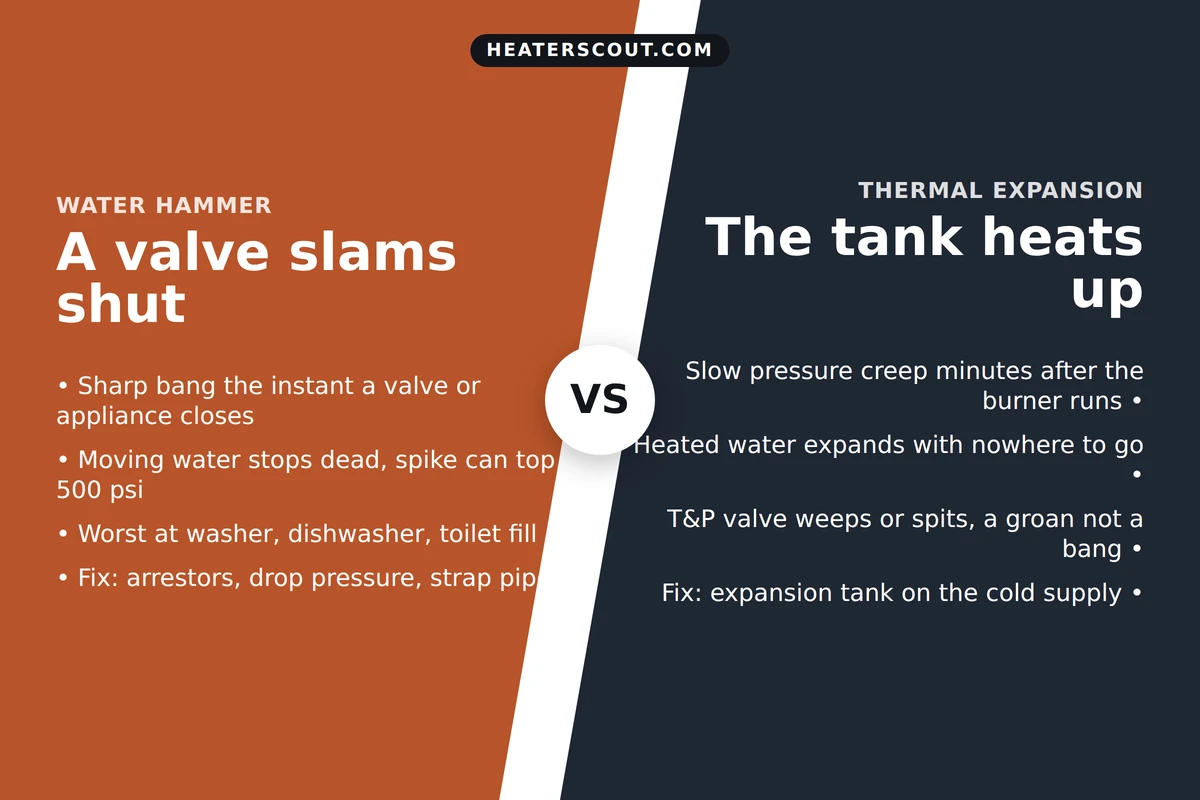
First, tell water hammer from thermal expansion
People lump every water heater noise together, but water hammer and thermal expansion are different problems with different fixes, and you can sort them by when the noise happens and what the relief valve is doing. Walk this before you buy anything.
Sharp bang the instant a valve or appliance closes
That is water hammer. A fast-closing valve stopped the flow and threw a shockwave back down the line. Note which fixture triggers it, a washer, dishwasher, or toilet is the usual culprit, because the arrestor goes at that valve.
Slow groan or tick minutes after the burner or element runs, relief valve dripping
That is thermal expansion, not hammer. The heater warmed the water, it expanded in a closed system with nowhere to go, and pressure crept up until the temperature and pressure relief valve weeped. The fix is an expansion tank on the cold supply, not an arrestor.
Bang everywhere and the water feels forceful
Check static pressure with a gauge on a hose bib. If it reads over 80 psi, high pressure is amplifying every shutoff, and a pressure-reducing valve on the main is the fix that quiets the whole house. Code requires a PRV above 80 psi anyway.
Rattle or vibration in the walls when water runs or stops
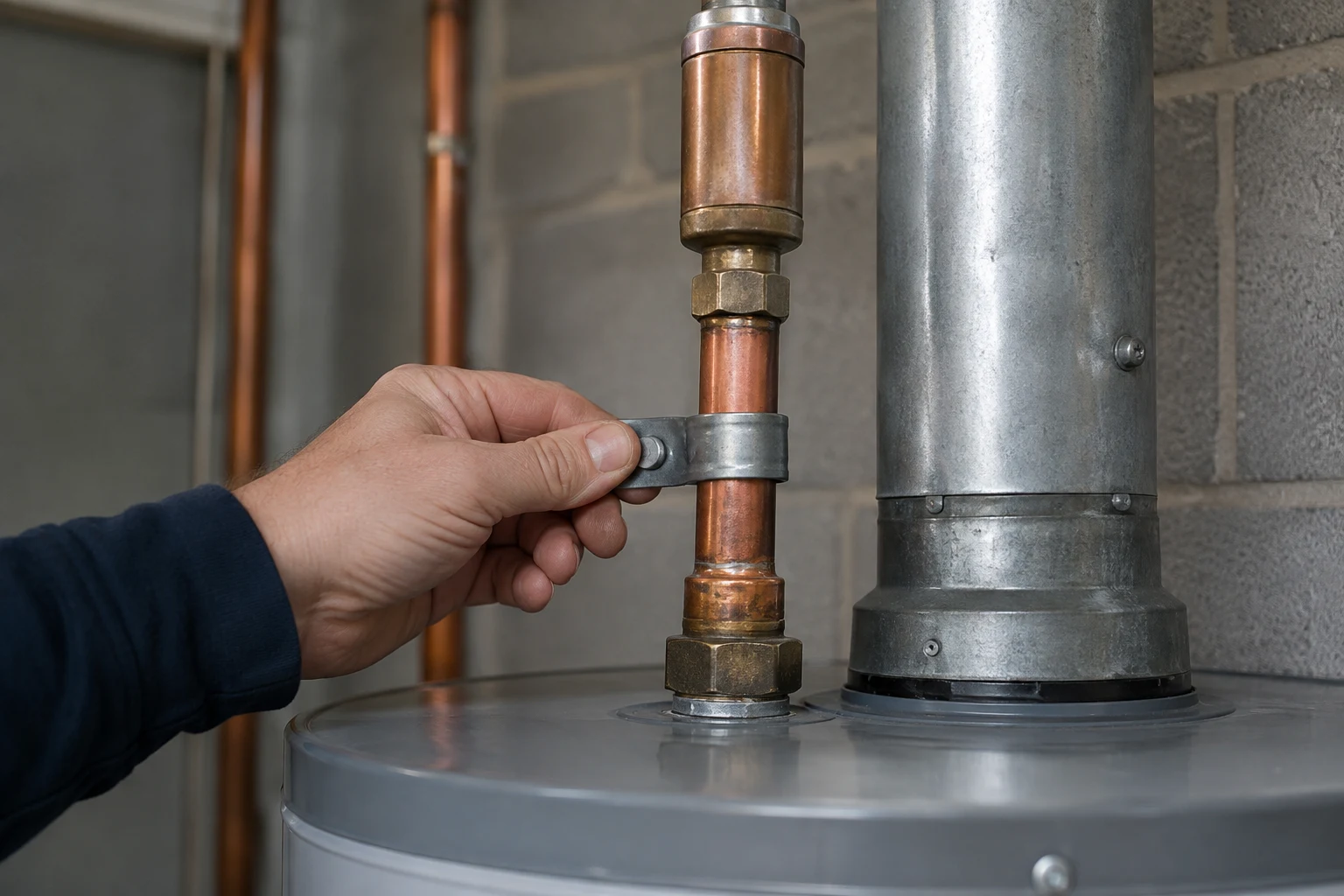
Loose pipe. The shockwave is real but the noise is a run of pipe banging against framing because a strap is missing or loose. Tighten or add pipe straps where you can reach the runs; it is often the cheapest part of the fix.
How to fix water hammer, in order
Work from the easiest and most direct fix outward. Most homeowners can do the first three. The point is to put a cushion where the shock is made, drop the pressure that amplifies it, and stop loose pipe from rattling.
Do not plug a weeping relief valve
A pressure-reducing valve, a backflow preventer, or a check valve on your incoming water makes the plumbing a closed system, which turns thermal expansion into a real pressure problem, and the temperature and pressure relief valve is the last-line safety device that dumps that pressure if it climbs too far. Never cap, plug, or block a weeping relief valve to stop the drip. A dripping relief valve on a closed system is telling you to add an expansion tank, not to silence the valve.
Arrestor, air chamber, PRV, expansion tank: which does what
These four parts get mixed up because they all involve air and pressure, but each solves a specific piece and they are not interchangeable. Match the part to the job.
| Water hammer arrestor | Sealed piston or bladder charged with air or nitrogen, threaded near a quick-closing valve. Absorbs the shock spike. Does not waterlog. Code wants ASSE 1010. |
| Air chamber | Older capped pipe stub trapping plain air as a cushion. Works until the air dissolves and it goes waterlogged, then needs the system drained to reset. |
| Pressure-reducing valve | Regulator on the main that brings static pressure down. Required by code above 80 psi. Lowers the force behind every shutoff, so it quiets hammer house-wide. |
| Expansion tank | Partly air-filled tank on the cold supply that absorbs thermal expansion in a closed system. Stops the relief valve weeping. Cushions some shock but is not an arrestor. |
| Pipe straps / clamps | U-straps that fasten supply runs to framing. Do not stop the shockwave, but stop loose pipe from banging against structure, which kills much of the audible rattle. |
| T&P relief valve | Safety device that dumps pressure if the tank overheats or overpressurizes. A drip signals thermal expansion. Never cap or block it. |
Frequently asked
Why does my water heater cause a banging noise in the pipes?
The bang is almost always water hammer, and the water heater is usually the setting rather than the direct cause. Water hammer happens when moving water is stopped suddenly, most often by a fast-closing valve like a washing machine solenoid, a dishwasher, or a toilet fill valve snapping shut. Water is nearly incompressible, so when that moving column slams to a halt it sends a pressure shockwave back through the supply lines, and a single spike can briefly top 500 psi against pipes that normally run 40 to 80. That wave rattles the hot and cold lines feeding the heater and can shake the tank itself, so the noise seems to come from the heater. If instead you hear a slow groan or a tick a few minutes after the burner runs, and the relief valve dribbles, that is thermal expansion, a different problem covered below. The sharp bang the instant a valve closes is water hammer.
What is the difference between water hammer and thermal expansion?
They sound different and they come from different causes. Water hammer is a sudden shock: a valve or appliance closes fast, the moving water stops dead, and you get a sharp bang or a series of knocks right at the moment of shutoff. Thermal expansion is a slow squeeze: the water heater warms the water, heated water takes up more room than cold, and in a closed system it has nowhere to go, so pressure climbs steadily over the minutes after the burner or element runs. Thermal expansion shows up as a temperature and pressure relief valve that weeps or spits shortly after a heating cycle, sometimes a groan or a tick, not the crack of a valve slamming. The fixes are different too. Water hammer wants arrestors, lower pressure, and secured pipes. Thermal expansion wants an expansion tank on the cold supply.
What is a water hammer arrestor and is it better than an air chamber?
A water hammer arrestor is a sealed device you thread onto the supply line near a quick-closing valve. Inside is a piston or bladder backed by an air or nitrogen charge that compresses to absorb the shockwave when water stops. An air chamber is the older approach: a capped vertical stub of pipe that traps a pocket of plain air as a cushion. The trouble with air chambers is that the trapped air slowly dissolves into the water and the chamber becomes waterlogged, so it quietly stops working after months or years. An arrestor is sealed, so its air charge does not dissolve away, which is why it needs no periodic draining and is the modern choice. Plumbing code backs this up: the IPC requires an arrestor conforming to ASSE 1010 wherever quick-closing valves are used. Arrestors do wear eventually, but they outlast an open air chamber by a wide margin.
How do I recharge a waterlogged air chamber?
You drain the system so fresh air can refill the chamber. Shut off the main water supply, then open the highest faucet in the house and the lowest one, often a basement or outdoor tap, and let the lines drain completely, which usually takes 20 to 30 minutes until the flow stops. As the water leaves, air is pulled back into the chambers. Then close the low faucet, turn the main back on slowly, and let the high faucet run until it stops sputtering and runs steady. That resets the air cushion. If the hammer comes back within weeks, the chambers are undersized or corroded, and swapping them for sealed arrestors at the quick-closing valves is the lasting fix rather than draining the house again.
When does high water pressure cause water hammer, and do I need a pressure-reducing valve?
High pressure does not create water hammer by itself, but it makes every shutoff hit harder and turns a faint knock into a real bang. Comfortable household pressure is roughly 45 to 65 psi, and the accepted operating range is 40 to 80. Once static pressure climbs past 80 psi it stresses fixtures, appliance valves, and joints, and it makes water hammer worse. Plumbing code draws the line there: where static pressure exceeds 80 psi, an approved pressure-reducing valve with a strainer is required, and the pressure has to be brought to 80 psi or less. Put a gauge on an outside hose bib to check. If you read over 80, a PRV is both a code item and one of the most effective things you can do to quiet hammer across the whole house at once.
Will an expansion tank stop water hammer?
It helps, but it is not the right tool for the job. An expansion tank is sized and placed to absorb thermal expansion, the slow pressure rise from heating water in a closed system, and it sits on the cold supply near the water heater. Its air cushion does soak up some shock, so a system with a healthy expansion tank may hammer a little less. But water hammer is generated at the quick-closing valve, often far from the heater, and the shockwave is strongest right there. To actually stop hammer you put the cushion where the shock is made, which means an arrestor at the washing machine, dishwasher, or toilet. Use the expansion tank for thermal expansion and arrestors for water hammer. If a closed system has neither, you can end up with both problems at once.
Can I fix water hammer myself or do I need a plumber?
A lot of it is do-it-yourself. Screw-on arrestors at the washing machine and dishwasher hoses take minutes and no soldering, resetting waterlogged air chambers by draining the system is free, and tightening or adding pipe straps to stop loose runs from rattling needs only a screwdriver and a few clamps. Where you want a plumber is anything past those. Sizing and installing a pressure-reducing valve on the main, adding an expansion tank and setting its precharge to match house pressure, or placing arrestors inside a finished wall are jobs that involve cutting into the main line and getting the details right. If the banging continues after you have added arrestors, checked pressure, and strapped the pipes, that is the signal to call someone, because a persistent spike can loosen joints and split lines over time.