Adding a second water heater is not one decision, it is two. First you buy the extra tank. Then you decide how the two tanks talk to each other, and that second choice is the one that actually determines whether you get more hot water at once or hotter water on a long draw. Pipe them in line, one feeding the next, and you have a series setup that leans on temperature. Pipe them side by side off a shared manifold and you have a parallel setup that leans on volume. They solve different problems, and picking the wrong one for your house means you spent the money and still run cold.
Quick answer
Pick parallel when the problem is volume, several fixtures wanting hot water at the same time, because both tanks draw together and the combined first-hour delivery nearly doubles. Parallel must be piped reverse-return so the total path length through each tank is equal, which balances flow and makes both tanks wear evenly. Pick series when the problem is temperature, very cold incoming water or one long sustained draw, because the first tank preheats and the second finishes, giving more temperature rise and steadier recovery. Series wears the second tank harder and does not double your usable gallons.
The non-negotiables on either layout
However you pipe the pair, a handful of things are not up for interpretation. These are the items an inspector looks for and the ones that keep the install safe and serviceable, whichever layout you land on.
| A T&P valve on each tank | Every heatable, isolatable tank keeps its own temperature and pressure relief valve, discharged down to within a few inches of the floor. Never share one or plug an idle tank's valve. |
| Isolation valves per tank | A shutoff on the cold inlet and the hot outlet of each tank lets you take one offline to flush, replace an anode or element, or swap it, without killing hot water to the house. |
| System expansion control | More stored water means more thermal expansion against a check valve or PRV. Size an expansion tank to the total combined volume and street pressure, usually larger than a single heater needed. |
| Equal tank volume | Twin identical tanks. Reverse-return only balances matched sizes; a small tank paired with a big one empties first and drops the blended outlet temperature. |
| Reverse-return on parallel | Equalize total path length through each tank so friction and flow split evenly. Skip it and one tank hogs the flow and wears out early. |
| Local code sign-off | Codes vary and some jurisdictions restrict series feeding. Have a licensed plumber confirm the layout, the feed, and the relief arrangement for your area. |
What each layout actually does
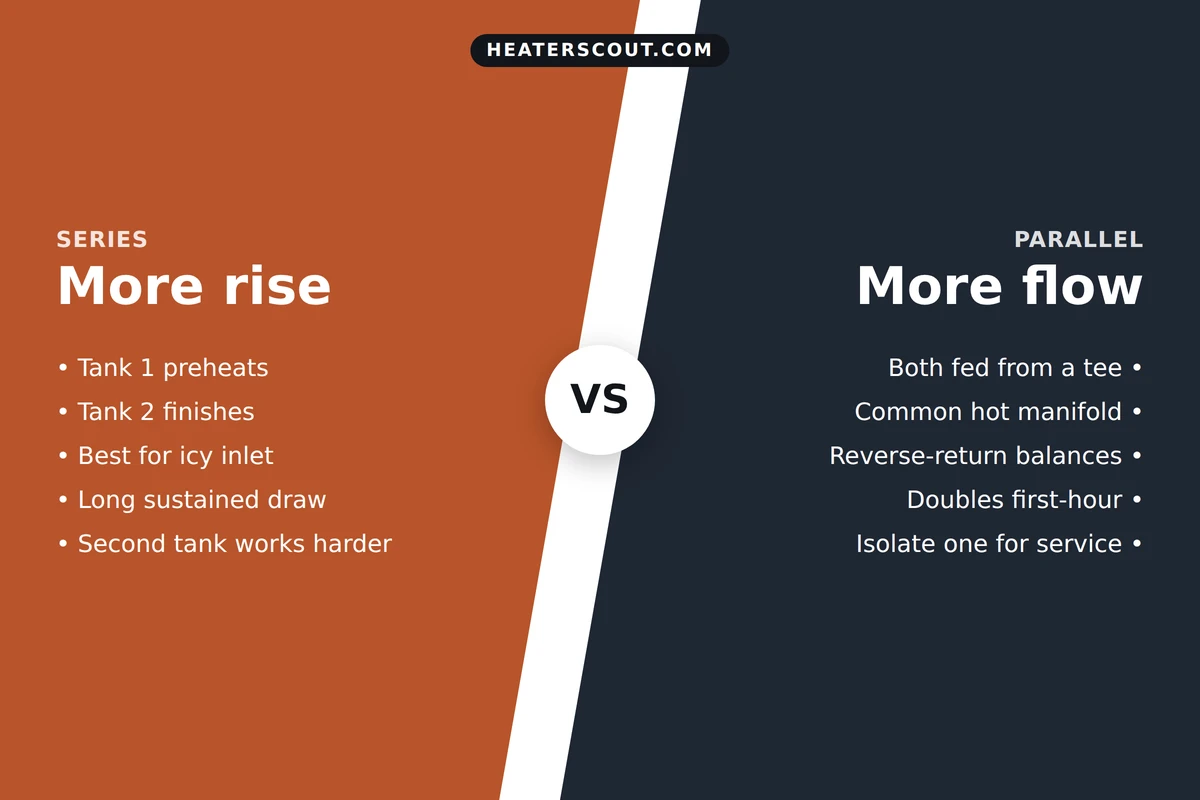
The names describe the plumbing, not the benefit, so it helps to picture the water. In series the cold supply enters tank one, gets preheated, and that warmed water becomes the feed for tank two, which does the final heating and sends hot water to the house. The tanks work like two stages of the same furnace. In parallel the cold supply hits a tee and splits, feeding both tanks at once, and both hot outlets join a common manifold that serves the house. The tanks work like two lanes of the same highway. That difference is why one wins on rise and the other wins on flow.
| Series (in line) | Parallel (reverse-return) | |
|---|---|---|
| How water moves | Cold to tank 1, then tank 1 to tank 2, then to the house | Cold tees to both tanks, both feed a shared hot manifold |
| What it buys you | More temperature rise and steadier recovery on a long draw | More simultaneous flow and near-double first-hour delivery |
| Best when | Incoming water is very cold, or one long sustained draw | Several fixtures want hot water at the same time |
| Wear pattern | Second tank does the final heating and wears faster | Both tanks fire and age together, if piped reverse-return |
| One tank fails | Usually no hot water unless you plumbed a bypass | Isolate it and run on the other tank |
| Piping care | Simpler runs, but code may restrict series feeding | Must equalize total path length through each tank |
| T&P valve | One on each tank, always | One on each tank, always |
Which house picks which
Skip the theory and match it to how your household actually runs out of hot water. The way you run short of hot water tells you the layout.
Morning-rush house, run short when taps overlap, go parallel
Three people showering back to back, the dishwasher and laundry stacked on top, and a single tank goes lukewarm by the last shower. This is a volume problem, not a temperature problem. Two tanks in parallel draw together, so the combined first-hour delivery nearly doubles and several fixtures can pull at once without the tank collapsing. Pipe it reverse-return so both tanks share the load, and add isolation valves so you can service one without a cold-shower day.
Cold-ground or long-draw house, water comes in cold or the pull runs long, go series
Groundwater comes in near 40 degrees in winter, or you have a big soaking tub or a jetted spa that runs a long steady draw. A single tank struggles to pull that cold water all the way up, or fades partway through the fill. Series preheats in the first tank and finishes in the second, so you get more temperature rise and the outlet holds steady through a long pull. You are not chasing more simultaneous fixtures, you are chasing hotter, steadier water.
Replacing and expanding at once, put in two new identical tanks in parallel
Your ten-year-old tank is on borrowed time and you already wanted more capacity. Do not bolt a fresh tank onto the tired one. Put in two new, identical tanks so they balance in parallel, wear evenly, and reach end of life together. Matched volume is what lets reverse-return split the flow down the middle, and matched age keeps you from being back in the closet in two years for the older tank.
The one detail that makes parallel work
Parallel piping fails quietly when it is done wrong. Tee both tanks off a header with whatever pipe length is convenient and the water does what water does: it takes the easiest path. The tank with the shorter, lower-friction run carries most of the flow, fires constantly, and ages out while the far tank sits half idle. You paid for two tanks and got the wear of one and a half. The fix is reverse-return, and it is not optional on a parallel pair.
Reverse-return piping
A parallel layout where each tank is fed by the shortest path but returns by the longest, so the first tank onto the cold supply is the last one onto the hot manifold. Total pipe length through every tank, inlet plus outlet, comes out equal. Because friction through each tank is then balanced, the incoming flow splits evenly, both tanks fire and recover at the same rate, and they wear and age together instead of one running lead. It only balances correctly when the tanks are the same volume. The tradeoff is a little extra pipe, which is cheap next to a tank that dies years early from doing all the work.
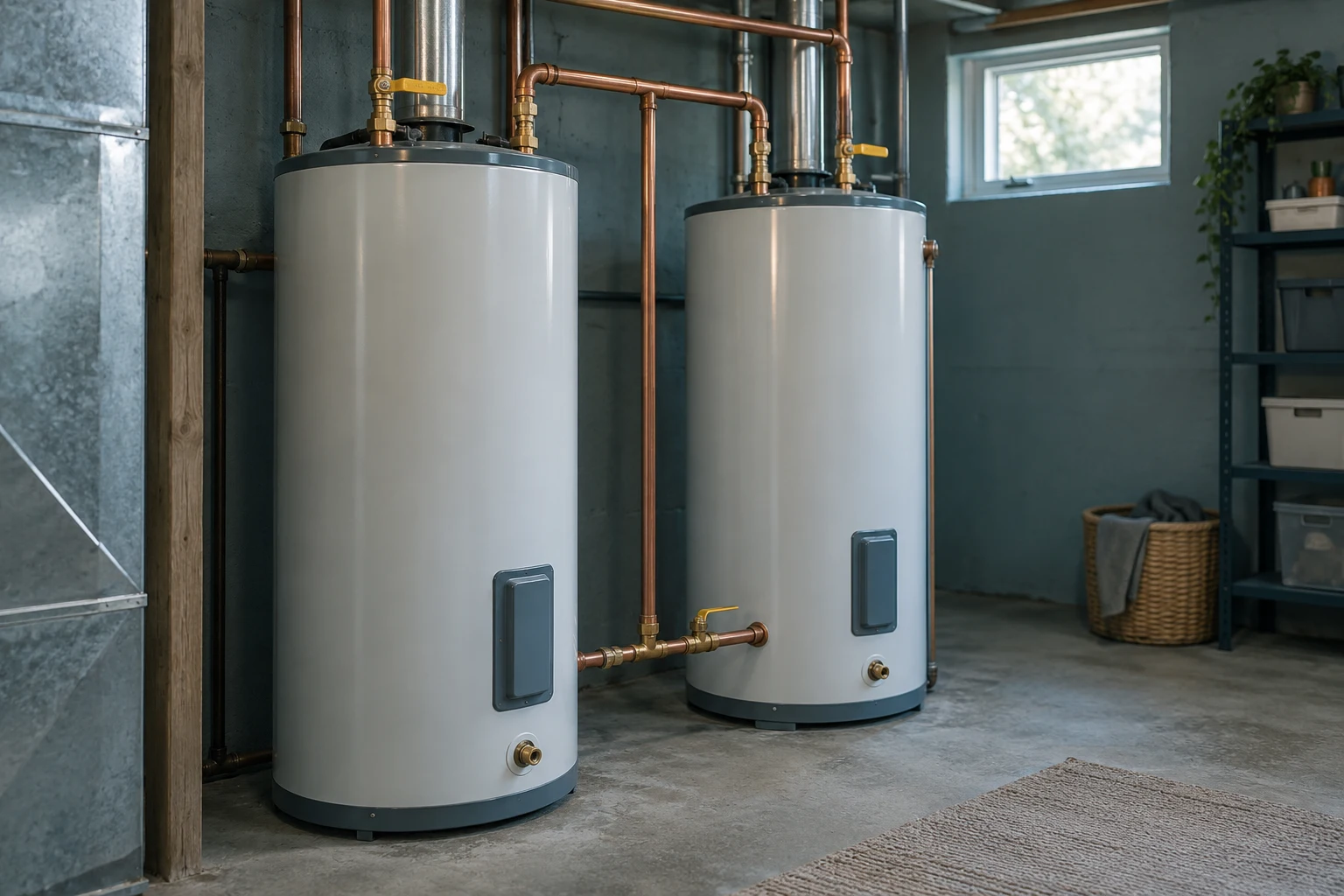
Two tanks fix two different shortages, and the piping is where you choose which one you solve. If the house runs out because too many taps open at once, go parallel, pipe it reverse-return, and add the isolation valves. If it runs out because the water comes in cold or the draw runs long, series stacks the heat and holds the temperature. Match the layout to your actual failure, give each tank its own relief valve, size the expansion tank for the pair, and let a local plumber confirm the code. Get that right and the second tank earns its place instead of just doubling your standby losses.
Frequently asked
Should I pipe two water heaters in series or in parallel?
It depends on whether you are short on temperature or short on volume. Pipe them in series when your incoming water is very cold or you have a long, steady draw like a big soaking tub that runs for a while, because the first tank preheats the water and the second finishes the job, giving you more temperature rise and steadier recovery on a sustained pull. Pipe them in parallel when the problem is everyone showering at once, because parallel splits the draw across both tanks and roughly doubles the first-hour delivery, so you get more simultaneous flow. Most homes that add a second tank are chasing the run-out-of-hot-water-in-the-morning problem, and that is a volume problem, which points to parallel with reverse-return piping. Series is the answer when a single tank cannot pull cold groundwater up to temperature fast enough on its own.
What is reverse-return piping and why do parallel tanks need it?
Reverse-return is the piping trick that makes two parallel tanks share the work evenly. Water flows to each tank by the shortest path but returns by the longest, so the tank that is first on the cold supply is last onto the hot manifold. Add up the total pipe run through each tank, inlet plus outlet, and they come out equal. That matters because water follows the path of least resistance. If you just tee both tanks off a header with unequal runs, the tank with the shorter, lower-friction path hogs the flow, so it heats and refills constantly while the far tank barely moves. One tank ages out years before the other. Equal total length equalizes the friction, the flow splits down the middle, and both tanks fire, wear, and age together. Reverse-return is the proper method for twinning equal-size tanks.
Does adding a second water heater actually double my hot water?
In parallel it nearly does, on the first-hour number that matters. First-hour rating is roughly the usable tank volume plus one hour of recovery: tank gallons times about 0.70, plus the recovery rate in gallons per hour. Two 50-gallon gas tanks that each deliver around 75 to 90 gallons in the first hour give you a combined first-hour rating close to 150 to 180 gallons when piped in parallel, because both are drawing and recovering at the same time. In series you do not double the volume the same way. The gain there is temperature rise and steadier output on a long draw, not a bigger gulp of hot water up front. So if the goal is more people showering back to back, parallel is what gets you the near-double. Do not invent your own gallon numbers though, check the first-hour rating printed on each unit's yellow EnergyGuide label and add them.
Do both tanks need their own T&P valve and expansion tank?
Each tank keeps its own temperature and pressure relief valve, no exceptions. The T&P is a safety device rated to the tank it sits on, and every tank that can be heated and isolated has to be able to relieve itself, so you never share one T&P across two tanks or plug the one on a tank you think is idle. Run each discharge line down to within a few inches of the floor per code. Thermal expansion is handled for the system, not per tank: because a two-tank setup holds more water and makes more expansion against a closed check valve or pressure-reducing valve, you want a properly sized expansion tank on the cold side, and a bigger combined volume usually means a bigger expansion tank than a single heater used. Size it to the total stored volume and your street pressure, and confirm against the expansion tank maker's chart.
Can I take one tank offline for service without losing hot water?
That is one of the best reasons to pipe in parallel with isolation valves. Put a shutoff on the cold inlet and the hot outlet of each tank, and you can close both valves on one tank, drain it, replace an element or an anode or flush it, and the house still has hot water from the other tank the whole time. It is why parallel is friendlier for a home that cannot afford a cold-shower day. Series does not give you that for free. Because the water runs through both tanks in line, pulling one tank normally breaks the path unless you also plumb a bypass around it. If uptime during service matters to you, parallel with per-tank isolation valves is the layout that delivers it.
Can I mix a big tank and a small tank, or an old one with a new one?
Twin equal tanks. Reverse-return balancing assumes both tanks are the same volume, and it only splits flow evenly if they are. Pair a 40 with a 50 in parallel and the smaller tank empties first, which drags down the blended outlet temperature the moment it runs dry, so you lose the even, predictable behavior the whole method exists to give you. Matching ages matters too. If you are adding capacity to an existing heater that is already eight or ten years old, you are bolting a fresh tank onto one that may fail soon, and then you are back in there. Most installers put in two new, identical tanks at the same time so they balance, wear together, and reach the end of their life together instead of stranding you with a mismatched pair.
Is series piping allowed by code, and are there gotchas?
Rules vary by jurisdiction, so check your local plumbing code and have a licensed plumber confirm the layout before you commit, because some areas restrict or disallow certain series feeding arrangements and how the tanks are fed and relieved. The practical gotchas with series are the ones that bite even where it is allowed: the second tank does most of the final heating and wears faster than the first, you generally have no hot water if either tank in the line fails unless you built in a bypass, and you still need a full T&P on each tank. Series earns its keep on genuinely cold-inlet or long-sustained-draw situations. For the everyday goal of more simultaneous hot water in a busy house, parallel with reverse-return is the more forgiving and more serviceable choice.