A Titan tankless has no screen and throws no error code, which throws people off the moment something goes wrong. These electric units, built by Niagara Industries in Miami and sold as the SCR2, SCR3, and SCR4 line, tell you what is happening with a single green power light and a red light for each heating element that fires. That is the whole readout. So troubleshooting a Titan is not about decoding a number, it is about reading three things in order: is the green light on, does a red light come on when you call for hot water, and what is the water temperature doing. Get that sequence straight and almost every no-hot-water, lukewarm, or dead-unit complaint sorts itself into one of a handful of causes, most of them at the cold-water inlet where the flow switch lives.
| N-64 (SCR2) | 6.4 kW · ~30 A · 30 A 2-pole breaker · 10 AWG · point-of-use |
| N-85 (SCR2) | 8.5 kW · 38 A · 40 A 2-pole breaker · 8 AWG · ~3.0 GPM |
| N-100 (SCR2) | 10.8 kW · 49 A · 50 A 2-pole breaker · 6 AWG · ~3.5 GPM |
| N-120 (SCR2) | 11.8 kW · 54 A · 60 A 2-pole breaker · 6 AWG · ~4.0 GPM · whole-house |
| SCR3 / SCR4 | N-160 up to N-270, 16–27 kW, 240V, up to ~112 A, multi-module |
| Readout | Green LED = board powered · red LED = element firing · no digital display |
| Reset | Red button under top cover, or cut breaker 5 min |
| Tech line | Niagara Industries 888-848-2680 |
Quick answer
Read the lights in order. No green light means no power to the board, so check the double-pole breaker and the wire terminals. Green on but no red light when you open a hot tap means the flow switch is not activating, usually from a clogged inlet filter or sediment and corrosion around the switch, so clean the cold inlet and confirm strong flow. Green on with a red light but cold water means a dead heating element or a bad SCR on the board. Lukewarm on clean flow is either a sizing shortfall for your winter rise or a partly failed element bank. There is no error code to look up, so the LED pattern plus the water temperature is the diagnosis.
Read the two lights before you touch anything
Titan built these units cheap and simple, and the diagnostic interface reflects that. On an SCR2 board there is one green LED that means the control board has power and is alive, and there is a red LED for each heating element the board is firing. When you open a hot tap and the flow switch closes, you should hear a faint click and see a red light come on within a second. That red light is good news: it means the unit sensed flow and is trying to heat. The mistake owners make is assuming a red light is a warning, the way it would be on almost any other appliance. Here it is the opposite. Red means firing.
So the fault map is short. Green light out entirely: the board has no power, and you start at the breaker and the incoming terminals, not inside the unit. Green on, but no red light appears when you run a full-open hot tap: the board is fine and powered but never saw enough flow to activate, which is a flow-switch or inlet problem. Green on, red lights come on and stay on, but the water is cold or barely warm: the activation worked and the board is calling for heat, so the failure is downstream in a heating element or the SCR that switches it. And all the red LEDs blinking or locked on together is the one genuine board alarm, a failed component or bad SCR, which points at replacing the control board.
The board is dead or unpowered
Nothing lights up at all. Kill the breaker, check that the 2-pole breaker has not tripped or loosened, and confirm both legs of 240V land on the unit's terminals. This is a power-delivery problem ahead of the heater, not a heater fault, until the green light returns.
It never activates
The board is alive but no element fires when you call for hot water. Titan activates on a magnetic flow switch at the cold inlet. A clogged inlet screen, sediment, or a corroded switch magnet keeps it from closing, so clean the inlet and confirm strong, full-open flow.
Element or SCR failure
Activation worked, the board is firing, and the water stays cold or lukewarm. One or more heating elements are open, or an SCR that switches an element is dead, so only part of the bank is heating. This is a real repair, and ohming elements is 240V work for a pro.
The cold-water inlet is where most no-hot-water calls end
If the green light is on and no red light shows up on demand, the problem is almost never the expensive electronics. It is the flow switch not seeing enough water move. Titan uses a small magnetic flow switch inside the cold-water inlet tube: water pushes a magnet, the magnet closes a reed contact, and only then does the board fire the elements. Anything that reduces flow through that tube, a clogged inlet filter screen, mineral scale, or a corroded magnet that no longer slides freely, stops the switch from closing and the unit sits there powered but idle.
- Green power LED is on with the cover in place (if not, stop, this is a breaker or terminal problem).
- Cold-water inlet filter screen is pulled and cleaned of grit and scale, then reseated.
- A hot tap is opened full so the flow switch sees strong, steady flow, not a trickle.
- You can hear the click and see a red element LED within a second of full flow.
- The dedicated 2-pole breaker matches the model: 60 A on 6 AWG for an N-120, 50 A for an N-100.
- No burning smell, no scorch marks, and no water inside the electrical cabinet.
240 volts, water, and live terminals
Titan units run on 240-volt power and the cabinet holds live terminals right next to the water connections. Always switch off the double-pole breaker before you remove any cover, and confirm both legs are dead with a meter. Ohming heating elements, chasing a ground fault, or replacing an SCR or control board is licensed-electrician work, not a homeowner reset. Never run the unit with the case open to watch the lights while power is on.
Lukewarm water is usually math, not a fault
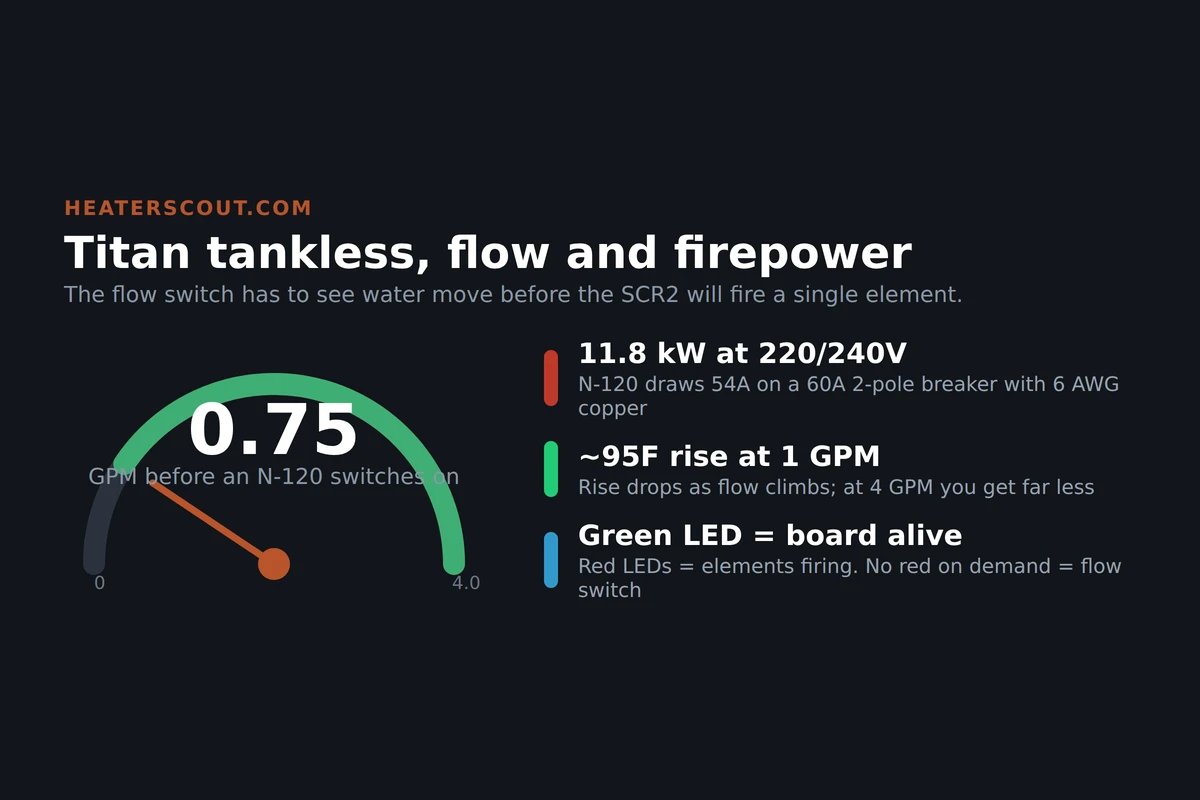
The single most misread Titan complaint is lukewarm water, because owners assume the heater is broken when it is often doing exactly what physics allows. An electric tankless can only add a fixed amount of temperature rise, and that rise shrinks as flow climbs. A whole-house N-120 at 11.8 kilowatts can push roughly a 95-degree rise when only about a gallon a minute is moving, but ask it to carry four gallons a minute and the rise collapses to a fraction of that. Now bring in winter. When the incoming water drops into the 40s, the unit has to climb 60 to 65 degrees just to reach a warm shower, at exactly the season you are drawing the most.
So before you condemn the heater, do the arithmetic. Desired temperature minus incoming temperature is your required rise; add up every fixture running at once for your total flow. If the numbers land outside what a single N-120 can deliver, the unit is undersized for your winter demand, and no repair fixes that. The answers are a larger SCR-4 model, a second Titan plumbed in series, or simply not running two hot draws at once in January. Only after the sizing math checks out should you suspect a partly dead element bank, where one SCR or element has failed and the unit is heating with half its power.
The reset, the breaker trip, and where a pro takes over
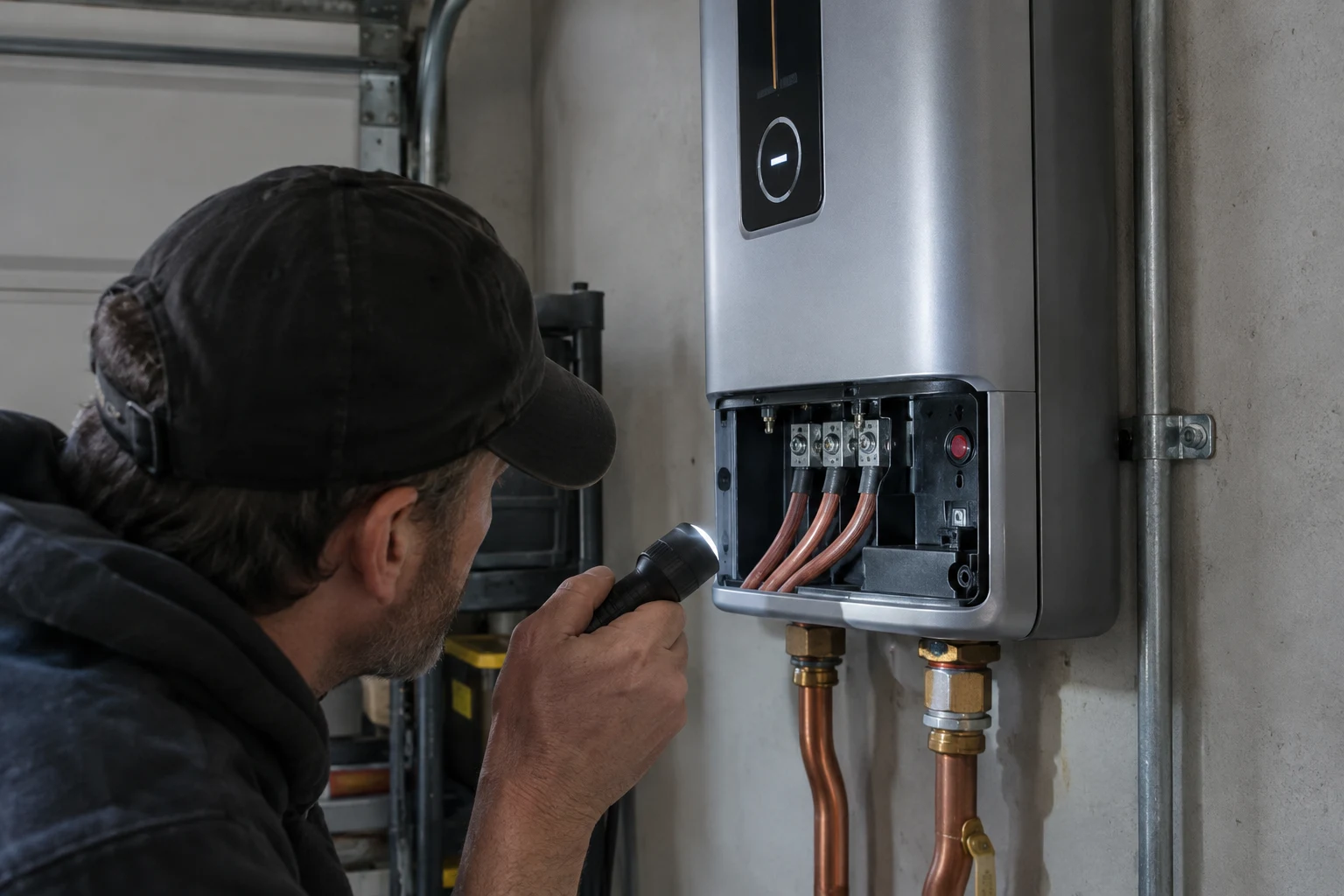
Titan hides the reset where people never look, on top of the unit rather than the front. To reach it, cut the breaker, remove the two screws holding the thin top cover, and press the small red button on the board, which is the manual reset for the high-temperature thermostat. If you would rather not open the case at all, cutting the breaker for a full five minutes and restoring power performs the same soft reset of the control board. A reset that holds tells you it was a one-time trip. A reset that trips straight back tells you a real fault is repeating, and repeatedly hitting that button on an overheating unit is the wrong move.
When the unit will not stop heating, or the breaker keeps tripping
Two Titan failures are the ones you do not experiment with. The first is a unit that will not stop heating, delivering scalding water even after you close the tap. On these boards that is a stuck-on SCR, the solid-state switch that gates an element, welded closed so the element keeps drawing power. Kill the breaker to make it safe and treat it as a board or SCR replacement, not a reset. The second is a breaker that keeps tripping. That is a genuine overcurrent, almost always a shorted heating element pulling fault current the instant it fires, or occasionally a wire that has chafed against the metal cabinet and is grounding out. Neither clears with a reset, and both live behind live 240-volt terminals.
Before you blame the heater on a trip, make sure the circuit itself is right. Titan units need their own dedicated circuit at the model's rated size, a 60-amp two-pole breaker on 6 AWG copper for an N-120 and 50-amp on 6 AWG for an N-100, with no other load sharing it. An undersized breaker, a loose lug, or a shared circuit will trip on a perfectly healthy heater. Once the circuit checks out, a repeated trip is the heater, and ohming each element to find the shorted one and replacing it, or replacing a failed SCR, is licensed-electrician work. There is no shortcut and no code on the display to shorten the hunt, which is exactly why the light pattern and the water temperature matter so much on a Titan.
Frequently asked
Why is my Titan tankless water heater not producing any hot water?
Work from the inlet out. First confirm the green power LED is on with the cover in place; no green light means the board has no power, so check the double-pole breaker and the wire terminals. If the green light is on but no red LED comes on when you open a hot tap, the unit is not sensing flow. Titan activates on a magnetic flow switch inside the cold-water inlet, and the usual reason it will not fire is sediment or corrosion around that switch or a clogged inlet filter starving the flow. Clean the inlet screen, make sure a full-open hot tap is pulling at least the switch-on flow the unit needs, and watch for a red element LED. If the green light is on, a red LED does come on, and the water is still cold, you are into a failed heating element or a bad SCR on the board. Titan units have no error-code display, so this LED-and-temperature sequence is the whole diagnosis.
Why is my Titan tankless only making lukewarm water?
Lukewarm almost always means the unit cannot add enough temperature rise for the flow and the incoming cold water it is fighting. A Titan raises water by a fixed number of degrees that shrinks as flow goes up: an N-120 can push roughly a 95-degree rise near one gallon a minute but far less at its full four gallons a minute. In winter, when the incoming water can sit in the 40s, that same unit simply cannot carry a big flow to a hot shower temperature. The cheap fixes come first: clean the cold-inlet filter screen, since a partly clogged screen forces the unit to run at reduced flow and output, and turn the hot tap toward full so the flow switch stays firmly closed. If it still runs lukewarm on clean flow, the unit is either undersized for your winter rise or has a dead element or SCR firing only part of its bank.
Where is the reset button on a Titan tankless water heater?
It is hidden under the thin metal cover on top of the unit, not on the front face, which is why so many owners never find it. Kill the breaker first, back out the two screws holding the top cover, and you will see a small red circular button on the board; that is the manual reset for the high-temperature thermostat. Press it, close the unit back up, and restore power. If you would rather not open the case, cutting the breaker to the heater for a full five minutes and turning it back on does the same soft reset of the control board. A reset that holds means it was a one-time trip. A reset that trips right back means the underlying fault, an overheating element or a stuck SCR, is still there and needs a real repair.
Why does my Titan tankless water heater keep tripping the breaker?
A tankless electric unit that trips its own breaker is drawing more current than the circuit allows, and on a Titan that points at the heating elements or the wiring, not the breaker being weak. The most common cause is a shorted or failed heating element inside a module, which pulls a fault current the instant the SCR fires it. Less often, a wire has chafed against the metal cabinet and is grounding out. Before you assume the heater, rule out an undersized or loose breaker and confirm the unit is on its own dedicated circuit at the correct size, which is a 60-amp two-pole breaker on 6 AWG copper for an N-120. This is 240-volt work behind a live panel, so ohming elements and chasing a ground fault is a licensed electrician's job, not a reset-and-hope.
What do the lights mean on a Titan tankless water heater?
Titan SCR2 units speak in LEDs, not codes. A steady green light means the control board has power and is alive; if the green light is out, the board is dead or unpowered and you start at the breaker and terminals. When you open a hot tap and the flow switch closes, a red LED lights for each element the board is firing, so seeing red is good, it means the unit is trying to heat. The bad sign is all of the red LEDs blinking or locked on together, which indicates a failed component on the circuit board or a bad SCR, and that usually ends in a board replacement. Green on and no red on a hot-water call is a flow or activation problem. Green on with steady reds but cold water is an element or SCR problem. There is no number to look up, so the light pattern plus the water temperature is your fault map.
How do I know if my Titan tankless water heater is too small for my house?
Do the temperature-rise math for your worst case, which is winter. Take your desired shower temperature, around 105 degrees, and subtract your incoming water temperature, which in a cold-climate winter can be 40 to 45 degrees, giving a required rise near 60 to 65 degrees. Then add up the flow you actually run at once, since a shower plus a kitchen tap can be three gallons a minute or more. A whole-house N-120 at 11.8 kilowatts can only deliver its high rise at low flow, so if you need 65 degrees of rise at three gallons a minute, one N-120 will fall short and run lukewarm no matter how healthy it is. That is a sizing shortfall, not a fault, and the fixes are a second unit in series, a larger SCR-4 model, or cutting simultaneous demand, not a repair.
Does the Titan tankless water heater work on 208 volts?
It runs, but it makes less heat. Titan rates its kilowatt and amp numbers at 220 volts, and the power a resistive element makes scales with the square of the voltage, so feeding a unit rated at 240 volts from a 208-volt commercial or apartment supply drops its real output well below the sticker. An N-120 fed 208 volts will not hit its rated 11.8 kilowatts, which shows up as weaker temperature rise and lukewarm water on the same flow that would be fine on 240 volts. If your unit runs cool and you are on a 208-volt service, that is expected behavior, not a broken heater, and the answer is a larger model or a service that supplies the rated voltage.