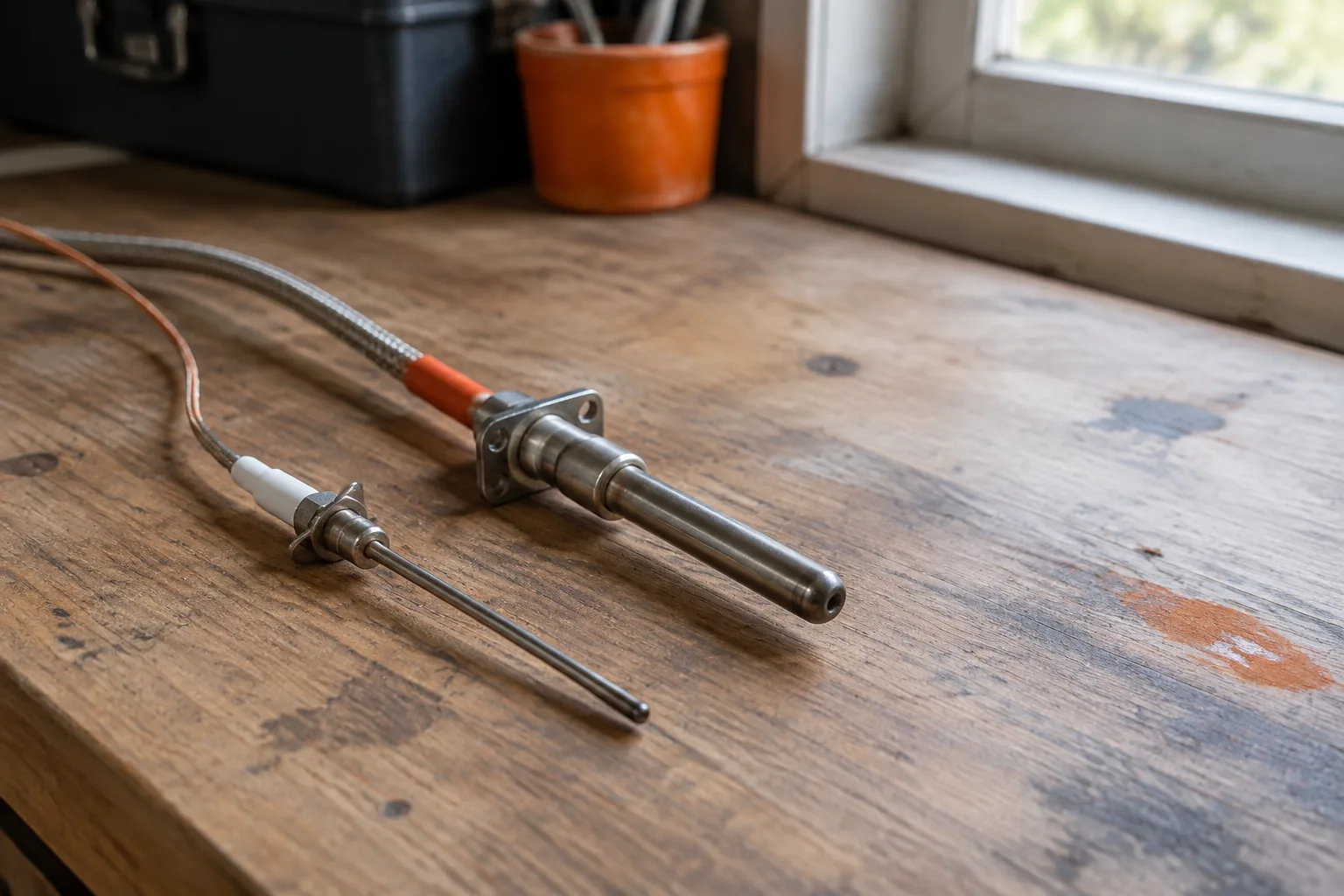
Two thin metal probes sit in the same pilot flame and look almost identical. One puts out about 30 millivolts. The other puts out 750. Swap them and nothing works, which is why the parts counter asks a question before selling you either.
The short version: a thermocouple is a safety sensor, and a thermopile is a power source. A thermocouple proves the pilot is lit and does nothing else. A thermopile makes enough voltage to actually run the gas valve. They are not interchangeable, and the fastest way to buy the wrong part is to grab whichever one is cheaper.
Which one do I have?
Answer both. The column that matches your heater lights up in the table below.
1. Is there a standing pilot flame you light by hand (hold a knob, push a button, apply a match)?
2. Does a piezo/electronic igniter or a control board (with a wall switch, remote, or thermostat) drive the burner?
| Thermocoupleyours | Thermopileyours | |
|---|---|---|
| Job | Safety only. Proves the pilot is lit. | Power source. Runs the gas valve. |
| Output (open) | 25–30 mV | 500–750 mV |
| Under load | Drops to 12–15 mV | Holds 300–500 mV while firing |
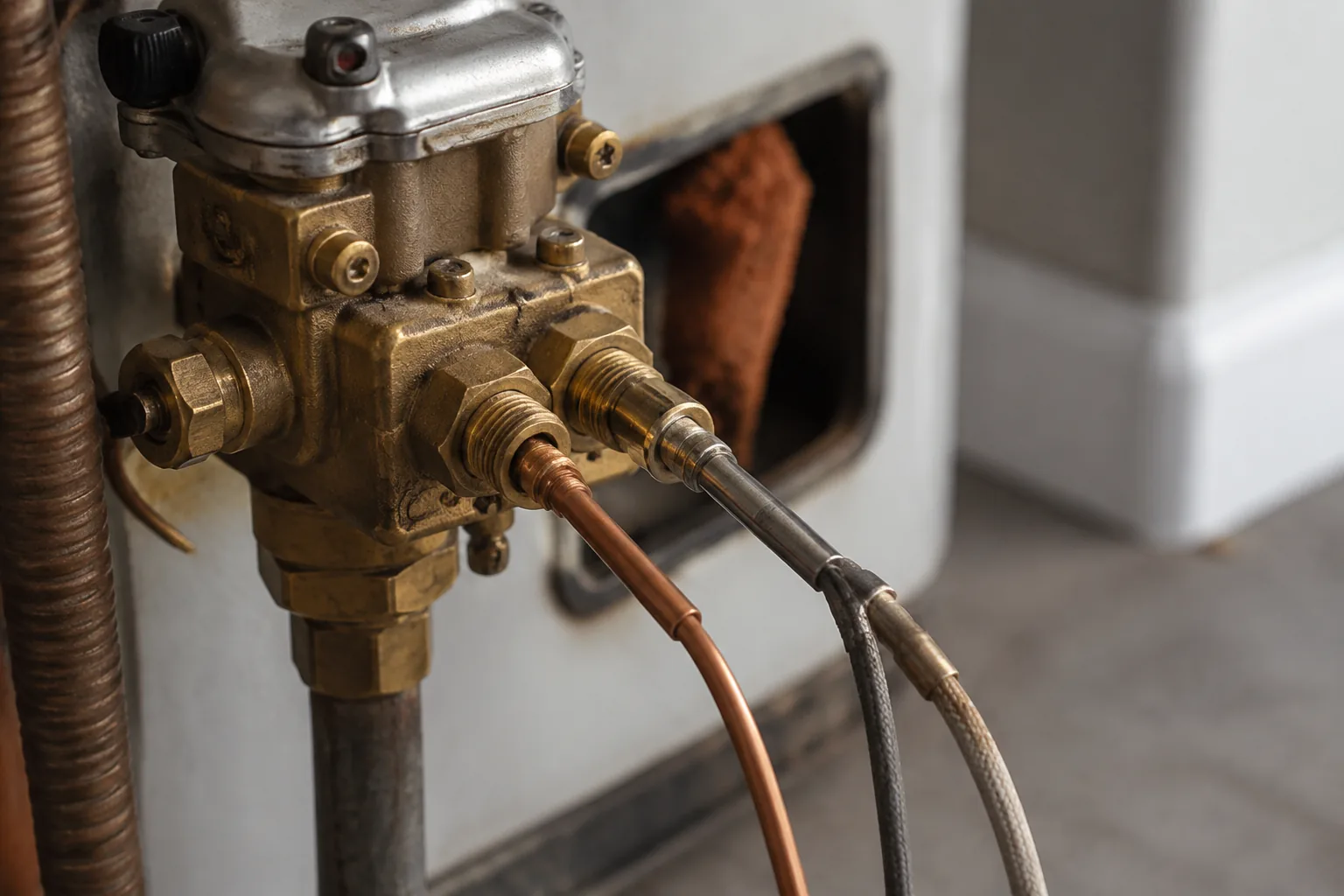
| Wires to valve | One copper lead, screws into the pilot magnet port | Two leads on marked TP/TP-TH terminals |
| Ignition style | Standing pilot you light by hand | Standing pilot plus a control that switches the valve |
| If it fails | Pilot lights, then dies when you release the knob | Pilot stays lit but the main burner never fires |
| Replace threshold | Below ~25 mV open / ~12 mV loaded | Below ~400 mV open |
What a thermocouple actually does
A thermocouple is two dissimilar metals welded together at a tip. Heat that tip and the junction produces a tiny voltage, a physics quirk called the Seebeck effect. On a water heater the tip sits in the standing pilot flame. As long as the flame is there, the probe makes about 25 to 30 millivolts open-circuit, which drops to roughly 12 to 15 millivolts once it is wired into the valve and carrying current.
That voltage does one job. It energizes a small electromagnet, the pilot safety magnet, inside the gas control. The magnet holds a solenoid open so pilot gas keeps flowing. Let the pilot go out and the voltage collapses, the magnet releases, and the solenoid snaps shut within about 90 seconds. That delay is why you hold the pilot knob down for a full minute during a relight: you are heating the thermocouple enough to take over from your thumb before the safety drops the gas.
Here is the limit that matters. Thirty millivolts is enough to hold a magnet, and that is all. It cannot run a gas valve, a control board, or anything with real electrical demand. A thermocouple heater has a burner that fires whenever the tank thermostat calls, driven directly off the pilot flame and the valve's own mechanical linkage. There is no switch, no board, no wall control in the gas path. If your heater has any of those, you are not looking at a thermocouple system.
What a thermopile does differently
A thermopile is what you get when you stop needing just a safety signal and start needing power. It is a bundle of thermocouple junctions, ten or more, wired in series so their tiny voltages add up. The same pilot flame that gives one junction 30 millivolts gives a stack of them 500 to 750 millivolts. People often call it a generator or a "750 mV pile" for exactly that reason.
With that much output, the pilot flame becomes a little power plant. The thermopile runs the gas valve electrically. When the thermostat, a wall switch, or a remote closes the circuit, the thermopile's voltage energizes the valve's operator and opens the main burner. No line power, no batteries. The pilot generates everything the control system needs. That is why these are called millivolt systems: the whole control circuit runs on a few hundred millivolts made by heat.
A thermopile is thicker than a thermocouple and lands on its own two terminals at the valve, usually stamped TP and TP-TH, instead of screwing into a single pilot-magnet port. Some designs use one probe as a combined pilot generator, so you will see either a dedicated thermopile alongside a thermocouple, or a single thermopile doing both the safety and the power job. The two-lead connection is the giveaway.
The fast tell: one wire or two, and how it lights
You do not need a meter to sort these out. Look at two things. First, count the leads landing on the gas valve from the pilot assembly. A single copper tube that threads into a fitting is a thermocouple. Two separate leads on their own screw terminals is a thermopile. Second, ask how the burner decides to fire.
If the heater has a standing pilot you light by hand and the main burner just follows the tank thermostat with no switch involved, that is a thermocouple safety system. If there is a wall switch, a remote, a thermostat wire, or a control board deciding when the burner runs, the valve needs power to operate, and that power comes from a thermopile. The identifier above walks those two questions and lights up the matching column so you can see the full contrast in one place.
One warning before you shop by looks alone. Modern electronic-ignition heaters, the kind with hot-surface igniters or spark and a 120V cord, usually have neither probe. They use a flame-sense rod and line power instead. If you find no standing pilot and no millivolt generator, stop reading part numbers and check the ignition label, because you are in a different repair entirely.
How to test each with a multimeter
A cheap multimeter that reads DC millivolts, shown as mVDC, does both jobs. Set it to the lowest DC millivolt range. The probes go on the sensor's connections while the pilot burns, and you always give the flame about 60 seconds to bring the tip up to temperature before you trust the number.
For a thermocouple, run two checks. The open-circuit test disconnects the probe from the valve and reads it alone: a good one shows 25 to 30 millivolts with the pilot on the tip. Anything under about 25 open-circuit is weak. The closed-circuit test uses an inline adapter so the probe reads while still loaded by the magnet; there you want 12 to 15 millivolts, and below roughly 12 means replace it. A probe that passes open but fails loaded is a common trap, so the loaded reading is the one that decides.
For a thermopile, put the meter across its two leads at the TP and TP-TH terminals with the pilot lit. Open-circuit you want to see somewhere in the 500 to 750 millivolt band. Then test it under load with the system calling for heat: a healthy pile holds several hundred millivolts, often 300 to 500, while the valve is energized. If it sags below about 400 millivolts open, or collapses toward zero under load, the valve will not stay open and the pile is done. A weak thermopile is the usual reason a pilot stays lit but the main burner refuses to run.
Why you cannot swap one for the other
This is the mistake that sends people back to the store. A thermocouple cannot power a millivolt valve. Thirty millivolts against a valve that needs several hundred is not a weak signal, it is nothing, and the burner never opens. Going the other way, a 750 mV thermopile screwed into a thermocouple's pilot-magnet port does not fit the single connection and is not what that safety circuit expects. The two parts serve different jobs on different terminals.
If your system uses a thermopile to run the valve and the pile dies, you replace it with a thermopile of matching output, usually a 750 mV generator. If your system is a plain thermocouple safety and the probe fails, you fit a thermocouple in the right length. Buying by output and by connection, not by which one the store had in a blister pack, is the whole game. Match the millivolts and match the terminals, and the heater lights.
Frequently asked
What is the difference between a thermocouple and a thermopile?
A thermocouple is a single-junction safety sensor that puts out about 25 to 30 millivolts, just enough to hold the pilot safety magnet open. A thermopile is many thermocouple junctions wired in series, so it makes 500 to 750 millivolts, enough to actually power the gas valve. One proves the pilot is lit; the other runs the valve. They are not interchangeable.
How many millivolts should a thermocouple put out?
About 25 to 30 millivolts open-circuit with the pilot flame on the tip, dropping to roughly 12 to 15 millivolts once it is wired to the valve and carrying current. Under about 25 open or 12 loaded means it is weak and should be replaced. Always give the flame around 60 seconds to heat the tip before reading.
How many millivolts should a thermopile produce?
A healthy thermopile reads 500 to 750 millivolts open-circuit with the pilot lit. Under load, while the valve is energized, it should hold several hundred millivolts, often 300 to 500. If it drops below about 400 open-circuit or collapses toward zero under load, the valve will not stay open and the thermopile needs replacing.
How can I tell which one my water heater uses?
Count the leads at the gas valve and look at how the burner fires. A single copper lead threading into a pilot-magnet port is a thermocouple, and the burner just follows the tank thermostat. Two leads on their own TP and TP-TH terminals is a thermopile, and something like a wall switch, remote, or control board decides when the valve opens. Electronic-ignition heaters with a 120V cord usually have neither.
Can I replace a thermocouple with a thermopile or the other way around?
No. A thermocouple's 30 millivolts cannot power a valve that needs several hundred, so a thermopile system will not fire the burner with a thermocouple in it. And a two-lead thermopile does not fit a single pilot-magnet port. Match the part to the job: a thermocouple for a plain pilot safety, a thermopile of matching output for a millivolt valve.
How do I test a thermocouple or thermopile with a multimeter?
Set the meter to DC millivolts and let the pilot heat the tip for about 60 seconds. For a thermocouple, read 25 to 30 mV open and 12 to 15 mV loaded through an inline adapter. For a thermopile, read across its two terminals: 500 to 750 mV open, several hundred under load. Low or collapsing readings mean the part is failing.