A gas tankless that runs water but never fires its burner is telling you one specific thing: ignition failed. You open a hot tap, the fan spools up, the igniter clicks, and nothing catches, so you get cool water and, on most units, an error code, commonly code 11 on Rinnai, Rheem, and Noritz, code 111 on Takagi, or E003 or E012 on Navien. The good news is that the cause is usually cheap. Before anyone talks about a control board, the real culprit is almost always no gas, air in the line, or too little water flow. This page walks the checks in the order a technician actually uses them, from the free ones you do with a flashlight to the parts that call for a licensed pro.
Read the error code first
Note the code on the remote before you touch anything. Code 11 on most brands means no ignition: the board called for spark and gas but the flame rod never confirmed a flame. The code narrows the field but does not name the part, so treat it as the start of the checklist, not the answer.
Verify gas is actually reaching the unit
Confirm the gas valve at the heater is fully open, then light another gas appliance in the house, a stove burner or the furnace. If that appliance fires normally, gas is in the house and the problem is at the heater. If nothing gas-fired works, the issue is upstream at the meter, the propane tank, or the main valve, and that is where you look.
Confirm adequate water flow
The burner will not fire until water moves through at the minimum activation rate, roughly 0.4 to 0.5 gpm. Open a hot tap wide, ideally a tub spout with no aerator. If it fires wide open but not at a trickle, you have a flow problem, not a gas or spark problem.
Inspect the igniter and flame rod
Only after gas and flow check out do you go inside. A sooted flame rod, a fouled igniter, or a loose igniter wire can leave you with a spark and no flame sense, or no spark at all. This is where the job shifts from homeowner checks toward a service call.
Check venting and, on cold LP, the regulator
A blocked or disconnected vent or air intake, or a plugged condensate line on a condensing unit, will trip a safety lockout. In freezing weather on propane, a frosted or frozen regulator starves the burner. Save the control board for last, after everything upstream is ruled out.
Quick answer
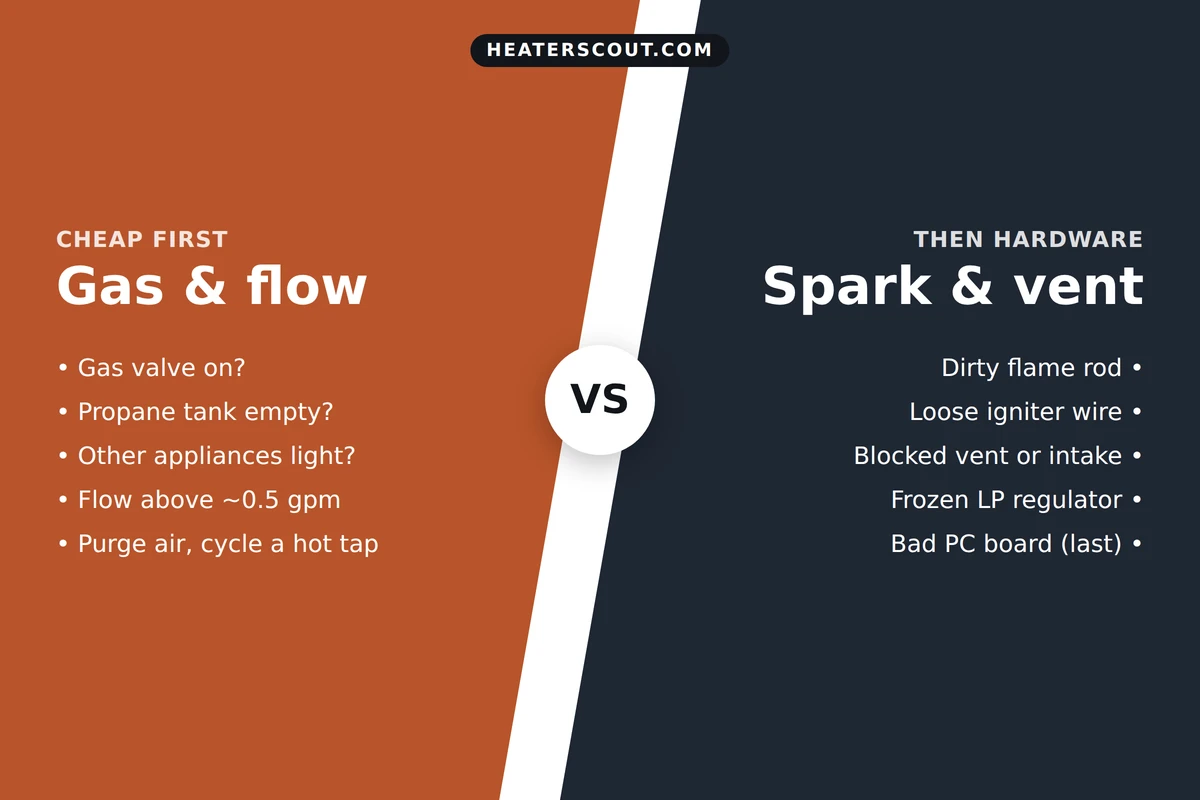
A gas tankless that runs water but never lights the burner has failed ignition, usually flagged as code 11. Work it cheapest first: confirm the gas valve is open and another gas appliance lights, purge air from the line by cycling a hot tap five or six times, then make sure flow is above about 0.5 gpm. Only after those check out do you look at the flame rod, igniter, venting, and, in cold weather on propane, the regulator. Reset the lockout once. If the same code returns right away, the cause is still there.
Start with the code, then rule out gas
Every no-ignition call starts the same way: read the code, then prove whether gas is even reaching the burner. Code 11 is the common ignition-failure code on Rinnai, Rheem, and Noritz, while Takagi flags the same fault as code 111 and Navien as E003 or E012. It means the control sequence ran, the board called for spark and opened the gas valve, and the flame rod never sensed a flame in the allowed window, so the unit locked out. That is the safety system working, not a broken part by itself.
The single fastest test costs nothing. Confirm the manual gas valve at the heater is turned fully parallel with the pipe, then go light another gas appliance in the house, a stove burner or the furnace. If that appliance lights and burns steady, gas pressure is in the house and the fault lives at the heater, so you move on to air and flow. If your stove will not light either, or lights weakly, the problem is upstream of the water heater entirely: an empty propane tank, a closed main valve, a meter issue, or a supply line that cannot deliver enough gas. Chasing the tankless in that case wastes your time.
Nothing gas-fired lights
Closed gas valve, empty propane tank, a tripped meter, or a line too small or too long for the unit's BTU demand. A big appliance running at the same time can also steal enough pressure to starve the heater. Confirm other appliances light before you suspect the heater itself.
Fails right after gas work
New install, a propane delivery, or any service can leave air in the gas line. It causes repeated ignition failures until it clears. Purge it by cycling a hot tap five or six times, resetting the lockout between tries, until the burner catches and holds.
Fires wide open, not at a trickle
The unit needs about 0.4 to 0.5 gpm to trigger. A clogged inlet screen, a partly closed valve, a scaled flow sensor, or a barely open faucet keeps you under the threshold and the burner never starts.
Purge trapped air before you suspect a part
If gas is in the house but the burner still will not catch, air in the gas line is the next suspect, and it is the reason a brand-new or freshly serviced unit throws code 11 out of the box. The gas line picks up air any time it is opened, and a tankless will fail ignition attempt after attempt until that pocket is pulled through. There is no part to buy here, just a procedure to run.
Do not reset in a loop
Reset the ignition lockout once to clear a one-time fault, then stop. If the same code returns within a minute or two of a clean reset, the cause is still present. Hammering the reset button just cycles unburned gas past a burner that will not light and delays the real fix.
When flow is the real problem
Flow gets overlooked because it feels unrelated to a burner. But a gas tankless is flow-activated: it will not fire until water moves through it at a minimum rate, usually around 0.4 to 0.5 gpm depending on the model. Below that, the flow sensor never signals the board to start the ignition sequence, so the burner stays cold even with plenty of gas waiting. This is why a unit can pass every gas check and still refuse to light.
The test is simple. Open a hot tap all the way, ideally a tub spout, which has no aerator to choke the flow. If the burner fires with the tap wide open but stays cold at a trickle, flow is your answer. The usual restrictions, in the order worth checking, are a clogged inlet water screen at the cold inlet, an isolation or supply valve left partly closed after service, a flow sensor fouled by scale, and, on hard water, mineral buildup narrowing the passages. Clean the inlet screen, walk every isolation valve to fully open, and if the unit is due, run a descale. If the sensor itself has failed, that is a parts job.
Igniter, flame rod, and venting
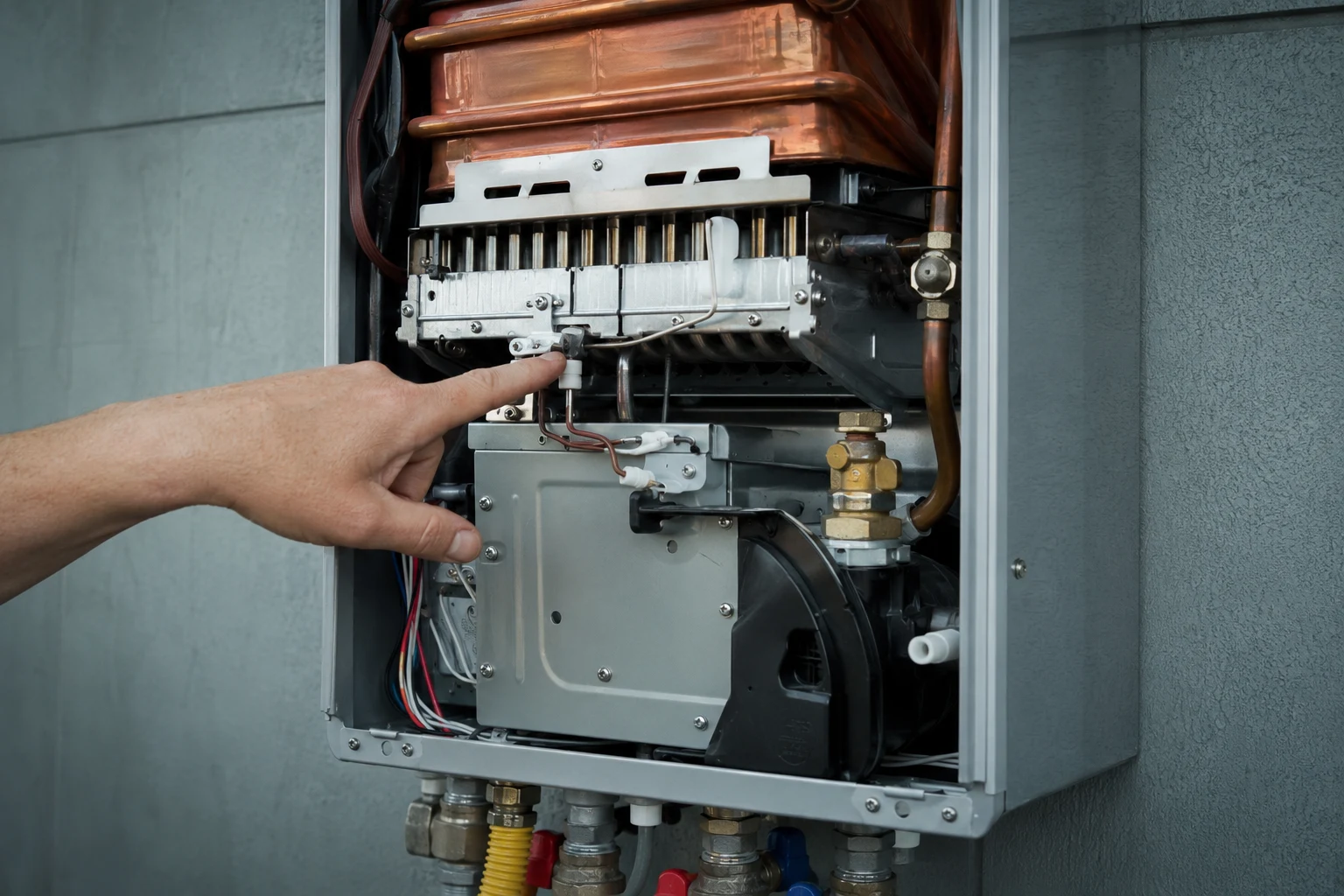
Only after gas and flow check out is it worth opening the cabinet. Two small parts do the work of starting and confirming a flame: the igniter, which throws the spark, and the flame rod, a thin metal probe that senses the flame's presence by conducting a tiny current through it. When the flame rod is coated in soot or oxide, it cannot sense the flame it is standing in, so the board thinks ignition failed and locks out even though gas did briefly light. A gentle cleaning of the rod with fine abrasive often brings it back. A loose or corroded igniter wire, or a cracked igniter, can leave you with no spark at all, which reads the same at the tap: cold water and a code 11.
Venting is the other safety-critical branch. A tankless pulls combustion air and pushes exhaust through its vent, and if either the intake or the exhaust is blocked, disconnected, or, on a condensing unit, if the condensate drain is plugged and backing up, the unit will refuse to run or lock out to protect you. Look for a bird nest, ice, debris, a disconnected joint, or a sagging vent holding water. On a condensing model, confirm the condensate line drains freely and is not frozen. Blocked venting is the branch to respect most, because forcing a unit to run against it can push combustion products into the space. If you find a vent problem, that is a service call, not a homeowner override.
Cold-weather propane, voltage, and the board
If a propane tankless lights fine in mild weather and only fails when it is freezing, look at the LP regulator before anything electronic. Pushing a lot of gas through a regulator in cold air chills it, and the pressure drop can freeze internal moisture or frost the vent, which restricts flow and starves the burner. A nearly empty tank compounds it: low propane level means low vapor pressure, and cold plus low level together can drop supply under what the unit needs to fire. Keep the tank above roughly 30 percent in winter and check the regulator for frost. On natural gas, a cold-only failure more often traces to an icing intake or a frozen condensate line than to a regulator.
The control board is the last suspect, not the first, and jumping to it is the most expensive mistake in this whole sequence. Before you condemn it, rule out a dip in incoming voltage and loose control wiring, both of which can mimic a board fault. Confirm the unit is getting steady voltage, that the plug or hardwired connection is tight, and that the control connectors are seated. Only when gas, air, flow, the igniter, the flame rod, venting, and voltage have all been cleared does a bad PC board become the reasonable conclusion, and that is squarely a job for a licensed technician with the model's diagnostics in hand.
One thing that is not an ignition fault
Do not confuse no ignition with the cold-water sandwich. They both hand you cold water at the tap, but they are different problems. No ignition means the burner never fires: the water is cold from the moment you open the tap and stays cold, and you usually get a code. The cold-water sandwich is a flow-and-timing quirk on a working unit. Hot water already in the pipe reaches you, then a slug of cooler water that entered while the burner was briefly off arrives, then the freshly heated water catches up, so you feel hot, cold, then hot again. If the burner is clearly lighting and the water only stutters cold in the middle of a draw, you are chasing the sandwich, and that is a separate fix involving draw patterns and, sometimes, a recirculation setup. If the water never gets hot at all, come back to this checklist and start at the code.
| Common code | 11 (no ignition) on Rinnai, Rheem, Noritz; 111 on Takagi; E003 or E012 on Navien |
| First check | Gas valve open, another gas appliance lights |
| Free fix | Purge air by cycling a hot tap 5-6 times |
| Min activation flow | About 0.4 to 0.5 gpm |
| Flow test | Open a tub spout wide, no aerator |
| Inside the cabinet | Clean flame rod, check igniter and its wire |
| Safety branch | Blocked vent, intake, or condensate line |
| Cold-only on LP | Frozen or frosted propane regulator, low tank |
| Last suspect | Low voltage, loose wiring, then PC board |
| Reset rule | Once to clear a lockout, not in a loop |
Frequently asked
Why does my tankless water heater run water but never fire the burner?
Water flowing while the burner stays cold is the textbook signature of an ignition failure. The unit senses your hot tap open, the fan spins up, the igniter clicks, but no flame ever establishes, so it gives you cool or lukewarm water and usually throws an ignition-failure code, commonly code 11 on Rinnai, Rheem, and Noritz. Takagi flags the same fault as code 111, and Navien as E003 or E012. The cause is almost always one of three cheap things before it is anything expensive: no gas reaching the burner, air trapped in the gas line, or too little water flow to trigger ignition. Start by confirming the gas valve is open and another gas appliance in the house lights normally. If your stove or furnace fires fine, gas is in the house and you move on to flow and the igniter. If nothing gas-fired in the house works, the problem is upstream of the heater, at the meter, the propane tank, or the main valve.
What does code 11 mean on a tankless water heater?
Code 11 is the ignition-failure or no-ignition code on most gas tankless brands. It means the control board ran its normal startup sequence, called for gas and spark, and the flame rod never confirmed a flame within the allowed window, so the unit locked out for safety instead of dumping raw gas. It does not tell you which part failed, only that ignition did not happen. Read it as a starting point, not a diagnosis. Work the cheap causes in order: gas supply, air in the line, then flow, then the igniter and flame rod, then venting. A code 11 that clears after you purge air or open a gas valve was never a broken part. A code 11 that comes right back after a reset means the real cause is still there and needs to be chased down, not reset away.
How do I purge air from the gas line on a tankless heater?
Air in the gas line is common right after a propane delivery, a new install, or any gas work, and it will cause repeated ignition failures until it clears. The fix costs nothing. Make sure the gas valve to the heater is fully open, then open a hot tap and let the unit attempt ignition. It will likely fail the first few tries as it pulls the air pocket through. Close the tap, wait about thirty seconds, and open it again. Repeat this cycle five or six times. Each attempt draws a little more air out and a little more gas in. On many units you also need to clear the lockout between tries by turning the unit off and on at the remote. If the burner catches and stays lit after several cycles, air was your problem. If it still will not fire after eight or ten honest attempts, move on, because you are not looking at trapped air anymore.
Can low water flow stop a tankless from igniting?
Yes, and it is one of the most missed causes. A gas tankless will not fire until water moves through it at a minimum activation rate, usually around 0.4 to 0.5 gpm depending on the model. Below that threshold the flow sensor never tells the board to start, so the burner stays cold no matter how much gas is available. A clogged inlet water screen, a partly closed isolation or supply valve, a stuck flow sensor, or simply a faucet barely cracked open can all drop you under the trigger point. Test it by opening a hot tap wide, ideally a tub spout that has no aerator to restrict it. If the burner fires with the tap wide open but not at a trickle, flow was the issue. From there, clean the inlet screen, confirm every isolation valve is fully open, and check for a scaled or failing flow sensor.
Should I keep resetting a tankless that will not ignite?
Once, to clear a one-time lockout, then stop. Cycling the unit off and on at the remote or the power resets the ignition lockout, and if the trouble was a momentary hiccup, air working through after a delivery, a brief flow dip, it will fire and stay lit. What you should not do is sit there hammering the reset while the same code keeps coming back. A lockout is the safety system doing its job: it stops the unit from repeatedly opening the gas valve with no flame to burn it. Repeated resets on a real fault just cycle unburned gas past the burner and delay finding the cause. If it locks out again within a minute or two of a clean reset, the underlying problem, gas, flow, igniter, or venting, is still there and that is what needs attention.
Is a tankless that will not ignite dangerous?
The lockout itself is the safe outcome, not the hazard. When the flame rod fails to confirm a flame, the board shuts the gas valve and locks out precisely so raw gas does not keep flowing. The danger comes from working around that safety: jumpering sensors, forcing repeated ignition on a unit with a blocked vent, or running a gas appliance in a space where you smell gas. If you ever smell gas near the heater, stop, shut the gas off at the valve, ventilate the area, and do not operate any switches until it clears. A blocked vent or intake is the case to respect most, because it can back combustion products into the space. Read the code, work the checks with the gas off where the steps allow it, and call a licensed pro for anything involving the gas connection, venting, or the control board.
Why does my tankless heater fail to ignite only in cold weather?
Cold-weather-only ignition failures on a propane tankless usually point at the LP regulator. When a regulator passes a lot of gas in freezing weather, the pressure drop across it can chill it enough to freeze internal moisture or frost the vent, and a frozen or restricted regulator starves the burner so it cannot light. A nearly empty propane tank makes it worse, because low tank level means low vapor pressure, and cold plus low level together can drop supply below what the unit needs to fire. Check the tank level first, keep it above roughly 30 percent in winter, and look for frost or ice on the regulator. On natural gas, cold-only failures more often trace to a blocked or icing intake or condensate line on a condensing unit than to a regulator.
What is the difference between no ignition and the cold-water sandwich?
They feel similar at the tap but they are different problems. No ignition means the burner never fires at all: you get cool water the whole time and usually an error code. The cold-water sandwich is a flow and timing quirk, not an ignition fault. It happens when hot water already in the pipe reaches you, then a slug of cooler water that entered while the burner was briefly off arrives, then the newly heated water catches up, so you feel hot, then cold, then hot. The sandwich means the burner is igniting fine, just not instantly on every draw. If your water is cold from the moment you open the tap and stays cold, that is ignition failure. If it starts hot, goes briefly cold, then recovers, that is the sandwich and a different conversation.