A tankless water heater that makes no hot water is really two complaints hiding under one sentence. One is the cold-water sandwich, where the unit does fire but a short cold slug slips through before the hot arrives, and nothing is broken. The other is a true no-heat, where the burner never lights or drops out mid-draw and the display throws a code. Sort which one you have before you touch a thing, because the sandwich gets a recirculation pump and the no-heat gets a gas, venting, or igniter diagnosis. Across Rinnai, Navien, Rheem, Takagi, and Noritz the code numbers differ but the logic underneath is the same.
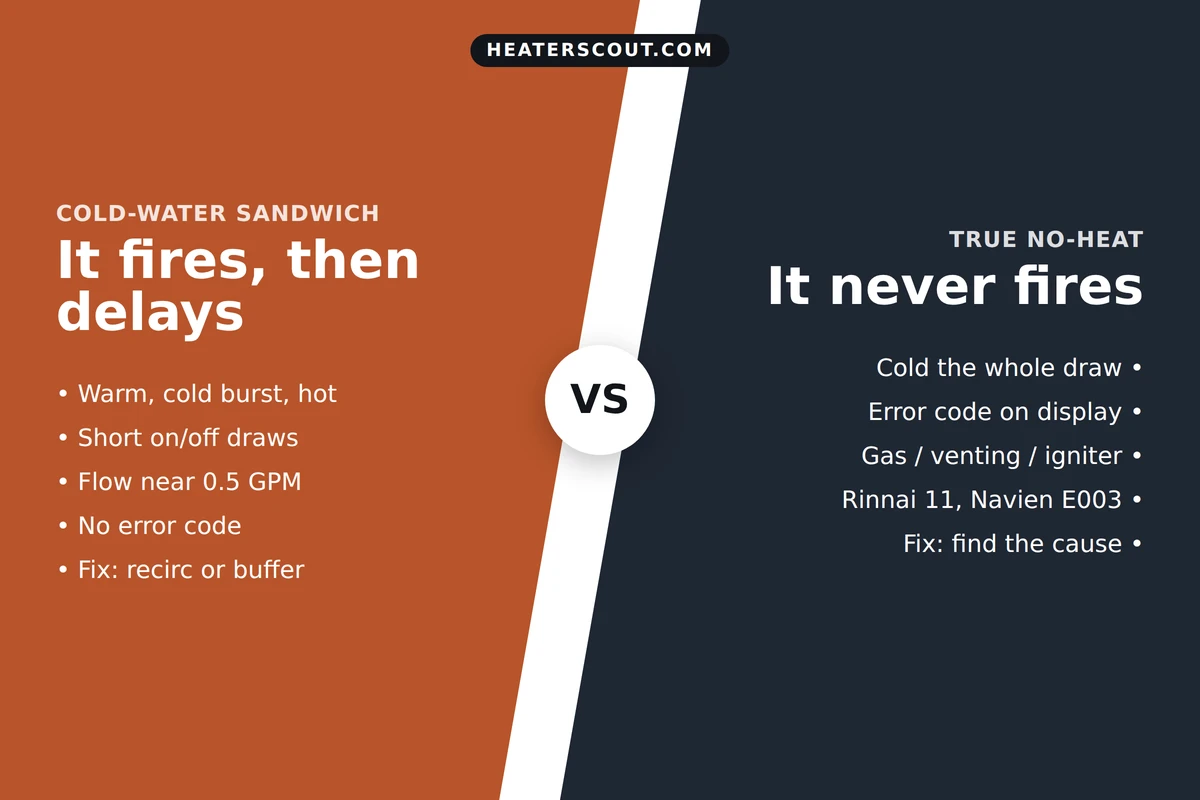
Cold-water sandwich
- Warm at first, a brief cold burst, then hot again.
- Worst on short on-and-off draws, like a kitchen faucet.
- No error code on the display. Nothing failed.
- Cure is a recirculation pump or a small buffer tank, not a repair.
True no-heat lockout
- Cold for the whole draw, not just the first few seconds.
- A code on the display: Rinnai 11, Navien E003, Takagi 111.
- Root cause is gas, venting, flow, or the igniter.
- Cure is finding and fixing the cause, not resetting past it.
Key takeaways
- First split the problem: a brief cold burst that turns hot is the cold-water sandwich (normal); cold for the whole draw with a code is a true no-heat.
- A tankless fires on measured flow, not demand. Below the minimum activation rate, about 0.5 GPM, it never ignites and stays cold.
- No ignition is Code 11 on Rinnai, Rheem, and Noritz, E003 on Navien, and 111 on Takagi. The diagnosis underneath is the same.
- Gas first: valve fully open, propane not empty, inlet pressure in range (Rinnai natural gas 3.5 to 10.5 inches WC). Then venting, then igniter.
- A venting or combustion code (Rinnai 10, Rheem 13) is a stop, not a reset. Gas smell means leave and call the utility.
Quick answer
Decide which problem you have. If the water is warm, then a short cold burst, then hot, that is the cold-water sandwich, it is normal, and a recirculation pump is the only real cure. If the water stays cold for the whole draw and the display shows a code, you have a true no-heat. Check in order: gas valve fully open and propane not empty, water flow above about 0.5 GPM, venting and intake clear, then the igniter and flame sensor. The code number varies by brand, no ignition is 11 on Rinnai, Rheem, and Noritz, E003 on Navien, 111 on Takagi, but the diagnosis is the same.
The cold-water sandwich is not a fault
Start here because it is the most common false alarm. You open a hot tap, get a few seconds of warm, then a jolt of cold, then steady hot. That pattern is the cold-water sandwich, and every tankless unit does it to some degree. The warm water you feel first was sitting in the pipe near the fixture. Behind it comes water that cooled in the line while the heater sat idle, and behind that comes the fresh hot water. The gap is the second or two the heater needs to sense flow, spin the fan up to speed, and light the burner. During that gap the cool slug gets through. It is physics and a short delay, not a broken part, which is why there is no error code.
It gets worse with short, choppy draws. Rinse a dish, shut the tap, rinse again, and you keep re-triggering that ignition delay, so you meet the cold slug over and over. The real cures are not repairs: a recirculation pump keeps hot water moving so it is already at the tap, or a small buffer tank holds a reserve that covers the ignition delay. If your complaint is really this brief cold burst, stop troubleshooting the heater.
Which problem do you have
If the water is cold for the entire draw, not just the first few seconds, this section does not apply to you. That is a true no-heat, and it almost always comes with a code on the display. Read the code, then work the diagnosis below.
Flow first: the unit fires on water, not on demand
Before you blame gas or the igniter, rule out flow, because a tankless heater does not light just because you want hot water. It lights because it measures enough water moving through it. Inside the cold inlet is a flow sensor, a small impeller or turbine that spins as water passes, and the control board reads how fast it spins to decide there is a real draw. Below a minimum, the board never sees a reason to fire. That minimum, the activation flow rate, sits around 0.5 gallons per minute on most units, and depending on the brand and how its sensor is calibrated the true threshold can run as high as 0.5 to 0.75 GPM.
So a barely cracked faucet, an aggressive low-flow aerator, or a nearly closed supply valve can fall under the line. The unit senses nothing, never ignites, and you get cold water while swearing the heater is dead. Open the tap wider and it lights. The tell is simple: if the unit makes hot water at full flow but not at a trickle, the problem is flow, not heat. A clogged inlet filter or a scaled heat exchanger can also drag flow below the threshold on an older unit, which is why an annual descale matters in hard-water homes.
Confirm it is a true no-heat, not the sandwich
Cold for the whole draw is no-heat. A warm, cold, hot pattern on short draws is the cold-water sandwich and needs no repair. Note the exact code on the display before you touch anything.
Check water flow above the minimum
Open the hot tap fully. If it heats at full flow but not at a trickle, you were under the roughly 0.5 GPM activation rate. Clean the inlet filter screen and aerators; descale the exchanger on an older unit.
Confirm gas at the unit
Gas valve at the heater fully open, other gas appliances in the house still working, and propane not empty. A closed valve or an empty LP tank is the single most common no-ignition cause.
Look at venting and intake
Walk outside to the exhaust and intake terminations. Clear debris, snow, insect nests, and confirm the condensate line is not frozen or backed up. A blocked vent throws its own code and is a stop, not a reset.
Read the flame side: igniter and sensor
A dirty or oxidized flame rod and igniter cause no ignition or flame loss. Cleaning the rod is homeowner work; confirming inlet gas pressure with a manometer is a tech job.
Same fault, different number: reading codes across brands
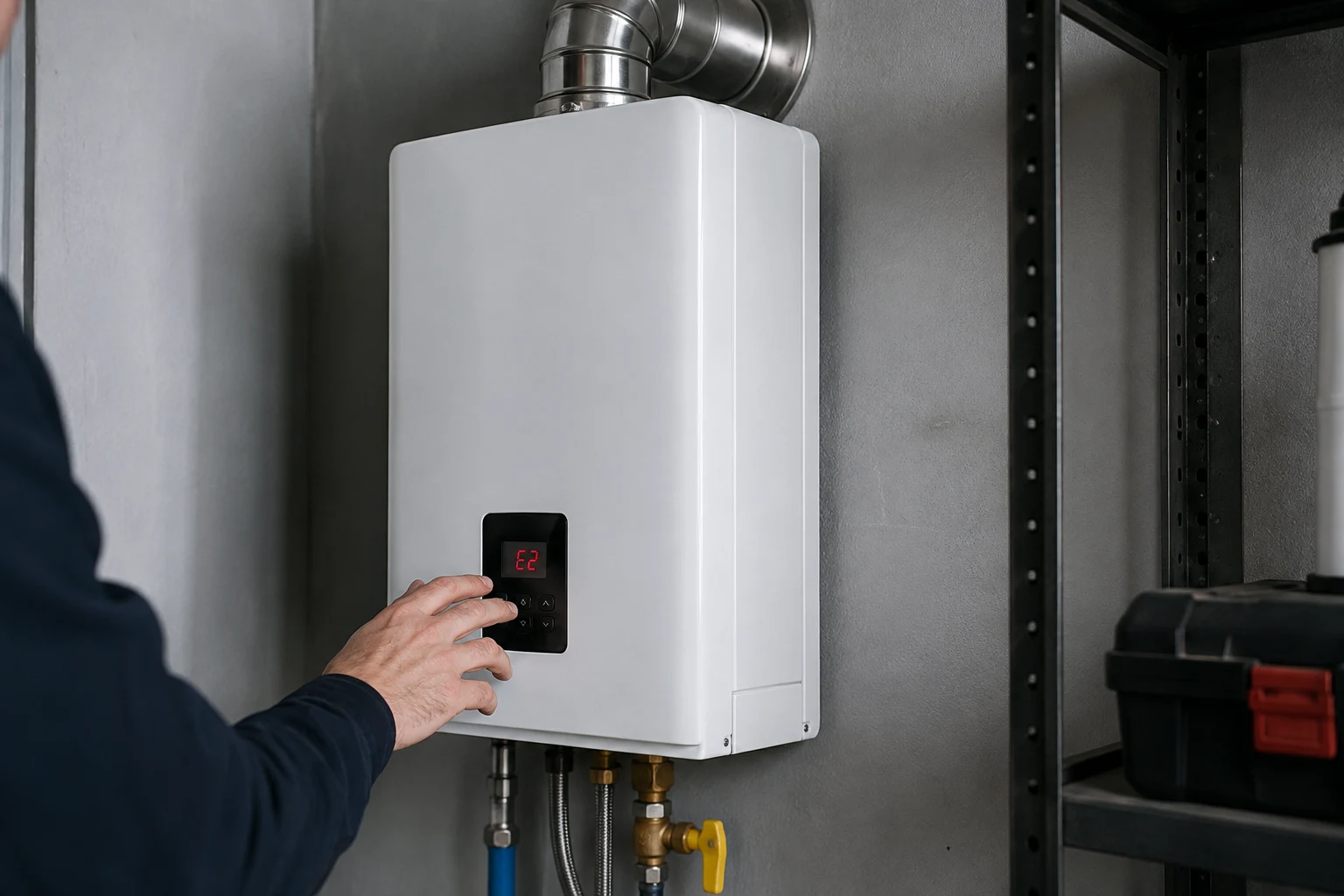
The five brands most US homes run, Rinnai, Navien, Rheem, Takagi, and Noritz, all diagnose the same physics, but each stamps its own number on the display. Learn the pattern once and the badge stops mattering. No ignition, meaning the burner tried and never caught, is Code 11 on Rinnai, Rheem, and Noritz, E003 on Navien, and 111 on Takagi. Every one of those points first at gas: a closed valve, empty propane, low inlet pressure, an air-filled line after a new install, or a fouled igniter. The homeowner checks are identical no matter which number lights up.
Flame loss during operation is the second family, and it means the burner lit fine and then dropped out mid-draw. That is Code 12 on Rinnai, E012 on Navien, and 121 on Takagi. This one leans toward marginal gas pressure that sags when the unit goes to full fire, wind or exhaust recirculating back into the intake, or a dirty flame sensor that loses sight of the flame. The third family is combustion and venting, Code 10 on Rinnai and Code 13 on Rheem, and that family is different in one important way: you do not reset past it. A unit that cannot exhaust or is burning with the wrong air-to-fuel ratio is a carbon monoxide risk, so it is a same-day pro call, not a button to press.
Gas pressure, propane, and the manometer line
A lot of stubborn no-ignition codes trace to gas pressure the homeowner cannot see. A tankless burner at full fire pulls a large, sudden slug of gas, and if the inlet pressure sags under that load the flame either never establishes or lights and then drops out. Rinnai wants natural gas inlet pressure roughly between 3.5 and 10.5 inches of water column, and propane between 8 and 13.5. Rheem runs a similar window, about 4 to 10.5 inches on natural gas and 8 to 13 on propane. Those numbers are a manometer reading, not a feel, and that is the line where the job leaves homeowner territory.
What you can check without a gauge still matters. An undersized gas line shared with a furnace and a range that all fire at once will starve a tankless and throw a code only under heavy demand. A propane tank low enough that pressure drops on a cold morning does the same. Air in a line after a fresh install can fail the first several ignition attempts until it purges. If gas checks look fine and the code repeats, a tech measures inlet pressure at the unit while it fires, the one reading that settles most no-ignition arguments.
The reset that helps and the reset that hurts
A power-cycle reset has a place, and it also has a limit. Rebooting the control board clears a soft code, the kind left behind by a one-time ignition hiccup or a power outage. On most units you unplug the heater or kill its breaker, wait, and restore power; Rinnai clears with a short unplug, and a deeper reset means leaving it off several minutes to let the board fully drain. Some Navien techs go as far as a thirty-minute power-off for a stubborn soft code. Done once, that is reasonable.
The reset that hurts is the loop, pressing the button again every time the code returns. A venting or combustion code is the clearest example, because clearing it lets the unit keep running in a state it locked out of for a reason. If a code comes back within a draw or two, the reset has done its job of telling you the fault is real, and the next move is diagnosis, not another press.
Flow or a soft code
Cold only at a trickle points at low flow; open the tap, clean aerators and the inlet screen. A one-time code after an outage clears with a single power-cycle. Both are safe homeowner work.
Cold-water sandwich
A brief cold burst that turns hot is normal. No parts, no reset. If it bothers you, price a recirculation pump or a buffer tank, which is a comfort upgrade, not a repair.
Repeating ignition or flame-loss code
Code 11, E003, 111, or a flame-loss 12, E012, 121 that returns under load means gas pressure or the igniter needs a manometer and a meter. That is a licensed gas tech, not a reset.
Venting, combustion, or gas smell
Rinnai 10, Rheem 13, any exhaust or combustion fault, and any smell of gas are same-day stops. Do not reset past them and do not run the unit. Gas smell means leave and call the utility first.
Where the line sits
Most tankless no-hot-water calls end without a tech. You confirm it is a true no-heat and not the sandwich, open the tap to clear a low-flow lockout, check that the gas valve is open and the propane is not empty, walk outside to clear the vent, and clean a fouled igniter rod. Those are an afternoon with the power off. The line is crossed the moment the answer needs a manometer on the gas inlet, a combustion analyzer on the exhaust, or any work past a code that guards against carbon monoxide. A repeating ignition code, a venting or combustion fault, and any gas smell all sit on the far side of that line. Read your specific code against your specific manual, work gas and flow before anything electrical, and reset once rather than in a loop.
Frequently asked
Why does my tankless water heater run cold for a few seconds, then hot?
That is the cold-water sandwich, and it is normal for a tankless unit, not a fault. When you open a hot tap, the warm water sitting in the pipe reaches you first. Behind it comes a short slug of cooler water that was in the line while the heater was off. The unit needs to sense flow, spin up the fan, and fire the burner, which takes a few seconds, so that cool slug gets through before the fresh hot water catches up. You feel warm, then a cold burst, then hot. It shows up worst when you turn the hot on and off quickly, like at a kitchen sink. There is no error code because nothing broke. If it bothers you, a recirculation pump or a small buffer tank keeps hot water closer to the tap and shrinks the cold burst. A heater that is cold for the entire draw is a different problem, a true no-heat, and that one usually throws a code.
What does Rinnai error code 11 mean and can I fix it myself?
Code 11 on a Rinnai is no ignition. The burner tried to light and never caught, so you get cold water. The usual causes are on the gas side: a gas valve that got bumped closed, an empty propane tank, low inlet gas pressure, an undersized or air-filled gas line after a new install, or a dirty flame rod and igniter. The homeowner checks are safe and worth doing. Confirm the gas valve at the unit is fully open, confirm other gas appliances in the house still work, and check that propane is not empty. Then power-cycle the unit to clear the soft code. If it comes right back, the gas supply or the igniter needs a tech with a manometer, because inlet pressure has to sit in range, roughly 3.5 to 10.5 inches of water column on natural gas, and you cannot read that by feel. Do not chase a Code 10 the same way. That one is combustion or venting and is a stop, not a reset.
Navien shows E003. What is the difference between E003 and E012?
Both are flame problems, but they happen at different moments, and that tells you where to look. E003 is an ignition failure at startup: the unit called for heat and the burner never lit. Think gas supply first, the valve open, propane not empty, adequate gas at the moment of ignition, plus grounding and power. E012 is flame loss during operation: the burner lit fine, then the flame dropped out mid-cycle. That points at marginal gas pressure that sags under full fire, a venting or air-intake restriction, or a dirty flame sensor. For either one, first confirm the gas is on and the intake and exhaust terminations outside are clear of debris, snow, or insect nests. A hard reset, unplugging the unit for a stretch, clears a soft code. If the same code returns under load, Navien support or a licensed tech takes it from there.
My tankless makes no hot water at a slow trickle but works fine at full flow. Why?
You are below the minimum activation flow. A tankless heater does not fire on demand alone, it fires on measured water flow. A small impeller inside spins as water passes, and the control board reads that spin to decide there is enough draw to justify lighting the burner. Most units need about 0.5 gallons per minute to wake up, and depending on the brand and its flow-sensor calibration the real threshold can sit as high as 0.5 to 0.75 GPM. A barely open faucet, a low-flow aerator, or a nearly closed valve can fall under that line, so the unit never senses the draw and never ignites, and you get cold water. Open the tap wider and it lights. If full flow also stays cold, the problem is not flow, it is ignition or gas, and you look for a code.
Is it safe to keep pressing reset when my tankless throws a code?
No, and the code tells you when to stop. A power-cycle reset reboots the control board and clears a soft code, which is fine for a one-time ignition hiccup or a code left over after a power outage. It is not fine as a way to live with a recurring fault. A venting or combustion code, a Rinnai 10 or a Rheem 13, means the unit cannot exhaust or is burning with the wrong air-to-fuel mix, and resetting past that is how you invite a carbon monoxide problem. A repeating ignition code means a real gas or igniter fault that is not going to reset away. And the hard stops override everything: if you smell gas, leave and call the gas utility, do not touch switches. Same for a major leak or any sign of fire or electrical damage. Reset once. If it comes back, diagnose, do not loop.
Do all the tankless brands use the same error codes?
No, the numbers differ by brand even when the underlying fault is the same, so read the code against your own display and manual. No ignition is Code 11 on Rinnai, Rheem, and Noritz, but E003 on Navien and 111 on Takagi. Flame loss during operation is Code 12 on Rinnai, E012 on Navien, and 121 on Takagi. A venting or combustion fault is Code 10 on Rinnai and Code 13 on Rheem. The diagnosis under the code is nearly identical across brands, because the physics of gas, air, spark, and flow does not care about the badge. Confirm gas and flow first, look at venting, then igniter and flame sensor. What changes brand to brand is which number lights up and the exact reset motion, not the logic you follow.