The little wrench blinking on your tankless heater is not telling you something broke. It is a service reminder on a timer, and the unit will keep making hot water with it lit for months. That is the first thing to get straight, because half the people who see it panic and look up error codes that do not apply. The maintenance light means one thing across brands: your heater has logged enough run time that it wants a descale, and the manufacturer built a nag into the controller so you would not forget.
Key takeaways
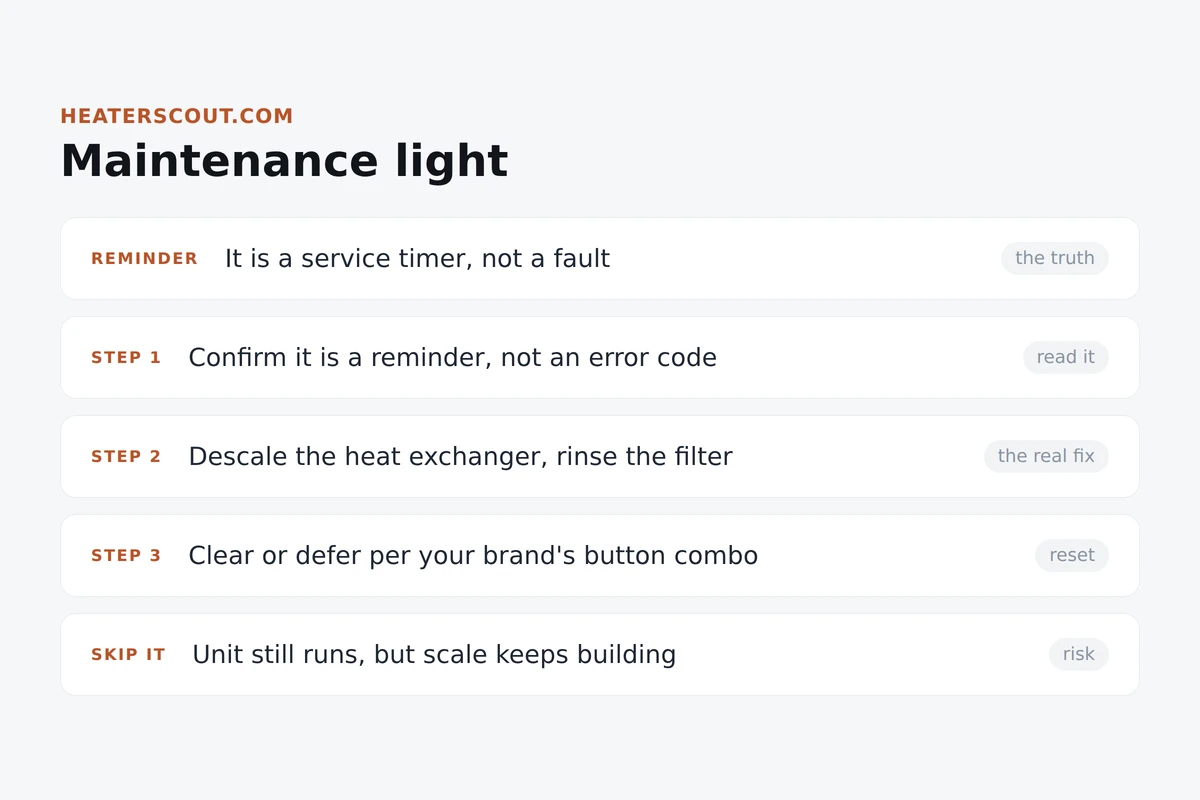
- The maintenance light is a time or run-hours service reminder, not an error or a fault code.
- The heater keeps running normally while it is lit. Nothing has failed.
- It is shorthand for one job: descale the heat exchanger, plus rinse the inlet filter.
- Each brand shows it differently: Rinnai SS message, Navien red wrench, Noritz code 90, Rheem app alert.
- Clearing the light and doing the descale are two separate steps. Do the flush first, then reset.
- Ignoring it does not lock the unit out, but scale keeps building and efficiency drops.
| What it is | Time / run-hours service reminder (not a fault code) |
| Rinnai | 'SS' service-reminder message on the controller |
| Rinnai reset | Press ON/OFF five times within five seconds to defer |
| Navien | Blinking red wrench icon on the panel / remote |
| Navien reset | Clears after service is performed and logged |
| Noritz | Maintenance code 90 = scheduled service due |
| Rheem | EcoNet app or control-panel maintenance alert |
| Takagi | No dedicated auto reminder on most lines; owner-scheduled |
| What it wants | Descale the heat exchanger; rinse the inlet filter |
| Also on some brands | Flame-rod clean, condensate-trap check, safety look-over |
| Typical interval | About annually (Noritz: every 1 to 3 years by hardness) |
| Does it stop the unit | No, the heater keeps running |
| DIY descale cost | Vinegar / solution and a pump kit, under $60 |
| Pro descale cost | About $150 to $300 for the flush visit |
Why a heater with no tank needs reminding at all
A tank water heater holds forty or fifty gallons and heats it slowly, so scale settles at the bottom and mostly gets ignored until the tank rots out. A tankless unit works the opposite way. It has no reservoir, so every time you open a hot tap it fires the burner and races the incoming water through a coiled heat exchanger, raising it to your setpoint in seconds. That exchanger is a maze of narrow passages sitting directly over a flame. Hard water flashing to temperature inside those passages drops its dissolved calcium and magnesium as lime scale, and scale in a narrow tube is a much bigger deal than scale in a big tank. It chokes flow, it insulates the metal from the water so the burner works harder, and left long enough it creates hot spots that stress the exchanger. The maintenance reminder exists because the people who own tankless heaters are the same people who forget to descale, and the exchanger is the single most expensive part in the box.
How each brand shows it
There is no industry-standard maintenance icon, so the same message wears a different face on each controller. Knowing your brand's version keeps you from mistaking a reminder for a breakdown.
Rinnai calls it a service reminder and shows an 'SS' on the controller when the unit passes a set number of operating hours that the installer configures. It is deliberately not counted as a hard error. Navien uses a blinking red wrench icon on the front panel or wireless remote; owners on the NCB and NPE lines regularly mistake it for a fault, but it is the same time-based nag, and it is designed to clear once the service is actually done rather than by a plain power cycle. Noritz drives it through a maintenance code, 90 on many models, that flags scheduled service is due and that a technician clears after the descale. Rheem leans on its EcoNet ecosystem: the reminder shows up as a control-panel alert or an app notification, and because Rheem watches runtime and airflow it often surfaces first as a clean-the-inlet-filter prompt. Takagi is the outlier. Most Takagi lines have no dedicated automated descale reminder at all, so the owner has to put the flush on a calendar; the 'LC' some people confuse with it is actually a low-water-flow limit, a real operating condition, not a maintenance timer.
My display shows a number, not a wrench. Is that still the maintenance reminder?
Probably not, and that is the key distinction. A blinking wrench, an 'SS', or an app 'service due' banner is the maintenance reminder and the unit keeps running. A standalone numbered fault code, like Rinnai 12 for flame failure or a Navien error number, usually stops the heater and points at a specific broken thing: gas, flame sensing, venting, a thermistor. Noritz code 90 is the confusing middle case, since it is a number that means 'maintenance due' rather than a failure. When in doubt, check whether the unit still heats water. If it does, you are almost certainly looking at the reminder; if it is locked out, look up that exact code instead of this article.
Reset is not the same as service
Clearing the light is not the repair. The reset only restarts the timer. If you dismiss the reminder without descaling, the controller happily counts another year while lime keeps building in the exchanger. Do the flush first, then clear or defer the reminder, so the next one measures time since a genuine service.
The actual job behind the light
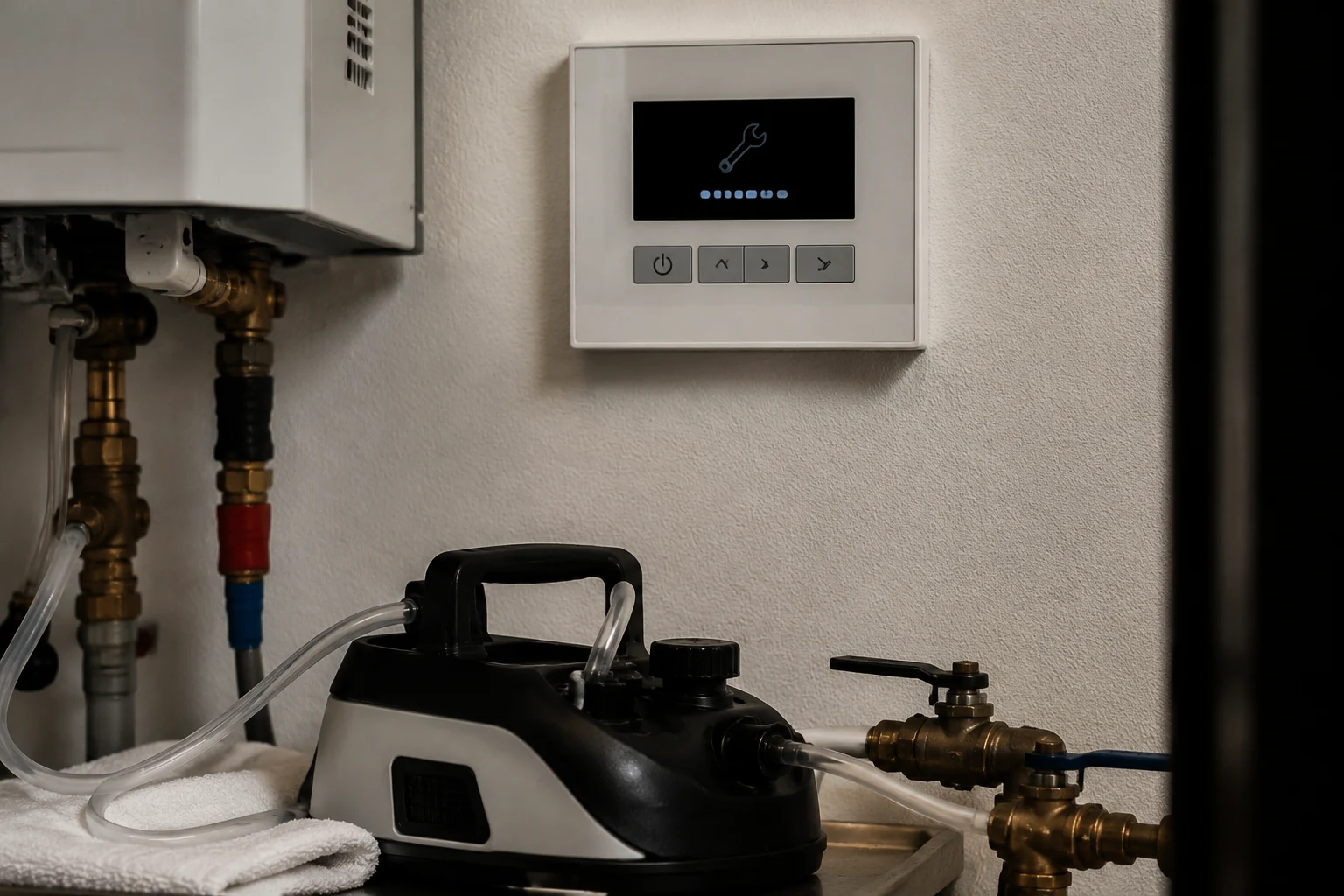
Strip away the brand differences and the reminder always points at the same short list. First and most important is descaling the heat exchanger. If your installer put in the isolation valves, the pair of service ports with little handles on the hot and cold lines, this is a homeowner job. You close the valves to the house, hook a submersible pump and two hoses to the ports, and circulate white vinegar or a descaling solution through the exchanger for the time your maker specifies, commonly around forty-five minutes to an hour, then rinse it out with clean water. Second is the cold-water inlet filter, a small screen that catches grit before it reaches the exchanger; you pull it and rinse it under the tap. On many units, especially Navien, there is also an air-intake filter you clean with a soft brush and a condensate trap at the bottom that needs its cup pulled and flushed so it does not clog and back up. Rinnai adds a flame-rod cleaning and a general safety inspection to its service interval. None of this touches the gas train tuning, which is what keeps the whole job on the DIY-friendly side for anyone comfortable with plumbing.
What happens if you just keep dismissing it
Nothing dramatic on day one, which is exactly why it gets ignored. The unit is not going to shut off because the reminder is lit. But the reminder is a proxy for scale, and scale does not pause because you tapped past the alert. Over months you will notice the practical symptoms first: the flow at your hot taps drops, hot water takes longer to arrive, and your gas bill creeps up because the burner is fighting an insulated exchanger. Push it far enough and the scale itself starts throwing real error codes, the kind that do lock the unit out, and a badly scaled exchanger can fail years early. Replacing a heat exchanger costs a large fraction of a whole new heater, so the annual flush the light is asking for is cheap insurance. If your reminder keeps coming back faster than once a year, that is your water telling you it is hard enough to justify a softener, which stretches every service interval and protects the most expensive part in the unit.
Where the homeowner line sits
Resetting the reminder is yours on every brand, it is a button combo or an app tap. The descale is yours too if you have the isolation valves and are comfortable running a pump and hoses for an hour. The one thing worth reading before you start is your warranty language. Noritz's service manual, for example, states the flush is intended for a qualified service professional, and a DIY descale that damages the unit may not be covered. If your unit lacks service valves, or you would rather not handle vinegar and a pump, a plumber's flush visit runs roughly $150 to $300 and clears the reminder as part of the call. Either way, the move is the same: service the unit, then reset the light. The light is not the problem. The scale it is counting is.
Frequently asked
Is the tankless maintenance light an error or a fault code?
No. On gas tankless heaters the maintenance light, service reminder, or blinking wrench is a scheduling nudge, not a fault. It fires on a timer or a count of run hours that the maker set at the factory or your installer set at commissioning. Nothing on the unit has failed when it appears, and the heater keeps making hot water. That is the whole difference between a reminder and an error code like Rinnai 12 (flame failure) or Navien's fault codes: an error stops the unit and needs diagnosis, while the reminder just says 'you are due for service.' If your display shows a numbered fault and the unit will not fire, that is a different problem and you should look up that specific code, not this reminder.
What does the maintenance reminder actually want me to do?
It wants a descale. Every gas tankless heater pushes water through a narrow heat exchanger, and in hard water that exchanger slowly furs up with lime scale that chokes flow and efficiency. The reminder is timed to land around when a year of use has passed so you flush that scale out with vinegar or a descaling solution. While you are in there most makers also want the cold-water inlet screen filter rinsed, and depending on brand the flame rod cleaned and the condensate trap checked. Rinnai bundles the descale, pre-filter clean, flame-rod clean, and a safety inspection into its service interval. So the light is shorthand for a short list of tasks, not a single button press.
How do I reset or clear the maintenance light?
It depends on your brand, and clearing it is not the same as fixing it. On a Rinnai controller you defer the SS service reminder by pressing the ON/OFF button five times within five seconds. On a Navien the blinking red wrench is meant to clear once the service is performed and logged, so a bare power cycle may not make it go away. Noritz surfaces a maintenance code (90 on many units) that a technician clears after the descale. Rheem drives its reminder off the EcoNet app or panel, so you acknowledge or reset it there after the flush. The honest move is to do the descale first, then clear the reminder, so the timer restarts from a genuinely serviced unit.
Can I keep using the water heater with the maintenance light on?
Yes, in the short term. Because the reminder is time-based and not a fault, the unit does not lock out and hot water keeps flowing. But the light is counting real scale building in the heat exchanger, and ignoring it for months has a cost: reduced flow, longer waits for hot water, higher gas use, and eventually a scaled exchanger that can trip real error codes or fail early. Think of it like the oil light's calmer cousin. The sky is not falling today, but the clock is running. In hard-water areas the damage accrues faster, so do not treat 'it still works' as 'it is fine.'
Will descaling turn off the maintenance reminder by itself?
Not on its own. The flush cleans the scale, which is the point, but the reminder is a separate timer the control board is running. On most brands you have to acknowledge or reset that timer through the controller or app after the service, or on Navien have the service logged, before the wrench or SS message stops showing. Descaling without clearing the reminder leaves the light on; clearing the reminder without descaling restarts the clock on a still-scaled unit. Do both, in that order: flush first, then reset, so the next reminder actually measures time since a real service.
Do I need a plumber, or can I clear the maintenance light myself?
The reset itself is a homeowner task on every brand: it is a button combo or an app tap. The descale behind it is DIY-friendly if you have the isolation valves (service ports) most tankless installs include, a bucket, a submersible pump, and a jug of white vinegar or descaling solution. You circulate the solution through the exchanger for the time your maker specifies, then rinse. The one caveat is warranty: Noritz's service manual, for one, states the flush should be done by a qualified service professional, and a sloppy DIY descale that damages the unit may not be covered. If you are not comfortable, or your unit has no isolation valves, a pro visit for the flush runs roughly $150 to $300.
How often does the maintenance light come on?
Roughly once a year on most gas tankless units, because that is the descale interval makers design around, though the exact trigger is run hours plus elapsed time, not the calendar alone. A heater feeding a big household or sitting on hard water racks up hours and scale faster, so its reminder can arrive sooner or you may want to service ahead of it. Noritz recommends descaling every one to three years depending on water hardness; Rinnai, Navien, and Rheem all center on annual service. If yours trips more often than yearly, that is a signal your water is hard enough to justify a whole-house softener, which stretches every service interval and protects the exchanger.