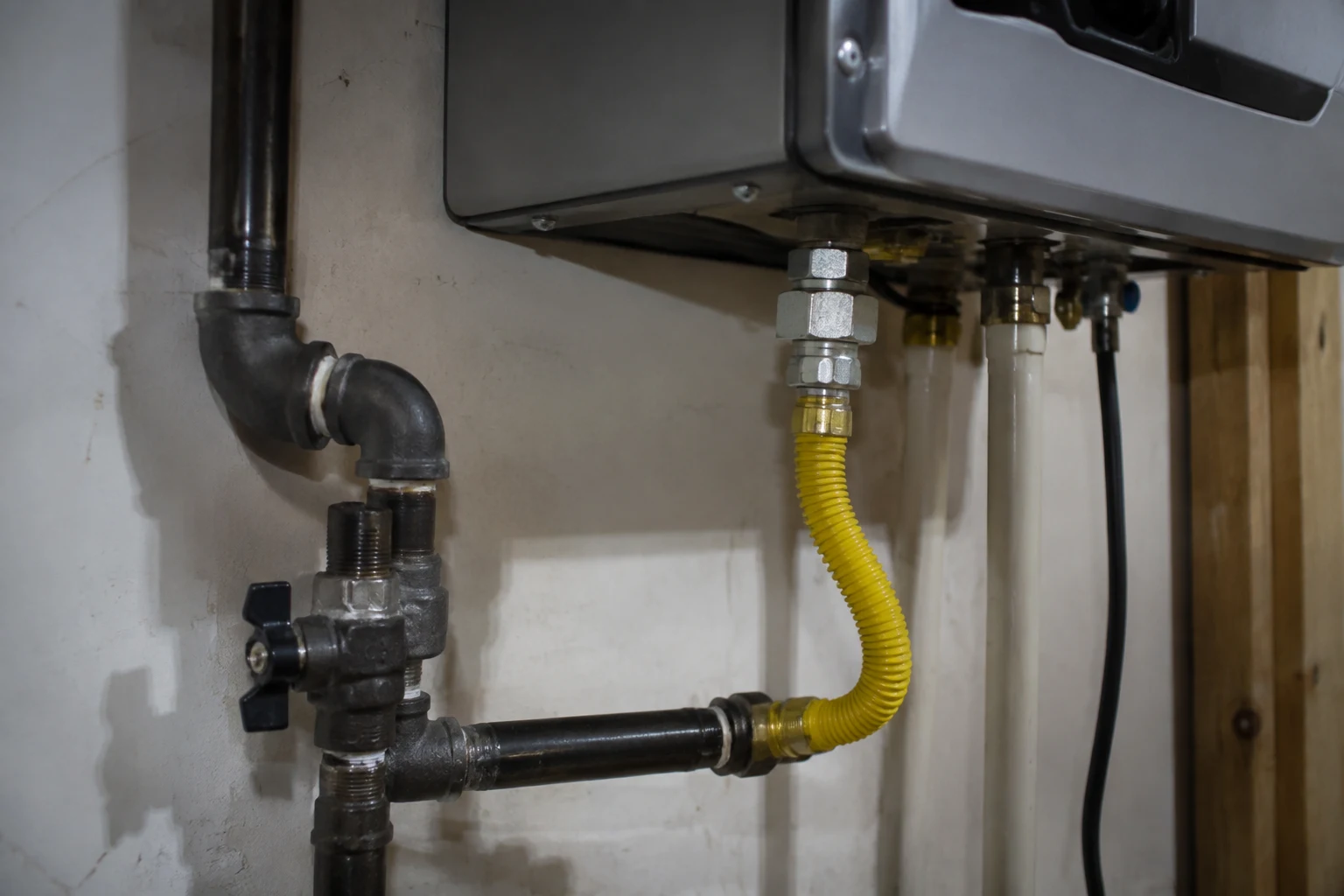
A plumber sets a shiny Navien on the wall, connects the water, opens the gas, and the unit coughs out a low-gas-pressure fault before the first shower is done. The heater is fine. The gas line feeding it is a 1/2-inch pipe that was perfectly happy running a 40,000 BTU tank and cannot come close to feeding a burner that wants five times the fuel. Nobody sized the pipe.
The 1/2-inch gas line is the number-one surprise on a tankless install. The unit is rated, the water is easy, and then the fuel supply turns out to be half the pipe the burner needs.
Why the number jumps so far
A conventional storage heater keeps 40 or 50 gallons hot around the clock, so its burner is small: around 40,000 BTU per hour, sipping fuel to hold temperature. A tankless unit stores nothing. When you open a hot tap it has to raise cold water to shower temperature in the seconds it takes to travel through the heat exchanger, and doing that on demand takes a much bigger flame. Residential tankless units run roughly 120,000 BTU per hour on the small end to 199,000 on the high-output models from Rinnai, Navien, and Rheem. That is not a small step up from a tank. It is four to five times the fuel moving through whatever pipe you connect to.
Gas piping is sized by how much gas it can pass, and that capacity is fixed by the pipe's inside diameter and the distance the gas has to travel. Push more fuel through than the pipe can carry and the pressure at the burner sags below what the unit needs. The heater reads that as low gas pressure, modulates down or shuts off, and you never see full output. So the question on every tankless install is not whether the gas is connected. It is whether the pipe is fat enough for the new load over the run it has to cover.
Turning BTU into pipe size
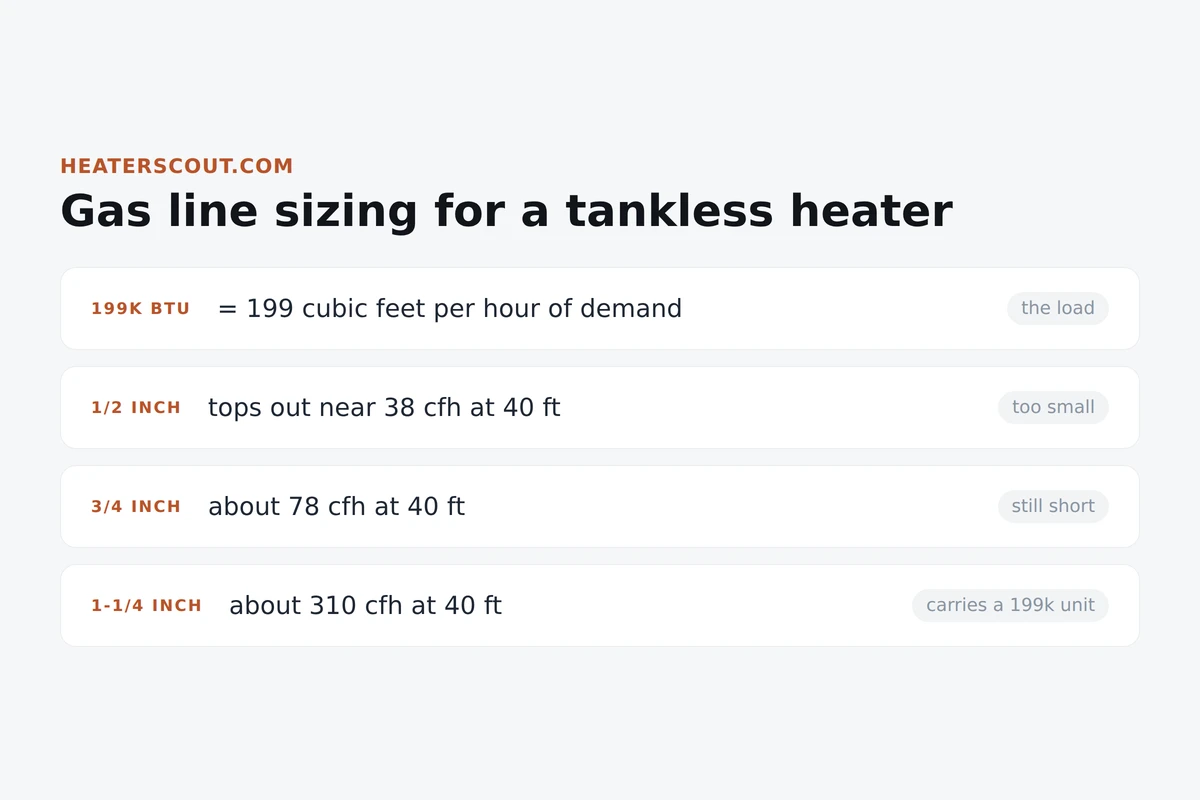
The math is simpler than it sounds because it rests on one conversion. Natural gas carries about 1,000 BTU in every cubic foot, so you turn the heater's input rating into a flow demand just by dropping three zeros. A 150,000 BTU unit wants 150 cubic feet per hour. A 199,000 BTU unit wants 199. That number, cubic feet per hour, is what a gas pipe capacity table is built around. The table below gives schedule-40 black iron capacity at a standard half-inch water column pressure drop and a 0.60 specific gravity, which is the common residential natural-gas basis. Notice how hard the length works against you: every pipe carries far less at 40 feet than it does at 20.
| 1/2" @ 20 ft | about 55 cfh |
| 1/2" @ 40 ft | about 38 cfh |
| 3/4" @ 20 ft | about 115 cfh |
| 3/4" @ 40 ft | about 78 cfh |
| 1" @ 20 ft | about 220 cfh |
| 1" @ 40 ft | about 150 cfh |
| 1" @ 60 ft | about 120 cfh |
| 1-1/4" @ 20 ft | about 450 cfh |
| 1-1/4" @ 40 ft | about 310 cfh |
Read it against a real unit and the pattern jumps out. A 199 cfh demand at a 40-foot run walks right past 1/2-inch (38), past 3/4-inch (78), and past 1-inch (150), and lands on 1-1/4-inch pipe, which carries about 310 cfh at that distance. At a short 20-foot run, 1-inch is borderline for a 199k unit and often the answer for the smaller 120k models. Only very short runs on the smallest units ever land on 3/4-inch, and 1/2-inch is off the table for any tankless heater the moment you leave the fitting.
How to measure your run and total demand
Sizing goes wrong when people guess the length or count only the heater. Both are easy to get right with a tape measure and the rating plates on your appliances. Work in this order and you will have the two numbers the table needs.
Size it for your unit and run
Set the burner's BTU input, drag the run length from the meter to the heater, and switch between black iron and CSST. The tool converts BTU to a cubic-feet-per-hour demand, then finds the smallest standard diameter that carries that demand across your run. It also shows how a 1-inch line stacks up, because that is the size most installs are hoping to reuse and the one that most often falls just short.
Tankless gas line sizer
Natural gas, schedule-40 black iron, 0.5" WC drop, 0.60 sg. CSST is derated about 15 percent. Sizing guidance only — gas work is code-regulated and usually needs a licensed plumber and a permit.
Minimum pipe diameter
—
Demand vs capacity
Black iron, CSST, or upsize the meter
Once you know the pipe has to grow, there are three moves on the table, and they solve different problems. Two are about the pipe itself and one is about the gas supply behind it. They are not interchangeable, and a job sometimes needs more than one.
| Approach | What it fixes | Trade-offs |
|---|---|---|
| New black iron branch | Runs the correct larger diameter from the meter to the heater | Threaded steel, rigid, labor-intensive, but the default and cheapest material |
| CSST run | Same larger effective capacity with flexible tubing | Faster to route around framing; carries about 15% less per nominal size, and must be bonded and grounded |
| Upsize the meter and regulator | Adds supply capacity when the whole house load exceeds the meter | Utility's job, not the plumber's; does nothing for an undersized branch pipe |
For most retrofits the answer is a new, larger branch in black iron or CSST from the meter to the unit, sized off the table for your run. The meter upsize enters the picture only when the total household gas load, furnace and range and dryer and the new heater together, outgrows what the existing meter and regulator can deliver. That is a call between your plumber and the gas utility, and it can travel with a pipe upgrade rather than replace it.
This is licensed, permitted work
Gas piping is code-regulated work. Sizing, materials, joints, bonding for CSST, pressure testing, and the meter and regulator are all governed by the fuel gas code and your local authority, and most jurisdictions require a permit and a licensed plumber or gas fitter to run or modify a gas line. The numbers here are for planning and understanding the problem. Have the final design and installation done and inspected by a licensed professional.
Frequently asked
Why won't my existing 1/2-inch gas line feed a tankless water heater?
A storage tank heater fires around 40,000 BTU per hour, which a 1/2-inch line handles without trouble. A tankless unit fires 120,000 to 199,000 BTU per hour, because it heats water on demand instead of keeping a tank warm. That is four to five times the fuel flowing through the same pipe. Convert it to volume and a 199,000 BTU unit wants 199 cubic feet of gas per hour, while a 1/2-inch line at a typical 40-foot run tops out near 38 cubic feet per hour. The pipe simply cannot pass that much gas, so the burner starves, the unit throws a flame-failure or low-gas-pressure code, and it never reaches full output. This is the single most common surprise on a tankless install.
How do I calculate the gas line size I need?
Start with two numbers. First, the demand: divide the unit's input rating by 1,000, because natural gas carries roughly 1,000 BTU per cubic foot. A 199,000 BTU unit needs 199 cubic feet per hour. Second, the length: measure the longest run from the gas meter or regulator to the heater, following the pipe, not a straight line. Then read a schedule-40 black iron capacity table at that length and find the smallest diameter whose capacity meets or beats your cubic-feet-per-hour demand. At a 40-foot run, a 199 cfh load lands on 1-1/4-inch pipe, because 1-inch only carries about 150 cfh at that distance. The calculator on this page does exactly this lookup.
Does propane change the pipe size?
Yes. Propane carries about 2,500 BTU per cubic foot, so the same burner moves less volume of gas, but propane also runs at a different supply pressure and uses its own capacity tables. You cannot read a natural-gas table for a propane job. The sizing tool and the numbers on this page are for natural gas at a 0.5-inch water column pressure drop. For propane, use the propane-specific tables in the fuel gas code or the manufacturer's manual, and confirm the regulator delivers the pressure the tables assume.
Is CSST the same size as black iron pipe?
No. Corrugated stainless steel tubing is sized by a different measure, called an EHD rating, and for a given nominal size it usually carries a little less gas than schedule-40 black iron over the same run. It also depends heavily on the manufacturer's own tables, since CSST brands are not interchangeable. As a rough planning number, treat CSST as carrying around 85 percent of what the equivalent iron pipe would, then verify against the specific product's listing. CSST installs faster and flexes around framing, but it must be bonded and grounded per code, which is not optional.
Can I keep the small line and just upsize the meter?
Upsizing the meter and regulator fixes a supply problem, not a pipe problem. If the whole house is near the meter's capacity once you add a 199,000 BTU unit, the utility may need to set a larger meter and regulator so there is enough gas and pressure to go around. But that does nothing about a 1/2-inch branch that physically cannot pass 199 cfh over 40 feet. You still have to run the correct diameter from the meter to the heater. Sometimes both are needed: a bigger meter and a larger branch line. Your plumber and the gas utility sort out which applies to your service.
Do other gas appliances on the line affect the size?
They do, and this trips people up. The pipe from the meter has to carry the combined demand of everything drawing from it at once. If the same branch feeds a furnace, a range, and the new tankless heater, you add up all their BTU inputs and size the common sections for the total, not just the heater. A 199,000 BTU heater sharing a trunk with a 100,000 BTU furnace can push the shared run to 300 cfh, which changes the required diameter. This is why a proper sizing job maps the whole piping system with a load at every branch, rather than looking at the water heater alone.