A condensing tankless water heater drips. That is not a defect, it is the whole point of the design. To reach 95 percent efficiency it cools its own exhaust past the dew point and squeezes liquid water back out of the flue gas, somewhere between half a gallon and a gallon and a half for every hour the burner fires. The catch is that this water comes out acidic, around pH 3 to 4, and it has to be trapped, neutralized, and drained before it corrodes the plumbing it lands in. Get the condensate side wrong and a $1,500 heater faults out on a cold morning or slowly eats a hole through your drain line.
Setting up and routing the condensate drain
The condensate path has a fixed order, and skipping a piece is what causes the calls in January. Water leaves the secondary heat exchanger, drops through a trap, passes through a neutralizer, and then goes to a drain by gravity or gets lifted by a pump. Every condensing model from Rinnai, Navien, and Noritz ships the trap and expects you to add the rest. Here is the sequence that keeps it working.
When the condensate side clogs: reading the symptoms
A condensing tankless is unforgiving about a blocked drain. The moment condensate cannot leave, it backs up into places water should never sit, and the unit's safety logic shuts it down. The good news is that it warns you first if you know the signs. Work through these from the mildest to the point where the unit quits.
Gurgling or bubbling at the drain
The earliest sign. As the trap or line starts to plug, water no longer passes freely and you hear it fighting past a partial blockage, a wet gurgle each time the unit fires. It means the trap is loading up with sludge or the neutralizer bed has slumped and shed grit into the line. Flush the trap now, before it goes fully solid, and you avoid the fault entirely.
A slow drip or a puddle under the unit
Condensate that cannot get down the drain finds the next lowest point, the floor. A puddle or a steady drip from the base almost always traces to a clogged trap, a blocked line, or a failed condensate pump, not to the water plumbing. Confirm the water is acidic with a pH strip if you are unsure whether it is condensate or a supply leak.
A musty or sour smell
Standing condensate and the biofilm that grows in a slow-moving trap give off a musty, sometimes sour odor near the unit. It signals water sitting where it should be flowing, and points toward the same clog that will eventually fault the heater.
An error code and a hard shutdown
When the backup reaches the heat exchanger or the pressure switch, the unit stops. Navien commonly logs a 438 condensate or pressure fault; Rinnai and Noritz have their own codes in the same family, listed in the manual. Resetting without clearing the cause just lets it fault again. Pull and flush the trap, clear the line, check the neutralizer, and verify the pump before you reset.
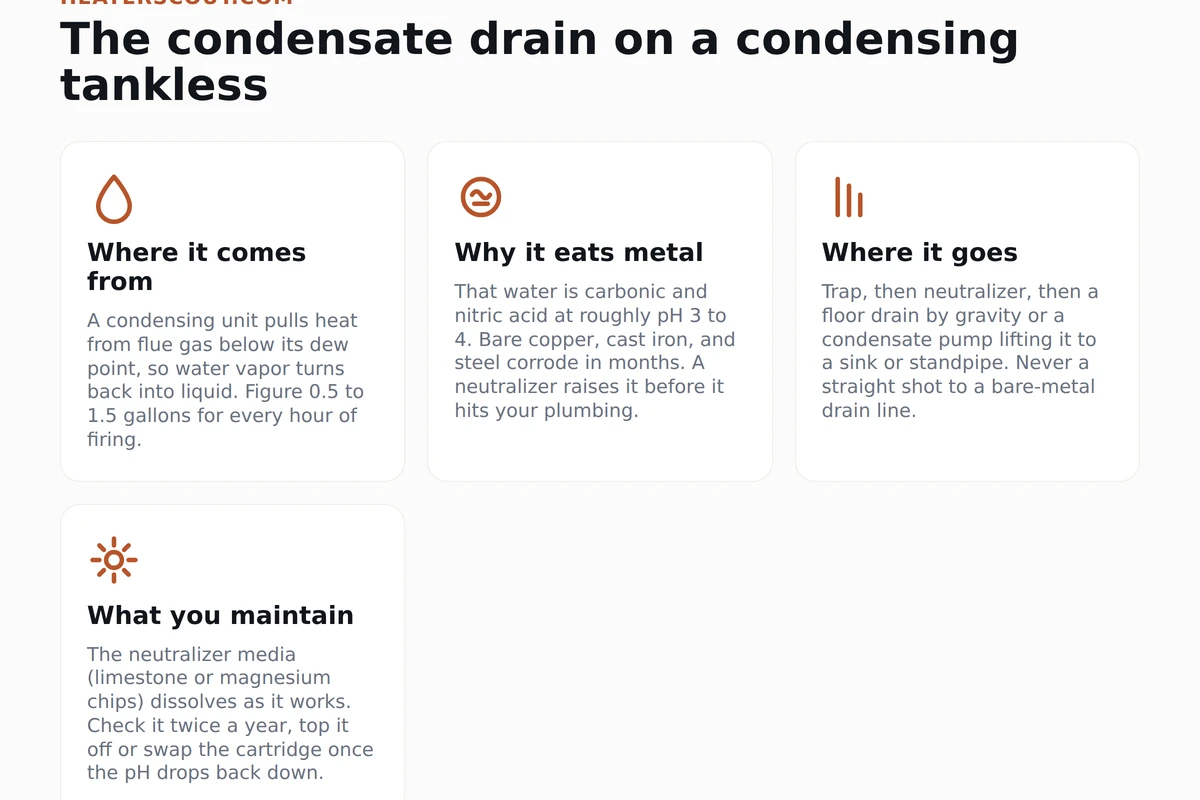
Drain routing and neutralizer options compared
There is no single right way to drain a condensing tankless. It comes down to whether a drain sits below the unit and what your local code allows for the acidity. Here are the common arrangements and where each one fits.
| Option | How it works | Best when | Watch out for |
|---|---|---|---|
| Gravity to a floor drain | Neutralizer outlet slopes down to a floor drain or standpipe; no moving parts. | A drain sits lower than the unit and the run stays indoors. | Sags that pool and freeze; missing air gap letting sewer gas back up. |
| Condensate pump | A reservoir collects water and a small pump lifts it to a higher drain or sink. | The only drain is above the unit, common in basements. | Pump failure floods the floor; needs a check valve and a float safety wired to the unit. |
| Limestone (calcium carbonate) neutralizer | Crushed limestone chips react with the acid and raise pH toward neutral. | Most residential installs; cheap and widely stocked. | Media dissolves and packs down; check every six months, refill yearly. |
| Magnesium oxide neutralizer | MgO pellets neutralize faster and buffer higher; often mixed with limestone. | Higher condensate volume or a run to a sensitive septic system. | Can over-raise pH if oversized; still needs periodic media checks. |
| Raw to sewer (no neutralizer) | Condensate runs through PVC or ABS straight to a municipal sewer. | Only where code allows and the entire path is plastic. | Illegal in many areas; corrodes any metal drain and harms a septic tank. |
Condensate neutralizer
A cartridge or tube packed with alkaline media, usually crushed limestone (calcium carbonate) or magnesium oxide pellets, that the acidic condensate flows through on its way to the drain. The acid reacts with and dissolves the media, raising the pH from around 3 to 4 up toward neutral (6 to 8) so the water no longer corrodes metal pipe or upsets a septic system. Because the media is consumed as it works, it is a maintenance item, not install-and-forget.
Condensing tankless
A gas tankless water heater with a second heat exchanger that cools the exhaust below its dew point to recover latent heat, reaching 94 to 97 percent efficiency. Cooling the flue gas condenses water vapor back into liquid, so the unit vents with PVC or polypropylene and needs a condensate drain. A non-condensing tankless, by contrast, exhausts hot and dry through metal venting and makes no condensate.
Acidic condensate corrodes metal and harms septic
Condensate from a condensing tankless is genuinely acidic, roughly pH 3 to 4, which is corrosive to bare copper, galvanized steel, and cast-iron drain pipe and disruptive to the bacteria in a septic system. Do not plumb it straight into a metal drain line or a septic tank without a neutralizer in the path. A cheap limestone cartridge protects hundreds of dollars of pipe. And do not assume the neutralizer works forever: the media dissolves as it neutralizes, so a cartridge you installed two years ago and forgot may be passing raw acid today. Test the outlet with a pH strip twice a year.
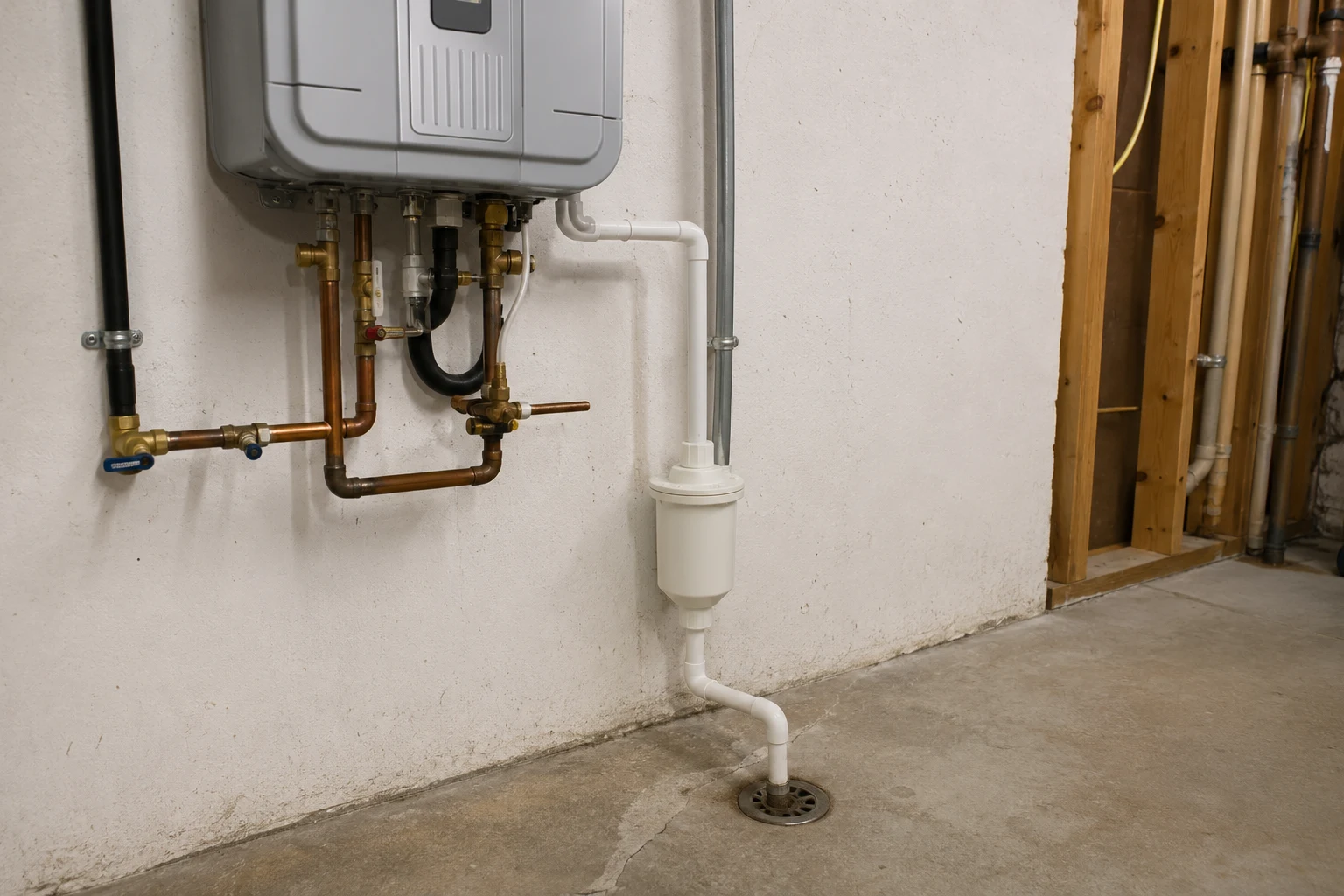
Maintaining the neutralizer media
The neutralizer is the one part of the condensate system with a service life measured in months, not years. Because it works by dissolving, a cartridge that protected your drain last winter can be spent this winter. Put it on the same schedule as descaling the heat exchanger, twice a year, and it never sneaks up on you. Open the cartridge, look at the media, and test the water leaving it.
Healthy media still looks like loose chips or pellets with space between them. Spent media has slumped into a packed, coated bed, sometimes with a gray sludge on top. The real test is a pH strip held under the outlet while the unit runs: neutralized condensate reads 6 to 8, and anything below about 5 means the bed can no longer keep up. Refillable cartridges take a bag of fresh limestone or magnesium media; sealed ones you replace whole for $20 to $40. Rinse the housing while it is open, and flush the trap and line at the same time so grit shed by the old media does not clog the drain downstream.
Frequently asked
Why does a condensing tankless water heater make condensate at all?
It is pulling extra heat out of the exhaust. A non-condensing tankless sends flue gas up the vent at 300 to 400 degrees F and throws that heat away. A condensing model runs the exhaust through a second heat exchanger and cools it past the dew point of the flue gas, roughly 130 degrees F. Below that point the water vapor combustion produces turns back into liquid, the same way a cold glass sweats on a humid day. Recovering that latent heat is how a condensing unit hits 94 to 97 percent efficiency instead of 80 to 85. The tradeoff is that all that recovered water has to drain somewhere, on the order of half a gallon to a gallon and a half for every hour the burner runs.
Do I really need a neutralizer, or can I skip it?
It depends on the drain line and your local code. Condensate leaves the unit at pH 3 to 4, about as acidic as orange juice. Dumped straight onto copper, galvanized steel, or cast-iron drain pipe, it corrodes the metal and eventually eats a pinhole through it. On a septic system the low pH can disrupt the bacteria the tank relies on. If the condensate flows only through PVC or ABS to a municipal sewer, some jurisdictions let you run it raw. But many codes, and every manufacturer protecting a septic tank or a metal drain, call for a neutralizer. It is a cheap cartridge. When in doubt, install one.
How often do I replace the neutralizer media?
Check it every six months and expect to refresh the media once a year in a typical household, more often on a unit that runs hard. The media, usually crushed limestone (calcium carbonate) or magnesium oxide pellets, works by dissolving. The acid consumes the chips, so the bed slowly shrinks and coats over. Once too little active media is left, the pH of the water leaving the cartridge drops back toward 3 to 4 and you are no longer protecting anything downstream. The simple test is a cheap pH strip held under the outlet: if it reads below about 5, refill or swap. Some cartridges refill with a bag of media; others you replace whole.
Why is my Navien or Rinnai throwing an error and the condensate is backing up?
A clogged condensate trap is a common cause. The trap fills with the sludge that neutralizer media and combustion byproducts shed, and once it plugs, condensate has nowhere to go. It backs up into the secondary heat exchanger and the burner area, and the unit's safety logic shuts it down rather than let water sit where it should not. Navien units often log a 438 or a related condensate or pressure fault; Rinnai and Noritz have their own codes in the same family. You will usually also see or hear the warning signs first: gurgling as the trap struggles to pass water, a slow drip or puddle under the unit, or a musty smell. Pull and flush the trap, clear the drain line, and check the neutralizer before you reset.
Can the condensate line freeze if it runs outside?
Yes, and it is one of the most common winter failures on these units. Condensate trickles rather than gushes, so a line run through an unheated space or out an exterior wall can freeze solid in a cold snap. Once it is blocked with ice, condensate backs up exactly like a clogged trap and the unit faults out on a cold morning. Keep the line indoors and drain it to an interior floor drain or a condensate pump whenever you can. If part of it must run cold, slope it steeply, insulate it, or add self-regulating heat-trace cable. An outdoor run to open air is asking for a January service call.
What is a condensate trap and why does the drain need one?
The trap is a small water-filled U or reservoir between the heat exchanger and the drain line, same idea as the P-trap under a sink. It keeps a plug of water in the path so exhaust gases and the fan's pressure cannot push back up the drain and out into the room, while still letting liquid condensate pass through. Without a proper trap, the pressure difference across the unit can blow the condensate out or pull air back through the drain and disrupt combustion. Most condensing tankless units have a trap built in or supplied in the box. It is also the first place to look when the unit throws a condensate fault, because it is where the sludge collects.
Does a condensate pump need a check valve and a high-water alarm?
A condensate pump is worth setting up right, because when it fails the water finds the floor. Use a check valve on the discharge line so the lift column does not drain back into the reservoir and short-cycle the pump. Wire the pump's built-in float safety switch to the tankless unit's shutdown terminals if the unit supports it, so a stuck float or a failed pump shuts the heater down before the reservoir overflows. Many pumps include a second high-water switch or an alarm contact for exactly that. And keep the pump downstream of the neutralizer, so you are pumping neutralized water rather than running raw acid through the pump's plastic and seals.