A tankless water heater will not light until a small pressure switch tells the control board that air is actually moving through the intake and exhaust. The combustion fan spools up, the switch closes, and only then does the burner get permission to fire. Choke that airflow with a wasp nest, an iced-over screen, a kinked vent, or a snowdrift over the termination, and the switch never confirms flow. The board locks out and posts a code. The number differs by brand, but the message is the same: the flue or the air supply is restricted, and the unit refuses to fire into it.
Treat a blocked exhaust as an emergency
A blocked exhaust on a gas appliance can send combustion products, including carbon monoxide, back toward the house. If a blocked-vent code keeps returning, or you smell exhaust near the unit, leave it off and have the vent inspected. Do not jumper the pressure switch or reset your way past the code.
Quick answer
The blocked-vent code is different on every brand, but it always means the fan cannot prove free airflow. On Rinnai it is code 10 (air supply or exhaust blockage). On Navien it is E110 (blocked exhaust or abnormal combustion-air pressure), with E109 the related fan-motor fault. On Noritz it is code 90 (combustion or airflow abnormality). On condensing Rheem and Ruud it is code 29 (venting and combustion fault). Bosch Greentherm units use fan and airflow codes in their C and F series. Start outside at the termination: clear snow, ice, nests, and debris, then check the internal air filter, the condensate trap, and the fan.
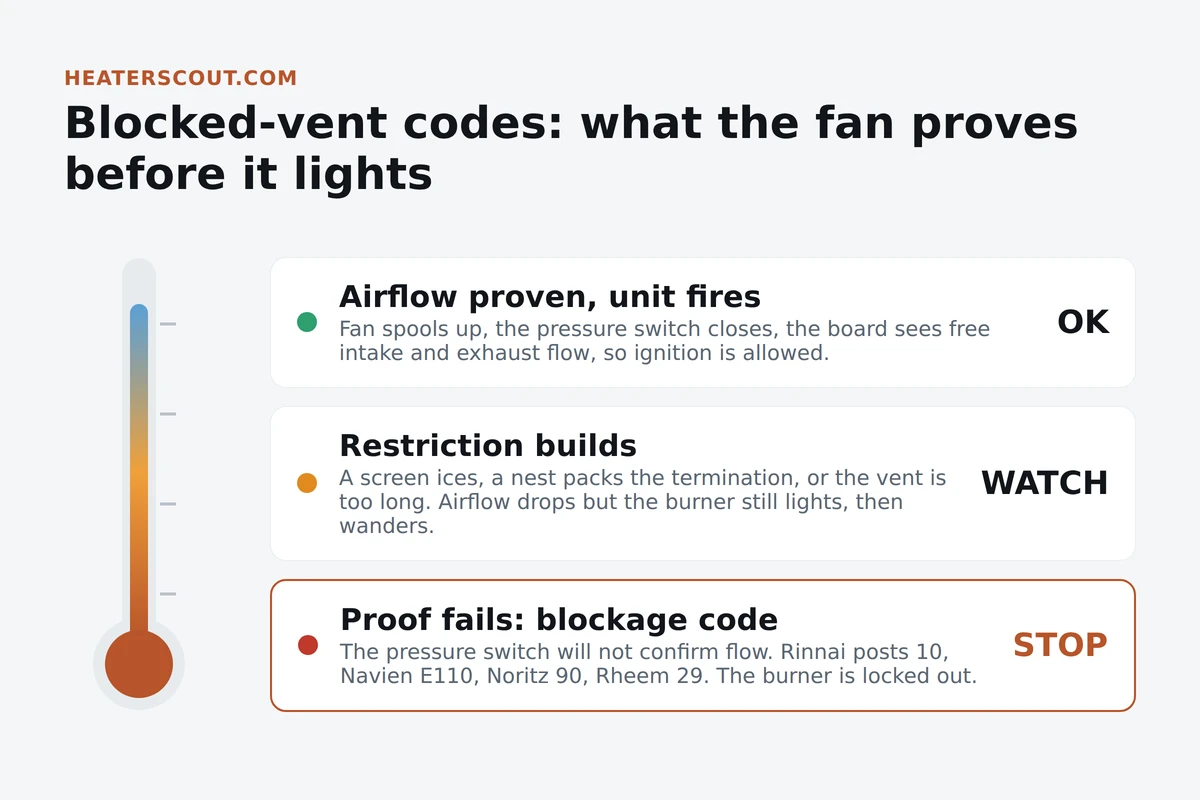
The combustion logic behind every one of these codes
All of these codes trip off the same physics, which is why understanding one brand teaches you the rest. A modern tankless heater is a forced-draft appliance. It does not rely on hot gas floating up a chimney the way an old atmospheric tank did. Instead a combustion fan draws fresh air in through the intake, mixes it with gas, and pushes the exhaust out through the flue. Because the burner depends on that fan, the board has to know the air is really flowing before it dares to light. It confirms this with a pressure switch, a diaphragm that senses the pressure difference the running fan creates. Free airflow makes the expected pressure, the switch closes, and ignition is allowed. Restrict the intake or the exhaust and the fan cannot build that pressure, the switch stays open, and the board reads it as a blockage. On some condensing units the same fan proof also covers a full condensate trap, because a trap brimming with water blocks the drain path and backs pressure into the exhaust.
That is the key thing to hold onto. These are not temperature codes or gas-valve codes. They are airflow codes. The board is not measuring how hot the water got or whether there was a flame. It is measuring whether air moved, and it decided air did not move freely enough. Everything downstream, the ignition-failure codes like Rinnai 11 or the flame-loss codes like Rheem 12, can be a secondary consequence of a blockage, because a burner starved of air or fighting back-pressure lights poorly and stays lit poorly. But the primary blocked-vent code is the one that points straight at the airflow path.
What each brand calls it
Rinnai is the cleanest example. Its service manual lists code 10 as 'air supply or exhaust blockage,' and the troubleshooting procedure walks straight to the intake screen, the exhaust, the vent length dip switch, the internal air filter, the fan, and the check valve between the fan casing and the burner body. Rinnai code 11 is separate, an ignition failure, but a unit that sat in a code-10 airflow restriction often throws 11 on the next attempt to light, so the two travel together. Navien splits the same job into E110, the abnormal exhaust or combustion-air pressure fault, and E109, the fan motor itself, and Navien service treats E110 as an emergency-class fault because a blocked exhaust is a carbon monoxide path. Noritz rolls it into code 90, a combustion or airflow abnormality: on the MM49 maintenance monitor, a value above 100 tells the tech the unit is straining to pull air in or push exhaust out, and the board ramps the fan to compensate until it gives up and posts 90. Do not confuse Noritz 90 with Noritz 92 or 93, which are neutralizer end-of-life warnings, not blockages. Condensing Rheem and Ruud units use code 29 for the venting and combustion fault, which also captures a clogged air-intake filter and a blocked condensate or neutralizer path. Bosch Greentherm units signal the same physical problem through fan and airflow codes in the C and F series, and Bosch names long vent runs, more than three elbows, and combination venting as triggers.
So is Rinnai 11 a blocked-vent code too?
Not directly. Rinnai code 10 is the blockage code; it fires when the fan and pressure switch cannot prove free airflow before ignition. Code 11 is an ignition failure, meaning the unit tried to light and saw no flame. They overlap because a restricted vent starves or destabilizes the burner, so a long-running code-10 condition can cascade into an 11 on the next light attempt. If you are chasing a blockage, work code 10 first. If the vent is clear and 11 stands alone, the trail runs to gas supply, the igniter, and the flame rod instead.
Working the blockage in order
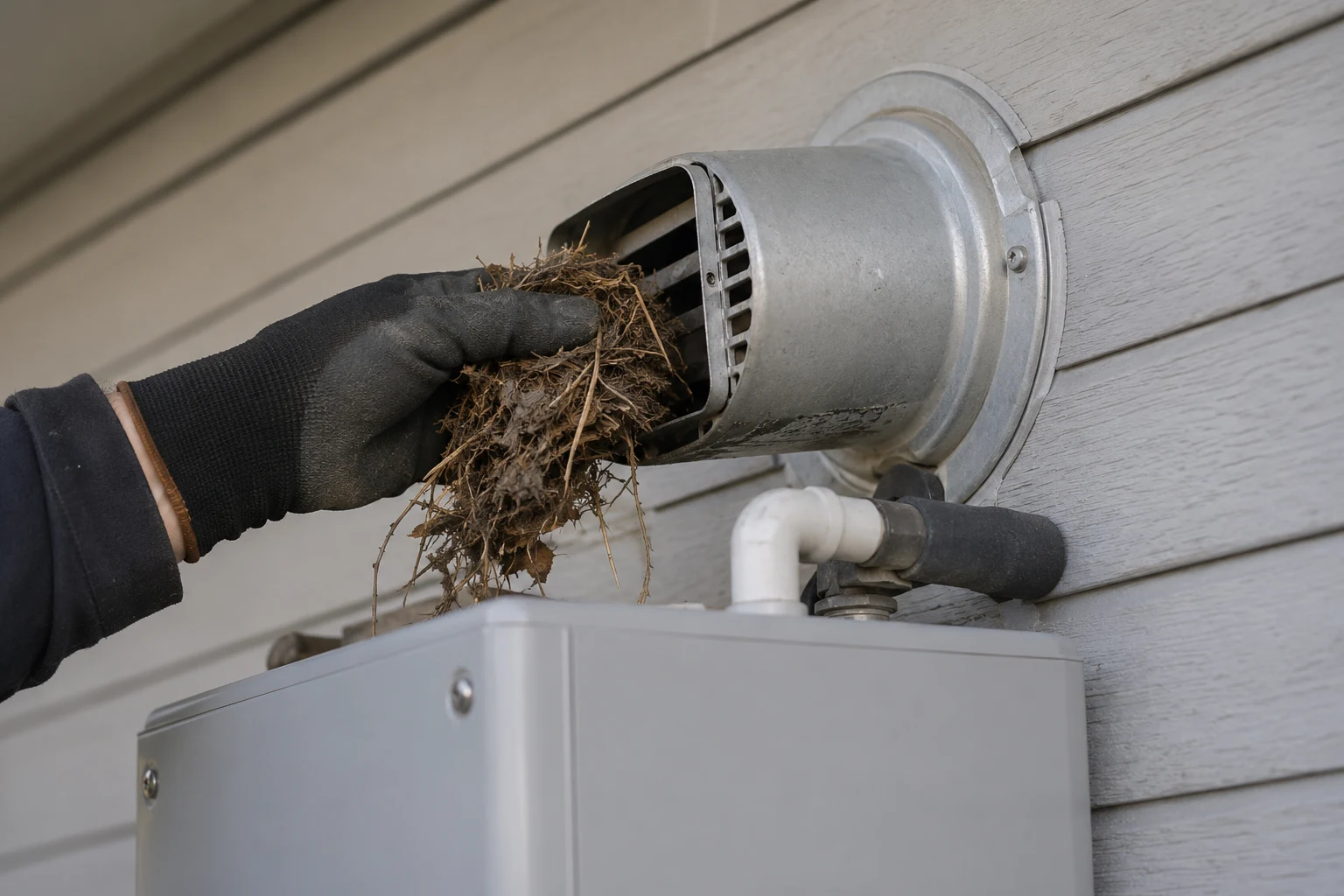
The fix path is the same across brands because the airflow path is the same. Start outside where the cheap problems live, then move inward. Kill power at the breaker before you open the cover.
Where the homeowner line sits
Clearing the outside termination is fully homeowner territory. So is cleaning the internal air filter and flushing the condensate trap, if you are comfortable cutting power and opening the cover. None of that touches the gas train. The line to stop at is the fan, the pressure switch, and the vent design itself. Diagnosing a weak fan or a sticking pressure switch calls for a manometer and the model service sheet, and correcting a vent that is too long, over-elbowed, or improperly terminated is a venting job that should follow the manufacturer install manual, not a guess. The reason the line is firm here is safety: everything on the far side of it can affect whether the unit vents its combustion products where they belong. Never bypass the pressure switch to force a unit past a blockage code. That switch is the last thing standing between a blocked flue and exhaust in your house.
Keeping the vent from tripping the code again
A blocked-vent code that keeps returning is almost always an install detail or a maintenance gap, not bad luck. If it re-ices every cold night, the exhaust probably is not pitched back toward the unit at the quarter inch per foot the manuals call for, so condensate freezes at the tip instead of draining internally, or the screen is too fine and frosts shut. If it only trips during a long draw, the vent is likely near its length or elbow limit, or a joint has crept apart, and the restriction only shows at full fire. Put a manufacturer-mesh screen on each termination to stop nests and debris while still passing full airflow, keep the terminations high enough above the snow line, and space the intake and exhaust far enough apart that the unit does not rebreathe its own exhaust. Then fold the airflow path into annual service: clear the terminations, clean the internal air filter, and flush the condensate trap on a condensing unit, the same visit you descale the exchanger. A vent that gets looked at once a year rarely surprises you with a blockage code on the coldest morning of the winter.
Frequently asked
What error code means my tankless vent is blocked?
It depends on the brand, because none of them agree on the number. On a Rinnai the blocked-vent code is 10, which the service manual labels 'air supply or exhaust blockage.' On a Navien it is E110, an abnormal exhaust or combustion-air pressure fault, and its cousin E109 is the fan motor. On a Noritz it is code 90, a combustion or airflow abnormality where the unit senses it cannot pull enough fresh air or push out enough exhaust. On a condensing Rheem or Ruud it is code 29, a venting and combustion fault that also covers a clogged condensate path and intake filter. Bosch Greentherm units throw fan and airflow codes in their C and F series for the same physical problem. Different labels, one root cause: the fan cannot move air freely through the intake and exhaust, so the board refuses to fire.
Can I clear a blocked-vent code myself?
You can clear the display, and if the cause was something simple outside, you can often fix the actual problem too. Cycle power at the remote and the breaker to drop the latched code, then go look at the vent termination outside. Snow drifted over it, a wasp nest, leaves, a bird nest, or ice on the intake screen are all homeowner fixes: clear the obstruction and the code stays gone. What you should not do is keep resetting to force the unit past the code without finding why airflow failed. A blocked exhaust on a gas appliance can push combustion products, including carbon monoxide, back toward the house. Navien treats E110 as an emergency-class fault for exactly that reason. Clear the blockage, not just the code.
Why does my tankless vent block in winter?
Two cold-weather mechanisms. First, the intake or exhaust screen ices over. Warm, moist exhaust meets freezing air at the termination, and the condensate that should drain back into the unit instead freezes on the mesh and slowly chokes the opening. Second, wind-driven snow drifts over a sidewall termination or the concentric cap. Both drop airflow until the pressure switch can no longer confirm free flow, and the board posts the blockage code, often on the coldest morning when the unit is working hardest. The install fix is to pitch the exhaust back toward the unit about a quarter inch per foot so condensate drains internally, keep the termination high enough above expected snow, and use the manufacturer screen mesh, not a fine bug screen that ices shut.
Is a blocked-vent code dangerous?
The code is the safe outcome; the blockage is the danger. A tankless heater proves airflow with a combustion fan and a pressure switch before it lets the burner light, and if that proof fails it locks out instead of firing into a blocked flue. That lockout is the safety system doing its job. The hazard is what happens if someone defeats it. A gas burner running against a blocked exhaust cannot get rid of its combustion products, and those products include carbon monoxide. That is why manufacturers, Navien among them, flag the blocked-exhaust code as an emergency and tell you to leave the unit off until the vent is inspected. Never jumper the pressure switch or tape over the code to force a unit past a blockage.
How much does it cost to fix a blocked-vent code?
The range is wide because the cause is wide. If it is snow, a nest, leaves, or ice on the screen, the fix is free beyond your time outside with a flashlight. A dirty internal air filter or a stuck check valve is a cleaning, so still cheap if you are comfortable inside the cover. Where it gets expensive is the hardware and the vent itself. A combustion fan or blower motor runs roughly $150 to $400 for the part, plus labor, so a pro replacement commonly lands $350 to $700. A pressure switch is cheaper, often under $80 for the part. The worst case is a vent that was installed too long, with too many elbows, or with a separated joint hidden in a wall or attic, because correcting that is a venting job, not a part swap, and the labor dominates.
Will descaling fix a blocked-vent code?
No. Descaling flushes mineral scale out of the heat exchanger waterways, and it is worth doing on schedule, but a blocked-vent code is an air and exhaust problem, not a water problem. The pressure switch that trips these codes watches airflow through the intake and exhaust, and it does not care how clean the exchanger is inside. If your unit is throwing Rinnai 10, Navien E110, Noritz 90, or Rheem 29, look at the vent, the termination, the fan, the internal air filter, and the condensate trap, not the descale kit. The one honest overlap: a unit neglected long enough to scale up has usually also gone years without anyone cleaning the intake filter or checking the vent, so while you have the cover off for other service, inspect the airflow path too.
Why does my blocked-vent code keep coming back?
Because the restriction is still there, or it comes and goes. The obvious repeat offender is a termination that re-ices every cold night, which points at an install detail: wrong slope, a fine screen that frosts shut, or a cap too low in the snow line. The subtler one is a marginal vent that only fails proof-of-airflow when the unit runs at full fire, so short draws pass and a long shower trips the code. That pattern often means the vent is near its length or elbow limit, a joint has partly separated, or exhaust is recirculating into the intake because the two terminations are too close. A weak combustion fan does the same thing as it wears, spinning fast enough at low fire but not at high. If clearing the obvious blockage does not hold, the vent design or the fan is the next place to look, and that is where a tech with the model spec sheet earns the call.