An overheat lockout on a tankless heater is not the burner misfiring. It is a safety device deciding the heat exchanger got too hot and cutting power to stop it. The catch is that there are two very different devices behind that decision. One is a sensor or high-limit switch that trips a code you can reset. The other is a one-shot thermal fuse, the thin film ribboned against the exchanger, and once it melts open it never comes back. Knowing which one you are staring at decides whether you power-cycle the unit or call for a part.
The verdict
A code read off a sensor or switch is resettable: cut power, wait, restore, and it clears if the cause is gone. A blown one-shot thermal fuse is not. It is physically melted open and stays locked out until a tech replaces it. Across Rinnai, Noritz, and Navien the number one root cause is the same, scale insulating the heat exchanger, so the real fix is almost always descale first, then reset or replace.
Why the exchanger overheats in the first place
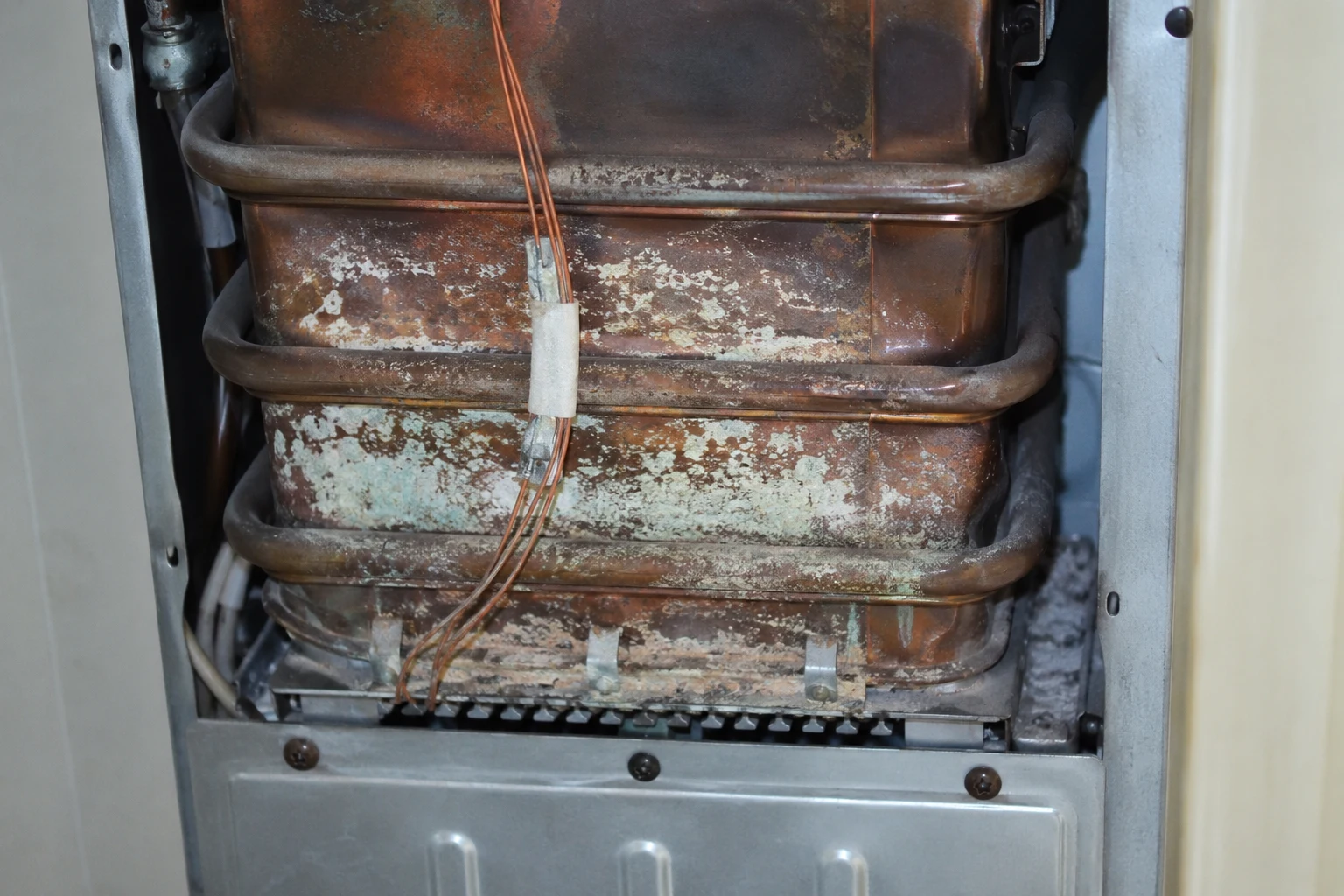
A tankless heater is a small heat exchanger with a big burner under it. The whole design assumes heat moves from the flame, through the metal, into the water rushing past, fast enough to keep the metal cool. Break that heat path and the exchanger climbs. Scale is the usual culprit. Hard-water minerals bake onto the inside of the waterways and act like a blanket, so the burner keeps dumping heat but less of it reaches the water. The copper gets hotter than it should, and eventually a protective device sees it. Low flow does the same thing from the other side: not enough water passing through to carry the heat away, whether from a clogged inlet filter, a partly closed valve, or a stuck bypass servo that is not routing water the way the board expects. A blocked or restricted flue traps combustion heat too, which is exactly what Navien is watching for when it reports a high flue temperature.
The two devices that trip a lockout
This is the part that trips up most homeowners, because both show up as the heater refusing to make hot water, but they behave completely differently.
Resettable overheat code (sensor or switch)
- Read off a thermistor or a high-limit switch that senses temperature and reports it to the board.
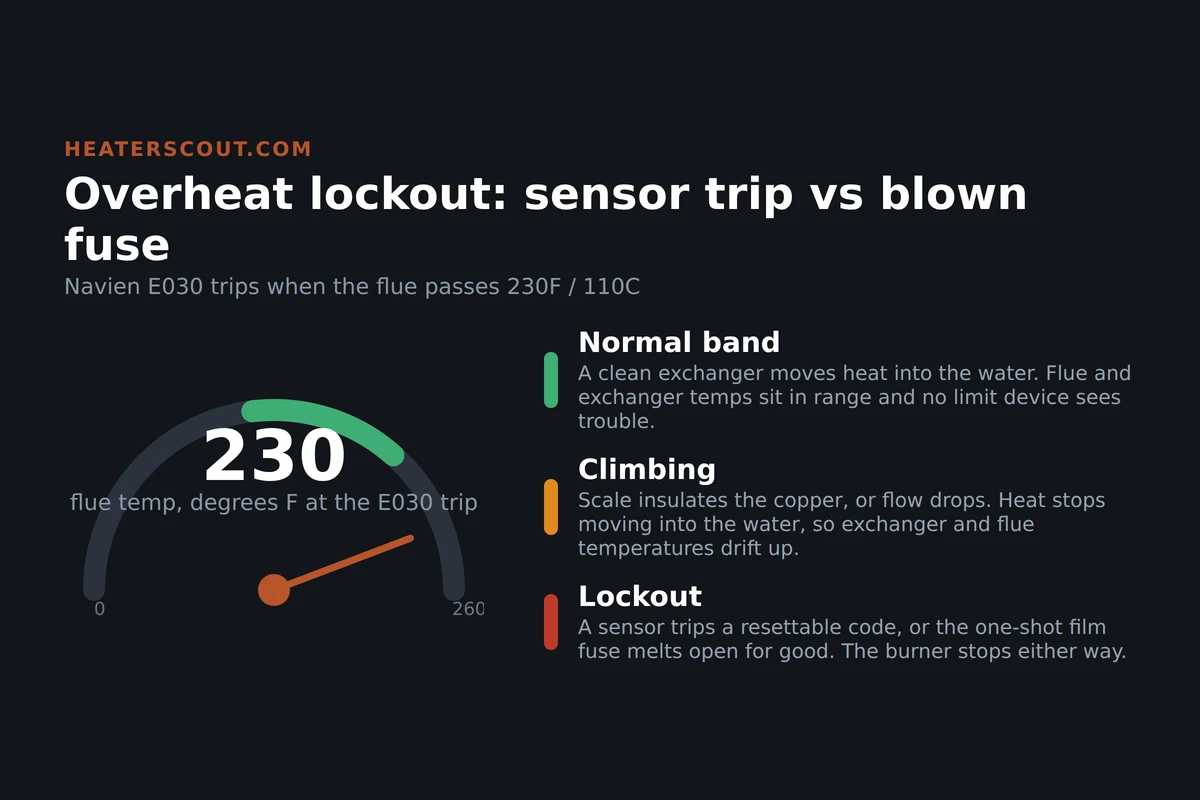
- Navien E030 is an exhaust high-limit trip when the flue passes about 230F, 110C, for more than ten seconds.
- Navien E016 reads the heat-exchanger water temperature directly and trips on overheat.
- Clears with a power cycle: turn the unit off about 30 minutes, then restart.
- If it clears and stays gone, the cause was transient. If it returns, the cause is still live.
One-shot thermal fuse (the film wrap)
- A thin fuse ribboned against the exchanger so it feels the metal directly. Noritz wraps all four sides of a copper exchanger.
- Rinnai Code 14 and Noritz Code 14 report this device tripping.
- It melts open permanently. No button, no power cycle, no wait brings it back.
- The only fix is a technician replacing the fuse or fuse harness.
- Never jumper or bypass it. That defeats the last line of defense against a runaway.
Check the cheap causes first
Rinnai's own Code 14 procedure starts before the fuse: verify the single DIP switch on the PC board is in the OFF position, confirm the unit is on the correct gas type per the rating plate, and check that clearances around the heater and vent terminals were kept. A misset DIP switch or wrong gas type can drive a Code 14 that has nothing to do with a bad fuse. Rule those out before condemning parts.
How to read it code by code
Rinnai Code 14 is labeled thermal fuse or overheat, tied to the overheat sensor on the right side of the heat exchanger. On many Rinnai units that fuse is a one-shot part, so a genuine Code 14 that will not clear means the fuse is open and needs replacement after the cause is fixed. Noritz Code 14, or EC14, is a significant heat-exchanger overheat on copper-exchanger models like the NRC98 and NRC86, and Noritz is blunt about it: the thermal fuse is a one-time part, physically broken once tripped, and the only path is to descale and replace. Navien splits its overheat logic. E030 is the exhaust high-limit, and it carries subcodes: subcode 0 points at the heat-exchanger high-limit switch and the board, subcode 1 at the exhaust sensor itself. E016 is a direct heat-exchanger overheat. Both Navien codes are resettable after a 30-minute cool-down, which is your clue you are dealing with a sensor, not a fuse.
What to actually do
Start with the reset test, once. Cut power at the unit or the breaker, wait, restore. If a Navien E030 or E016 clears and the unit runs normally at a real draw, you had a transient, though a scale-driven overheat will usually come back within a few uses, which is your signal to descale. If the code refuses to clear at all, you are almost certainly looking at a blown one-shot fuse, and no amount of power cycling will help. Either way the durable fix is the same on most of these units: descale the heat exchanger to strip the insulating scale, clean the inlet filter, and confirm the flue and clearances are clear. On a Rinnai or Noritz that blew its fuse, that work has to happen first, then a licensed tech replaces the fuse so the unit is not simply set up to blow the next one.
Where the homeowner line sits
Descaling, cleaning the inlet filter, checking for a closed valve or an obvious vent blockage, and running the reset test are all fair game for a careful owner. Those address the causes that trip most overheat lockouts, and none of them touches the gas train or the fuse circuit. The line is the fuse itself and the combustion side. Replacing a one-shot thermal fuse means opening the unit, confirming why it blew, and often measuring the exchanger and wiring, which is a licensed tech's job. So is diagnosing a Rinnai DIP-switch or gas-type problem, or a Navien exhaust sensor fault. The one thing that is never acceptable, at any skill level, is jumping or bypassing the fuse to force the heater to fire. That fuse is the reason a scaled exchanger becomes a locked-out unit instead of a fire.
Keeping the lockout from coming back
Nearly every repeat overheat traces to water quality and skipped maintenance. Descale on a schedule, once a year on hard water, more often if your water is very hard, because scale is the single biggest driver of these codes across all three brands. Pull and rinse the cold inlet filter at the same visit so flow stays up. Keep the vent terminals clear and the clearances the installer set, since a restricted flue pushes flue temperatures toward the Navien E030 limit even with a clean exchanger. If you are on a private well or notably hard municipal water, a softener ahead of the heater pays for itself in fuses and exchangers you never have to buy. A unit that gets a yearly flush rarely surprises you with an overheat lockout on the coldest morning of the year.
Frequently asked
Can I reset a tankless overheat code myself?
Sometimes. It depends entirely on which device tripped. If the code comes off a sensor or a high-limit switch, like Navien E030 or E016, you clear it by turning the unit off for about 30 minutes and restarting, which lets the sensor cool and the board drop the fault. If the code is a blown one-shot thermal fuse, like Rinnai Code 14 or Noritz Code 14 on a copper exchanger, no button and no power cycle will bring it back. That fuse is physically melted open and has to be replaced. So the honest answer is: try the power cycle once. If the code clears and stays gone, it was a sensor trip and you found a transient cause. If it will not clear at all, or it comes right back, you are past the reset stage and into diagnosis.
What is the film wrap on a tankless heat exchanger?
It is the thermal fuse, a thin ribbon-style safety device ribboned against the heat exchanger so it feels the metal temperature directly. On Noritz copper-exchanger units the fuse wraps all four sides of the exchanger; on Rinnai an overheat sensor sits on the right-hand side. People call it the film wrap because it looks like a flat tape or film hugging the exchanger body rather than a bulky part. Its whole job is to be the last line of defense: if the electronic controls miss a runaway heat condition, the fuse melts open and kills power before the exchanger cooks itself or starts a fire. It is a one-shot part on purpose. A fuse that could quietly reset would let the same dangerous condition repeat unseen.
Why does my tankless keep throwing an overheat code?
Because the real reason the exchanger got hot is still there. The number one cause across Rinnai, Noritz, and Navien is scale. Hard-water minerals bake onto the inside of the heat exchanger and act like insulation, so the burner heat cannot pass into the water fast enough and the metal overheats. Low or restricted flow does the same thing: too little water to carry the heat away. A stuck bypass servo, a clogged inlet filter, or a partly blocked flue that traps combustion heat all push temperatures up too. Clearing the code without fixing the cause just resets the clock. If you have never descaled the unit and it lives on hard water, start there, because that single fix resolves the majority of repeat overheat lockouts.
How much does it cost to fix a tankless overheat lockout?
It splits sharply by cause. A descale to clear scale off the exchanger runs roughly 150 to 300 dollars if a plumber does it, or the cost of a pump-and-vinegar kit if you do it yourself. Cleaning an inlet filter or freeing a stuck bypass is cheap or free. Replacing a blown one-shot thermal fuse is where it climbs: the fuse or fuse harness itself is a modest part, often 30 to 90 dollars, but it is a labor job and a licensed tech has to find and fix the overheat cause first, so a fuse replacement visit commonly lands around 200 to 450 dollars all in. If the overheat damaged the heat exchanger, that is the expensive outcome, since a replacement exchanger can run several hundred dollars in parts before labor.
Will descaling clear a tankless overheat code?
It clears the cause more often than any other single fix, but it does not clear the code by itself. Descaling strips the mineral scale that insulates the heat exchanger and drives the overheat in the first place, so on a resettable code like Navien E030 or E016 a good flush plus the normal power-cycle reset usually ends the problem. On a blown one-shot fuse, Rinnai or Noritz Code 14, descaling fixes why it blew but the fuse is still physically open, so the unit stays locked out until someone replaces the fuse. Think of it as two steps: descale to remove the cause, then reset the sensor or replace the fuse to actually restore operation. Skipping the descale means the same code returns, fuse or no fuse.
Is a tankless overheat lockout dangerous?
The lockout is the safe outcome, not the danger. An overheat code or a blown film fuse means a protective device did exactly what it should: it shut the burner down before the heat exchanger reached a temperature that could damage the unit or start a fire. What is dangerous is defeating it. Never jumper, bypass, or wire around a thermal fuse to force the unit to run, because then the heater can fire with no last-resort protection while the underlying overheat condition is still live. That is how a contained fault becomes a real hazard. If you smell gas, see scorching at the exchanger or wiring, or the fuse blows again right after replacement, stop and get a licensed tech, because something is driving a genuine runaway.
What is the difference between Rinnai code 14 and Navien E030?
They are both overheat safeties, but they trip different devices, which changes how you clear them. Rinnai Code 14 is a thermal fuse or overheat lockout tied to the exchanger overheat sensor. On many Rinnai units the fuse is a one-shot part, so Code 14 will not reset with a button and needs the cause corrected and the fuse replaced. Navien E030 is an exhaust high-limit trip: the flue temperature crossed about 230F, 110C, for more than ten seconds, usually because a scaled exchanger is dumping combustion heat up the vent instead of into the water. E030 is resettable by turning the unit off for 30 minutes. Same family of problem, scale and heat not moving into the water, but one is a sensor you reset and one is a fuse you replace.