Open a hot tap just a crack on a gas tankless heater and you get cold water, even though the unit is healthy and the pilot electronics are fine. That is not a fault. Below a certain flow, roughly 0.4 to 0.5 gallons per minute depending on the brand, the burner simply will not light. A small turbine in the cold inlet has to spin fast enough for the control board to register real demand. When that turbine fouls with scale, the same no-heat behavior shows up at flows that used to work fine, and the sensor, not the burner, is the thing to fix.
Activation flow versus minimum sustained flow
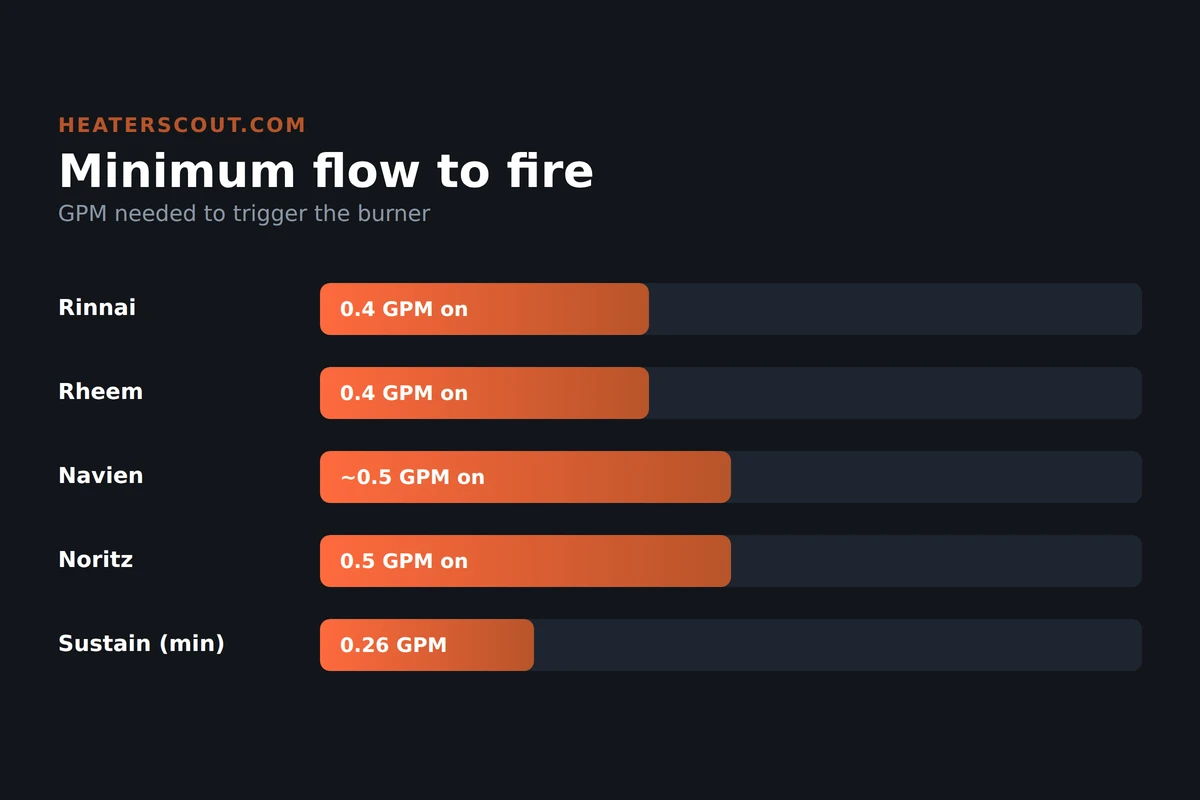
Two numbers get confused constantly, so separate them. The activation flow rate is how much water must move before the heater starts an ignition cycle. The minimum sustained flow, sometimes called the shutoff or maintain rate, is how low the flow can drop after the burner is already lit before the unit gives up and shuts down. The activation number is always the higher of the two. A Rinnai or Rheem residential unit wants 0.4 GPM to fire but will keep heating down to about 0.26 GPM once running. That gap is why a shower can stay hot when you crack the valve back a little, but a faucet opened only to a dribble from cold never lights at all. You have to cross the activation line first, then you can coast below it.
| Brand | Activation (fire) | Min sustained | Notes |
|---|---|---|---|
| Rinnai | 0.4 GPM | 0.26 GPM | Low-flow class; Sensei and RUR lines |
| Rheem | 0.4 GPM | 0.26 GPM | Marketed as industry-leading low flow |
| Navien | ~0.5 GPM | ~0.5 GPM | NPE service literature; users report more in practice |
| Noritz | 0.5 GPM | 0.5 GPM | Per installation manual and min-flow FAQ |
Treat those as the published figures for common residential models. Commercial and buffer-tank units shift the numbers, and a heater with a recirculation buffer can heat with almost no live draw because the pump keeps water moving past the sensor. Always cross-check the spec sheet for your exact model number before you conclude your flow is too low, because two units from the same brand can differ.
What the flow sensor actually does
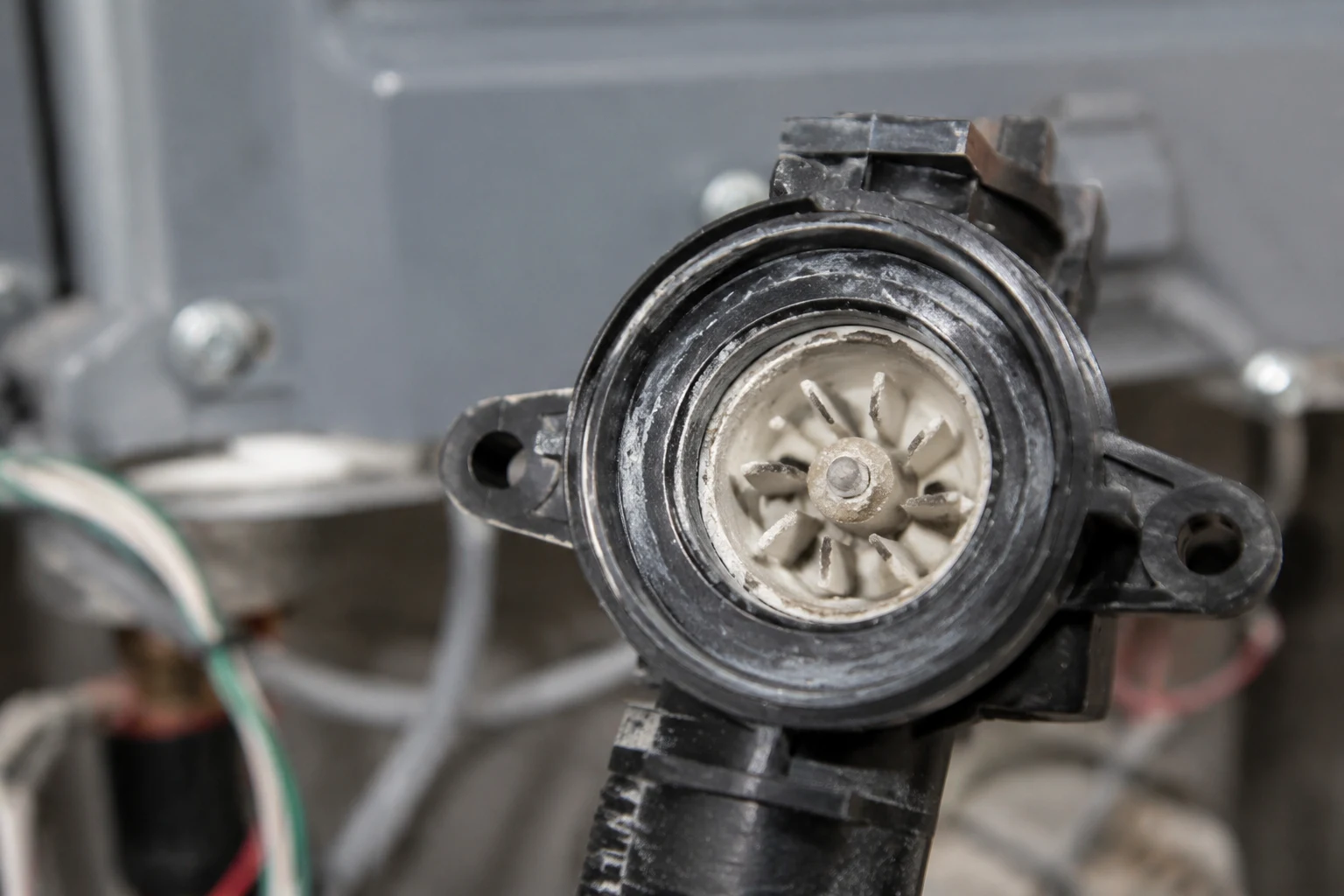
The flow sensor is a small turbine, a plastic paddle wheel with a magnet in it, sitting in the cold water inlet. When water flows it spins, and each rotation moves the magnet past a Hall-effect pickup that sends a pulse to the control board. The board counts pulses per second and converts that to a flow rate. No pulses means no flow means standby. Enough pulses per second to clear the activation threshold, and the board opens the gas valve, sparks the igniter, and modulates the burner to hit your setpoint. The whole decision to fire or not hinges on that spinning wheel. It is a cheap part doing a critical job, and it is the first thing in the water path to collect scale.
Why does the burner drop out mid-shower when the sensor is failing?
As the turbine gets dragged by scale it spins slower for the same real flow. Right at the edge of the activation threshold the pulse count wobbles above and below the line, so the board keeps deciding there is demand, then no demand, then demand again. The burner lights, drops out, relights, and you feel it as a cold-water sandwich or a shower that pulses warm and cold. A clean, free-spinning turbine gives a steady pulse count, so the fix for the flicker is usually the same pull-and-soak that fixes a hard no-light.
Cleaning a fouled turbine
The failure people call a bad flow sensor is usually a good sensor with a stuck wheel. Two things gum it up. First is ordinary calcium scale on hard water, which coats the blades and the bore until drag wins. Second, on water with manganese or iron, is a fine black powder, largely manganese dioxide, that is paramagnetic and gets pulled onto the magnet in the turbine, caking the wheel until it barely turns. Either way the cure is mechanical. Shut off the water and the gas, pull the flow sensor out of the cold inlet, and look at the impeller. Soak a stiff or stuck turbine in warm white vinegar for about half an hour, rinse it, and blow through it to confirm it spins free and coasts. Reinstall a wheel that spins clean. Replace the sensor only if the impeller is cracked, visibly worn, or the board still reports no flow after the wheel spins freely again.
Most 'dead flow sensor' calls are a good sensor with a scaled turbine. Pull it, soak the wheel in warm vinegar, and it spins again.The pull-and-soak fix
When it is not the sensor
Before you condemn the turbine, rule out the things that starve it of flow. A clogged inlet screen filter drops the flow reaching the sensor, so a wide-open tap still reads low. Low incoming water pressure does the same. A high-efficiency aerator or showerhead can put your actual draw genuinely below the activation rate, in which case nothing is broken and the unit is behaving to spec. A partly closed service valve, a kinked flex line, or a fixture teed off a long undersized run all rob flow. Check the easy causes first: pull and rinse the inlet screen, open every service valve fully, and measure the actual GPM at the tap with a bucket and a watch. If you are genuinely above the activation spec and the burner still will not light, then the sensor earns suspicion.
Keeping the sensor spinning
The turbine lasts longer on soft, clean water and fails early on hard or mineral-heavy supply. You cannot change your water for free, but you can slow the fouling. Descale the heat exchanger on schedule, yearly on hard water, because a unit that gets serviced yearly is a unit whose sensor gets looked at yearly. Keep the inlet screen filter clean so grit does not reach the wheel. If your water carries iron or manganese, expect the turbine to need its own vinegar soak more often than the exchanger does, since the magnet in the wheel actively collects that black powder. Catching a dragging turbine at a service visit beats discovering it on the coldest morning when a cracked-open faucet gives you nothing but cold.
Frequently asked
What is the minimum flow rate for a tankless water heater?
For gas residential tankless units the number you care about is the activation flow rate, the GPM that has to move through the heater before it will light the burner. On the low-flow brands, Rinnai and Rheem, that is 0.4 GPM to ignite, and the unit will keep running down to about 0.26 GPM once it is already lit. Navien and Noritz sit a little higher at roughly 0.5 GPM to activate. Those are the manufacturer spec numbers. In a real house with an aging sensor and some scale you often need a bit more than the spec to get a reliable light, which is why a trickle at a faucet leaves you cold even though the tap is open.
Why won't my tankless heater fire at low flow?
The heater does not fire until it senses water moving. A small turbine, the flow sensor, sits in the cold inlet and spins as water passes. The control board counts the pulses that spinning generates and only starts the ignition sequence once the count crosses the activation threshold, around 0.4 to 0.5 GPM depending on brand. Below that the board reads it as no demand and stays in standby. So a barely-cracked faucet, a low-flow aerator, or a hot tap teed off a long run can all fall under the line and get no heat. This is by design: firing a burner into a trickle risks overheating the exchanger.
Can I clean a tankless flow sensor instead of replacing it?
Often yes. The most common failure is not a dead sensor but a turbine that has stopped spinning freely, gummed up with mineral scale or a fine black manganese/iron sludge that sticks to the magnetized wheel. Shut off the water and gas, pull the flow sensor out of the cold inlet, and check the impeller. If it is stiff or stuck, soak it in warm white vinegar for about 30 minutes, then rinse and spin it with a puff of air to confirm it turns free. A turbine that spins smoothly and generates a signal is worth reinstalling. Replace it only if the impeller is cracked, worn, or the board still reads no flow after cleaning.
How do I know if my flow sensor is bad?
The tell is intermittent or no hot water with no obvious cause, sometimes with a flow-related error code, sometimes with none at all. You open a hot tap at normal pressure and the burner never lights, or it lights and drops out. Blow gently into the inlet side of the removed sensor and listen: a healthy turbine spins with a soft whir and coasts to a stop. One that does not spin, stops abruptly, or grinds is fouled or worn. If your meter or the unit's service mode can read the flow pulse, a good sensor shows a rising signal as flow increases; a flat or erratic signal at real flow condemns it.
Does hard water cause flow sensor problems?
Yes, and it is the main reason a sensor fouls early. Calcium scale builds on the turbine blades and the bore, adding drag until the wheel drags or seizes. Water with manganese or iron adds a second problem: a fine paramagnetic powder that clings to the magnet in the turbine and cakes it. Both raise the flow you need before the wheel spins fast enough to activate, so a unit that used to light at a trickle now needs the tap wide open. Annual descaling with white vinegar keeps the exchanger and, indirectly, the sensor cleaner, but the sensor itself sometimes needs its own pull-and-soak on hard water.
Will descaling fix a stuck flow turbine?
A full descale circulates vinegar through the heat exchanger and helps the waterways, but the flow sensor usually sits upstream of the exchanger loop on the cold inlet, so a standard pump-and-flush may not reach the turbine well. If the turbine is already stuck, the reliable fix is to remove the sensor and soak the turbine directly. Think of it as two jobs: the annual descale for the exchanger, and a separate sensor clean if you have a flow complaint. Doing the descale on schedule slows sensor fouling but does not guarantee it clears a turbine that has already locked up.
How much does a tankless flow sensor cost to replace?
The flow sensor itself is an inexpensive part, commonly in the $20 to $70 range depending on brand and whether it comes as a bare turbine cartridge or a full assembly with the housing and wiring pigtail. Cleaning costs nothing but your time. If you swap it yourself it is a screwdriver job once the water and gas are off. A plumber's visit to diagnose and replace typically runs $150 to $300 with the trip and labor, more in high-cost metros. Because cleaning frees a fouled turbine most of the time, try the vinegar soak before you buy a part.