A Takagi that locks out on 701 is not complaining about your water, your gas, or your venting. It is complaining about its own brain. The 701 code is a control-board, or PCB, abnormality: the computer board that runs the whole unit failed its self-check or stopped responding the way the firmware expects. On many Takagi units the green diagnostic LED backs this up with a single flash. Here is the part that saves people money: a code that names the board is very often not a dead board at all. It is power, a blown fuse on the surge box, or a scorched connector, and those cost a fraction of a new PCB.
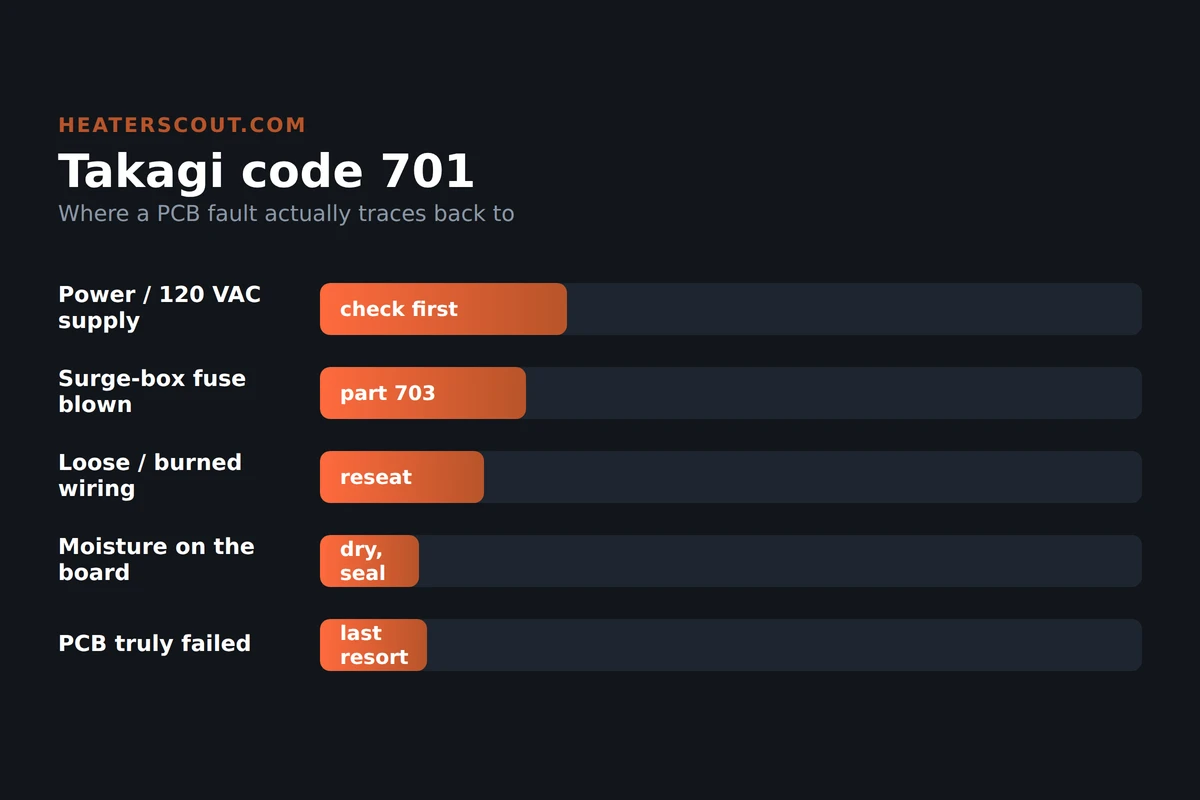
What 701 usually turns out to be
- No clean 120 VAC reaching the board, or a power blip that scrambled it
- A blown or browning fuse on the surge box (part 703)
- A loose, corroded, or heat-damaged connector on the board harness
- Moisture or condensation dripping onto the board, corroding traces
- A surge event that cooked a component and left burn marks
What 701 is not
- A scale or flow problem, so descaling will not touch it
- A gas, ignition, or flame-sensing fault (those are other codes)
- A venting or condensate blockage
- A reason to replace the whole water heater
- Automatically a dead board on the first occurrence
The fix, cheapest first
Takagi's own maintenance sheets walk a tech down a ladder before condemning the board, and the ladder matters because the board is the priciest part in the cabinet. This is line-voltage work inside a gas appliance, so the hands-on steps below belong to a licensed tech. Your job as the owner is to try the reset, then know what a good tech should be checking so you are not sold a board you did not need.
Takagi code 701
A PCB, or printed circuit board, abnormality. The control board that runs the water heater failed its self-check or is not responding as the firmware expects, so the unit locks out rather than fire the burner without a brain it can trust. On many models the green diagnostic LED shows a single flash alongside it. It is an electronics fault, part of the 7xx family, and it is distinct from gas, flame, flow, or venting codes. Naming the board is not the same as proving the board is dead: power, the surge-box fuse, and wiring get ruled out first.
What a tech is actually looking for
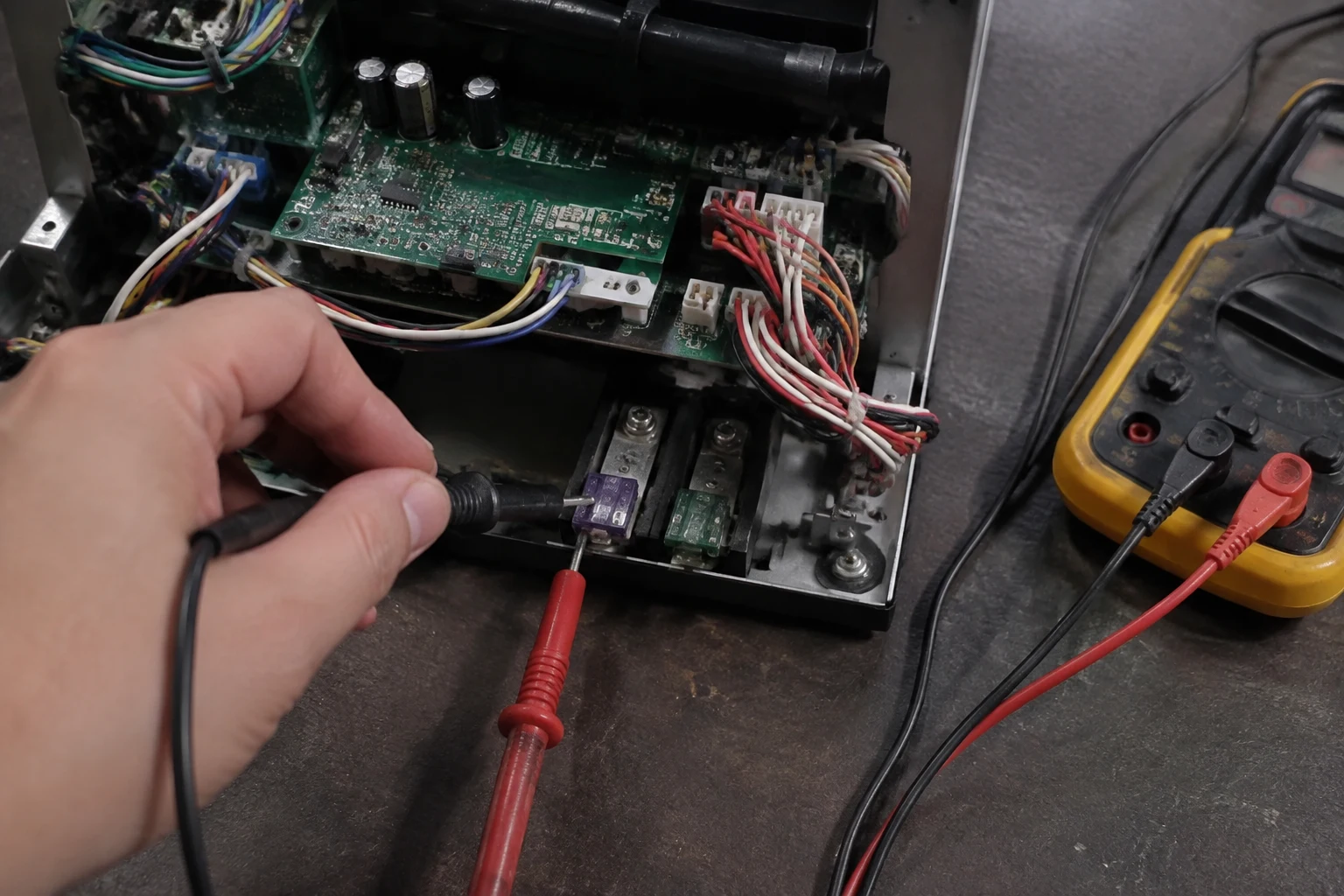
Takagi's guidance to look for brown spots and burn marks is not casual. Discoloration on a fuse or scorching on the board is the fingerprint of a surge or an overheated connection, and spotting it changes the repair. Run this checklist against what your tech reports so you can tell a real board failure from a cheaper root cause.
- 120 VAC confirmed clean at the unit, not sagging or shared with a surging load
- Red LED on the PCB lights for a few seconds at power-up
- Surge-box fuse (part 703) is intact, no brown spot or discoloration
- No burn marks, brown spots, or melted spots anywhere on the board
- Every harness connector seated firmly, no green corrosion or scorched terminals
- No sign of moisture, dripping, or condensation reaching the board
- Correct genuine Takagi PCB on hand for the exact model before any swap
Where the homeowner line sits
The owner's safe zone on a 701 is short and honest: try the power cycle, and if it returns, call a pro. That is it. Unlike a fouled flame sensor you can clean with sandpaper, a 701 lives in a cabinet with 120-volt line power, a surge box, and a fuse, all next to a gas valve. There is no jumper, no reset trick, and no consumer part you swap to defeat it. Anyone telling you to bypass a board fault to force the unit to run is telling you to ignore a safety lockout on a gas appliance. The reason the board refuses to fire is that it cannot vouch for itself, and that is exactly when you do not want it running anyway.
Keeping 701 from coming back
Most repeat 701 codes trace to power and moisture, so that is where prevention lives. If your area has rough utility power, frequent outages, or nearby lightning, put a surge protector ahead of the water heater. A dedicated or whole-home unit costs a fraction of a PCB and takes the hit that would otherwise blow the surge-box fuse or cook a component. Keep the cabinet dry: fix any small leak or dripping fitting before condensation finds the board, and make sure a condensing model's drain is clear so it is not backing up moisture inside. On an annual service, have the tech glance at the board and connectors for early discoloration. A brown spot caught early is a fuse. Left alone, it becomes a board. That is the whole economics of 701 in one line: the cheap parts protect the expensive one, so watch them.
Frequently asked
Can I reset Takagi code 701 myself?
You can try a power cycle, and you should, but do not expect it to hold. Turn the water heater off at the remote controller, then switch off the breaker feeding the unit for a full 30 seconds and switch it back on. That clears the latched fault and lets the board run its power-on self-check again. If 701 was a one-time glitch from a power blip or a brownout, the unit may come back and stay clean. If the code returns on the next call for hot water, the board is reporting a real problem with itself or its power, and a reset will not touch that. The reset is a diagnostic step, not a repair. It tells you whether you are chasing a ghost or a genuine hardware fault.
What does 1 flash on the green LED mean on a Takagi?
The green diagnostic LED on the control board blinks a count that maps to the fault family. On the units that pair code 701 with a single green flash, that one blink is the board saying the problem is the PCB itself, the electronics, not the burner, sensors, or flow side. It is the board pointing at its own house. Read it alongside the number on the controller. A 701 on the display plus one green flash at the board is a consistent story: the computer board's self-check failed or the board is not responding as expected. It does not tell you why yet. That is what the power, fuse, and wiring checks are for.
How much does it cost to fix Takagi code 701?
It depends entirely on whether the board actually failed. If the real cause is a blown fuse on the surge box, that fuse is a few dollars and a few minutes for a tech. A loose or corroded connector costs nothing but the labor to find and reseat it. A power-supply problem in the house wiring is an electrician's call, priced by the job. The expensive path is a genuine Takagi PCB, which typically runs about $250 to $450 for the part on common T-series and condensing models, plus a service call. All in, a real board replacement lands roughly in the $400 to $700 range depending on your market and the model. That gap is exactly why a good tech rules out power and wiring before quoting a board.
Will descaling clear Takagi code 701?
No. Descaling flushes scale out of the heat exchanger on the water side of the unit. Code 701 is an electronics fault on the control board, which sits dry inside the cabinet and has nothing to do with water flow or mineral buildup. A flush will not change a board fault by even a little. Keep descaling on schedule because it protects the heat exchanger and the flow sensor, but understand it is aimed at a completely different part of the machine. If someone tells you a vinegar flush fixes a 701, they are guessing. The moves that address 701 are the power supply, the surge-box fuse, the internal wiring, and, as a last resort, the board.
Why does Takagi code 701 keep coming back?
A 701 that returns after a reset is telling you the underlying fault is still present. The usual repeat offenders are power quality and connections. If the house feed is dirty, if the unit shares a circuit with something that surges, or if a surge already cooked part of the board, the code comes back every time the board struggles through its self-check. A fuse on the surge box that is failing intermittently will do the same. So will a connector that is loose enough to drop contact when the cabinet warms and expands. Moisture is another repeat cause: condensation or a small leak dripping onto the board corrodes traces and causes flaky faults that come and go with humidity. Chase the power and the connections before you accept that the board is simply dying.
Is Takagi code 701 dangerous?
The code itself is protective. When the control board cannot verify that it is working correctly, it refuses to run the burner rather than fire gas without a brain it can trust. That lockout is the safe response. The danger is not the code, it is what people do around it. A 701 means opening a cabinet that has 120-volt line power inside, a surge box, and a fuse, so this is not a sandpaper-and-a-screwdriver homeowner fix like a fouled sensor. Line voltage and gas in the same box is a licensed tech's territory. Never bypass or jumper anything to force the unit to run past a board fault. If you smell gas or see scorch marks or a burned smell from the cabinet, shut the unit down at the breaker and the gas valve and call a pro.
Can a power surge cause Takagi code 701?
Yes, and it is one of the most common real causes. A surge from a storm, a utility event, or a large motor on the same circuit can blow the fuse on the surge box, damage a component on the board, or leave the board in a confused state. Takagi's own guidance points techs to look for brown spots on the surge-box fuse and burn marks or brown discoloration on the board, both telltale signs of a surge event. If your area has rough power or frequent outages, a whole-home or dedicated surge protector ahead of the water heater is cheap insurance compared to a board. After any known surge or lightning nearby, a 701 that shows up is a strong hint the surge box or board took the hit.
Do I need to replace the whole water heater for a 701?
Almost never. A 701 is a component-level fault, and the fixable parts are the surge box, the fuse, the wiring, and the PCB, all of which are serviceable on their own. Even a full board swap is far cheaper than a new unit. The only time whole-unit replacement enters the conversation is when the heater is already old, out of warranty, and racking up other faults, so that spending several hundred dollars on a board for a tired machine stops making sense. That is an age-and-economics decision, not something the 701 forces. Diagnose the board fault first. If the unit is young and otherwise healthy, fix the board or its power and move on.