A Takagi throwing 651 is almost always a heater wired into a bank of other heaters, not a lone unit in a closet. The code points at the flow adjustment valve, a small motor-driven valve that meters how much water each linked heater passes so the group can share load and hold a steady temperature. When the board commands that valve and the motor does not move or does not answer, it locks out and shows 651. The usual cause is not exotic: scale has jammed the valve, or a wire has failed. The part is Takagi part 402, and the first real test is a resistance reading, not a parts order.
Key takeaways
- 651 is a flow adjustment valve fault, and Takagi lists it as Easy-Link or Multi-Link only.
- The valve is a motor-driven metering valve (Takagi part 402) that balances flow across linked units.
- Most common cause: scale locking the motor drive, or a broken wire at the valve connector.
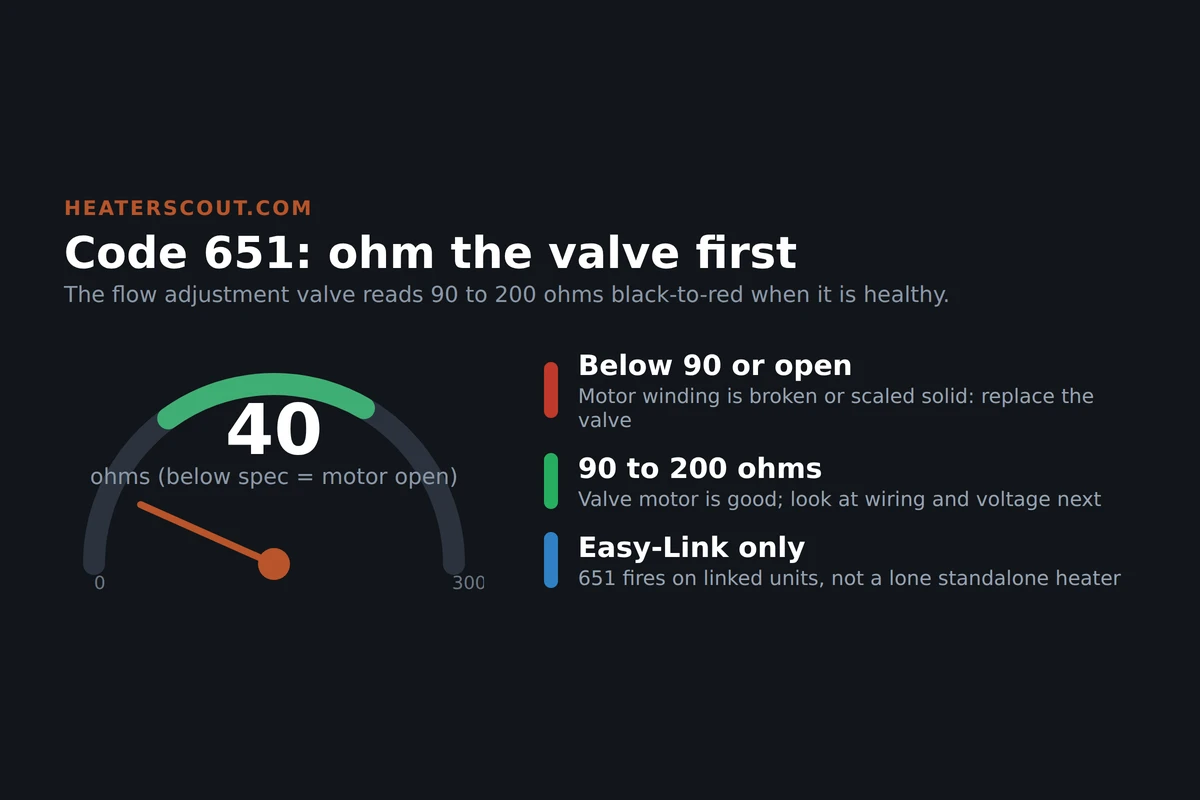
- Test it: black-red resistance 90 to 200 ohms, checkpoint J voltage 7 to 16 VDC.
- Descaling can genuinely clear 651 if scale jammed the valve; a dead motor needs the valve replaced.
Power off first
Cut power at the breaker before you open the cover. The flow adjustment valve sits in the waterway with a low-voltage motor on it. You will be unplugging its connector and ohming the motor, which is safe with the unit dead, but never probe a live board unless the checkpoint J voltage step calls for it and you know where checkpoint J is on your model's diagram.
Is 651 the same as a flow sensor error?
No, and this trips people up. A tankless heater has two different flow parts. The flow sensor is a little turbine that counts how fast water is moving so the board knows when to fire. The flow adjustment valve is a motor-driven valve that actively meters flow to balance linked units. Code 651 is the valve, not the sensor. If you order a flow sensor to fix 651 you will have bought the wrong part. Look for the valve with the small motor and the multi-pin connector, part 402 on the T-H3 line.
Why linked systems need a valve at all
A single tankless heater does not need to negotiate with anyone. It sees a hot tap open, measures the flow and the inlet temperature, and fires to hit your setpoint. Gang three or four heaters onto one manifold to serve a building, and the picture changes. Now the units have to agree on who carries how much load, because if the closest heater just fires flat out it starves the others and the outlet temperature wanders every time demand shifts. Easy-Link and Multi-Link are Takagi's names for that coordination. The flow adjustment valve is the muscle behind it: each board can throttle its own unit's water passage up or down so the group shares the draw and holds a stable temperature at the tap. Take that valve out of the loop and the whole coordination breaks, which is exactly why the board treats a valve it cannot command as a hard lockout and posts 651 rather than limp along.
What actually fails
Two things throw 651 far more than anything else. The first is scale. The valve is a mechanical part sitting in hard water, and mineral buildup can lock the motor drive so the valve physically will not swing when the board commands it. Takagi calls this out directly: check whether the motor drive is locked from scale or water leakage before you condemn the part. The second is wiring. The valve rides a connector back to the board, and a corroded pin, a backed-out terminal, or a chafed wire opens the circuit and looks identical to a dead motor. The valve motor winding itself can also simply fail open with age. All three land as 651, and a resistance reading is what separates them.
Homeowner / on-site can do
- Power cycle to clear the latched 651 and confirm whether it returns.
- Descale the unit; a jammed valve motor often frees once scale is flushed.
- Rinse the cold-inlet screen filter while the unit is open.
- Unplug the valve connector and ohm black-to-red for 90 to 200 ohms.
- Inspect the connector for corrosion, backed-out pins, or a burnt terminal.
Leave to a licensed tech
- Live voltage check at checkpoint J (7 to 16 VDC) on the wiring diagram.
- Replacing the flow adjustment valve assembly (part 402 / EKK0T family).
- Diagnosing a suspected control board on a linked rack.
- Sorting DIP-switch and link settings on a Multi-Link install.
- Anything past the low-voltage side toward the gas train.
Reading the numbers
The two measurements below are the whole diagnosis. Ohm the motor cold with the connector unplugged and power off. If the valve reads in band but 651 stays, restore power and check the drive voltage at checkpoint J with the valve commanded. Voltage present and a good motor but no movement means the valve is mechanically locked, which points back at scale.
| Test | Normal reading | Bad reading means |
|---|---|---|
| Valve motor resistance (black-red) | 90 to 200 ohms | Open or below 90: motor winding broken or seized, replace valve |
| Drive voltage at checkpoint J (black-red) | 7 to 16 VDC | No voltage: board or harness fault, not the valve |
| Valve movement when commanded | Audible or visible swing | Voltage good but no motion: scale-locked drive, descale |
| Connector and wiring | Clean, tight, no corrosion | Green pins or a chafed wire: repair before replacing parts |
| Water at the valve body | Dry | Leakage: valve seal failing, replace the valve assembly |
The repair path in order
Work cheap to expensive. Clear the code and see if it even returns. Descale, because a scale-locked valve is the single most common 651 and a flush is the least invasive fix. Ohm the motor; a reading well outside 90 to 200 ohms condemns the valve regardless of scale. Inspect and repair the wiring, since a bad connector fakes a dead motor for free. Only when the motor ohms out fine, the wiring passes, the voltage is present, and the valve still will not move do you replace the flow adjustment valve, part 402 on the T-H3 line or one of the EKK0T, EKK3D, and EK438 assemblies on the T-K3 family. Those are combined valve-and-sensor units, which is why they cost more than a bare sensor. Suspect the control board dead last, after everything upstream checks out.
Keeping 651 from coming back
Scale is the enemy here more than on most codes, because the fault is a moving valve rather than a static sensor. On hard water, descale a linked system on schedule, at least yearly, and pull the cold-inlet screens at the same time. The valve motor gives you no warning before it locks, so a routine flush that keeps the waterway clear is cheap insurance against a $200 assembly and a service call. While the covers are off, reseat each valve connector and look for the first green tint of corrosion, since a pin caught early beats an intermittent 651 that only shows up when the whole rack is under peak morning demand. And if your install is genuinely standalone, confirm the DIP and link settings actually say standalone, so the board is not expecting flow-balancing hardware it does not have.
Frequently asked
Can I reset Takagi error code 651 myself?
You can clear the latched code, but clearing is not fixing. Takagi does not give 651 a dedicated reset button; you drop the fault by cycling power. Turn the unit off at the remote controller, shut the breaker or unplug the heater for about 30 seconds, then restore power and run a hot tap. If the flow adjustment valve or its wiring is still bad, 651 comes right back the next time the linked system tries to balance flow between units. Use the power cycle to confirm a repair worked, not as the repair. And because 651 only appears on Easy-Link or Multi-Link setups, a stray 651 after you clear it is worth chasing at the manifold, not just at one heater.
What does the flow adjustment valve actually do?
In a linked Takagi system, several heaters feed one hot water manifold. They cannot all just fire flat out or the units nearest the demand hog the flow. The flow adjustment valve is a small motor-driven valve inside each heater that meters how much water passes through that unit, so the control boards can share the load evenly and hold a stable outlet temperature. It is a servo-style valve, meaning a tiny motor opens and closes it on command from the board. Code 651 means the board sent that motor a command and did not get the movement or the feedback it expected, so it locks out rather than let flow control drift.
Why does a single standalone Takagi still show 651?
It usually should not. Takagi's own handbook lists 651 as an Easy-Link or Multi-Link fault, so the code is tied to the flow-balancing hardware that only matters when units are ganged together. If a lone heater that was never linked throws 651, treat it as a real hardware fault on that flow adjustment valve anyway, since some model lines share the same valve and board logic. Check the valve connector, ohm the motor, and confirm the DIP-switch and link settings match how the unit is actually plumbed. A unit set for link mode but wired standalone can report link-only faults.
How do I test the flow adjustment valve on a Takagi?
Kill power to the unit and open the cover. Find the flow adjustment valve on the water side, unplug its connector from the control board, and put a multimeter on ohms across the black and red wires on the valve side. A healthy motor reads roughly 90 to 200 ohms. An open reading or a number well below 90 means the motor winding is broken or the drive is seized. With power restored and the valve commanded, you can also check voltage at checkpoint J on the wiring diagram: black to red should sit between 7 and 16 volts DC. No voltage points at the board or harness; voltage present but no motion points at a mechanically locked valve, usually scale.
Will descaling clear Takagi code 651?
Sometimes, and this is the one flow code where descaling genuinely helps. The flow adjustment valve is a moving mechanical valve sitting in the waterway, and Takagi ties 651 directly to scale locking the motor drive. If mineral buildup has jammed the valve so the motor cannot swing it, flushing the unit with a descaling solution can free it and clear the code. Pull and rinse the cold-inlet screen filter while you are at it. That said, if the valve motor winding is electrically open or a wire is broken, no amount of descaling fixes that. Descale first because it is cheap and often the cause, then ohm the motor if 651 survives the flush.
How much does it cost to fix Takagi code 651?
If scale locked the valve and a descale frees it, the fix costs you a jug of descaler and an hour. If the valve itself is dead, the flow adjustment valve is a real assembly, not a cheap sensor. Replacement valve assemblies for the T-K3 and similar lines, sold as parts like EKK0T, EKK3D, or EK438, commonly run in the $150 to $300 range for the part alone because they include the metering valve, its motor, and often the flow sensor in one unit. A pro visit to diagnose and swap it typically lands around $300 to $500 all in, more in high-cost metros. On a multi-unit commercial rack the labor to isolate which heater is faulting adds time, so getting the ohm reading yourself narrows it fast.
Is Takagi error code 651 dangerous?
The code is a protective lockout, not a hazard. When the board cannot trust the flow adjustment valve it stops the unit rather than let flow control run wild, which could swing outlet temperature and risk scalding or wild pressure changes across a linked system. So 651 shutting a heater down is the safety logic doing its job. The fault lives on the water and low-voltage electronics side, not the gas train, so it is low risk to work on once power is off. What you should not do is bypass or force the valve to hold the unit running, because then the whole linked group is balancing flow blind. If you smell gas or see scorching at the wiring while you are in there, stop and call a licensed tech.