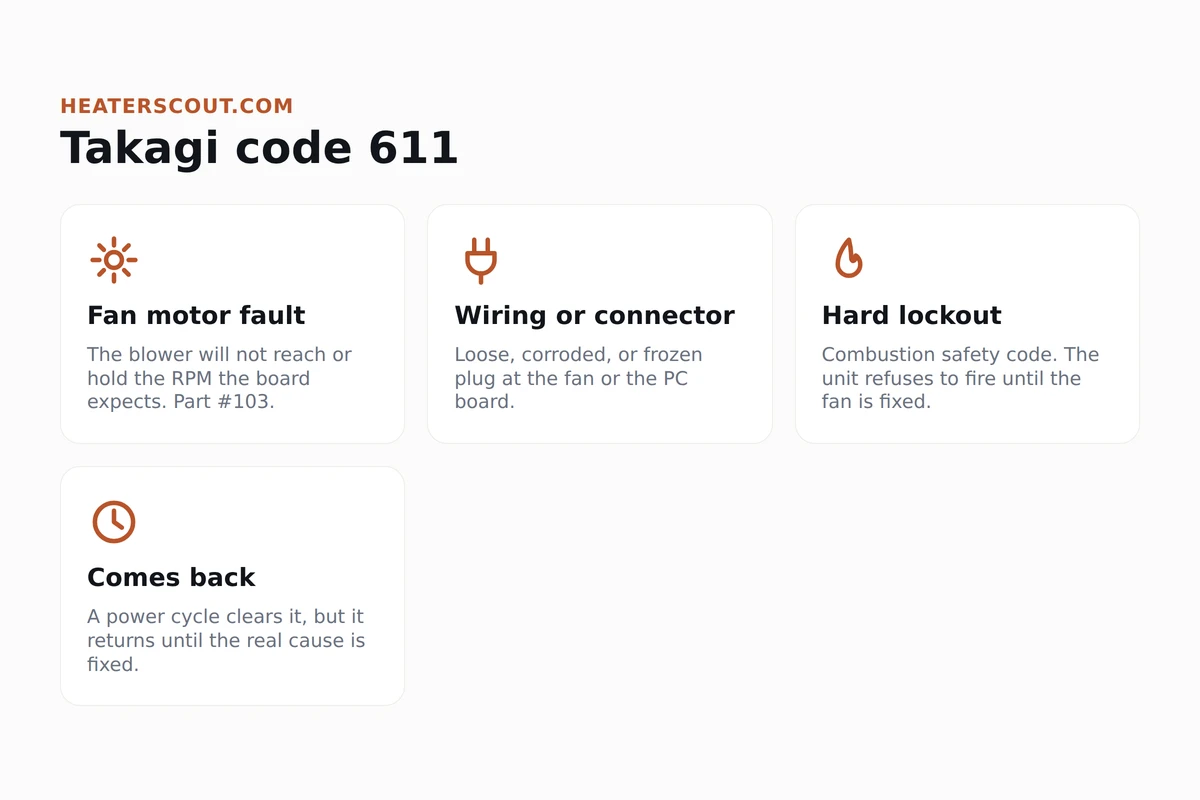
A Takagi that locks out on 611 has stopped before it ever tried to light the burner. Before ignition, the control board spins the combustion fan to purge the heat exchanger and the vent, and it watches a feedback signal that reports how fast the blower is actually turning. If that fan will not start, runs outside the speed window the board expects, or sends no readable signal, the unit throws 611 and refuses to fire. It is a hard lockout, which means the heater treats it as a combustion-safety problem, not a hiccup. Most of the time the culprit is dust on the fan, a loose connector, or a tired motor, not a dead circuit board.
Is 611 the same as my heater 'not getting power'?
No. The unit has power, that is how it can display 611 in the first place. The code is telling you the board powered up, started its pre-ignition sequence, commanded the fan, and did not get the fan speed it was waiting for. If the whole controller is dark, that is a separate power or transformer problem, not 611.
Before you go near the blower
This is a hard lockout on a combustion component. Before you open anything, turn the unit off at the remote controller, switch off the breaker or unplug the heater, and close the gas shutoff valve. This is a sealed combustion unit with mains-voltage fan wiring and gas at the burner. If you ever smell exhaust or a CO alarm sounds, ventilate and call a licensed gas tech before doing anything else.
How the blower earns its own error code
The combustion fan does two jobs, and both are safety-critical. It pulls fresh air into the sealed burner compartment and pushes flue gas out through the vent. On a Takagi, the board will not light the burner until the fan has run a pre-purge, clearing any lingering gas from the heat exchanger and proving the vent path is moving air. The fan carries a speed feedback line back to the board, and the board holds a target RPM range for that stage of startup. When the measured speed sits inside the window, startup continues. When it does not, the board stops there and posts 611. That is why you almost never see the burner attempt to light on a 611: the lockout happens during the purge, before ignition, on purpose.
Takagi's maintenance sheets are specific about where to look. They name the fan motor as Part #103 and the control board as Part #701, and the listed diagnosis is a wiring check first: confirm the fan connector is seated, not broken, not corroded, and, in cold installs, not frozen. If the wiring is sound, the sheet moves to metering the motor, checking voltage between the blue wire and each fan lead and resistance between the white and red leads. Only after the motor and its wiring check out does the board come into suspicion. That order matters, because the cheapest causes are also the most common ones.
Where 611 usually lands
Sort the causes by how often they show up and how much they cost, and the repair path picks itself.
Dust or lint on the fan
A blower motor packed with dust drags and never reaches its target RPM, so the board reads the speed as out of range. Clean the fan blade and motor housing, clear the intake screen, and retest. Free, and it fixes a large share of 611 faults, especially in dusty basements and utility rooms.
Loose or corroded connector
The fan speed signal drops in and out when the plug at the fan or at the PC board is loose, green with corrosion, or frozen in a cold climate. Reseat it firmly, look for burnt or melted terminals, and clean corrosion. An intermittent 611 that comes and goes points straight here.
Worn fan motor
Bearings wear, and a tired motor spins on a cold start but falls out of range once the compartment heats up. If the wiring is sound and cleaning does not hold, the motor, Part #103, is the honest fix. Confirm with the voltage and resistance checks before you buy it.
Control board
If the fan, its wiring, and the motor all test good and 611 still returns, the PC board, Part #701, may not be supplying steady power to the fan or may be misreading the speed signal. Look for burn marks on the board. It is the most expensive part, so it is the last thing you replace.
| Code meaning | Combustion fan (blower) motor abnormality |
| Lockout type | Hard lockout, unit will not fire until cleared and fixed |
| When it trips | During the pre-ignition purge, before the burner lights |
| Fan motor part | Part #103 (combustion fan motor) |
| Control board part | Part #701 (PC board) |
| Most likely cause | Dust on the fan or a loose / corroded connector |
| Reset method | Power off at controller, 30-sec breaker or unplug cycle |
| Service test | Voltage: blue wire to each fan lead. Resistance: white to red lead |
| OEM fan motor | Roughly $120 to $300 depending on model |
| Fan motor installed | Often about $300 to $600 with diagnosis and labor |
| Board (worst case) | About $300 to $600 for the part alone |
| Difficulty | Call a pro for diagnosis and wiring; motor swap is advanced DIY |
Working through it in order
Start with a power cycle so you have a known state and one clean firing attempt to observe. Turn the unit off at the remote controller, kill the breaker or unplug the heater for about 30 seconds, restore power, and run a hot tap. Listen and watch. If you can hear the fan try to spin and then the unit locks back to 611, the fan is engaging but missing its target, which points at dust, drag, or a marginal motor. If you hear nothing from the fan at all, the motor is not being commanded or not receiving power, which pushes the suspicion toward the connector or the board.
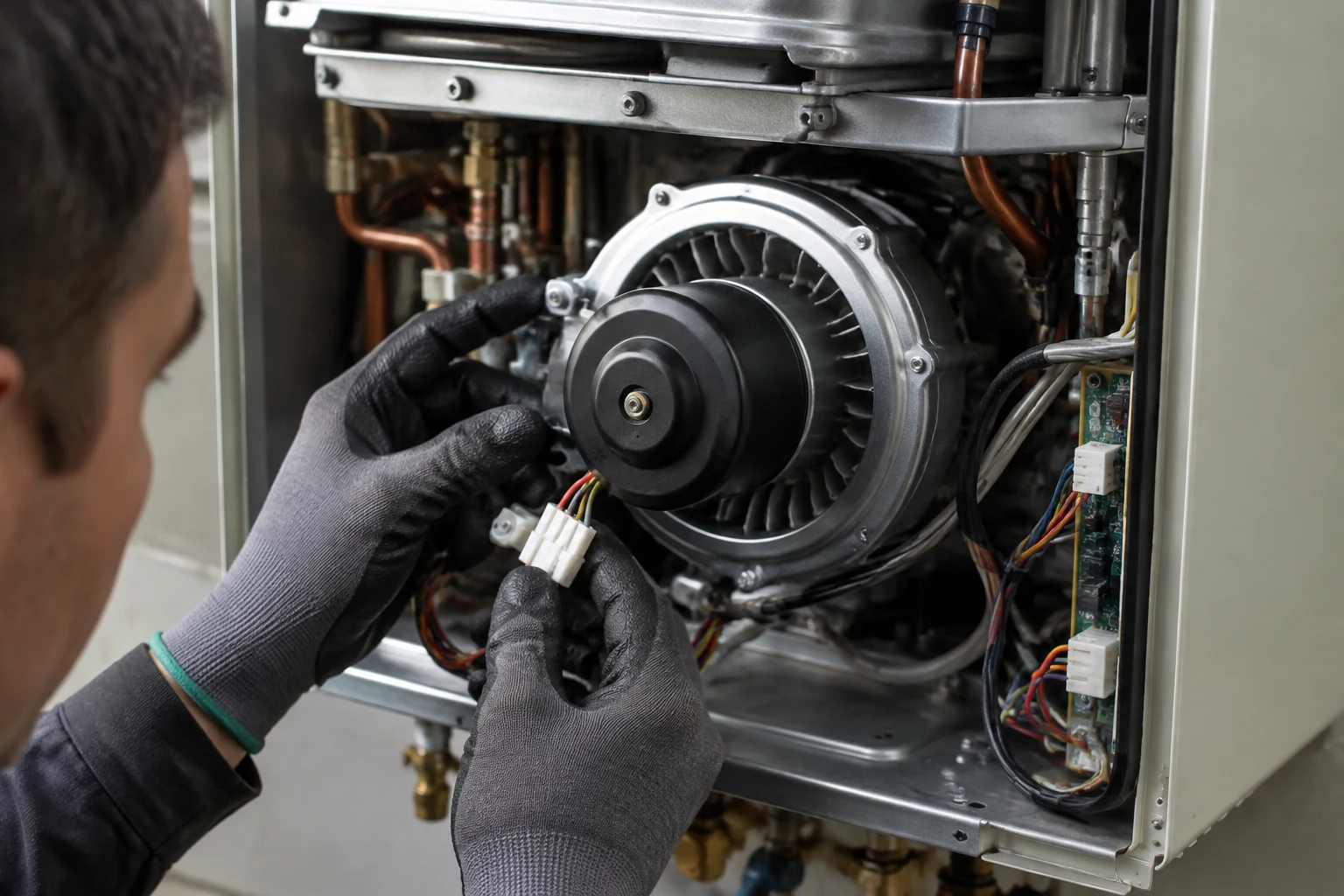
With power and gas off and the cover removed, get eyes on the fan. Dust caked on the blade or motor is the first thing to clear. Follow the fan wire to its connector at the motor and again at the board, and reseat both firmly. Look for green corrosion, a burnt terminal, or melted insulation, and check the board itself for scorch marks near the fan circuit. A lot of 611 calls end right here, with a cleaned fan and a reseated plug. If it survives that and still locks out, this is where the meter comes out and where most homeowners hand it to a tech.
The line between DIY and a service call
Cleaning the fan, clearing the intake, and reseating connectors are fair game for a careful owner who is comfortable shutting off gas and opening a sealed unit. That is a screwdriver, a vacuum or a soft brush, and patience, and it clears a real share of these codes. The line you should not cross casually is the electrical diagnosis. Deciding whether the motor or the board has failed means metering voltage and resistance against Takagi's published values, and getting it wrong means buying a fan motor the unit never needed or, worse, a board it did not need. Setting or bypassing the fan circuit is off limits entirely: that feedback exists so the burner never fires without proper venting. If the meter work or the gas shutoff reads as unfamiliar, this is a licensed-tech job, and the diagnosis is quick enough that a good tech earns the visit.
Keeping the fan out of lockout
A blower fails on 611 mostly because it got dirty or because nobody has looked at it in years. The best prevention is keeping the air path clean. Vacuum the intake screen and the area around the unit, and have the fan and its wiring inspected during annual service. If the heater lives in a dusty basement, a workshop, or a laundry room full of lint, check the intake more often than once a year, because that is exactly the environment that packs a fan motor with debris. Keep the intake and exhaust vents clear of nests, snow, and clogged screens so the fan is not fighting a blocked path. And do not skip the combustion side of service just because the water side gets the attention: descaling keeps the heat exchanger healthy, but it is a look at the fan, the connectors, and the vent that keeps 611 from showing up on the coldest morning of the year, which is when a marginal fan motor tends to finally quit.
Frequently asked
Can I reset Takagi code 611 myself?
You can clear the display, but clearing is not the same as fixing. Takagi tankless units latch 611 as a hard lockout, so the fastest way to reset is a power cycle: turn the unit off at the remote controller, then unplug the heater or switch off its breaker for about 30 seconds and restore power. That drops the code and lets the unit attempt one more startup. The problem is that 611 is a fan motor fault, so if the blower is fouled with dust, a connector is loose, or the motor is worn, the board runs the pre-purge again, sees the fan miss its target RPM, and re-locks on 611 within seconds. The reset buys you one clean firing attempt to watch what the fan does, not a permanent fix. If it locks out again immediately, the fan or its wiring is the next stop, not another reset.
What does Takagi error code 611 actually mean?
611 is a combustion fan motor abnormality. Before the burner lights, the control board spins the blower to purge the heat exchanger and vent, and it watches a feedback signal that reports the fan's actual speed. The board has a window of RPM it expects to see. If the fan does not start, spins too slow or too fast, or sends no valid speed signal at all, the board decides the blower cannot safely support combustion and shuts down on code 611. Takagi maintenance sheets name the fan motor as Part #103 and point the diagnosis at its wiring, its connectors, and the PC board, Part #701. It is a hard lockout because a blower that cannot move the right volume of air is a real combustion-safety problem, not a nuisance.
Is Takagi code 611 dangerous?
The code itself is protection working correctly. The blower moves combustion air in and flue gas out. If it cannot spin at the speed the board needs, the burner would run without proper venting, which risks incomplete combustion and carbon monoxide. That is exactly why 611 is a hard lockout: the unit refuses to fire rather than burn gas with a bad fan. So the code is not the danger, a defeated fan circuit would be. Never bypass or jumper the fan feedback to force the heater to run. If you also smell exhaust or your CO alarm sounds, treat it as an emergency, ventilate, and get a licensed gas tech out. Otherwise the lockout has already done the safe thing by keeping the burner off.
How much does it cost to fix Takagi code 611?
It depends on where the fault lands. A loose connector reseated or dust cleaned off the fan blade costs nothing but your time. A replacement Takagi combustion fan motor, Part #103, typically runs somewhere around $120 to $300 for the OEM part depending on the model, and a plumber's visit to diagnose and swap it usually adds a few hundred more once you count the trip and labor, so many 611 fan-motor jobs total in the $300 to $600 range installed. The worst case is the PC board, Part #701, which can run $300 to $600 for the part alone on some models and pushes a full repair past that. Because the diagnosis is straightforward voltage and resistance checks, a tech can usually tell the cheap fix from the expensive one in the first visit.
Why does Takagi code 611 keep coming back?
A code that returns after a reset is telling you the reset was the only thing that changed. The usual repeat offenders on 611: dust or lint packed into the fan motor so it drags and never reaches target RPM, a connector at the fan or the board that is loose, corroded, or, in a cold climate, frozen, so the speed signal drops in and out, or a motor whose bearings are worn and cannot hold speed under load. A blower that spins on a bench but fails once the burner heats the compartment points at a marginal motor. If a tech has reseated the wiring and cleaned the fan and 611 still returns, the fan motor is usually failing and needs replacement, or the board is not feeding it steady power.
Can I replace the Takagi fan motor myself?
This one sits at the edge of DIY. Physically, the fan motor is a bolt-on part, and a mechanically confident owner who is comfortable shutting off gas, draining nothing, and working inside a sealed combustion unit can swap it. The parts of the job that push most people toward a pro are the diagnosis and the wiring. Confirming it is the motor and not the board means metering voltage between the blue wire and each fan lead and checking resistance between the white and red leads against spec, which is the exact procedure Takagi's maintenance sheets lay out. Get that wrong and you buy a fan motor the unit did not need. If you can follow the service sheet and safely handle the gas shutoff, it is doable. If any of that reads as unfamiliar, this is a call-a-pro repair.
Will descaling clear code 611?
No. Descaling flushes vinegar or a descaling solution through the heat exchanger to strip mineral scale off the waterways. It touches only the water side of the unit. Code 611 lives entirely on the combustion-air side: the fan motor, its wiring, its connectors, and the board that reads its speed. There is no scale involved. Descaling on schedule is still worth doing for the overall health of the heater, and a unit that has skipped its water-side service has often skipped its combustion-side service too, but do not expect a flush to touch 611. Cleaning the fan, reseating its wiring, and testing or replacing the motor are the moves that clear this one.
How is code 611 different from other Takagi fan or ignition codes?
611 is specifically about the combustion fan motor not meeting its expected speed. It is not the same as an ignition-failure code, where the burner tries to light and never proves a flame, and it is not a flame-loss code, where the fire lit and then went out. On a 611 the burner usually never gets the chance to light, because the board checks the blower during the pre-purge and locks out before ignition when the fan is wrong. If you see 611 alongside an ignition or flame code, fix the fan first: the board needs a healthy purge before it will even attempt a light, so a fan fault can cascade into what looks like an ignition problem downstream.