Your Takagi tankless heater flashes 311, the burner cuts out, and the hot water goes lukewarm or cold. That three-digit code points at one specific part: the outlet thermistor, the sensor that measures the temperature of water leaving the unit. When the control board can no longer trust that reading, it refuses to fire. Here is what the code actually means, what causes it in order of likelihood, and where the line sits between a fix you can do at the wall switch and one that needs a licensed tech inside the cabinet.
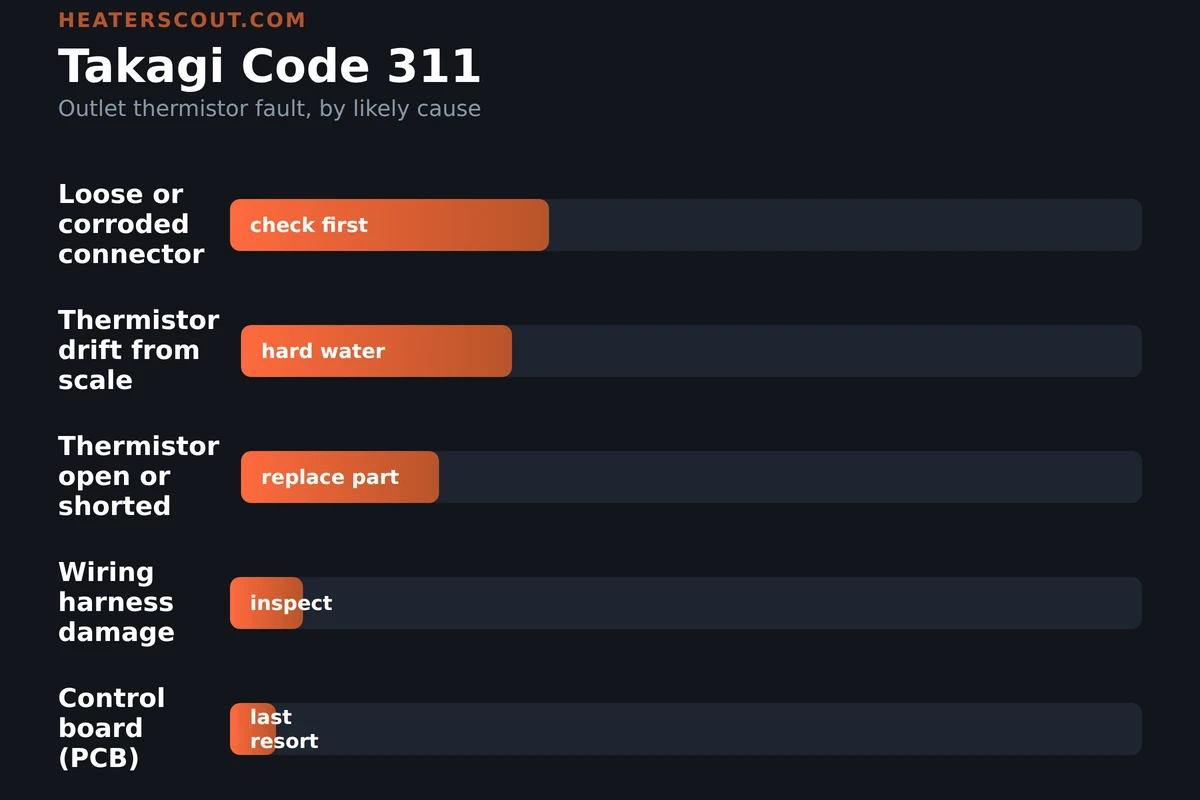
What actually causes code 311, most likely first
The failure modes are not evenly common. Techs who see this code regularly start at the cheap, likely end and only move toward the board if everything upstream checks out. Code 311 is the board reporting that the outlet thermistor, the sensor on the hot-water side of the heat exchanger, is sending a signal that does not make sense. Either the resistance is too high (an open circuit, like a broken wire), too low (a short), or simply outside the range the board expects for real water temperatures. Here is how those break down in order of likelihood.
| Cause | Why it happens | Who should fix it |
|---|---|---|
| Loose or corroded connector | Vibration and heat cycling back the plug out, or moisture corrodes the pins | Homeowner can reseat, tech if corroded |
| Thermistor drift from scale | Hard-water minerals coat the sensor tip so it reads the deposit, not the water | Tech (test and clean or replace) |
| Thermistor open or shorted | The sensor has aged or failed, resistance is far out of spec | Licensed tech replaces the part |
| Wiring harness damage | A chafed, pinched, or rodent-chewed wire between sensor and board | Licensed tech |
| Control board (PCB) | The board's input circuit is bad, rare, and diagnosed by elimination | Licensed tech, last resort |
Notice the order. A loose connector and a scaled sensor together account for most 311 calls. A genuinely dead thermistor is next. The control board is at the bottom of the list for a reason: it is the most expensive part and the least likely culprit. Any tech who quotes you a board on the first visit without testing the sensor is skipping steps.
What the outlet thermistor actually does
Every Takagi tankless unit watches several thermistors while it runs. A thermistor is a small temperature sensor whose electrical resistance changes with heat. The control board reads that resistance and calculates the water temperature at each point in the flow path. On Takagi's service handbooks, 311 sits in a group with 321, 331, and 341. Those are the inlet, heat exchanger, and exhaust thermistors. The diagnostic path is the same for all four, which is worth knowing because if you have ever chased one of them, 311 will feel familiar. What changes is only which sensor you are testing.
Outlet thermistor
The temperature sensor mounted on the right side of the heat exchanger, on the hot-water outlet. It tells the control board how hot the water leaving the unit actually is, so the board can modulate the burner to hit your set temperature. Takagi references it by connector position (for example connector No.113 on several models) and by part numbers such as 407, 408, 411, or 718 depending on the model line. When its resistance leaves the expected window, the board throws 311 and stops firing.
Because the outlet reading is how the unit protects you from scalding, Takagi treats a bad signal there as a hard stop. The heater would rather give you no hot water than deliver water it cannot measure. That is why 311 shuts the burner down instead of limping along.
How to read and clear the code
Clearing 311 is simple. Turn the unit off at its dedicated wall switch or the breaker, wait roughly 30 seconds so the board fully powers down, then turn it back on. The display resets. If the fault was a momentary hiccup, a connector that had barely wiggled loose and reseated when the unit cooled, you might not see 311 again. Some Takagi models also store an error history you or a tech can pull to see how many times 311 has logged, which tells you whether this is a one-off or a pattern.
But be honest about what a reset does. It clears the number. It does not repair a sensor that is out of range. If 311 returns within a cycle or two of hot-water use, stop resetting and start diagnosing. The board is not confused. The sensor or its connection is.
How do I know if it is the connector or the thermistor itself?
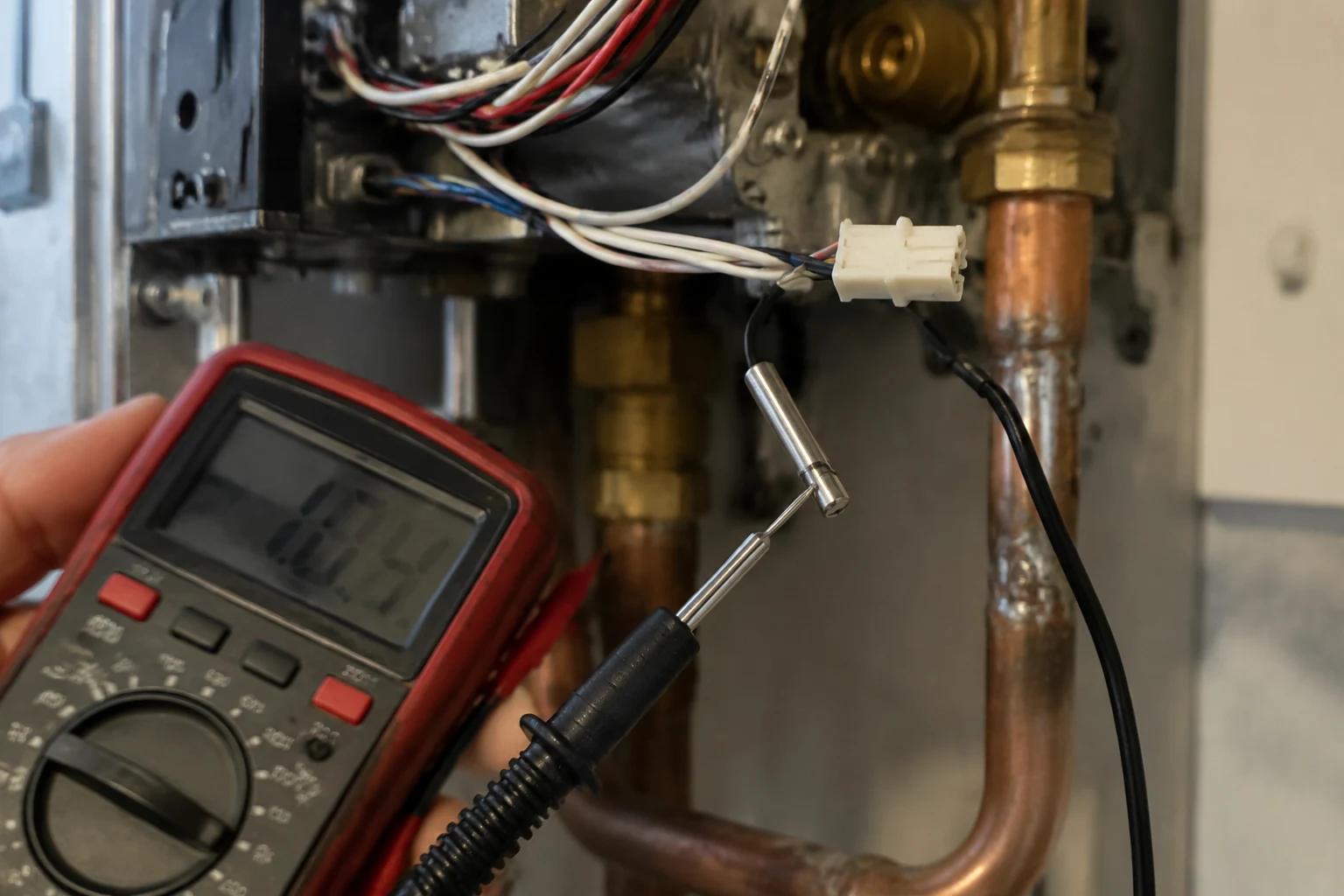
Power the unit down completely, open the cabinet, find the outlet thermistor on the right side of the heat exchanger, and unplug then firmly reseat its connector. Look for green corrosion or a loose pin. If reseating and a power cycle clears 311 for good, it was the connection. If the code returns, the next step is a resistance test on the sensor with a multimeter, comparing the reading to Takagi's chart for your model. A common healthy reference is around 9K ohms at room temperature, but always use your model's published values.
Homeowner-safe steps vs licensed-tech work
There is a clean line here, and it matters because the cabinet holds a gas valve, 120V wiring, and a heat exchanger that stays hot after shutdown. Stay on the safe side of that line unless you genuinely know what you are doing.
Safe for a homeowner
- Power cycle the unit at the switch or breaker to clear the display
- Check that nothing tripped the breaker or cut power to the unit
- With the unit fully off and cool, visually inspect the outlet thermistor connector and reseat it
- Confirm the area around the unit is dry and free of dripping condensate or a nearby leak
- Pull the stored error history if your model shows it, to see if 311 is chronic
Call a licensed tech
- Testing thermistor resistance against the model chart and interpreting the result
- Removing and replacing the outlet thermistor (part 407, 408, 411, or 718 by model)
- Tracing or repairing a damaged wiring harness between sensor and board
- Confirming a PCB fault and replacing the control board (part 701)
- Descaling a scaled heat exchanger and inspecting related sensors
The reason the thermistor swap lands on the tech side for most people is not that the part is hard to physically remove. It is that a correct diagnosis depends on reading resistance against the right chart, and the work happens six inches from a gas line and live terminals. A tech does this in fifteen minutes with the right meter and the model's service sheet. A homeowner guessing at it can condemn a good sensor or, worse, a good board.
Do not reset in a loop
If you keep resetting Takagi code 311 and forcing hot water out of a unit that cannot measure its own outlet temperature, you are defeating a safety shutoff. The board pulled the burner for a reason. Diagnose the sensor, do not train yourself to ignore the code.
The scale connection, and why prevention matters
If you are on hard water and you have never descaled, 311 may be your first sign of a bigger pattern. Minerals plate out on every hot surface the water touches, and the outlet thermistor tip is one of them. A coated sensor reads the deposit instead of the water, so its resistance drifts until the board flags it. Clean the coating off and the resistance can come back into spec. Ignore it and the same scale is already working on your heat exchanger, which is a far more expensive part to lose.
This is why a plumber who replaces your thermistor should also ask about your water and whether the unit has ever been flushed. Fixing the sensor without addressing the water is treating the symptom.
Keeping 311 from coming back
Prevention on a Takagi is mostly about water and moisture. Do these and thermistor faults become rare.
Descale the unit once a year, more often on hard water. A yearly vinegar or descaler flush keeps mineral buildup off the heat exchanger and the sensors that live near it. If your water is genuinely hard, a whole-home softener upstream does more than any single flush, because it stops the scale before it starts. Keep the unit and its wiring dry. Condensate, a slow fitting leak, or a damp install area corrodes connectors and pins, and a corroded outlet thermistor connector is a classic intermittent 311. And when a tech is in the cabinet for anything, have them glance at the connectors and reseat anything that looks loose, since heat cycling slowly backs them out over years of service.
None of that is exotic. It is the same maintenance that keeps the whole unit alive. The thermistor just happens to be the first part loud enough to complain when the maintenance slips.
When to stop and call someone
Reset it once. Reseat the connector once, if you are comfortable opening a powered-down, cooled-off cabinet. If 311 is back after that, you are past the DIY steps. A resistance test tells the tech in minutes whether you need a $40 sensor or a $300 board, and that single measurement is the whole reason not to guess. The code is specific on purpose. Match your fix to it.
Frequently asked
Can I reset Takagi error code 311 myself?
Yes, you can clear the display. Turn the unit off at the wall switch or breaker, wait about 30 seconds, and power it back on. If a connector had just wiggled loose or the sensor briefly saw debris, the code may not return. But a reset only clears the number on the screen. It does not repair a drifting or failed thermistor, so if 311 comes back within a few cycles you have a real hardware problem, not a glitch.
How much does it cost to fix Takagi code 311?
An outlet thermistor is an inexpensive part, roughly $20 to $60 depending on your model. If you hire a plumber, expect a service call and diagnostic in the $120 to $250 range, and total ticket around $150 to $350 with the sensor swapped. If the board tests bad instead, a Takagi PCB runs $150 to $400 for the part alone, and a full board replacement can push the job to $400 to $700 installed. That is why techs test the sensor before condemning the board.
Will descaling clear error code 311?
Not directly. Descaling flushes the heat exchanger with vinegar or a descaler and does not clean the thermistor itself. But scale is a top reason the outlet thermistor drifts out of range, so if you are on hard water and the sensor has a mineral coating, cleaning that coating off can bring resistance back into spec. Think of descaling as prevention and the reason 311 showed up, not the reset button for it.
Is Takagi code 311 dangerous?
It is not an immediate safety hazard the way a gas or venting fault is. The outlet thermistor measures the temperature of water leaving the unit. When Takagi loses a trustworthy reading there, the control board stops firing rather than risk delivering scalding or wildly unregulated water, so the unit fails safe. You lose hot water, which is the real problem, but the shutdown is the heater protecting you, not a leak or a combustion risk.
What is the difference between code 311, 321, and 331 on a Takagi?
They are all thermistor faults on the same family of sensors, just different locations. 311 is the outlet (hot water leaving the unit). 321 is the inlet thermistor (cold water coming in). 331 is the heat exchanger thermistor. 341 is the exhaust thermistor. The diagnosis is nearly identical for each: check the connector, test resistance against Takagi's chart, then clean or replace. Only the physical sensor you are testing changes.
Why does Takagi error code 311 keep coming back?
A repeating 311 almost always means the outlet thermistor is genuinely out of range or the connection is intermittent. The usual culprits are a corroded or partially seated connector, mineral scale on the sensor from hard water, or a sensor that has aged past its resistance spec. Vibration and heat cycling can back a connector out over time. If you reset it and it returns, stop resetting and test the sensor resistance, because the board is telling you the truth.
Do I need a plumber to replace the Takagi outlet thermistor?
For most homeowners, yes. Reseating the connector and power cycling are safe DIY steps. But opening the cabinet exposes you to gas lines, live 120V, and a hot heat exchanger, and swapping the thermistor means working inside that space and knowing how to read a resistance chart. If you are comfortable with a multimeter and the unit is fully powered down and cool, some owners do it. If any of that gives you pause, call a licensed tech.
Can hard water cause Takagi code 311?
Yes, and it is one of the most common reasons. Hard water leaves mineral scale on everything the water touches, including the outlet thermistor tip. A scaled sensor reads the deposit instead of the water, so its resistance drifts until the board flags it as out of range. Homes without a softener or a regular descaling routine see thermistor and heat exchanger faults far more often than homes that keep the water in check.