A Takagi that fires up, gives you thirty seconds of hot water, then quits and flashes 121 is not failing to start. It started fine. The burner lit, the flame rod saw a real flame, and then the flame either went out or the board stopped reading it partway through the burn. That is code 121: a flame failure, or loss of flame. It is a different problem from a unit that never lights, and chasing it like an ignition fault sends you down the wrong road. The fault almost always lives on the fuel and flame-sensing side, and the two places to look first are the gas supply under load and the flame rod.
Read this before you touch anything
Code 121 is a gas-appliance combustion fault. You can safely power-cycle the unit to clear the code, check that the vent terminal is clear, and confirm the condensate drain is not blocked. Do not open the sealed burner, adjust gas pressure, test the gas valve, or handle the flame rod unless you are a licensed technician. A flame that keeps failing can mean a blocked vent or a backdraft, which is a carbon monoxide concern. If 121 returns after one reset, get a pro on it.
What the board is actually reporting
Every gas tankless watches its own flame with a thin metal probe called a flame rod, or flame sensor, in the burner. Once the igniter lights the gas, the rod passes a tiny electrical current through the flame to ground, and the control board reads that current as proof there is a real flame. If the board loses that signal while the burner is supposed to be firing, it assumes the flame is gone, snaps the gas valve shut, and posts 121. That shutdown happens in a fraction of a second, which is the whole point: gas must never flow into a chamber with no flame to burn it. So 121 is the safety chain doing its job. Your work is to figure out why the flame, or the reading of it, keeps dropping out.
| Code | 121 (display shows “121”) |
| Meaning | Flame failure / loss of flame. Flame was confirmed after ignition, then lost. |
| Family | Ignition and flame group. Grouped with 111 in some Takagi service handbooks. |
| Not the same as | 111 (ignition failure, burner never lit on the try). |
| Most likely cause | Gas pressure sagging under load, then a sooty or misaligned flame rod. |
| Homeowner can do | Power-cycle to reset, check vent terminal is clear, check condensate drain. |
| Needs a licensed tech | Gas pressure, gas valve, flame rod, control board, grounding. |
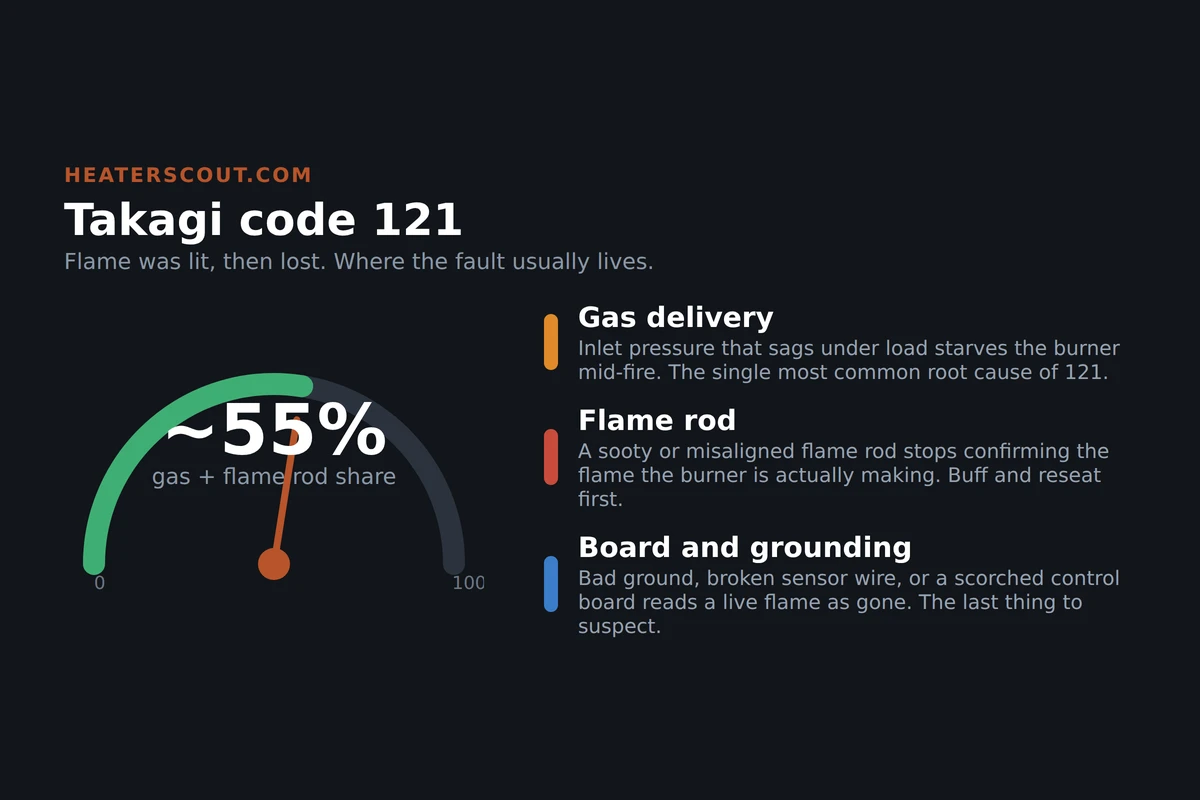
The two causes that fix most 121 faults
Field experience and Takagi's own maintenance sheets point at the same short list, and two items sit at the top by a wide margin. Get these checked before anyone pulls a board. One is about the fuel reaching the burner, the other about the sensor confirming the flame.
Gas supply that sags under load
- Inlet gas pressure can read fine at rest, then drop below the burner's requirement once the unit ramps to full fire. A starved flame blows out mid-burn, a textbook 121.
- A gas line shared with a furnace, range, or pool heater is a classic trigger: the flame fails only when the other appliance kicks on and steals pressure.
- An undersized line or a regulator that cannot keep up gives the same load-dependent flameout. A tech measures pressure at the inlet while the unit runs at high fire.
- This is the number-one root cause of a repeating 121, and the reason the fault feels random. It is not random, it is load-dependent.
Flame rod not reading the flame
- The flame rod slowly builds soot over months. A coated rod passes less current, so the reading drifts below threshold and the board calls a live flame gone.
- A rod knocked out of position, or bent so it sits at the edge of the flame, gives an unstable reading that fails under certain fire rates.
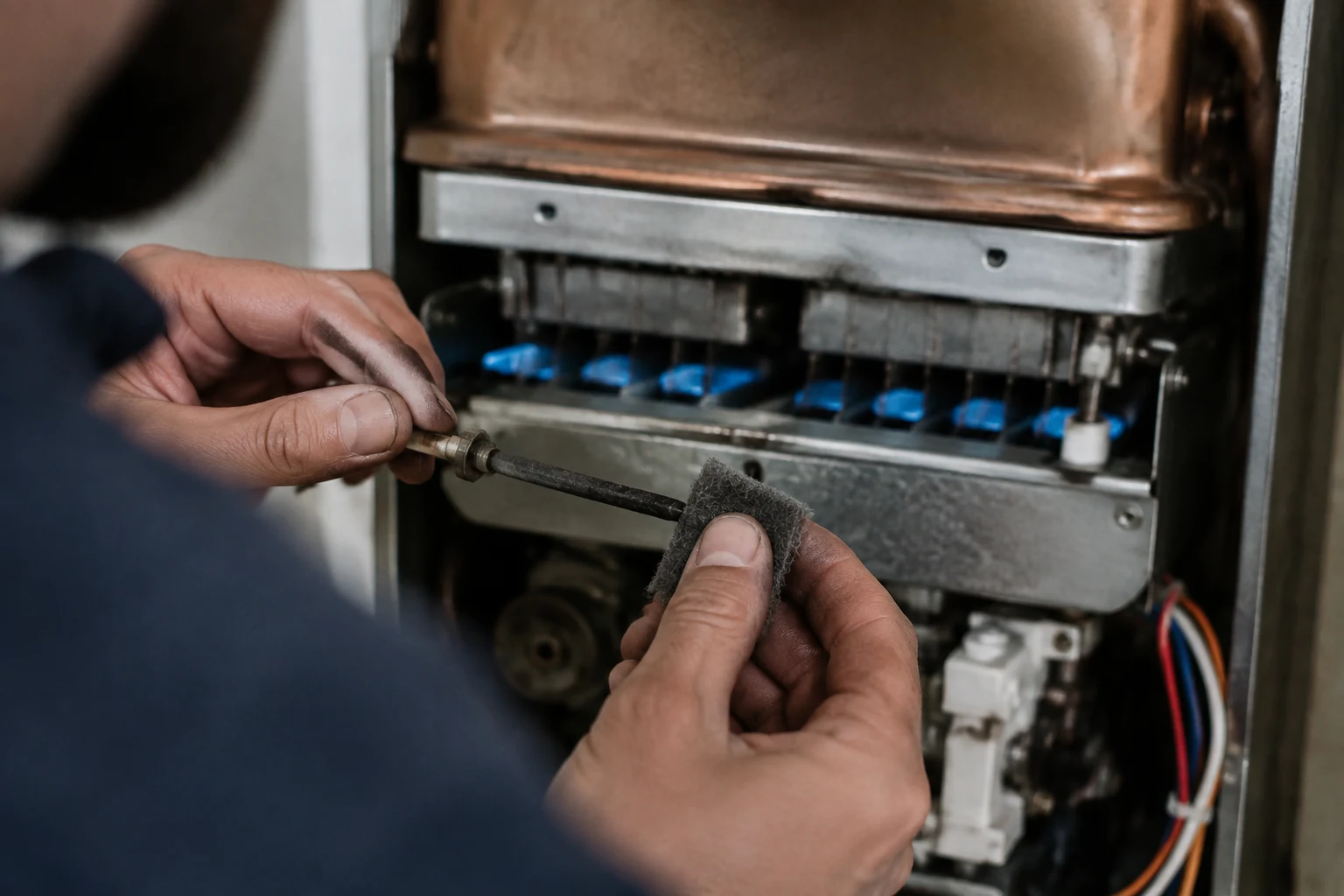
- The fix is often just cleaning: a tech buffs the rod with fine sandpaper, wipes it, and reseats it. Rod part cost is roughly 20 to 60 dollars.
- A bad ground, a loose sensor wire, or a scorched control board mimics a dirty rod because they all break the same low-current signal path.
Which cause you probably have
The way the unit fails narrows it down before a tech puts a gauge on it. Watch the pattern and match your symptom to the cases below.
Shared gas line, sagging pressure
Hot water is fine until the furnace or range fires, then the tankless drops out with 121. That timing is the tell. The gas line cannot feed both at full demand, so pressure at the inlet sags and the flame starves. A tech measures inlet pressure at high fire and looks at line sizing.
Sooty or drifting flame rod
The unit ran clean for a year, then started throwing 121 now and then, more often as time goes on. That slow onset is soot building on the flame rod until the reading drifts below threshold. Cleaning and reseating the rod clears a large share of intermittent flame-failure faults.
Vent, backdraft, or condensate
If 121 showed up after a storm, a vent change, or freezing weather, look at combustion airflow. A partly blocked or iced vent terminal, a backdraft, or a plugged condensate trap on a condensing model can disturb the flame enough to fail it. Clear the vent terminal and check the condensate drain.
Look at 111 first, then gas-off
If you get no warmth at all and it faults right away, you may be seeing 111 territory or a gas-off condition: a closed manual gas valve, an empty propane tank, or air in a new gas line. Confirm gas is on and other gas appliances work. A true 121 gives you a brief burn first.
Flame rod (flame sensor)
A thin metal probe seated in the burner flame. After ignition it passes a small current through the flame to ground, a process called flame rectification, and the board reads that current as proof of a real flame. Soot on the rod, a rod out of position, a broken sensor wire, or a bad ground all weaken the current. When the reading falls below the safe threshold during a burn, the board treats the flame as lost, shuts the gas, and posts code 121. Cleaning and reseating the rod is the cheapest common fix, which is why a tech checks it before suspecting the gas valve or the board.
How a tech works through it, in order
A good technician does not start by swapping parts. They follow the fuel and the signal from the outside in, cheapest and most likely first, because a sooty flame rod is far more common than a failed board. The rough order: confirm gas is on and measure inlet pressure with the unit at high fire, watching whether it sags when other appliances cycle. Then pull and inspect the flame rod for soot and position, clean it, and check the sensor wire and ground. Then check the vent terminal and, on condensing models, the condensate trap for blockage. Then inspect the manifold nozzles for dust and lint. Only after all of that comes the gas valve assembly and, last, the control board. Takagi's maintenance sheets follow the same logic: gas supply and pressure, hi-limit switch, wiring and connectors, flame-rod soot and current, before anything gets condemned.
The order matters because of money. The top of the list is a service call and a cheap rod; a gas valve or control board runs into the low hundreds before labor. If a tech reaches for the board first without measuring gas pressure or looking at the flame rod, get a second opinion.
Keeping 121 from coming back
Most repeat 121 faults trace to two things a yearly service handles: a flame rod that never gets cleaned and a gas supply that was marginal from day one. Book an annual service that includes a burner and flame-rod cleaning, not just a water-side descale, because the descale does nothing for a combustion fault. If your tankless shares a gas line with a furnace, range, or other large appliance, have the line sizing checked once for good; a line that was borderline when the heater went in keeps starving the flame as demand grows. Keep the vent terminal clear of leaves, snow, and nests. On condensing models, keep the condensate trap flowing and never let it dry out or freeze. Do those few things and a clean, properly sized unit rarely revisits 121.
One note on sources. Takagi's service handbooks group 111 and 121 in the same ignition-and-flame section and share much of the troubleshooting, and a few third-party pages muddle 121 with an overheat fault. The manufacturer documentation and the plumbing forums agree on the meaning that matters: 121 is a flame that was there and then was lost. Start with the gas supply and the flame rod, and leave the sealed combustion work to a licensed tech.
Frequently asked
What does error code 121 mean on a Takagi tankless water heater?
Code 121 is a flame failure, also written as loss of flame. The unit lit its burner normally, the flame rod confirmed a flame, and then partway through the burn the board stopped detecting that flame and shut the gas down for safety. Takagi service handbooks group 121 with the ignition family, but the distinction matters: 111 means the burner never lit on the ignition try, while 121 means it lit and then went out or the flame reading dropped below the safe threshold. So 121 points you at what interrupts a running flame rather than what stops a first light. In practice that is a gas supply that cannot hold pressure under load, a flame rod that has stopped reading the flame, or, less often, a grounding or control board fault.
Can I reset Takagi error code 121 myself?
Yes, clearing the code is safe. Turn the unit off at its power switch or pull its plug, or flip the dedicated breaker off for thirty seconds, then restore power. That power cycle clears the current fault and lets the unit attempt a normal ignition sequence again. On some models with a remote controller you can scroll the error history to see whether 121 has logged once or repeatedly. What you cannot safely do is chase the underlying cause on the sealed combustion side. Adjusting gas pressure, opening the burner to reach the flame rod, or testing the gas valve are licensed-tech jobs on a gas appliance. Reset it once to confirm the fault was not a one-off. If 121 comes right back or returns within a few draws, stop resetting and move to diagnosis.
Why does Takagi code 121 keep coming back?
A 121 that returns every few hot-water draws means the flame is genuinely dropping out, not throwing a fluke. The usual repeat offender is gas supply. A line that measures fine at rest can sag below the burner's requirement once the unit ramps to full fire, especially if the heater shares a gas run with a furnace, range, or pool heater that cycles on. An undersized line or a regulator that cannot keep up starves the flame and blows it out mid-burn. The second repeat cause is a flame rod slowly losing its ability to read the flame as soot builds on it, so the reading drifts below threshold under certain fire rates. Intermittent grounding and a marginal sensor-wire connection do the same. Because the trigger is load-dependent, the fault feels random, and that randomness is the clue that it is fuel or sensing under load rather than a hard failed part.
Is Takagi error code 121 dangerous?
The lockout itself is the safety system doing its job, so the code is protective rather than dangerous. When the board loses the flame signal it closes the gas valve within a fraction of a second, so raw gas is never dumped into a chamber with no flame to burn it. The danger sits in the causes, not the code. A flame that keeps failing can point at a partially blocked vent or a backdraft, which is a carbon monoxide concern a technician needs to check with a combustion analyzer. It can also point at a gas supply or gas valve problem, and gas work is not homeowner territory. Treat a persistent 121 as a reason to get a licensed tech on the combustion side.
How much does it cost to fix Takagi code 121?
It depends on which cause you land on, and the cheap ones are common. If the fix is cleaning or reseating the flame rod, that is often just a service-call fee, roughly 100 to 200 dollars, since the part itself runs about 20 to 60 dollars and the labor is around half an hour. A gas supply problem varies: adjusting a regulator or clearing a shared-line issue can be modest, while upsizing an undersized gas line is a real plumbing job that can run several hundred dollars. The expensive end is the gas valve assembly or the control board, either of which can push parts alone into the low hundreds before labor. A tech should diagnose before quoting, because guessing at a board when the real fault is a sooty flame rod wastes money.
Will descaling clear Takagi error code 121?
Usually not. Descaling flushes vinegar or a descaler through the heat exchanger to dissolve mineral scale, which fixes flow, temperature swings, and overheating faults tied to a scaled exchanger. Code 121 is a combustion and flame-sensing fault, not a water-side fault, so a descale rarely touches it. The one indirect link is that a heat exchanger badly fouled with scale or soot can disturb combustion enough to make sensing unreliable, so full annual service that includes both a descale and a burner and flame-rod cleaning can help. But if your only symptom is 121, spend your first effort on the gas supply and the flame rod, not on running descaler through the water side.
What is the difference between Takagi code 111 and code 121?
Both live in the ignition and flame family, and some Takagi documentation lists them together, but they mark two different moments. Code 111 is an ignition failure: the unit tried to light and the flame rod never confirmed a flame, so the burner never established. Code 121 is a flame failure: the burner did light, the rod did confirm a flame, and then the flame was lost during the burn. The causes overlap heavily, gas, flame rod, wiring, board, which is why the troubleshooting looks similar. The practical split is timing. If you never feel any warmth and it faults immediately, think 111 and look at what prevents a first light, like gas being off or air in a new line. If you get hot water briefly and then it drops out, think 121 and look at what interrupts a running flame, especially gas pressure sagging under load.