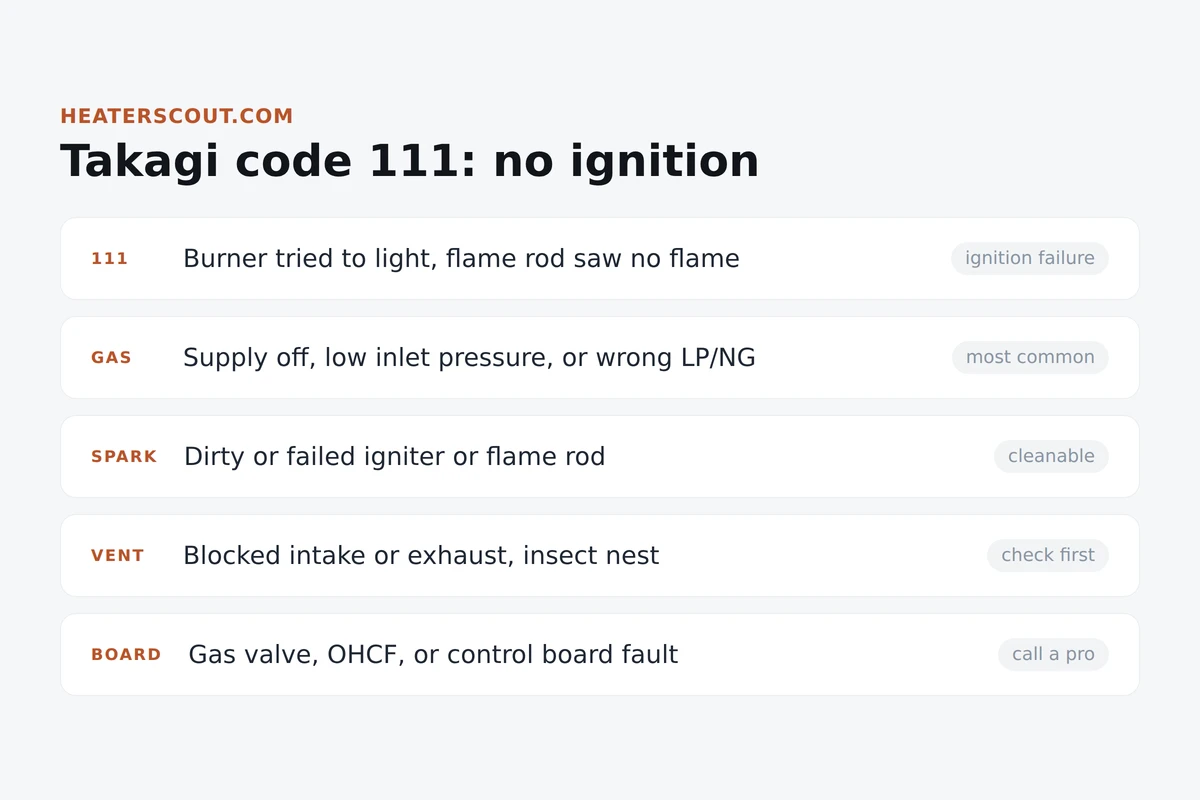
Open a hot tap on a Takagi and you should hear a soft click, a spark, then the low whoosh of the burner catching. Code 111 means that last part never happened. The gas valve opened, the igniter sparked, and the flame rod, a thin metal probe that has to feel the flame, never confirmed one within the ignition window. So the board shut the gas off and locked out rather than keep pushing raw gas past an unlit burner. On units without a numeric screen the same fault reads as three flashes of the status light. It is a no-ignition lockout, and most of the time the reason is boring and fixable: the gas is not fully on, the flame rod is dirty, or the vent is choked.
Is 111 the same as 121 on my Takagi?
On some model lines it is grouped with it. The T-H3J-DV service handbook lists 111 or 121 together as ignition failure or flame loss, where 111 leans toward the burner never lighting and 121 toward a flame that lit and then dropped out. On other Takagi models 111 is the standalone ignition-failure code. Check your specific unit's manual, because the exact split depends on which board you have. The troubleshooting is nearly identical either way: gas, flame rod, vent, then the expensive parts.
Start with the free checks before you touch a part
Do not buy an igniter yet. A large share of 111 calls come down to something outside the sealed combustion area that costs nothing to fix. Work this list in order. Each item rules out a common cause, and the first four are things any homeowner can do safely with no tools and no gas work.
- Confirm the gas is on. Trace the gas line to the shutoff valve at the unit and make sure the handle is inline with the pipe, not crosswise. A bumped or half-closed valve is the single most common cause of a sudden 111.
- Check another gas appliance. Light a gas stove burner or run the furnace. If they are weak or dead too, the problem is your gas supply to the whole house, not the water heater, and a 111 is just the symptom.
- Look for a recent gas outage or a just-filled propane tank. Air in the line after either one makes the first few ignition attempts fail. Purge by running a gas appliance, then reset the Takagi.
- Clear the vent and air intake. Walk outside and check the termination for a bird or wasp nest, snow, leaves, or a rag. A blocked intake starves ignition and throws 111. This is a top offender after a season change.
- Power-cycle to reset. Kill power at the outlet or breaker for a full 30 seconds, restore it, and open a hot tap to run a fresh ignition trial.
- Note whether it comes right back. A one-time 111 that clears is likely a fluke. A 111 that returns within a few ignition attempts is a real fault, and that tells you which section below to read.
Homeowner checks versus what needs a licensed tech
The clean line on 111 is gas. Anything on the water side of the outer cabinet, plus the vent termination outside, is fair game for a homeowner. Anything involving live gas, the sealed combustion chamber, or combustion tuning is a licensed job. Here is the split, so you know where to stop.
Safe for a homeowner
- Confirm the gas shutoff at the unit is fully open
- Verify other gas appliances have normal flame and pressure
- Purge air after a gas outage or a propane refill
- Inspect and clear the outside vent and intake termination
- Run one power-cycle reset and note if 111 returns
- Check the condensate drain is not clogged or frozen on condensing models
- Read the stored error history from the remote controller if your model has one
Call a licensed tech
- Measure gas inlet pressure (roughly 5 to 10.5 in WC for natural gas, 8 to 14 in WC for propane)
- Test the igniter for a proper spark and replace it if weak
- Clean or replace the flame rod inside the burner assembly
- Verify the LP versus natural gas configuration and dip-switch settings
- Check OHCF and hi-limit continuity with a meter
- Diagnose and replace the gas valve or the control board
The flame rod and igniter
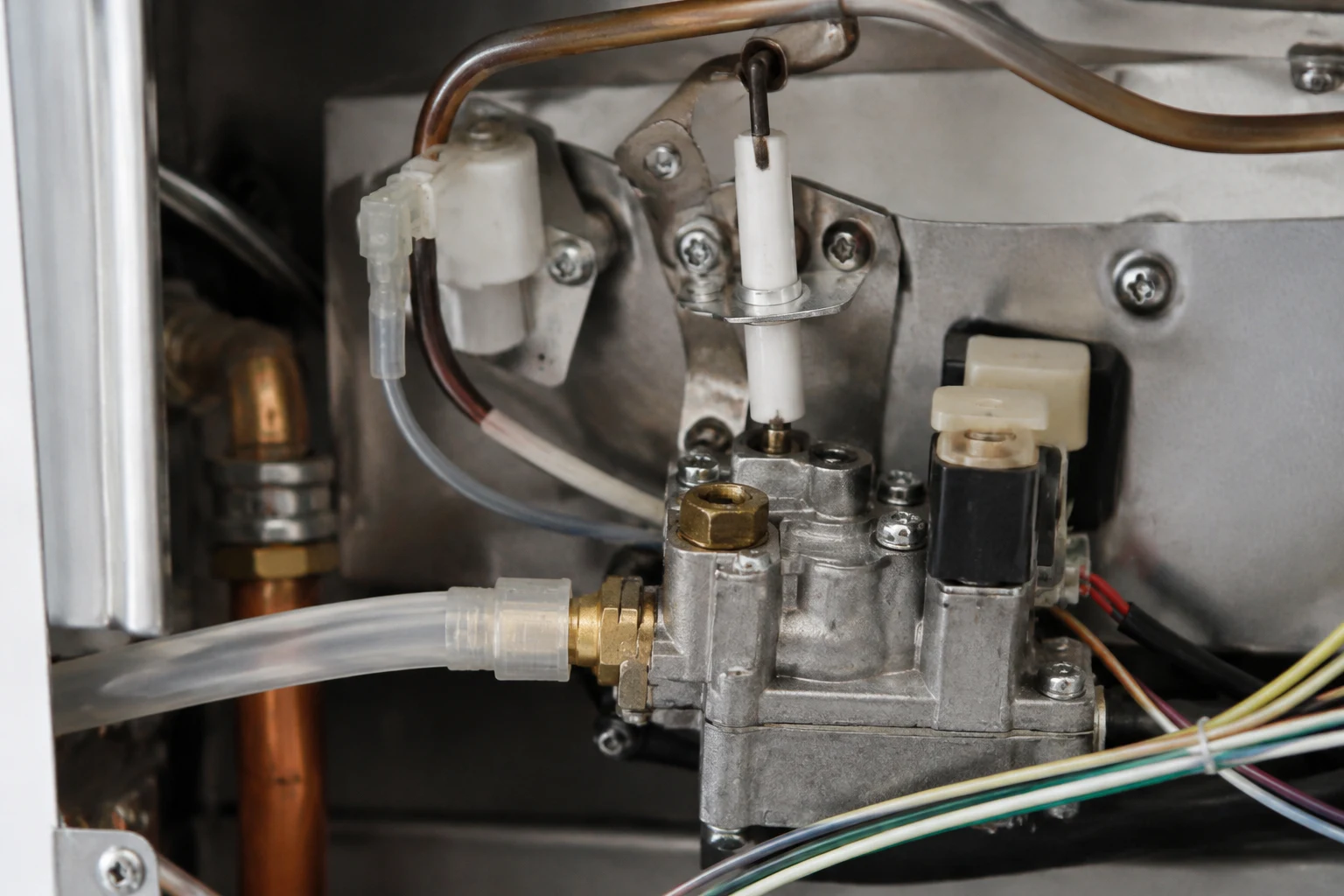
If the free checks pass and 111 still repeats, the flame rod is the next suspect and the cheapest real repair. The flame rod sits in the burner and senses the flame by conducting a tiny current through it. Coat that rod in soot or scale and it stops sensing, so the board sees no flame even when the burner is lit, and posts 111. A tech pulls the rod and cleans it with fine sandpaper or steel wool until the metal is bright, then reseats it. Cleaning is often the whole fix. If the igniter itself is not sparking, from a loose wire or a worn electrode, the burner never lights at all. Both parts are inexpensive, roughly $30 to $90, and a service visit to diagnose and swap one usually lands between $150 and $350 with labor.
Gas pressure, valve, and the board
Low or unsteady inlet gas pressure starves the burner right when it needs the most gas, at ignition, so the flame never establishes. A tech measures inlet pressure at the unit against the rating plate. Undersized gas piping, a long run feeding several appliances, or a weak regulator all show up here. Wrong fuel configuration is its own trap: a unit plumbed for natural gas but fed propane, or the reverse, fails ignition every single time until the conversion and dip switches are corrected. When gas, flame rod, and vent all check out, the remaining causes are the gas valve not opening correctly, an open OHCF or hi-limit circuit, or a failed control board. Those are the priciest repairs, $200 to $500-plus in parts, and they are diagnosed by elimination after the cheap causes are ruled out.
Do not defeat the lockout
Never keep forcing ignition on a unit that will not prove a flame, and never jumper or defeat the flame-sensing circuit to get past 111. That lockout exists so raw gas does not pour past an unlit burner into the heat exchanger. If you smell gas at any time, stop, leave the building, and call your gas utility from outside before touching the water heater.
Reading the error history and clearing it
If your Takagi has a remote controller, it stores a short history of recent fault codes, not just the live one. That history tells you whether 111 is a one-off or a pattern, and whether other codes are riding along with it. A single 111 buried among clean runs points to a transient, like a brief gas hiccup. A wall of 111s stacked back to back points to a hard cause you need to chase down. To clear the live fault, cut power for 30 seconds or use the on/off button on the controller. Just remember that clearing the code is not the same as fixing it. If the flame rod is still sooty or the gas is still low, the next ignition trial fails and 111 comes right back.
Keeping 111 from coming back
Most repeat 111 faults trace to neglect, and the prevention is unglamorous. Get the unit serviced once a year. A real service visit cleans the flame rod and burner, checks the igniter spark, verifies gas inlet pressure, and inspects the vent and intake, which is the same list that causes 111 in the first place. Keep the outside vent termination clear year round. Screens catch bird and wasp nests, snow drifts block low terminations, and lint or leaves choke the intake, and any of those can starve ignition. On condensing models keep the condensate drain flowing so a backed-up trap does not push the unit into a fault. If you ever convert between natural gas and propane, make sure the conversion kit and dip switches are set correctly, because a mismatched fuel setting is a guaranteed, chronic 111. Do those few things and a no-ignition lockout becomes a rare event instead of a recurring one.
Frequently asked
Can I reset Takagi error code 111 myself?
Yes, and it is the first thing to try. Turn off the tap so there is no demand, then cut power to the unit at the outlet or the dedicated breaker for a full 30 seconds. On models with a remote controller you can also press the on/off button to clear the fault after power is restored. When power comes back the board clears the stored 111 and runs a fresh ignition trial the next time you open a hot tap. A one-time 111 after a gas outage, a bumped shutoff, or a run of very short draws often clears for good with a single reset. What a reset will not do is fix a real cause. If the gas is actually off, the flame rod is coated in soot, or the vent is blocked, the unit will fire, fail to prove a flame, and throw 111 again within a few ignition attempts. Reset once. If it comes right back, stop resetting and work the checklist instead of hammering the igniter over and over.
What does error code 111 mean on a Takagi tankless water heater?
It means ignition failure: no flame proven. When you open a hot tap the water heater runs an ignition sequence. The gas valve opens, the igniter sparks, and a thin metal probe called the flame rod has to sense the flame within a set trial-for-ignition window, usually a few seconds. If the flame rod never confirms a flame, the board shuts the gas and posts 111 rather than keep pumping raw gas into the burner. On units without a numeric display the same fault shows as three flashes of the status light. On some model lines, such as the T-H3J-DV, the service handbook groups 111 and 121 together as ignition failure or flame loss, so the exact wording depends on which Takagi you own. Either way the board is telling you the burner tried to light and the flame did not show up.
How much does it cost to fix Takagi code 111?
It ranges from nothing to a few hundred dollars depending on the cause. A gas shutoff you forgot to reopen, or a reset after a utility outage, costs nothing. Cleaning a sooty flame rod is a $0 fix if you do it yourself, or the price of a service call if a tech does it. A new flame rod or igniter is a $30 to $90 part, and a pro visit to diagnose and swap one typically runs $150 to $350 with labor. A gas valve or control board is the expensive end: the part alone can be $200 to $500, and total repair on an out-of-warranty board can push past $500 once labor is added. Before you spend anything on parts, confirm the free stuff first. Gas on, other gas appliances working, vent and intake clear, and one clean power-cycle reset. A surprising share of 111 calls turn out to be a closed valve or a wasp nest in the intake.
Is Takagi error code 111 dangerous?
The lockout itself is a safety feature, not a hazard. The board detected that the burner did not light and shut the gas off on purpose, which is exactly what you want, because the alternative is unburned gas building up in the heat exchanger. The thing to respect is the cause. If you smell gas at any point, near the unit or anywhere in the house, stop, leave, and call the gas utility from outside before you touch the heater. A partially blocked vent that lets the unit fire but not cleanly is also worth taking seriously, since that is a combustion and carbon monoxide concern. The code doing its job is fine. Do not defeat it, do not jumper anything, and do not keep forcing ignition on a unit that will not prove a flame. If you cannot find and fix a clear, simple cause, get a licensed tech on it.
Why does Takagi 111 keep coming back?
Because the underlying cause is still there and a reset only clears the memory, not the fault. The usual repeat offenders are a flame rod that is coated in soot or scale so it cannot sense the flame it is sitting in, low or unsteady gas inlet pressure that starves the burner during ignition, and a vent or air intake that is partly blocked so the unit cannot get a clean burn started. Wrong gas configuration causes chronic 111 too. A unit set up for natural gas but fed propane, or the reverse, will fail ignition every time until the conversion is corrected. If 111 returns within a few ignition attempts of every reset, treat it as a real hardware or supply problem. Clean the flame rod, verify the gas is fully on and other appliances have normal pressure, and clear the vent. If it still repeats, the igniter, gas valve, OHCF continuity, or control board need a pro.
Will descaling clear Takagi code 111?
Usually not. Descaling flushes mineral scale out of the water side, the heat exchanger passages and the flow path, and 111 is a gas-and-ignition fault on the combustion side. Those are two different systems. Annual descaling is still worth doing because scale drops your flow and efficiency and can trigger other codes, but it does not touch the igniter, flame rod, gas valve, or vent that cause 111. The one indirect link is neglect. A unit that never gets serviced tends to collect soot on the flame rod and debris in the intake at the same time it collects scale inside, so the descale visit is a good chance to also clean the flame rod and check the vent. Book them together, but do not expect a vinegar flush by itself to make a 111 go away.
Do I need a professional to fix code 111?
For the diagnosis steps a homeowner can safely do, no. You can confirm the gas is on, check that other gas appliances work, clear the vent and intake, and run one power-cycle reset without any special tools. Those free checks resolve a large share of 111 calls. Beyond that, yes, call a licensed tech. Measuring gas inlet pressure, testing or replacing the igniter and flame rod, checking OHCF continuity with a meter, and swapping a gas valve or control board involve live gas and combustion tuning that carry real risk if done wrong. Anything that requires opening the sealed combustion area, touching the gas valve, or verifying an LP-versus-natural-gas conversion belongs to a qualified installer. The line is simple: outside checks and a reset are yours, gas and internal components are a pro's.