A Takagi that stops on code 102 is not complaining about hot water. It is telling you the burner cannot get the air it needs to burn cleanly, or the exhaust cannot get out. This code lives in the same family as Takagi's well-known 101, improper combustion, and both are protective shutdowns aimed at one thing: keeping incomplete combustion and carbon monoxide from building up. The honest catch is that 102 does not appear in Takagi's public error-code tables the way 101 does. It is model and firmware specific. So the smart move is to treat it as an abnormal air-supply or venting condition, check the vent and intake first, and verify the exact wording against your own model's manual.
Start here: the combustion-air checklist
Before you touch a tool, walk the outside of the vent. The vast majority of Takagi combustion codes clear at the terminals, not inside the unit. Run this list first.
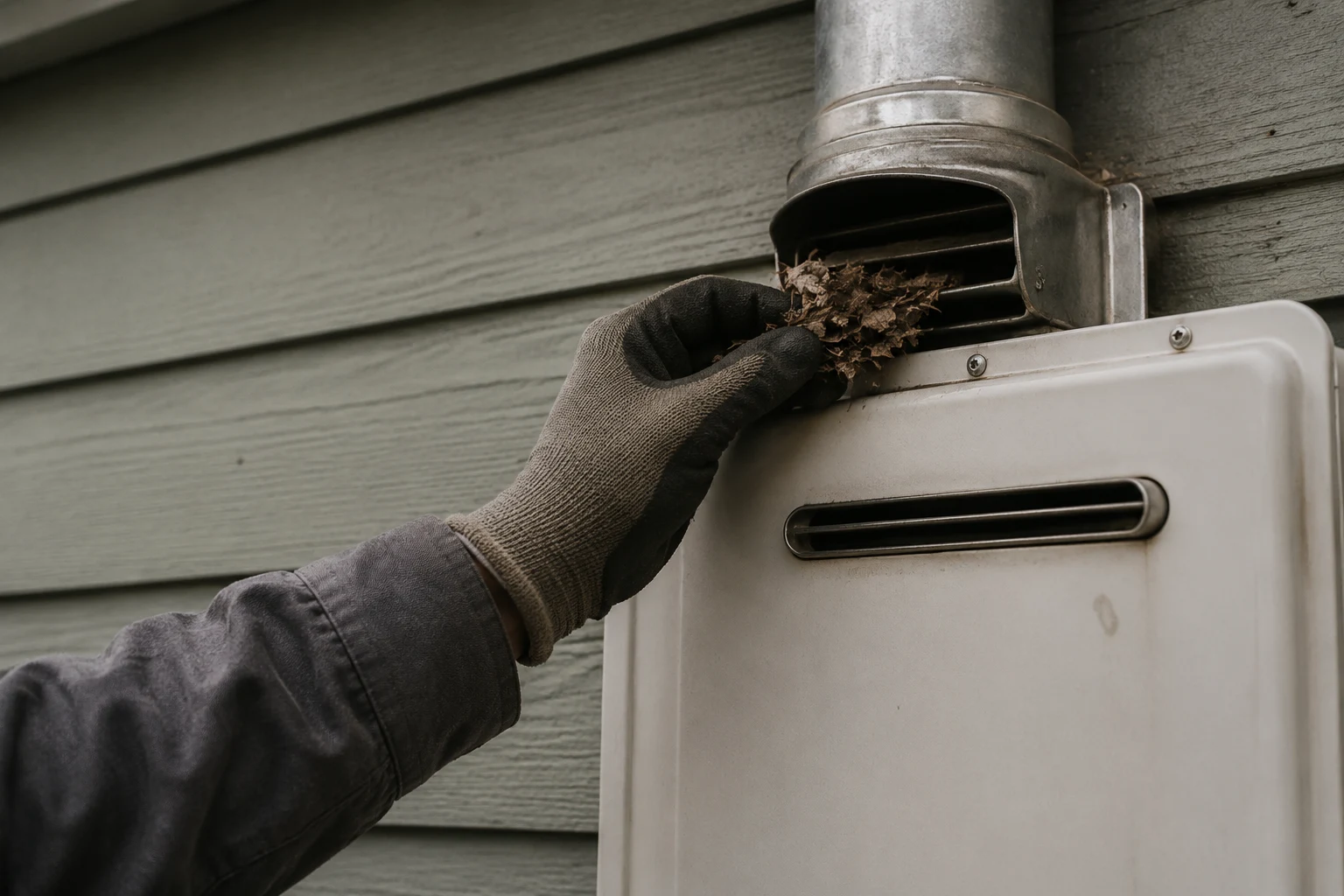
- Look at the exhaust and intake terminals outside. Are they clear of leaves, lint, nests, snow, or a planter someone parked in front of them?
- Check the bird screens and terminal caps. Lint and dust pack these solid on a heater that runs a lot.
- On a direct-vent unit, confirm the intake terminal is far enough from the exhaust so the heater is not re-breathing its own flue gas.
- Confirm the vent run is not too long. Takagi limits many models to about 50 equivalent feet, deducting roughly 5 feet for every elbow used.
- Check for a sagging or disconnected vent joint, or condensate pooling in a low spot in the run.
- Verify the altitude DIP switch matches where the heater is installed. A wrong setting makes the burner run rich for the air it actually has.
- Listen for the fan. It should spin up on a call for heat and purge after. A silent or straining fan points at the fan motor.
Which situation are you in?
Not every 102 is the same problem. Sort yourself into one of these before you spend money.
Code clears, comes back in a day or two
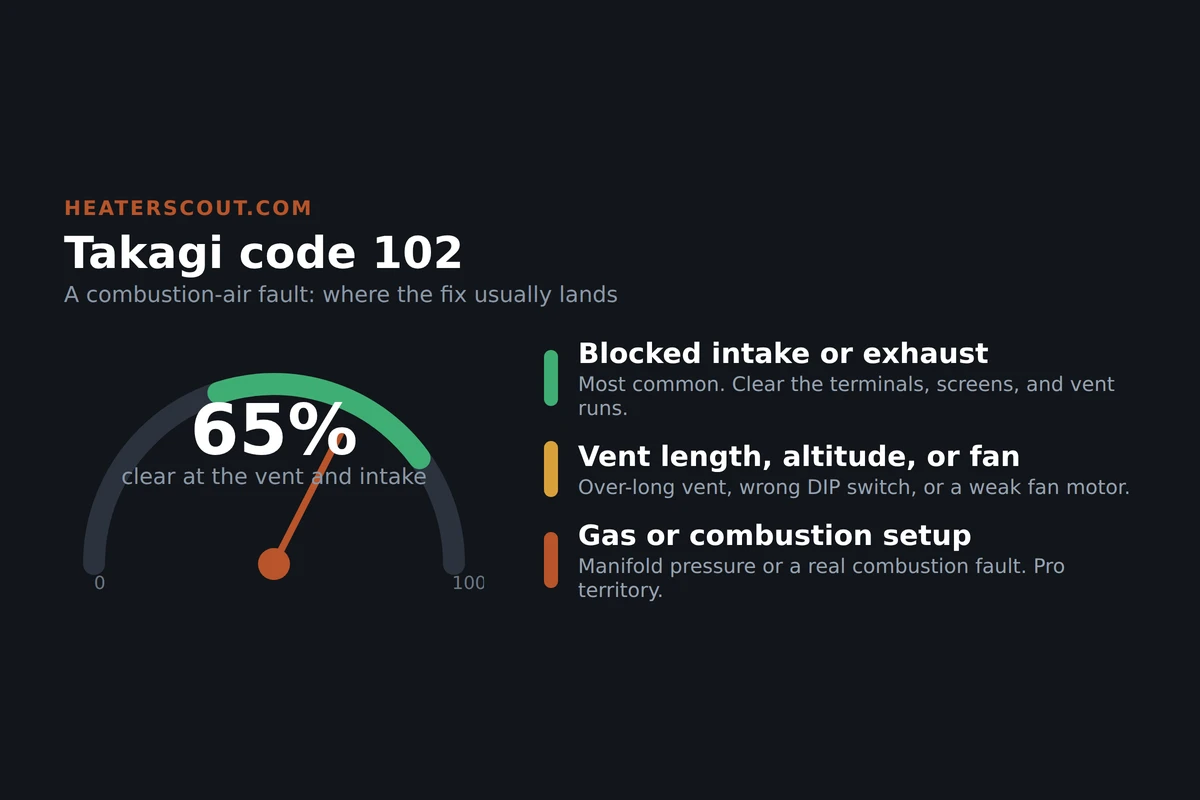
Almost always a slowly restricting intake or exhaust. A lint-packed screen, a terminal that leaves keep drifting against, or a partial nest. Clean the terminals and screens, then watch. This is the DIY-friendly path and it fixes a large share of these codes.
Code showed up after work was done
Suspect the vent design or a DIP switch. An over-long run, too many elbows, an intake and exhaust set too close, or the wrong altitude setting will all starve or unbalance combustion. This is a callback to whoever did the work, not a part you buy.
Terminals are clear and it still faults
Now the restriction is deeper, or the problem is the fan motor, the gas and manifold pressure, or a genuine combustion fault. This needs a manometer and a combustion analyzer, so it is a licensed gas tech's job, not a screwdriver fix.
Code 102 at a glance
Here is the shape of the code and its fixes in one place. Where Takagi's public documentation is silent on 102 specifically, this table says so rather than inventing a spec.
| Code family | Combustion / abnormal air supply (with 10, 99, 101) |
| Public table listing | Not printed in Takagi's general error-code tables; model specific |
| Best-documented sibling | Code 101, improper / abnormal combustion |
| Most likely cause | Blocked intake or exhaust terminal, or packed screens |
| Next likely cause | Over-long vent, too many elbows, or wrong altitude DIP switch |
| Also check | Fan motor, condensate in the vent, gas and manifold pressure |
| Reset method | No reset button; cut power at breaker ~30 sec, restore |
| Vent length limit (many models) | About 50 equivalent ft, minus ~5 ft per elbow |
| Safety class | Protective combustion shutdown, CO-related |
| Terminal cleaning / bird screen | Free to about $15 to $60 for a cap or screen |
| Fan motor (OEM) | About $120 to $250 for the part |
| Pro diagnose and repair | About $250 to $450 typical, more for a vent re-route |
| Difficulty | DIY terminal cleaning; gas tech for pressure, fan, or PCB |
Before you keep resetting it
This is a carbon monoxide safety code, not a nuisance trip. If you smell exhaust, see soot at a terminal, or a CO alarm goes off, shut the heater off, ventilate the space, and get a licensed gas tech out before you run it again. Never defeat a combustion safety switch to force the unit to keep running. The shutdown is the heater doing its job.
102 versus 101 versus 99: how the codes relate
These codes overlap because they all describe the same failure from slightly different angles. Knowing which sibling you are looking at tells you where to point the flashlight.
| Code | What it reports | Where to look first |
|---|---|---|
| 102 | Abnormal air supply / combustion (model-specific, not in the public table) | Intake and exhaust terminals, screens, vent run, then fan and gas |
| 101 | Improper / abnormal combustion (documented) | Blocked flue or chimney, downdraft, draft-inducer or fan problem |
| 99 | Imperfect combustion (older 2-digit LED units) | Same combustion-air checks as code 10, plus gas pressure and flame rod |
| 10 | Warning ahead of a 99 fault | Vent blockage, vent length, altitude DIP switch, dirt in burner and fan |
| 61 | Fan motor fault | Fan wiring, corroded or frozen connectors, fan motor voltage |
Working the fix in order
Cheap to expensive, outside to inside. Do not order a fan motor or a control board because a combustion code sounds serious. Clear the air path first, because that is where the money is not.
Kill power at the breaker before you handle anything on the unit itself, and close the gas shutoff if you are going to open the cover. Outside, pull the terminal caps and clear the intake and exhaust of every bit of lint, leaf, nest, and screen debris. On a heater that runs hard, a lint film on the intake screen alone can starve combustion enough to trip the code. Feel the vent run for a sag holding condensate, and confirm the joints are seated. Then restore power, cut it for 30 seconds to clear the latched code, and run a hot tap while you watch and listen for the fan.
When clearing the terminals does not hold
If the code survives a clean intake and a clean exhaust, stop cleaning and start measuring. The restriction is either deeper in the vent or the problem has moved to the fan and gas side.
The next suspects, in order: a vent run that was always too long or has too many elbows, which no amount of cleaning fixes and which needs a re-route; an altitude DIP switch set wrong for where the heater actually sits, which makes the burner run rich for the air it has; a fan motor that is dusty, has a corroded or frozen connector, or is simply weak, which shows up as a slow or straining spin-up; and finally the gas side, where a manifold pressure that is off or a real combustion fault will trip the code even with a perfect vent. That last group needs a manometer and a combustion analyzer, and reading CO in the flue is not a DIY measurement. This is the point where a careful homeowner hands off to a licensed gas tech.
Verify the wording against your own manual
Because 102 is model specific and not in the public tables, the single most useful thing you can do is read the maintenance sheet or service handbook for your exact model number. Two Takagi units can flash the same digits and mean slightly different things depending on the control board and firmware. The model number is on the rating plate on the unit. Match the code to that sheet, not to a generic table you found online, and you will know whether your 102 is pointing at the vent, the fan, or the gas side before you spend a dollar. If the sheet is silent on 102, that itself is a signal to treat it as the combustion-air condition it behaves like and to lean on a pro for the gas-side measurements.
Keeping 102 from coming back
A combustion-air code is a maintenance code more than a parts code. Keep the intake and exhaust terminals clear year round, because the same lint, leaves, and snow that tripped it once will do it again. Add a combustion check to the annual service: have the tech read manifold pressure, run a combustion analyzer, verify the fan, and confirm the vent is still within length and clearance limits. If the heater sits in a dusty or lint-heavy spot, a laundry room being the classic case, plan on cleaning the intake screen more than once a year. The unit will keep protecting you from bad combustion whether or not you maintain it. The maintenance just means it does that on a warm afternoon of your choosing instead of the first cold morning of the winter.
Frequently asked
What does Takagi error code 102 actually mean?
It reads as a combustion problem tied to air supply. On Takagi tankless units the family of combustion codes covers a burner that is not getting the clean intake air and free exhaust path it needs to burn correctly. The well-documented public code in this family is 101, improper or abnormal combustion, which Takagi and the repair guides describe as a blocked flue or chimney, a downdraft, or a draft and fan problem. Code 102 is the companion code that shows up on some model and firmware combinations, and here is the honest part: 102 is not printed in Takagi's general error-code tables or the common troubleshooting guides. It is model specific. Treat it as an abnormal air-supply or venting condition, verify the exact wording against the maintenance sheet for your model number, and work the combustion-air checklist first. Do not assume it means something exotic just because it is not in the public table.
Can I reset Takagi code 102 myself?
You can clear it, and clearing is worth doing once to see if it comes right back. Takagi tankless units have no dedicated reset button. Turn the unit off at the remote controller if one is fitted, then cut power at the wall or at the breaker for about 30 seconds and restore it. That power cycle drops the latched code and keeps your temperature setting. If the heater is hard-wired, use the breaker. The catch with a combustion-air code is that a reset changes nothing physical. If the intake is screened with lint or the exhaust terminal is blocked, the code returns the moment the burner tries to run and cannot get clean air. So reset once, then go look at the vent and intake. A code that returns immediately is telling you the cause is still sitting in the vent system.
Why does Takagi code 102 keep coming back?
Because the reset never fixed the airflow. The repeat offenders are all physical. A bird screen or intake terminal packed with lint, leaves, or snow. An exhaust terminal too close to the intake so the unit re-breathes its own flue gas. A vent run that is too long or has too many elbows, which Takagi limits to about 50 equivalent feet with a 5-foot deduction per elbow on many models. A DIP switch set for the wrong altitude, so the burner runs rich for the air it actually has. A fan motor that is dusty, corroded at the connector, or weak. Or a real gas and manifold pressure problem starving or flooding combustion. If you cleared the terminals and it still returns, the airflow restriction is deeper in the run or the problem is on the gas and fan side, which is a pro's call.
Is Takagi code 102 dangerous?
Treat it as a safety shutdown, not a nuisance trip. This code family is the unit protecting you from bad combustion. Incomplete combustion produces carbon monoxide, and a blocked or downdrafting flue can push that CO back toward the house instead of outside. The heater shutting down on this code is the safe outcome. The dangerous move is forcing it to run, defeating a switch, or ignoring a code that keeps returning while you smell exhaust or your CO alarm chirps. If you have any combustion smell, a sooty terminal, or a CO alarm, shut the unit off and ventilate before you do anything else. A combustion code is one of the few tankless faults where you do not experiment for long before calling a licensed gas tech.
How much does it cost to fix Takagi code 102?
It depends entirely on where the airflow is choked. If it is a lint-packed intake screen or a leaf-blocked terminal, the fix is free, just clearing and cleaning. If a bird screen or terminal cap needs replacing, that is a $15 to $60 part. A vent run that was installed too long or with too many elbows is a bigger job, several hundred dollars to re-route, because it is a labor and materials fix. A fan motor on a Takagi runs roughly $120 to $250 for the OEM part, and a pro swap usually lands in the $250 to $450 range with the trip. A diagnostic visit alone is commonly $100 to $200. Setting gas or manifold pressure needs a manometer and a combustion analyzer, so that is always a licensed tech, not a DIY line item.
Will descaling clear Takagi code 102?
No. Descaling flushes vinegar or a descaling solution through the heat exchanger to strip mineral scale off the waterways. Code 102 lives on the combustion and air side, dry, in the vent and burner path. Scale in the water side does not cause an air-supply code, and flushing it does nothing for a blocked intake, a fouled fan, or a vent that is too long. Descaling is still worth doing on schedule, because a neglected heater is usually neglected everywhere, but do not expect a flush to touch this code. The moves that clear 102 are at the intake terminal, the exhaust terminal, the vent run, the fan, and the gas side, not in the heat exchanger flush.
Do I need a licensed technician for Takagi code 102?
For part of it, yes. A careful homeowner can safely inspect and clear the intake and exhaust terminals, remove lint and debris from screens, check that nothing outside is blocking the terminals, and confirm the vent looks intact. Those checks clear a large share of these codes. The line you do not cross is the gas side. Reading manifold pressure, running a combustion analyzer, checking CO in the flue, adjusting the altitude DIP switch on some models, or diagnosing a fan motor and PCB all need a licensed gas tech with the right meters. Because this is a combustion and CO safety code, if clearing the terminals does not hold, stop and call a pro rather than chasing it yourself.