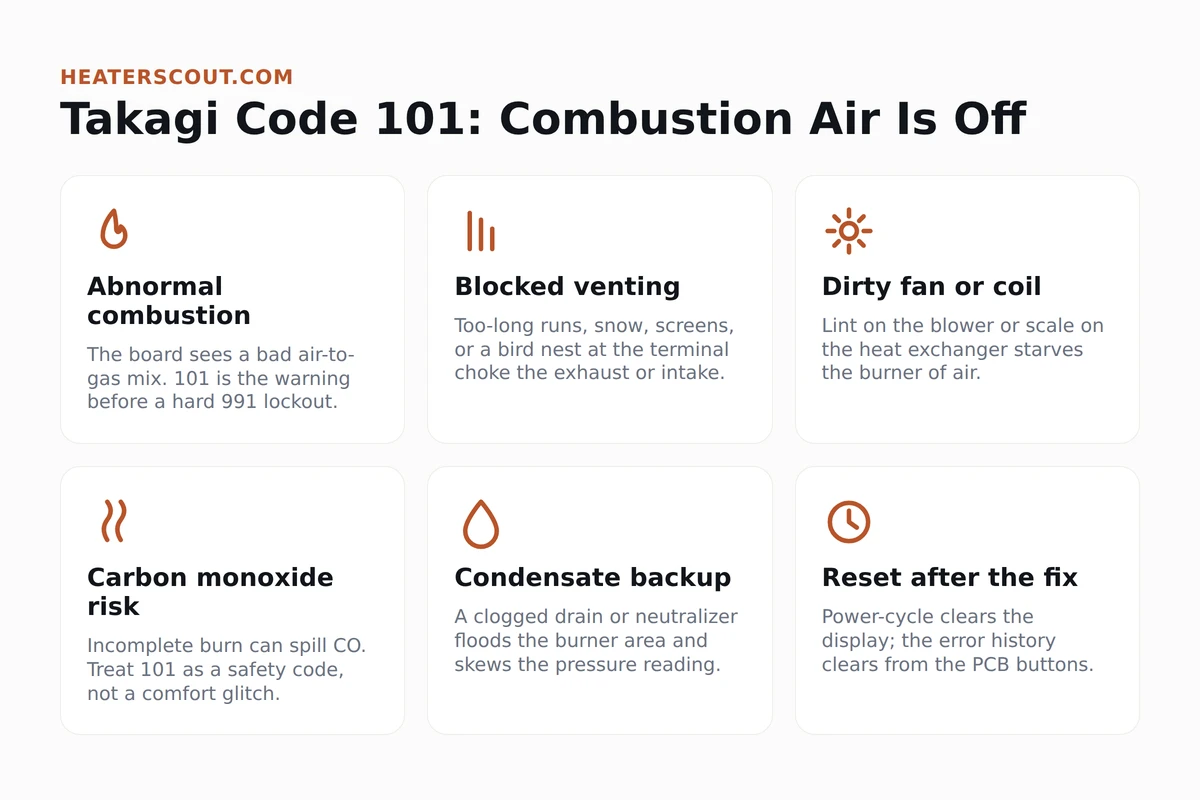
A Takagi unit throwing code 101 on a cold, snowy morning is telling you one thing: the burner cannot get a clean breath. The control board watches the air-to-gas mix during combustion, and when that mix drifts out of range it flags 101 as a warning before it hard-locks with 991. This is not a comfort hiccup like a low-flow shutdown. It is the same condition that produces carbon monoxide, so it earns your attention the first time it shows, not the fifth.
Read this before you reset
Code 101 is a combustion-air warning, and incomplete combustion is how carbon monoxide gets made. If you smell exhaust inside, see soot at the vent, or the code returns after you clear the obvious blockages, shut the unit off and get a licensed tech before running it again. A battery CO alarm near the unit is cheap insurance.
What code 101 actually reports
On Takagi condensing and non-condensing models, 101 reads as abnormal combustion, specifically an imperfect supply of combustion air or exhaust. The unit meters gas and air together and expects a predictable flame. When the exhaust cannot leave or the intake cannot pull, the flame runs rich or lean, the board sees it, and it posts 101. Think of 101 as the yellow light and 991 as the red one. 991 is the hard lockout for imperfect combustion; 101 is the board waving its arms while it still tries to run.
Because the root is airflow, the fault often tracks the weather. A vent that is a foot too long or has one elbow too many will run fine in October and start throwing 101 in January, when cold dense air and a snow-crusted terminal shrink the margin. That weather link is your first clue about where to look.
It also helps to know what 101 is not. It is not a low-flow shutdown, and it is not the ignition-failure family in the 110 and 120 range. A unit that never lights is a fuel or spark problem. A unit that lights and then flags 101 has a combustion-air problem: the flame started fine and then the board did not like the burn. If you can hear the burner fire and then see 101 appear, you are chasing air, not gas delivery. That distinction saves you from swapping igniters and gas valves that were never the issue.
Fix it in order, easiest first
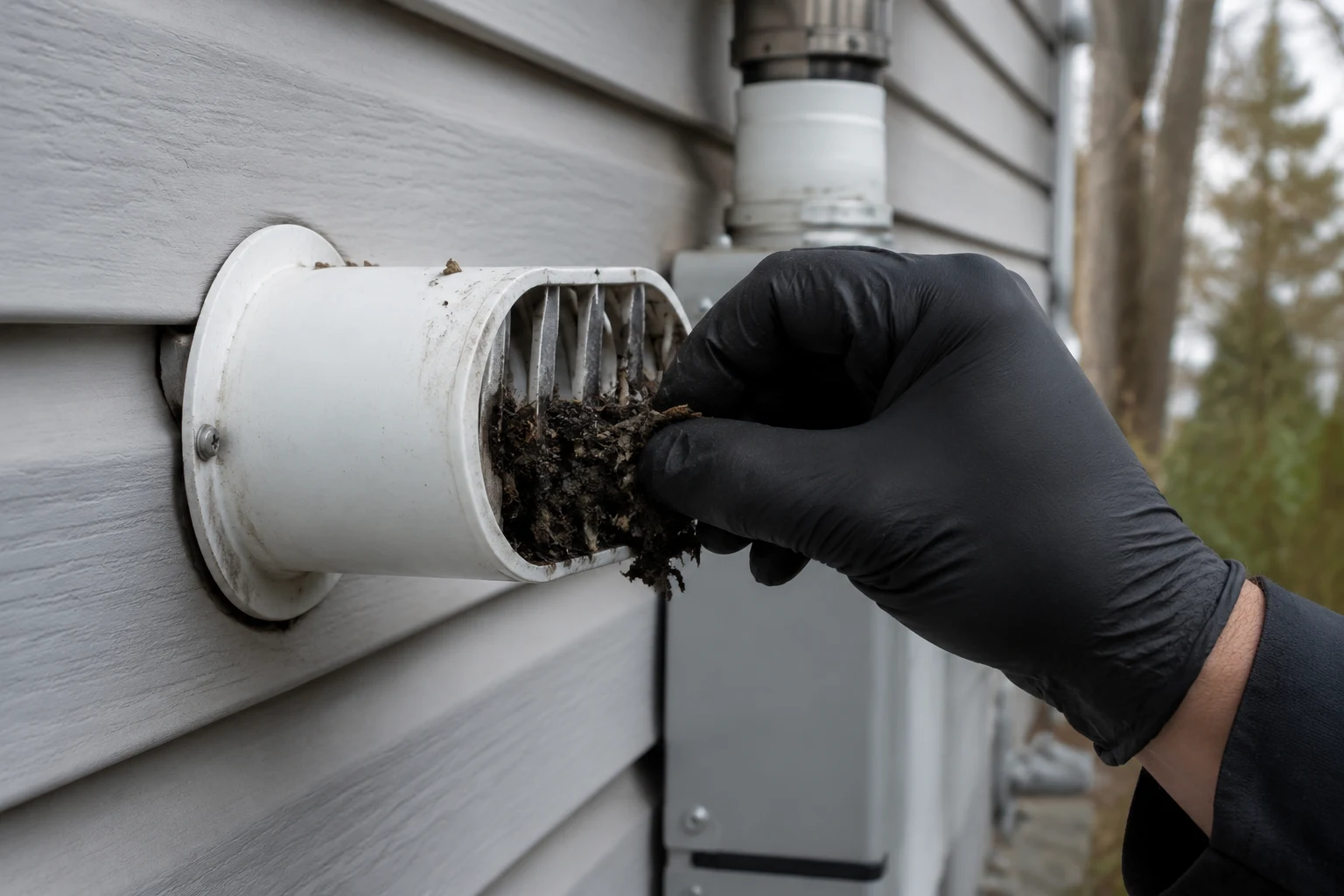
Work from the outside in. Most 101 calls that never reach a tech get solved at the vent terminal or the condensate drain, both of which you can reach without opening the unit.
Homeowner-safe vs licensed-tech work
The line is simple. Anything you can do with the gas and power off, without touching the burner, sensor wiring, or venting design, is fair game. Anything that changes how the unit combusts belongs to a pro.
| Task | Homeowner | Licensed tech | Why |
|---|---|---|---|
| Clear the vent and intake terminals | Yes | Outside the cabinet, no combustion parts touched | |
| Flush the condensate line and trap | Yes | Plumbing task, keeps burner area dry | |
| Vacuum the intake, descale the exchanger | Yes, with a kit | Restores airflow without altering the burn | |
| Clean or replace the blower fan | Yes | Fan sits in the combustion path, needs testing after | |
| Test or replace the air-pressure sensor | Yes | Reads combustion air, mis-set reading is unsafe | |
| Re-run or resize the venting | Yes | Vent length and pitch are code and CO-safety items | |
| Replace the PCB or heat exchanger | Yes | Combustion control and warranty parts |
How to clear the error history
Power-cycling drops 101 off the display, but the fault stays logged in the board. After a real repair a tech usually clears the stored history so the next 101 they see is a fresh one, not an echo. On many Takagi models you pull the front cover, find the INC and DEC buttons on the PCB, and hold both for several seconds until the red LED lights, then cycle the on/off switch. If you are not comfortable inside the cabinet with power around, leave this step to the tech. The unit runs fine either way; clearing history is for diagnosis, not for operation.
What it costs and what the parts are
| Clear vent or condensate blockage | Free, DIY, 20 to 45 min |
| Service call: clean fan and exchanger | $150 to $350 |
| Blower fan assembly | $120 to $300 part, plus labor |
| Air-pressure sensor | $40 to $120 part, plus labor |
| Condensate neutralizer refill | $25 to $60 |
| Re-run undersized or over-long venting | $400 to $1,200 |
| Control board (PCB) | $200 to $450 part, often warranty |
The spread is wide because 101 is a symptom, not a single broken part. A snow-blocked terminal costs nothing. A vent that was installed 15 feet too long costs real money to correct, and it is the reason a small share of 101 faults keep coming back no matter how many times the fan gets cleaned.
Which cause fits your situation
Look at venting first
Weather-linked 101 almost always means the vent run is marginal or the terminal is icing and recirculating exhaust. Clear the terminal, then have the run length and elbow count checked against the model spec.
Clean the fan and coil
Lint on the blower and scale in the heat exchanger build up slowly and choke airflow. A descale plus a fan cleaning restores the air margin and often clears a nagging 101 for good.
Chase the condensate
On condensing models, a flooded burner area from a clogged drain or frozen line throws the combustion reading off. Clear the trap and neutralizer before you suspect the fan or sensor.
Sensor or board
If the vent is clear, the fan is clean, and the condensate flows but 101 persists, the air-pressure sensor or the PCB is misreading combustion. That is a tech diagnosis, not a guess-and-swap.
Keeping 101 from coming back
Prevention is mostly about protecting the air path. Keep the vent terminal clear year-round, and after a snowstorm make it part of your walkaround. Give the intake room; do not stack storage against an indoor unit or let a new deck or fence box in an outdoor one. Descale annually if your water is hard, more often on well water, and have the fan and burner cleaned every year or two. On condensing models, keep the condensate line and neutralizer flowing, and heat-tape any line that runs through freezing space. Do those things and 101 mostly stays a stranger.
The one prevention step people skip is honest venting. If the unit fired fine for a year and then started throwing 101 every cold snap, no amount of cleaning fixes a run that was always a little too long. Getting the venting right is the difference between a code you clear once and a code you fight every winter.
Frequently asked
Can I reset Takagi error code 101 myself?
You can power-cycle the unit, and that clears the code from the display. But 101 is a combustion warning, so clearing it without finding the cause just delays a hard 991 lockout. Fix the airflow problem first (vent terminal, intake, condensate drain), then reset. If the code returns within a cycle or two, stop and call a licensed tech.
Is Takagi code 101 dangerous?
Yes, treat it as a safety code. It means the burner is not getting a clean air-to-gas mix, which is the exact condition that produces carbon monoxide. A little CO from incomplete combustion is odorless. If you smell exhaust, see soot, or the code keeps coming back, shut the unit off and get it inspected before you run it again.
Will descaling clear code 101?
Sometimes, if scale in the heat exchanger was choking airflow. Descaling with white vinegar or a pump-kit flush is worth doing on any unit past a year without service. But scale is only one of several causes. If the vent, intake, or fan is the real problem, a flush will not touch it.
Why does Takagi code 101 keep coming back?
The most common repeat cause is a vent run that is too long or has too many elbows for the model. It works in mild weather and fails when it is cold, snowy, or windy at the terminal. Other repeat causes are a fan slowly clogging with lint and a condensate drain that keeps backing up. If it recurs after you clear the obvious blockages, the venting or the fan usually needs a pro.
How much does it cost to fix Takagi 101?
If it is a blocked terminal or a clogged condensate drain, it costs nothing but your time. A service call to clean the fan and heat exchanger runs about 150 to 350 dollars. A blower fan assembly is roughly 120 to 300 dollars in parts plus labor. Air-pressure sensor is 40 to 120 dollars in parts. Re-running undersized or over-long venting is the big one, 400 to 1,200 dollars depending on the run.
Does code 101 mean I need a new water heater?
Almost never. 101 is an airflow and combustion condition, not a dead unit. The heat exchanger, fan, sensor, and board are all serviceable parts. The only time replacement enters the picture is a cracked heat exchanger, and even that is a warranty part on many Takagi models. Fix the air path before anyone talks you into a new heater.
What is the difference between Takagi code 101 and 991?
They describe the same combustion problem at two stages. 101 is the early warning: the board detected an abnormal air-to-gas condition but is still trying to run. 991 is the hard lockout after imperfect combustion, where the unit stops firing. If you keep clearing 101 without fixing the cause, you are driving the unit toward a 991 shutdown.