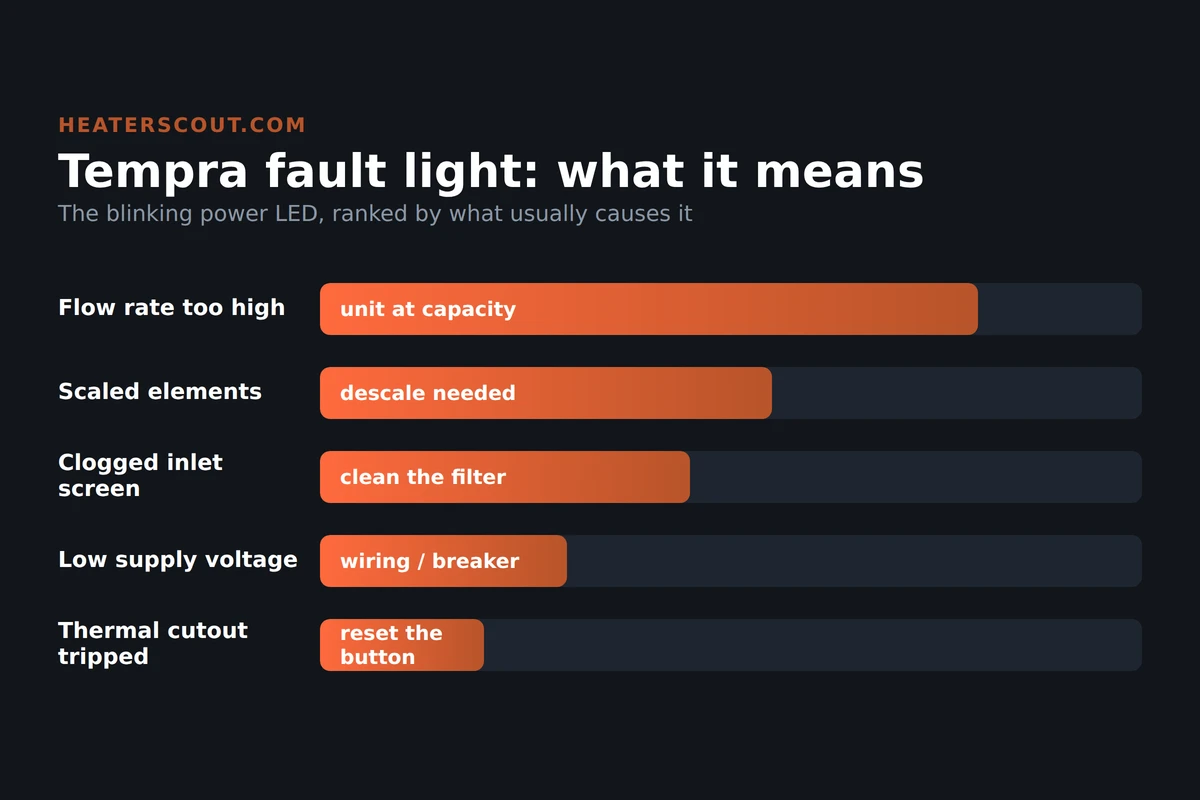
A blinking power light on a Stiebel Eltron Tempra is the one people panic about, and it is the one that usually is not a fault at all. On the classic Tempra and the Tempra Trend, that light on the front cover is the power status LED, and when it flashes the manual is blunt about the meaning: the water flow rate is too high for the unit to fully heat. The heater is running, it just cannot hold your setpoint at that flow. Stiebel Eltron's own fix is to reduce the flow until the light stops blinking. That is a very different thing from a sensor failure or a tripped safety, both of which look and behave nothing like a steady blink under load.
Read the light correctly
Steady power light means the Tempra is heating normally. A flashing power light means it cannot hold temperature at the current flow. No light means no power reaching the unit, so check the breakers first. Reversing those in your head sends you chasing the wrong problem.
Key takeaways
- On the classic Tempra and Trend, a blinking power LED is a capacity warning, not a hardware fault.
- The manual's own remedy is: reduce water flow until the power light stops blinking.
- Scale on the elements and a clogged inlet screen make the unit fall behind and flash sooner.
- The Tempra Plus adds a digital display with numbered error codes for real sensor faults.
- The red safety thermal cutout is a separate physical reset button on each copper canister.
- Colder winter inlet water cuts capacity, so the light flashes in winter on units that were fine all summer.
Why the light blinks instead of throwing a code
An electric tankless heater has a hard ceiling that a gas unit hides better. The Tempra heats water with electric elements rated at a fixed kilowatt output, and that number sets the absolute limit on how much water it can raise to a given temperature per minute. There is no tank of stored hot water to lean on. Every gallon has to be heated in the seconds it takes to pass through the copper canisters. When you draw more flow than the elements can heat to your setpoint, the water simply comes out cooler than the dial promises, and the power LED flashes to tell you the unit is maxed out.
That is why the classic Tempra flashes a light rather than posting a numeric fault. Nothing broke. The unit is doing exactly what it was built to do, it just ran out of headroom. The blink is a modulation warning, the same way a car's tachometer redlines when you ask the engine for more than it has. This matters because the wrong instinct, resetting or replacing parts, does nothing for a capacity limit. The right move is to reduce demand or restore the capacity the unit lost to scale.
What actually makes it flash
The list is short and physical. Flow that exceeds the unit's heating capacity is the headline cause, and it is worse the colder the incoming water is. Then come the things that quietly shrink capacity: scale coating the elements so they transfer less heat, and a clogged inlet filter screen or aerator starving flow and confusing the sensing. Low supply voltage undercuts the wattage the elements can produce, so a unit fed 208 volts on a shared or sagging circuit heats less than one on a solid 240. Last and least common, a tripped safety thermal cutout kills power to an element entirely.
| Blinking power LED means | Flow rate too high; unit cannot hold setpoint |
| Steady power LED means | Normal; powered and heating within capacity |
| No light means | No power reaching the unit; check breakers |
| Manual's own remedy | Reduce flow until the power light stops blinking |
| Capacity killers | Scaled elements, clogged inlet screen, low voltage |
| Tempra Plus Error 2 | Inlet temperature sensor failure |
| Tempra Plus Error 3 | Outlet temperature sensor failure or loose cable |
| Other Plus codes | Contact Stiebel Eltron technical support |
| Safety thermal cutout | Red reset button on top of each copper canister |
| Cutout reset | Kill all breakers, open cover, press button until it clicks |
| Operating voltage | 208 to 240 V across multiple double-pole breakers |
| Owner-fixable | Reduce flow, clean screen, descale, reset cutout |
| Call a pro for | Voltage tests, sensor codes, repeat cutout trips |
Work the flow and scale first
Because the blink is almost always about capacity, start where capacity is lost. Reduce the flow at the fixture and watch the light. If it goes steady, you have confirmed the cause is demand, and the answer is either running fewer fixtures at once or accepting the unit was sized light for your climate. If the light still flashes at modest flow, the unit has lost capacity it used to have, and that points at scale or a restricted inlet.
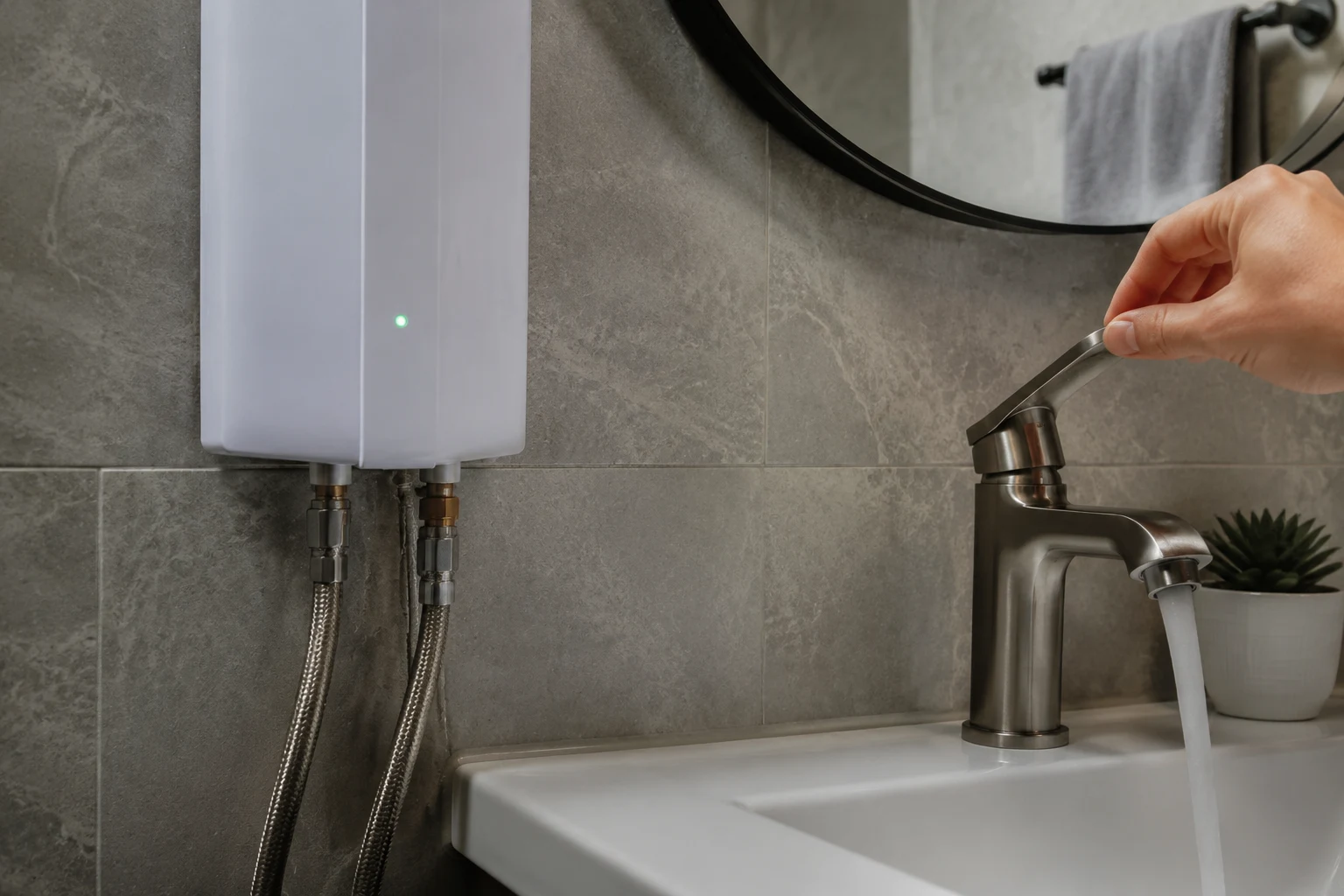
Descaling is the highest-value maintenance on an electric Tempra in hard water. Scale insulates the elements, so they dump less heat into the water for the same power, and the unit falls behind exactly where it used to keep up. Flushing a descaling solution through the heat exchanger strips that layer and restores the original output. While you are at it, clean the inlet filter screen at the unit and the aerators and shower heads on the fixtures, because a partially blocked inlet both starves flow and skews the flow sensor the control board relies on. These three jobs, descale, inlet screen, aerators, recover most of the capacity a Tempra loses over years of service.
When the light is really a sensor code or a tripped cutout
Two other signals get lumped in as the fault light and should not be. On a Tempra Plus, the digital display can show a numbered error with an error-code symbol. Those are real sensor or board faults, not flow warnings. Error 2 is an inlet temperature sensor failure and Error 3 is an outlet temperature sensor failure, where you first confirm the sensor cable is seated on the main control board. Most other Plus codes tell you to call Stiebel Eltron technical support, because they involve the control board or internal parts that are not owner-serviceable. The classic Tempra and the Trend have no numeric display, so if you have a code on screen you own a Plus.
The other one is the safety thermal cutout, a small red button on top of each copper heating canister that trips when an element sees water that is too hot. That is a mechanical over-temperature safety, unrelated to the power LED. To reset it, turn off every circuit breaker feeding the heater, open the front cover, find the buttons on top of the vessels, and press each until it clicks. The manual and Stiebel Eltron are emphatic on the order: power off at the breakers first, always, because you are reaching next to line-voltage terminals. A canister that needs repeated resets has an underlying problem and belongs to a technician, not another button press.
Keeping the light steady
Most Tempra light complaints trace back to sizing and scale, and both are manageable. Size honestly for your coldest inlet, not your summer inlet, because the flashing shows up in January when the water is 40 degrees and the unit has to add 80 to reach 120. If the model on the wall was chosen for a mild expectation, it will always flash under a real winter shower, and no repair changes that. Where the unit is sized right, keep it that way by descaling on schedule and cleaning the inlet screen so it does not quietly lose the headroom it started with. Do those, and the power LED sits steady the way it should, which is the whole point of watching it.
Frequently asked
Why is the power light flashing on my Stiebel Eltron Tempra?
On a classic Tempra and the Tempra Trend, a blinking power light on the front cover is not a broken part. It is the heater telling you it cannot fully heat the water at the flow rate you are drawing. The Tempra modulates its heating elements to hold your setpoint, and when you open too many taps or run a high-flow fixture, the demand outruns the unit's kilowatt capacity. The temperature sags below target, so the power LED flashes as a warning. Stiebel Eltron's own troubleshooting table lists the cause as water flow rate too high and the fix as reduce the flow until the power light stops blinking. Turn down the tap or the shower, or run one fixture at a time, and the light goes steady again. If it flashes even at low flow, the cause has shifted to scale, a clogged inlet screen, or low voltage, which the rest of this page covers.
Is a steady light bad, or is a flashing light bad on the Tempra?
It is the opposite of what people assume. A steady power light means the Tempra is powered and heating normally, holding your setpoint at the current flow. That is the light you want. A flashing or blinking power light is the alert state: the unit is running but cannot reach the target temperature at that flow, so the water comes out cooler than the dial says. No light at all means no power reaching the unit, so check the breakers first. So steady is good, flashing is the warning, dark means dead. On a Tempra Plus with the digital display you also get a separate error-code symbol on the screen for actual sensor faults, which is a different signal from the front-cover power LED.
How do I reset the fault light on a Stiebel Eltron Tempra?
There is no reset button that clears the blinking power LED, because it is not a latched fault. It tracks live conditions, so it stops on its own the moment the unit can hold temperature again. Reduce the flow, clean the inlet filter screen, or descale the elements, and the light goes steady. The thing people call the Tempra reset is a different part: the red safety thermal cutout buttons on top of each copper heating canister. Those trip on over-temperature and must be reset by hand. To do it safely, turn off every circuit breaker feeding the heater, open the front cover, find the small buttons on top of the copper vessels, and press each one until you feel or hear it click. Never touch those buttons with power on. If a cutout keeps tripping after a reset, stop resetting and get it looked at, because something is overheating the element.
Will descaling stop the Tempra power light from flashing?
Often, yes, if scale is the reason the unit fell behind. Mineral scale coats the heating elements and insulates them, so they transfer less heat into the water for the same power draw. A Tempra that used to hold 120 degrees at 2 gallons per minute may drop to 110 after a few years of hard water, and that shortfall is exactly what makes the power light flash. Flushing the elements with a descaling solution strips the mineral layer and restores the heat transfer, which is why annual descaling matters more on electric tankless units in hard-water areas than most owners expect. That said, descaling only helps if scale is the cause. If the light flashes because you are simply drawing more hot water than the unit's kilowatt rating can heat, no amount of descaling changes the physics. In that case the unit is undersized for the demand.
What do the numbered error codes on a Tempra Plus mean?
Only the Tempra Plus, with its digital LCD, reports numbered errors; the classic Tempra and the Trend do not have a code display, just the power LED. On the Plus, an error-code symbol appears on the screen alongside a number. Per Stiebel Eltron's manual, Error 2 is an inlet temperature sensor failure and Error 3 is an outlet temperature sensor failure, where you first confirm the outlet sensor cable is plugged into the main control board. Several other codes simply instruct you to contact Stiebel Eltron technical support, because they point at the control board or internal sensors that are not owner-serviceable. If you see a numbered code rather than a blinking power light, you are dealing with a sensor or board issue, not a flow or capacity problem, and the two have completely different fixes.
Why does the Tempra light flash worse in winter?
Because incoming water is colder, and that is the single biggest factor in an electric tankless unit's real-world output. The Tempra has to raise the water from whatever temperature it arrives at up to your setpoint. In summer the inlet might be 65 or 70 degrees, so the unit only has to add 50 degrees. In January that same inlet can be 40 degrees, so it now has to add 80 degrees to hit 120, and its maximum flow at full temperature drops sharply. The kilowatts did not change, but the work per gallon did. So a Tempra that never flashed all summer starts blinking on cold mornings when you run the shower. It is the same capacity limit, exposed by colder water. The fix is the same too: lower the flow, or accept that a bigger model was needed for that climate and that fixture count.
Do I need an electrician for the Tempra fault light, or can I fix it myself?
It depends which light and which cause. Reducing flow, cleaning the inlet filter screen, cleaning faucet aerators and shower heads, and descaling the elements are all owner-level jobs that need no electrician. Resetting the safety thermal cutout is also doable if you strictly kill all breakers first and only then open the cover. Where you stop is anything electrical inside the unit. Measuring supply voltage at the terminal block, chasing a sensor error on a Tempra Plus, or a thermal cutout that keeps tripping all mean line voltage and heating elements, which is a licensed electrician's territory. The Tempra runs on 208 to 240 volts across multiple double-pole breakers, so the inside is not a place to probe casually. If clearing flow and scale does not settle the light, that is the line to call a pro.