A State tank that quits on you at 6 a.m. feels like a mystery until you notice the heater is already telling you what is wrong. On the gas models a small status light on the control valve is blinking a code, and on the electric models a single red button behind a panel explains most dead units. Because State is part of the A. O. Smith family, that gas valve and its flash codes behave like the A. O. Smith and American units, which is handy when you are hunting for answers. The job here is sorting the handful of things a homeowner can safely check from the two or three failures where the right move is to stop and call a licensed tech.
No hot water: read the light, then the reset
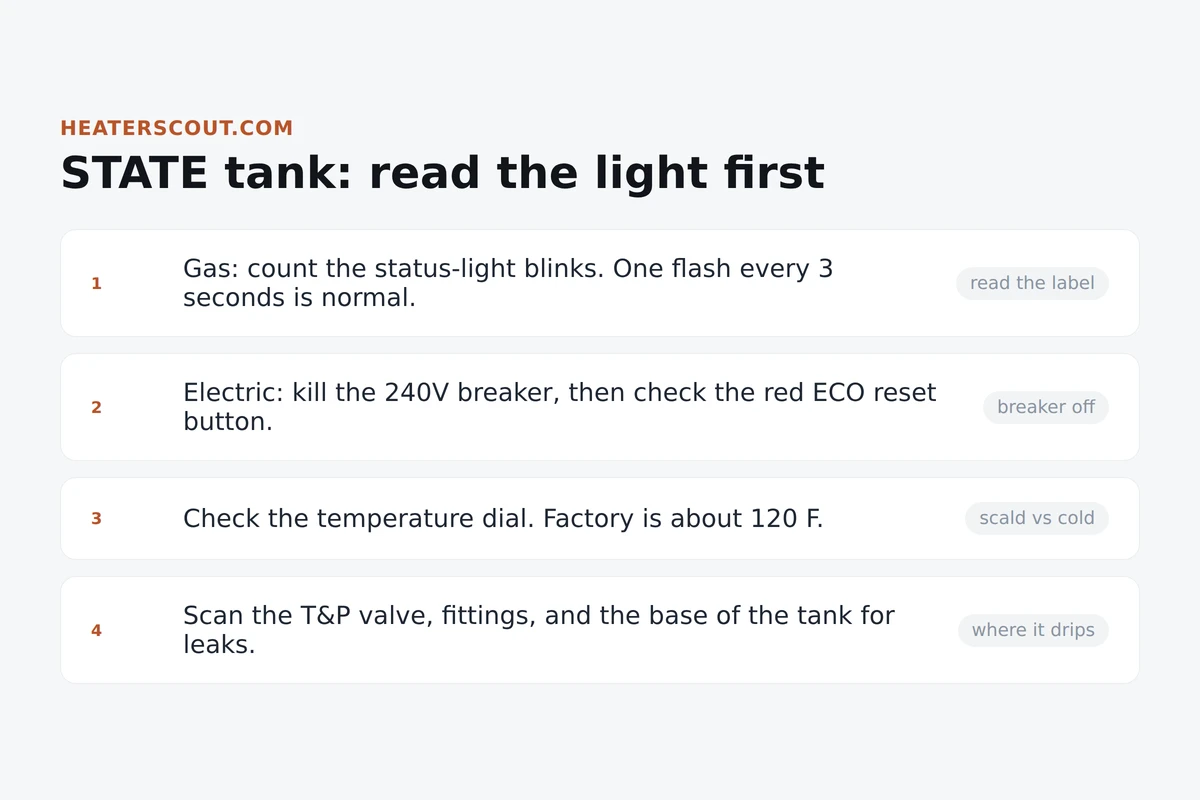
No hot water is the call that starts most of these, and the first split is by fuel type. On a gas State heater, look at the status light on the gas control valve down at the base of the tank. One flash roughly every three seconds is the heater telling you it is fine, pilot lit and valve healthy. A repeating pattern of two or more flashes is a fault code. Two flashes means not enough power is reaching the control, which almost always traces back to a weak or dirty pilot and a thermopile that cannot hold voltage. Four flashes is a high-temperature shutdown, the high-limit tripped because the water overheated. Six flashes is a soft lockout, either failed ignition after a few tries or a flame that was lit and then lost. No blink at all means the pilot is out or there is not enough power to hold it. Match what you see to the label on the front of your heater, because State and its A. O. Smith siblings print the exact map there and it can shift a little by model.
On an electric State unit with no hot water, the usual culprit is the ECO, the red high-temperature reset button on the upper thermostat. Before you go near it, kill the breaker. The panel you are opening sits on 240 volts. With the power off, fold back the insulation, press the red button until it clicks, and put everything back before restoring power. If there was no click, the ECO was never tripped and the problem is elsewhere, often a burned-out element. If it clicks and holds, you are done. If it trips again within a day, the water is genuinely overheating and you have a failed thermostat or an element shorted to the tank, not a nuisance trip. That is where you stop resetting and get it diagnosed.
ECO (Emergency Cut-Off, the high-limit)
A one-shot safety switch that cuts the heat when tank water climbs past a safe limit. On electric State units it is the red reset button on the upper thermostat; on gas units the same job surfaces as a four-flash high-temperature shutdown. It exists to stop a runaway from turning the tank into a pressure vessel. Because it only trips when the water really did overheat, a repeat trip is a symptom of another failure, never something to keep resetting.
Does any of this apply to a State tankless or heat-pump hybrid unit?
No, not the flash codes. State also sells tankless and heat-pump hybrid heaters, and those use different controls and numbered error codes shown on a display, read a different way than a tank's status light. The temperature, leak, and smell notes carry over, but this hub is about residential storage tanks, gas and electric. If you have a tankless or a hybrid, use its own display code and manual.
The gas status-light flash codes
Here is the flash map for the State gas control valve, the same family behavior you will see on A. O. Smith and American tanks. Read the flash count, not the LED color, because the color varies by valve maker and model. Then confirm the meaning against the label on the front of your own heater before you act.
| Flash pattern | What it means | What to do |
|---|---|---|
| 1 flash / 3 sec | Normal. Pilot is lit and the gas valve is working. | Nothing. This is the healthy state. |
| 2 flashes | Not enough power to the control, usually a weak or dirty pilot and low thermopile voltage. | Relight the pilot per the label. Clean the pilot; if it still reads low, replace the thermopile. |
| 4 flashes | High-temperature shutdown. The high-limit (ECO) tripped because the water overheated. | Call a pro. Do not keep relighting a heater that overheated. |
| 6 flashes | Soft lockout. 6-then-1 is failed ignition after retries; 6-then-3 is a flame that was lost. | Try one relight per the label. A repeat six-flash is a call-a-pro fault. |
| No blink | Pilot is not lit, or there is not enough power to keep it lit. | Relight the pilot per the label. If it will not hold, suspect a dirty pilot or a bad thermopile. |
| Steady, no flashing | Controller or power fault on the valve. | Cycle power once. If it stays solid or dead, the gas control valve needs service. |
Not enough hot water, or it runs out fast
This is a different problem from no hot water, and the difference points at the cause. If you get hot water but it turns lukewarm halfway through a shower on an electric tank, the classic reason is a dead lower heating element. The upper element heats the top of the tank for the first few gallons, then the lower element carries the rest, so when the lower one fails you get a short burst of hot followed by cold. On a gas unit that same short-supply feeling usually comes from a low temperature setting, a partly clogged burner, or a thick layer of sediment insulating the flame from the water. Check the dial first, it costs nothing.
Sediment is the quiet thief. Years of mineral scale settle on the tank floor and steal usable volume and burner efficiency, so a 40 gallon State tank starts acting like a 30. A yearly flush is both the fix and the prevention, though once the scale has cooked hard on an old tank the capacity loss can be permanent.
Pilot and ignition: relight it right
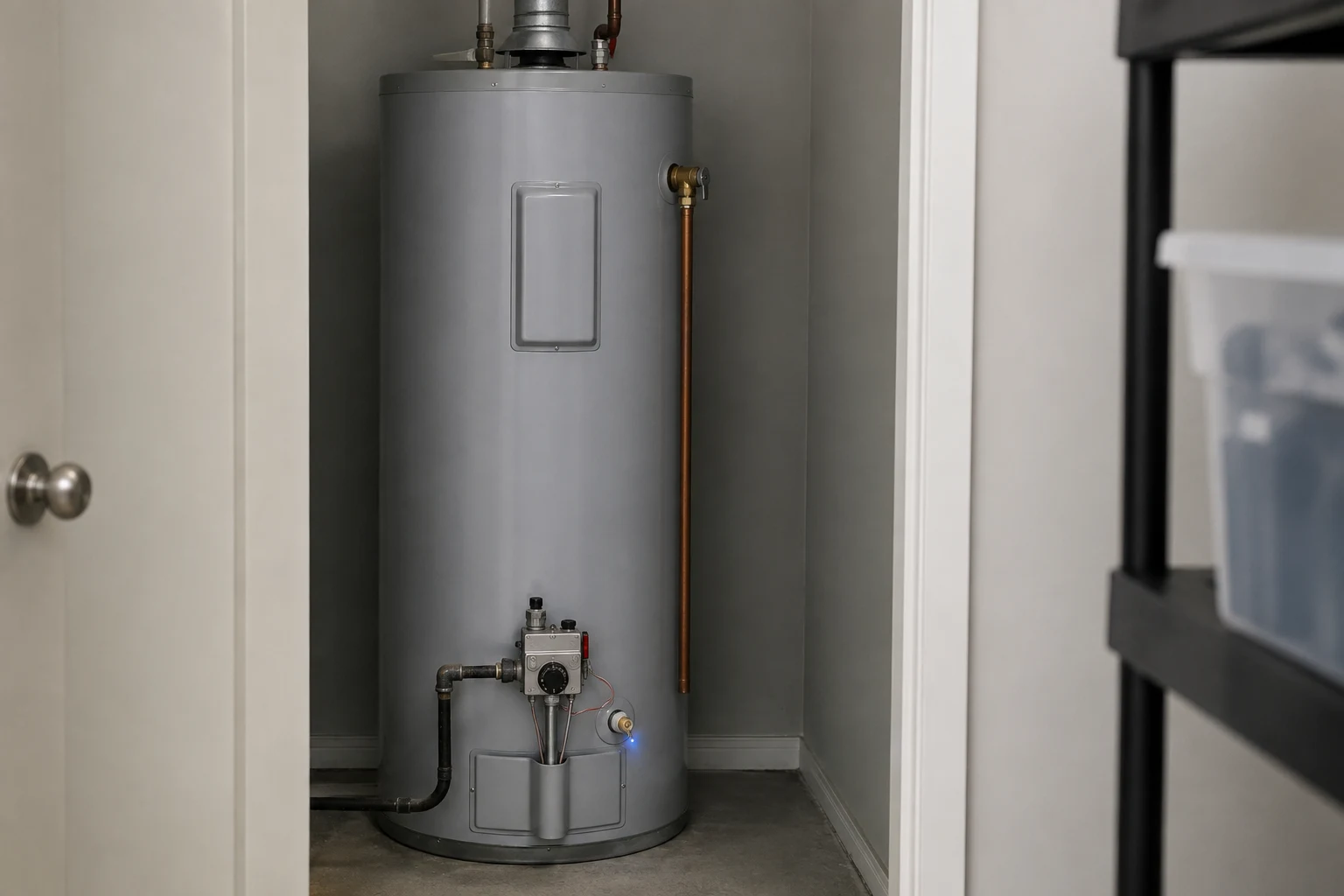
A two-flash code, a no-blink light, or a pilot you can see is out all point to the same homeowner job: relight the pilot the way the label describes. Before anything, trust your nose. If you smell gas near the heater, do not light a match or touch a light switch, leave the area and call the gas utility from somewhere else. When there is no gas smell, the sequence is to turn the gas knob to OFF and wait five full minutes so any gas clears, then turn it to PILOT, hold the knob down, and light the pilot. Keep holding for about thirty seconds after it catches so the thermopile warms up, then release slowly. If the pilot dies the moment you let go, the thermopile is too weak to hold the valve open. A healthy one puts out roughly 400 to 500 millivolts under load; down below about 400 it cannot hold the solenoid and the fix is a new thermopile or a good pilot cleaning.
The stop-and-call-a-pro line
Plenty of this is homeowner work: relighting a pilot, resetting an ECO once, turning the dial down from scalding, flushing sediment, swapping an anode rod. The line worth respecting is where a fault keeps coming back or where the failure is the tank itself. A four-flash high-temperature shutdown or an electric ECO that trips a second time both mean the water is genuinely overheating, and chasing that with repeated resets is how a safety device gets worn out while a real hazard gets ignored. A six-flash lockout that will not clear, a steady no-flash controller fault, and any smell of gas are hard stops. So is water seeping from the body of the tank. None of those are dial-and-reset problems.
If you smell gas near the heater, stop. Do not light the pilot, flip a switch, or touch anything electrical. Leave the area and call your gas utility from somewhere else. And treat a repeat four-flash high-limit, a repeat electric ECO trip, or a six-flash lockout that will not clear as a stop-and-call-a-pro fault, not a reset-it-again fault. Those mean the water is really overheating or the combustion side has failed, and pressing reset one more time does not fix either one.
Everything above that line is a reasonable afternoon for a careful homeowner with the breaker off and the manual open. Everything below it is where a licensed plumber or gas tech earns the call, because the failure mode is a burn, a flood, or a combustion problem. When in doubt on a gas unit, the label on the front of your specific State heater is the tie-breaker, and the flash count printed there beats any generic chart.
Frequently asked
Are State and A. O. Smith the same, and do they share flash codes?
Yes on the family, mostly yes on the codes. State Industries is a subsidiary of A. O. Smith Corporation, the same parent that owns the American and Reliance brands, and it shows up that way in A. O. Smith's own SEC filings. In practice that means State residential tanks use the same electronic gas control valves as the A. O. Smith and American units, so the status-light flash patterns read the same way: one flash every three seconds is normal, and a repeating count of two or more is a fault. What you should not do is trust a flash-count chart off the internet as gospel for your exact heater. The valve and the front label on your specific model spell out the code map, and there can be small differences by year and valve revision. Use the family behavior to know what you are looking at, then confirm the meaning on your own label before you act on it.
Why does my State gas water heater have no hot water and a blinking status light?
Count the blinks, because that little light on the gas control valve at the base of the tank is telling you what it sees. A single flash about every three seconds is the good news, it means the pilot is lit and the valve is working. Trouble is a repeating pattern of more flashes. Two flashes points at not enough power reaching the control, which usually traces back to a weak or dirty pilot and a thermopile that cannot hold voltage. Four flashes is a high-temperature shutdown, meaning the water got too hot and the high-limit tripped. Six flashes is a soft lockout after failed ignition or a lost flame. No blink at all means the pilot is out or there is not enough power to keep it lit. Relighting the pilot per the label on the front of your heater clears many two-flash and no-blink cases. A repeat four-flash or six-flash is a call-a-pro fault, not something to keep relighting.
Where is the reset button on a State electric water heater, and how do I use it?
It is the red button on the upper thermostat, called the ECO or high-temperature cutoff, tucked behind the upper access panel with the insulation folded back. The rule that outranks its location: turn the breaker off before you open anything. Those terminals sit on 240 volts. With the power off, fold back the insulation, press the red button firmly until you feel or hear it click, then reassemble before you restore power. If you press it and there is no click, the ECO was never tripped, so the dead heater is some other fault, often a burned-out element. If it clicks and resets but trips again within a day, the water is genuinely overheating, usually a thermostat set too high, a failed thermostat, or an element shorted to the tank. Do not keep resetting a switch that keeps tripping. Leave it off and get the cause found.
What temperature should I set my State water heater to?
Set it to 120 degrees Fahrenheit unless you have a specific reason not to. That is the Department of Energy and EPA number, and it is where most State tanks ship. It is hot enough for showers and dishes and low enough that a hand under a running tap does not scald on contact. The dial goes higher, and on many units the marks past HOT climb toward 130, 140, and 150 degrees, but every notch above 120 shortens the time it takes to burn skin. Water at 140 can cause a third-degree burn in about five seconds, which is a real hazard with young kids or older adults in the house. If your water comes out scalding, check the setting before you assume a fault. On a gas unit the dial is on the control valve and each mark is roughly a ten degree step. On an electric unit there are two thermostats behind the upper and lower panels, and both have to be set to the same point with the breaker off. Water hotter than the dial says, or that will not turn down, is a failing thermostat rather than a setting problem.
My State water heater is leaking. Is it dangerous, and can I fix it?
Where it leaks decides everything. A little water dripping from the temperature and pressure relief valve during a heating cycle can be normal thermal expansion, but a T&P valve that drips steadily or runs is telling you the pressure is too high or the valve is worn, and that matters because the T&P is the tank's last-line defense against rupture. Never plug or cap it. Replace it, and if a new valve still weeps, the house likely needs a thermal expansion tank. A leak at a threaded fitting or a union up top can often be tightened or resealed. The one leak you cannot fix is water weeping from the body or the base of the tank itself. That means the steel has corroded through, no patch holds, and the answer is replacement.
Why does my State hot water smell like rotten eggs, and why is the tank rumbling?
Two different problems, both common. The rotten-egg smell is hydrogen sulfide gas, produced when sulfate-reducing bacteria in the water react with the magnesium anode rod inside the tank. The anode is a sacrificial rod that corrodes on purpose to protect the steel, and magnesium happens to feed the smell. The usual fixes are swapping the magnesium anode for an aluminum-zinc or a powered anode, and disinfecting the tank with a chlorine flush. If the smell is in the cold water too, it is coming in with your supply and it is a water-treatment issue, not a heater fault. The rumbling or popping is a separate thing: sediment settled on the tank floor, with water trapped underneath flashing to steam as the burner fires. The fix is to drain and flush the tank. On an old unit that has never been flushed, heavy sediment also insulates the burner and hastens the tank's failure, so it is worth clearing.
How do I know when a State water heater needs replacing instead of repairing?
Age plus the type of failure. A residential tank typically lasts 8 to 12 years, with electric units trending toward the high end and gas toward the low end, and past that window the math tilts toward replacement. The clearest replace-it sign is water weeping from the body or base of the tank, which means the steel has rusted through and cannot be sealed. Rusty hot water that stays rusty after a full flush, an anode rod eaten down to its core wire, and heavy sediment that keeps causing rumble and overheating all point the same way. Repairs make sense on a younger tank: a bad thermostat, a single shorted element, a worn T&P valve, a weak thermopile, or a pilot that will not stay lit are all normal parts jobs with years of life left. The tougher call is a repeatedly tripping ECO or a four-flash high-limit on a ten year old tank, where the repair money is often better spent on a new heater.