The roof is baking in full sun, the collector is too hot to touch, and the shower still runs cold. That gap between a hot panel and a cold tank is the signature complaint on a residential solar water heater, and nine times out of ten it is not the collector that failed. It is the part that decides when to move heat off the roof: a temperature sensor, the differential controller that reads it, or the pump they command. This page walks the triage in the order a solar tech would, covers both pumped and passive systems, and marks the line where a homeowner check ends and a licensed pro starts, because solar water gets hot enough to scald and the glycol loop runs under pressure.
Key takeaways
- A hot collector and a cold tank almost never means the panel failed. Suspect the sensor, controller, or pump that move heat off the roof.
- A pumped (active) system fails differently than a passive thermosiphon one. Know which you have before you start swapping parts.
- Glycol in a closed loop degrades in three to five years. Old glycol loses both freeze protection and heat transfer.
- A solar tank can hit 160 F, so a working mixing valve is a scald-safety item, not an upgrade.
- Anything pressurized, on the roof, or involving glycol is a pro job. Visual and breaker checks are yours.
The verdict
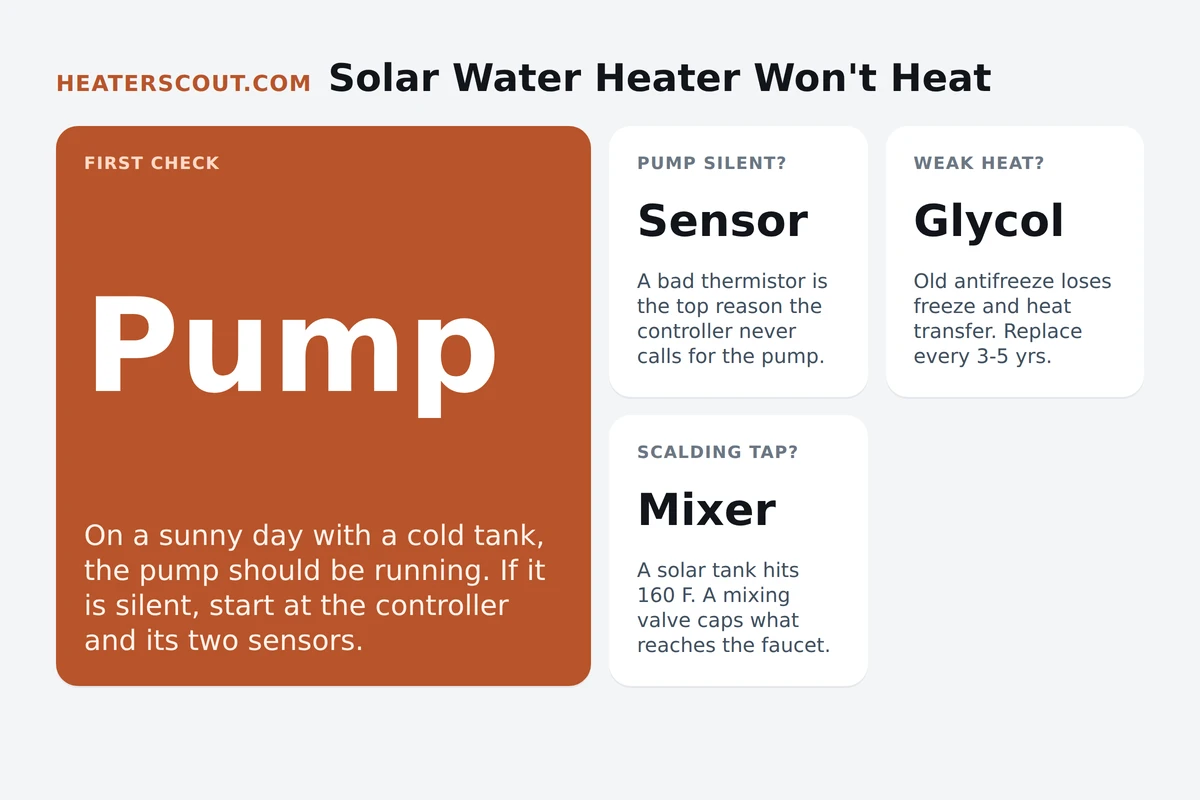
On a sunny day with a cold tank, the pump should be circulating. If it is silent, suspect a failed thermistor sensor first, then the wiring, then the controller, then the pump itself. Weak or missing heat over time usually means degraded glycol, which loses freeze protection and heat transfer and should be changed every three to five years. Scalding taps mean a missing or failed mixing valve, a safety item, since a solar tank can reach 160 F. A rising backup bill is a clue the solar side quit, not proof solar does not work. Visual checks are yours; anything pressurized, on the roof, or involving glycol is a pro job.
Start here: the sunny-day triage
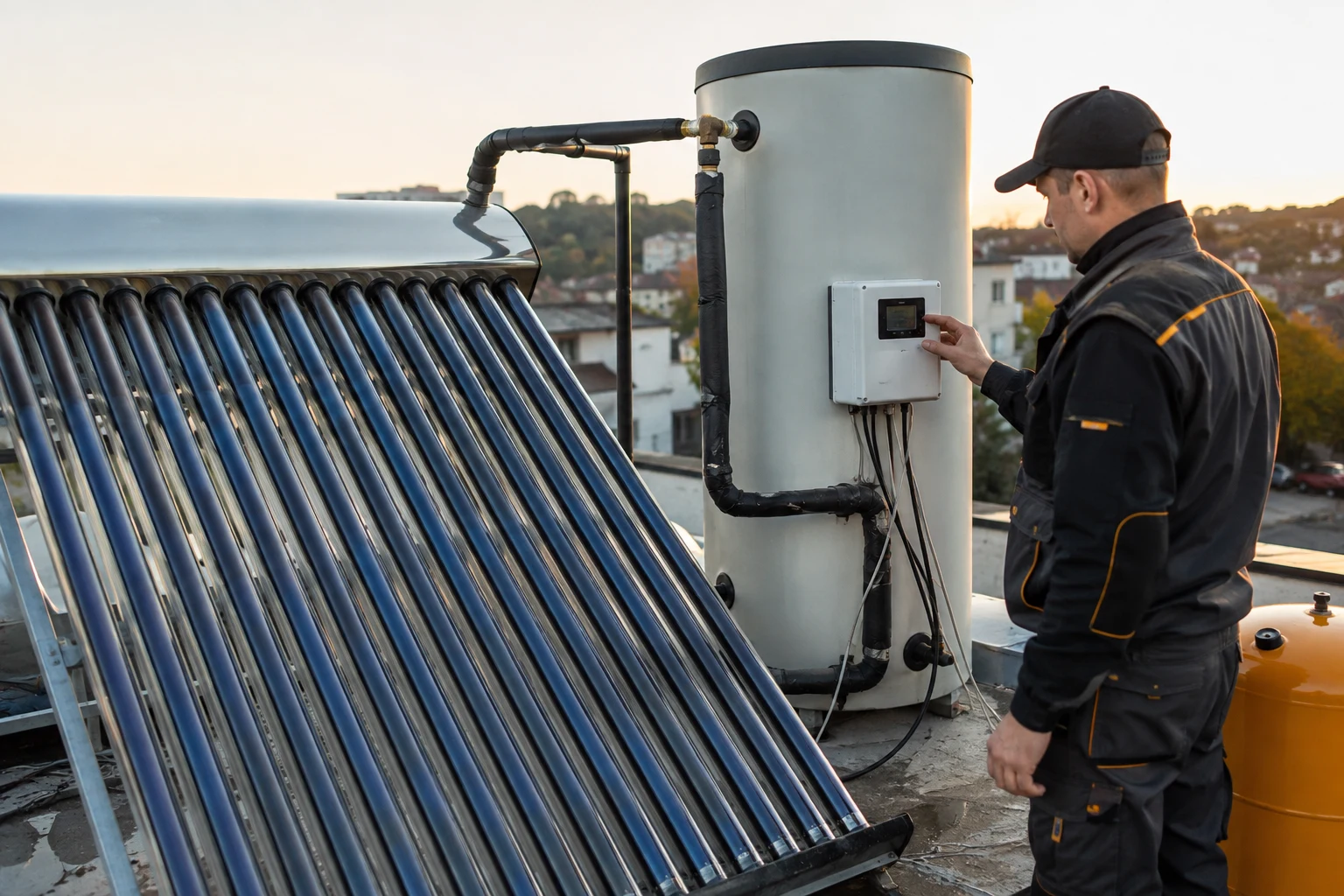
Before you buy a single part, run this list on a clear day around noon when the collector should be hottest and the controller should be calling for the pump. It sorts the harmless from the real and tells you whether you are even looking at the right end of the system. Most of it is eyes and ears, no tools.
- Is the circulating pump actually running? Put a hand on it or listen. A silent pump on a hot sunny day is the core symptom, not normal.
- What does the controller display show? At noon it should read the collector hotter than the tank. If it shows the collector cooler, a sensor or its wiring is lying.
- Is the breaker on and the pump plugged in? A tripped breaker or a bumped plug stops the pump cold with everything else looking fine.
- Are the collectors shaded, leaf-covered, or dirty? A new tree branch or a fallen antenna can quietly kill output on a system that worked for years.
- Any water stains, drips, or green corrosion at the roof or tank fittings? A slow leak drops loop pressure and can stop circulation.
- Is the collector glazing cracked or yellowed and are the seals intact? Cracked glazing tanks efficiency and lets weather into the collector.
Know your system before you touch it
The right fix depends entirely on which kind of solar water heater you have, because a drainback loop, a glycol loop, and a passive rooftop tank fail in different ways. There are two broad families, active and passive, and four common designs inside them. Match yours before you start, since the freeze protection and the fluid are what set the repair apart.
Closed-loop glycol (active)
A pump pushes food-safe propylene glycol through the collector and a heat exchanger, so tank water never goes to the roof. Freeze protection is the antifreeze itself. Watch for degraded glycol, lost loop pressure, and stagnation overheat when the pump is off in full sun.
Drainback (active)
Plain water circulates, and when the pump stops the collector drains back to a reservoir so there is nothing to freeze. The weak point is the controller and its sensor: if the loop fails to drain, a hard freeze can split the collector.
Open-loop direct (active)
A pump moves the actual potable water through the collector and back to the tank. Simple and efficient where it never freezes, but with no antifreeze and no drainback it is exposed to freeze damage and to hard-water scaling inside the collector.
Thermosiphon or ICS (passive)
Thermosiphon uses hot water rising to circulate with no pump; an ICS or breadbox holds 30 to 50 gallons in the rooftop collector itself and feeds a conventional tank. No pump to fail, but both are used only where freezing is not a real risk.
What actually fails, in order of how often
Across the pumped systems that make up most US installs, the failures cluster hard at the control end. The collector is glass and metal with no moving parts; the sensors, wiring, controller, pump, and fluid are what wear out. Rough frequency, from the complaints solar techs see most to least:
Work the fix in order
Follow the sequence rather than jumping to the expensive part. Each step either clears the problem or rules out a cause and points you to the next one. Stop and call a pro at any step that puts you on the roof, into the pressurized glycol loop, or against a hot collector.
My backup electric bill jumped. Does that mean the water heater is broken?
Not the backup heater, most likely the solar side. Your solar tank preheats the water that feeds a conventional electric or gas backup, and the backup only fires to finish the job when the solar-preheated water is too cool. If the solar loop has quit circulating, or the collector is shaded or fouled, the backup suddenly carries the entire load and the bill spikes. A rising backup bill is a troubleshooting signal to check the pump and controller, not evidence that solar does not save money.
One quirk worth naming is stagnation, because it damages the parts people assume are indestructible. When a closed-loop collector sits in full sun with the pump off, whether from a control failure or a power outage, the trapped glycol keeps heating with nowhere to dump it. Bulk fluid temperatures climb past 300 degrees, and glycol that hot breaks down fast, turns acidic, and starts corroding the loop from the inside. A system that stagnates repeatedly burns through its antifreeze years early and can scale or scar the collector. So a controller or pump fault is not just a comfort problem you can ride out for a month; left running, it quietly ages the whole loop.
Frequently asked
Why is there no hot water from my solar system on a sunny day?
On a clear day with a cool storage tank the circulating pump should be running and moving heat off the roof, so if you have no hot water the first thing to check is whether the pump is actually running. The most common reason it stays silent is a bad temperature sensor. A solar system is run by a differential controller that compares a sensor on the collector against a sensor on the tank, and it only switches the pump on when the collector reads roughly 8 to 20 degrees hotter than the tank. If the collector sensor has failed, come loose from the absorber plate, or lost its wiring connection, the controller never sees the temperature difference and never calls for the pump, so the roof gets hot while the tank stays cold. Other causes are an unplugged or seized pump, a tripped breaker, or a controller that has quit. Look at the controller display first: if it shows the collector cooler than the tank at noon, the collector sensor or its wiring is the suspect.
How do I know if the sensor or the controller is bad?
Test the sensors before you condemn the controller, because sensors fail far more often and cost far less. Solar collector and tank sensors are thermistors, which change resistance with temperature, so you can unplug a sensor and read it with a multimeter set to ohms, then compare the reading against the resistance-versus-temperature chart for your controller. A reading that is open, shorted, or wildly off the chart means the sensor is dead and needs replacing. Also confirm the collector sensor is clamped tight to the absorber plate or the header pipe and not dangling in the air, and that the tank sensor is seated in its well or strapped firmly to the tank, because a loose sensor reads the wrong temperature even when it is electrically fine. If both sensors test good and are mounted correctly but the controller still will not run the pump on a sunny day, or it runs the pump nonstop day and night, then the controller itself is the failure and gets replaced.
How often does the glycol antifreeze need to be changed?
In a closed-loop antifreeze system the propylene glycol should generally be replaced every three to five years, and sooner if the system has taken a lot of thermal abuse. Glycol does not last forever because heat breaks it down. Fluid degradation speeds up once the bulk glycol runs around 250 degrees, and a collector that sits in the sun with no flow, called stagnation, can push past 300 degrees. As the glycol degrades it loses freeze protection, its pH drops, and its corrosion inhibitors wear out, so old glycol turns acidic and starts eating the loop from the inside. The practical check is fluid condition, not just the calendar: a technician measures the freeze point and the pH and changes the fluid when either one is out of range. Because it involves draining, refilling, and purging air from a pressurized loop, glycol replacement is a job most homeowners hand to a solar pro.
My solar-heated water is scalding hot. Is that normal and is it safe?
Very hot water off the roof is normal for a solar system, and it is exactly why a mixing valve matters. Even when your backup heater is set to 120 degrees, the solar storage tank can climb to around 160 degrees on a strong sunny day because the sun does not stop heating at your setpoint. Water at 160 degrees scalds skin in a couple of seconds, so a solar install is supposed to have a thermostatic mixing valve, sometimes called a tempering or anti-scald valve, on the hot outlet. That valve blends in cold water to cap the temperature delivered to your faucets, commonly below 120 degrees, while the tank itself is allowed to store the hotter water. If your taps run scalding, either the system was never fitted with a mixing valve or the valve has failed and needs adjusting or replacing. This is a safety item, not a comfort preference, so do not just live with it.
Can freezing weather damage my solar collectors even though they are designed for the sun?
Yes, freeze damage is one of the most common ways a solar collector cracks, and it happens when the freeze protection fails rather than from cold alone. Systems handle freezing in one of two ways. A closed-loop system fills the collector with propylene glycol antifreeze, which protects only as long as the concentration stays strong, so weak or degraded glycol is a freeze risk. A drainback system leaves the collector empty when the pump is off and relies on the controller and a correctly placed sensor to drain the loop before it freezes, so a failed sensor or a controller fault can leave water sitting in the panel to freeze and burst it. An older recirculation scheme that runs warm tank water up to the roof on cold nights is unreliable and should never be used on a drainback or closed-loop system. If you live where it freezes, confirming your freeze protection actually works before winter is cheaper than replacing a split collector in spring.
Why does my solar system still run my electric or gas bill up?
Because almost every US solar water setup is a preheat system with a conventional backup, and the backup is doing its normal job. Solar heats a storage tank, and that preheated water feeds the inlet of a regular electric or gas tank, or a tankless unit, which only fires to top the temperature up to your setpoint when the solar water is not warm enough. On a sunny stretch the backup barely runs. On a run of cloudy days, a shaded collector, or a solar loop that has quit circulating, the backup carries the whole load and your bill looks like you never had solar at all. So a sudden jump in the backup bill is itself a troubleshooting clue that the solar side has stopped contributing: check the pump, the controller reading, and whether the collector is shaded or fouled before you blame the backup heater.
What can I safely check myself, and when should I call a solar pro?
Homeowner checks are the visual and the obvious. Look for shade or debris on the collectors, water or green corrosion staining at pipe fittings, cracked or yellowed collector glazing and worn seals, and wet or missing pipe insulation, and watch the controller display to see whether it reports the collector hotter than the tank at midday. You can also reset a tripped breaker and confirm the pump is plugged in. Where it gets hands-off is anything under pressure or under high heat: draining and refilling glycol, opening a pressurized closed loop, clearing an air lock in the pump, replacing a collector or a failed sensor on the roof, or brazing a leaking collector fitting. A solar system should also get a professional inspection at least once a year. If you are not sure which type of system you have or the collector is on a steep roof, that yearly visit is the safe call.