A Rheem heater that flashes A107 and a message reading "Water Detected on Floor" has not decided your tank is failing. It has decided the little sensor sitting in its base pan is wet. That is the whole point to understand about every smart leak alert, from Rheem's LeakGuard to A.O. Smith's E04 to a twenty-dollar puck on the floor: the alarm reports moisture, it does not diagnose the cause. Most of the panic these codes create comes from treating a wet-sensor warning as a death sentence for the tank, when a large share of them are condensation on a humid day. This page separates the real leaks from the nuisance trips, and shows exactly how to clear the alarm without muting a sensor that might be right.
The code says the pan is wet. It does not say why. A107 and E04 are moisture alarms, not diagnoses, so the first move is a flashlight and a dry paper towel, not the reset button.Rheem A107 / A.O. Smith E04 leak alerts
What actually triggers a leak alert
Every one of these systems works the same way at the bottom: a moisture sensor or float switch sits in the base pan of the heater. When water bridges its contacts, the control board raises the alarm. On Rheem that is alarm code A107, the LeakGuard or LeakSense system, and Rheem says LeakSense can catch a leak in about fifteen seconds. On A.O. Smith iCOMM heaters the same event throws E04 with the red status LED blinking four times. Bradford White's Connect line and the puck-style add-on sensors do the same job with different names. The sensor is dumb on purpose: it fires on any water, which is why the causes range from a catastrophic tank failure down to a bead of summer condensation.
Four things wet that sensor. A genuine tank or plumbing leak, the case the system was built for. Condensation on cool metal, the most common false trigger, worse in humid basements and in summer when incoming water is cold. Debris or trapped standing water in the pan from an old spill that never dried. And a sensor or wiring fault, where the sensor reports water that is not there. On the smart-valve models, Rheem LeakGuard and A.O. Smith Leak Shield, the alarm also closes a motorized shutoff valve on the supply, so a nuisance trip can leave you with no hot water until you reopen it.
How to clear or override the alarm the right way
On a Rheem, press and hold the Clear Alarm button on the control panel for about one second until it beeps. That bypasses the leak alarm for 24 hours. The purpose of that window is not to make the problem go away, it is to stop the heater from re-alarming every few minutes while you dry the sensor and hunt down the source. You can also clear the active alert in the EcoNet app from a phone on your home Wi-Fi. On LeakGuard the shutoff valve stays closed until you reopen it from the app or the valve handle, so do that only after you have confirmed there is no active leak. A.O. Smith clears E04 similarly once the sensor is dry, and its Leak Shield valve reopens by the same logic.
The order matters. Dry the sensor and pan first, find the source or rule it out, then clear the alarm. Clearing first is how people mute a real slow leak for 24 hours and come home to a wet floor.
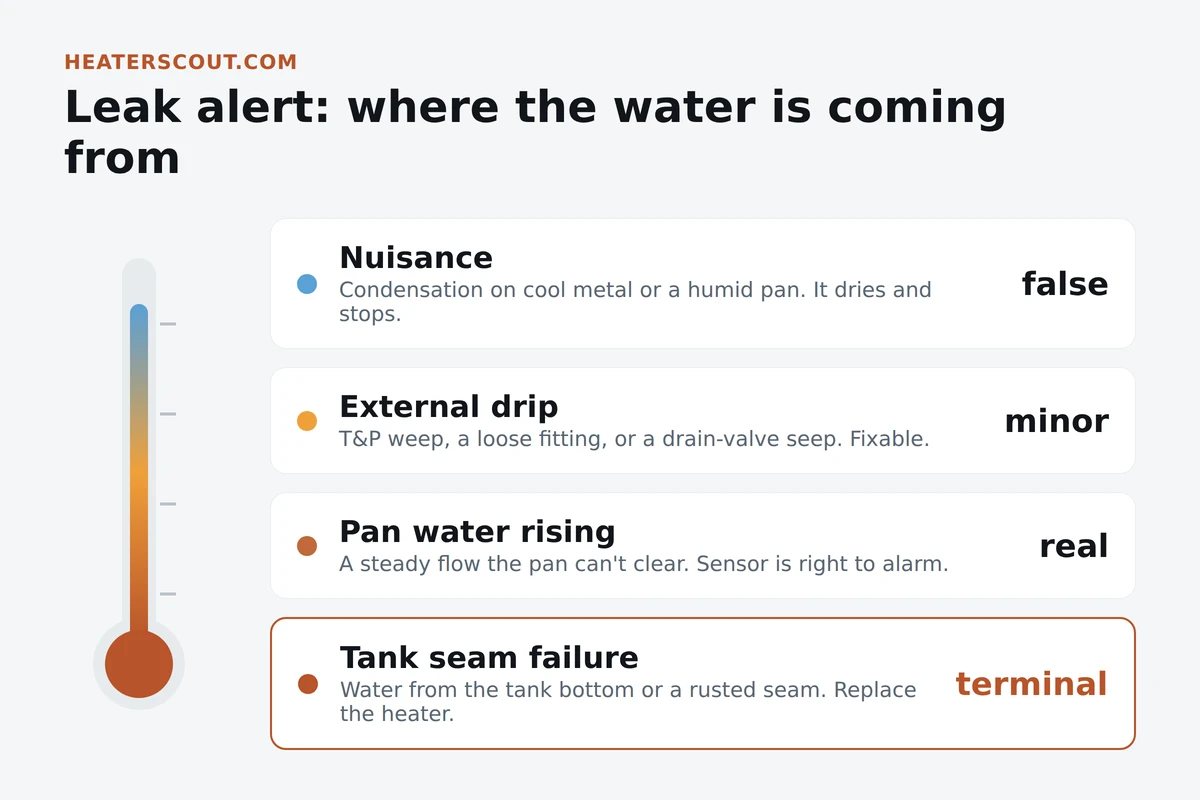
Reading the severity: nuisance versus real
The sensor cannot tell condensation from a leak, but you can, and it comes down to one question: does the water stop? Condensation stops. Dry the pan, dry the sensor, wait a day. If it stays dry, it was condensation or humidity and you can end the nuisance trips by ventilating the space or running a dehumidifier. A real leak does not stop. It comes back to the same spot no matter how many times you wipe it, because something upstream is still feeding it.
Nuisance leak trip
A leak alarm raised by water that is not a plumbing failure. The usual cause is condensation forming on the cool tank shell and cold inlet pipe on a humid day, then dripping into the base pan onto the sensor. Trapped water from an old spill and simple high humidity in a basement or crawl space do the same thing. The signature of a nuisance trip is that it dries up and does not return once the pan is dry and the humidity drops, whereas a real leak refills the same spot within hours. Chronic nuisance trips are an argument for relocating the sensor slightly, improving ventilation, or a dehumidifier, not for silencing the alarm permanently.
What to inspect, from cheap to terminal
Trace the water upward from the pan, because the height of the leak tells you the cost. Start dry: wipe everything, then lay dry paper towels around each suspect and come back in an hour to see which one wets. The temperature and pressure relief valve is a common source. A T&P that weeps into its discharge pipe usually means house pressure over 80 psi, which needs a pressure-reducing valve, or a setpoint above 120 degrees, or a tired valve seat. That is a real issue but not a dead heater. Threaded connections come next: the nipples on top, the drain valve at the bottom, unions and flex connectors. A drain valve that seeps is a ten-dollar part.
Nuisance or fixable (keep the heater)
- Condensation on the tank and cold pipe that dries up and does not return.
- T&P valve weeping from pressure over 80 psi or a setpoint above 120 F.
- A dripping drain valve or a loose threaded fitting you can snug or reseal.
- Trapped water in the pan from an old spill, gone once dried.
- A sensor or wiring fault that alarms on a bone-dry pan.
Tank is failing (replace it)
- Rusty water at the bottom center of the tank with no fitting above it.
- A weep from a welded seam or the tank shell itself, not a connection.
- Water that refills the same low spot within hours, every time you dry it.
- A heater already past 10 to 12 years showing bottom leakage.
- Corrosion streaks running down from a seam, staining the jacket.
The line between those two columns is whether the water comes from a connection you can service or from the steel tank itself. Fittings, valves, and the T&P are all repairable. A leak from a seam or the bottom of the tank is not, because the glass lining has failed and the steel is rusting through. No sealant or reset fixes that. On a heater past ten or twelve years, bottom leakage is the tank telling you it is done, and the smart alarm did its one job: it caught it before the tank dumped forty gallons on your floor.
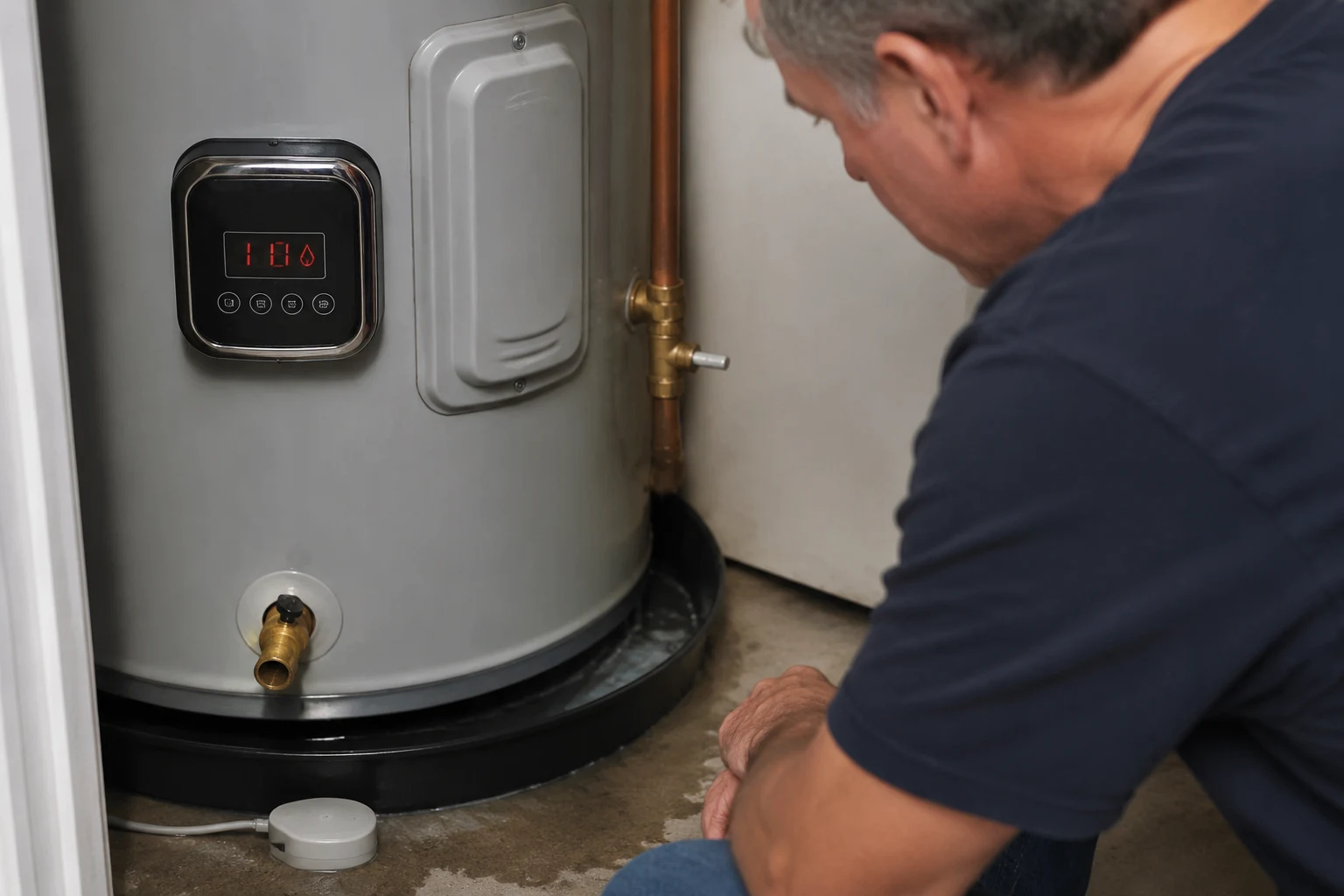
DIY versus a pro, and the retrofit case
Clearing the alarm, drying the sensor, wiping the pan, snugging a loose fitting, backing the temperature down to 120 degrees, and swapping a drain valve are all homeowner jobs. Diagnosing a T&P weep from high house pressure is homeowner work, but adding a pressure-reducing valve to the main is usually a plumber's task. A leak sensor that fires on a dry pan, or a smart shutoff valve that will not reopen, is a warranty-service call. And a tank leaking from its seam is a replacement, full stop, which most people hand to a licensed installer because it means draining, disconnecting, and hauling out a heavy tank.
If your heater is older and has no smart brain, the retrofit is cheap and worth it. A puck-style Wi-Fi sensor on the floor runs 20 to 60 dollars and will alarm your phone the instant it gets wet. Pair it with an automatic main shutoff, like a Flo by Moen valve, and you get the part that actually matters when a tank fails while you are away: something that closes the water before the floor is ruined. The built-in codes on a Rheem or A.O. Smith are convenient, but the real protection is any sensor plus a shutoff valve, and you can add both to a heater that shipped without a single smart feature.
Frequently asked
What does alarm code A107 mean on my Rheem water heater?
A107 is Rheem's leak alert. The full wording in the EcoNet app and on the unit is roughly "Water Detected on Floor, Check for Leaks." It comes from the LeakGuard or LeakSense sensor sitting in the base pan of the heater. When that sensor gets wet, the control board raises A107, beeps, pushes a notification to your phone, and on a LeakGuard model it closes the motorized shutoff valve on the cold water inlet so the tank stops filling. The code itself does not tell you whether the water is a real tank leak or harmless condensation, only that the pan is wet. So the code is a prompt to go look, not a verdict. Before you clear it, get down at the base of the tank with a flashlight and a dry paper towel and find where the water is actually coming from.
How do I clear or reset the Rheem leak alarm?
Two ways. On the unit, press and hold the Clear Alarm button on the control panel for about one second until you hear a beep. That silences and bypasses the leak alarm for 24 hours, which is meant to give you time to dry the sensor and confirm the source without the heater re-alarming every few minutes. The other way is the EcoNet app: open it on a phone that is on your home Wi-Fi, find the active leak alert for the water heater, and tap to clear it. On a LeakGuard model the shutoff valve stays closed until you reopen it, so after you have confirmed there is no leak you reopen the valve from the app or the valve handle. The 24-hour override is a grace window, not a fix. If you clear it and never find the water, you are just muting a sensor that may be telling the truth.
Is condensation setting off a false leak alert?
Very often, yes, and it is the single most common reason a smart heater cries leak when the tank is fine. The sensor cannot tell the difference between a drop of leaked water and a drop of condensed water. On a humid day, or in a damp basement or crawl space, moisture condenses on the cool metal of the tank and the cold inlet pipe and drips into the pan, right onto the sensor. Cold incoming water in summer makes this worse. The tell is that condensation stops. If you dry the pan and the sensor and the area stays dry for a day or two, it was condensation or humidity. A real leak keeps coming back to the same spot no matter how many times you wipe it. If humidity is the culprit, better ventilation or a dehumidifier in the space usually ends the nuisance alerts.
What does E04 mean on an A.O. Smith water heater?
On A.O. Smith iCOMM smart electric heaters, E04 is the leak or moisture code, and the status LED blinks red four times to show it. It means the leak sensor in the base has detected water. If your heater has the Leak Shield or Water Shut Off Valve kit, the AOS-SOV1, that valve also closes the water supply automatically and the app sends a notification. Same as with the Rheem code, E04 is a moisture alarm, not a diagnosis. Dry the sensor, find where the water came from, fix or rule out the source, then clear the code. If E04 returns immediately on a dry sensor with no water anywhere, you are looking at a sensor or wiring fault rather than a leak, and that is a warranty-service call rather than a plumbing job.
Should I turn off the water and power when I get a leak alert?
If you can see actual running or pooling water, yes. Shut off the cold water supply at the valve above the heater, and on an electric unit cut power at the breaker. On a LeakGuard or Leak Shield model the smart valve may have already closed the supply for you. If all you find is a damp sensor and a pan that is dry everywhere else, you probably have condensation and you do not need to shut anything down, just dry it and watch it. The judgment call is volume: a few drops that dry up is nuisance, a wet spot that refills after you wipe it is a leak. When in doubt, killing the water supply costs you nothing but a cold shower and protects the floor while you figure it out.
How do I tell a real tank leak from a T&P drip or a fitting leak?
Trace it upward from the pan. Water at the bottom center of the tank with no fitting above it, especially rusty water, points to a tank seam or a corroded bottom, and that heater is done. Water from the temperature and pressure relief valve or its discharge pipe is a T&P issue, often from house pressure over 80 psi or a setpoint above 120 degrees, and it is fixable. Water at a threaded connection, the nipples, the drain valve, or a union, is a fitting leak you can often snug or reseal. Dry everything, lay dry paper towels around each suspect point, and come back in an hour. The wet towel is your leak.
Why does my leak alarm keep coming back?
A leak sensor that re-alarms after you clear it is telling you one of three things. Either there is a real, slow leak that you dried but did not stop, and it is refilling the same spot. Or the space is chronically humid and condensation keeps wetting the sensor, in which case you fix the environment, not the heater. Or the sensor or its wiring has failed and is reporting water that is not there. Work them in that order: confirm the pan is truly dry, watch it for a day, and if it re-wets, find the source. If the pan stays bone dry and the alarm still fires, it is a sensor fault. Clearing the alarm more than once or twice a year without ever finding water is a sign something real is going on, not that the heater is oversensitive.
Do add-on leak sensors work with any water heater?
Yes. Puck-style Wi-Fi water sensors from Moen Flo, Phyn, and generic brands sit on the floor next to any heater, smart or not, and alarm your phone the moment their contacts get wet, for roughly 20 to 60 dollars. What they do not do is diagnose. They tell you water is present, the same as the built-in sensor, and you still have to find the source. Some whole-home systems like Flo by Moen add an automatic main shutoff valve, the piece that actually saves your floor when a tank lets go while you are away.