It is the first cold shower of the trip that tells you the RV water heater quit. Maybe no hot water at all, maybe a fault light glowing, maybe the burner lights and dies. The good news is that RV water heaters are simple machines and the failures fall into a short list. The catch is that this system runs on propane, so the order you check things in matters and guessing is not allowed. This guide walks the checks in order for the three systems in a coach: Suburban and Atwood or Dometic tank heaters, and Girard tankless. One thing up front, because it can cost you a tank: a Suburban has an anode rod, an Atwood or Dometic does not.
The short version
Start with what kills both modes at once: confirm 12 volt power and a good fuse, then press the ECO high-limit reset. If electric works but gas does not, the tank is fine and the problem is propane, ignition, or a burner tube full of spider web. A DSI fault light means the board tried three times and gave up, so reset it off a minute then on, and purge air with a stove burner first. Suburban tanks are steel and use a magnesium anode rod that is also the drain plug; Atwood and Dometic tanks are aluminum and have no anode rod, never add one.
Before you touch anything: know your system
Three systems cover almost every rig on the road, and the fix depends on which you have. Suburban builds a steel tank, so it carries a sacrificial magnesium anode rod threaded into the drain port, and that rod is the drain plug. Atwood, now sold as Dometic, builds an aluminum tank that needs no anode, so its drain is a plain nylon plug. Girard makes a tankless unit with no tank at all, heating on demand and reporting problems as numbered error codes. Pull your drain plug and look: a long metal rod means Suburban, a short plastic plug means Atwood or Dometic, and a display with E-codes means Girard.
- Confirm the water heater switch inside the coach is on, and that you actually have 12 volt house power. The control board runs on 12 volts DC even in gas mode.
- Check the fuse that feeds the water heater. A blown fuse leaves the board dead and nothing will spark.
- Find the ECO, the high-temperature limit switch, and press its reset button firmly until it clicks. A tripped ECO cuts both gas and electric.
- Prove propane is flowing: tank valve open, gas in the bottle, and a stove burner that lights and holds a steady blue flame.
- On a Suburban, know that the anode rod is the drain plug. On an Atwood or Dometic, there is no anode rod at all.
This system runs on propane
Everything downstream of here involves propane. If you ever smell gas, if a fitting hisses, or if the burner backfires or throws soot, shut the propane off at the tank and stop. A weak yellow flame and a sooty compartment are a combustion problem, not just an efficiency one. When in doubt on the gas side, close the bottle and have an RV tech look at it. No repair is worth a fire in a box you sleep in.
No hot water at all: the whole-system checks
When there is no heat in either mode, the fault is almost never the burner or the element, because both would have to fail at once. It is something they share. The first shared thing is power: the control board needs 12 volts DC to spark the igniter and open the gas valve, so it runs off the house battery even in propane mode, and a dead battery, a tripped converter, or a blown fuse takes the whole heater offline. Confirm 12 volt power and a good water heater fuse before you go any further.
The second shared thing is the ECO, short for energy cut off, a high-temperature limit switch that trips if the water ever climbs past its safe ceiling and cuts power to both the burner and the element, which is exactly the no-heat-anywhere symptom. On most tank units there is a small reset button beside the thermostat behind the outside access panel. Press it firmly until you feel it click, then try the heater. If it trips again soon after, something is genuinely overheating the water, usually a thermostat stuck closed, and that needs fixing rather than repeated resetting.
Splitting the problem: gas versus electric
Most RV tank heaters run both propane and 120 volt electric, and the two modes are nearly independent, each with its own thermostat and path to the water. That makes the split your best diagnostic tool. Try electric alone, then gas alone. Whichever mode still works has proven the tank, the water level, and the shared plumbing are fine, so you only chase the mode that failed.
If electric heats but gas will not, the tank is healthy and the problem lives on the propane and ignition side, covered below. If gas heats but electric will not, you are looking at the electric leg: the 120 volt supply and breaker, the element, its own thermostat, and its own reset, since many units put a second ECO-style reset on the electric side. A dead element or a corroded connection is the usual electric-only culprit, and an element is a cheap, screw-in part. Lukewarm water in either mode, rather than none, often means sediment has built up and is insulating the element or holding the thermostat off the tank wall so it reads wrong. Draining and flushing the tank fixes that.
| No heat, gas or electric | Dead 12 V power or blown fuse, or a tripped ECO high-limit reset. Check both first. |
| Electric works, gas does not | Propane supply, ignition, flame sensor, or a burner tube blocked by spider web or a mud dauber nest. |
| Gas works, electric does not | 120 V breaker off, a failed electric element, its thermostat, or the electric-side reset button. |
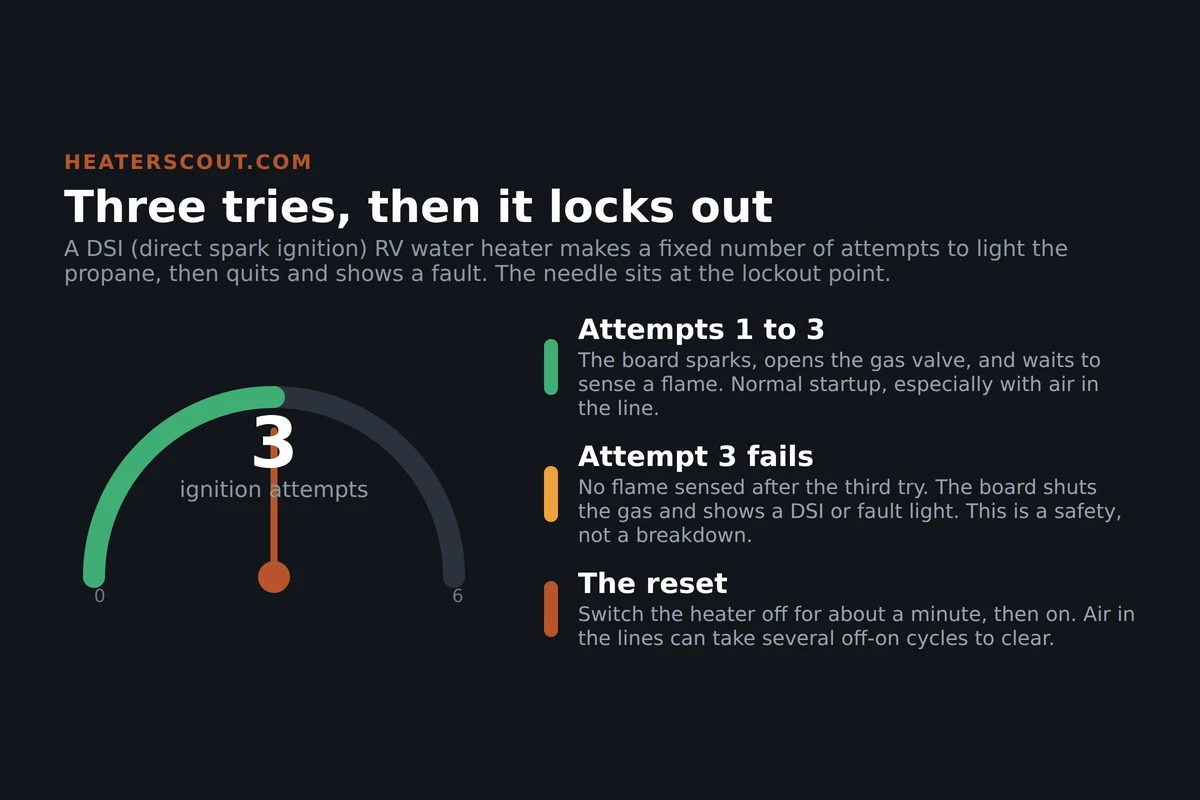
| Fault or DSI light after clicking | Board made three ignition tries and locked out. Reset off a minute then on; purge air in the line. |
| Weak, yellow, or sooty flame | Blocked burner tube or a failing regulator not holding steady pressure. Clean the tube first. |
| Lukewarm, never hot | Sediment insulating the element or thermostat, or a thermostat set low or reading wrong. Drain and flush. |
| Rotten-egg smell (Suburban) | Magnesium anode reacting with sulfur in the water. Swap the magnesium rod for aluminum or zinc. |
The gas side: DSI lockout, ignition, and the burner tube
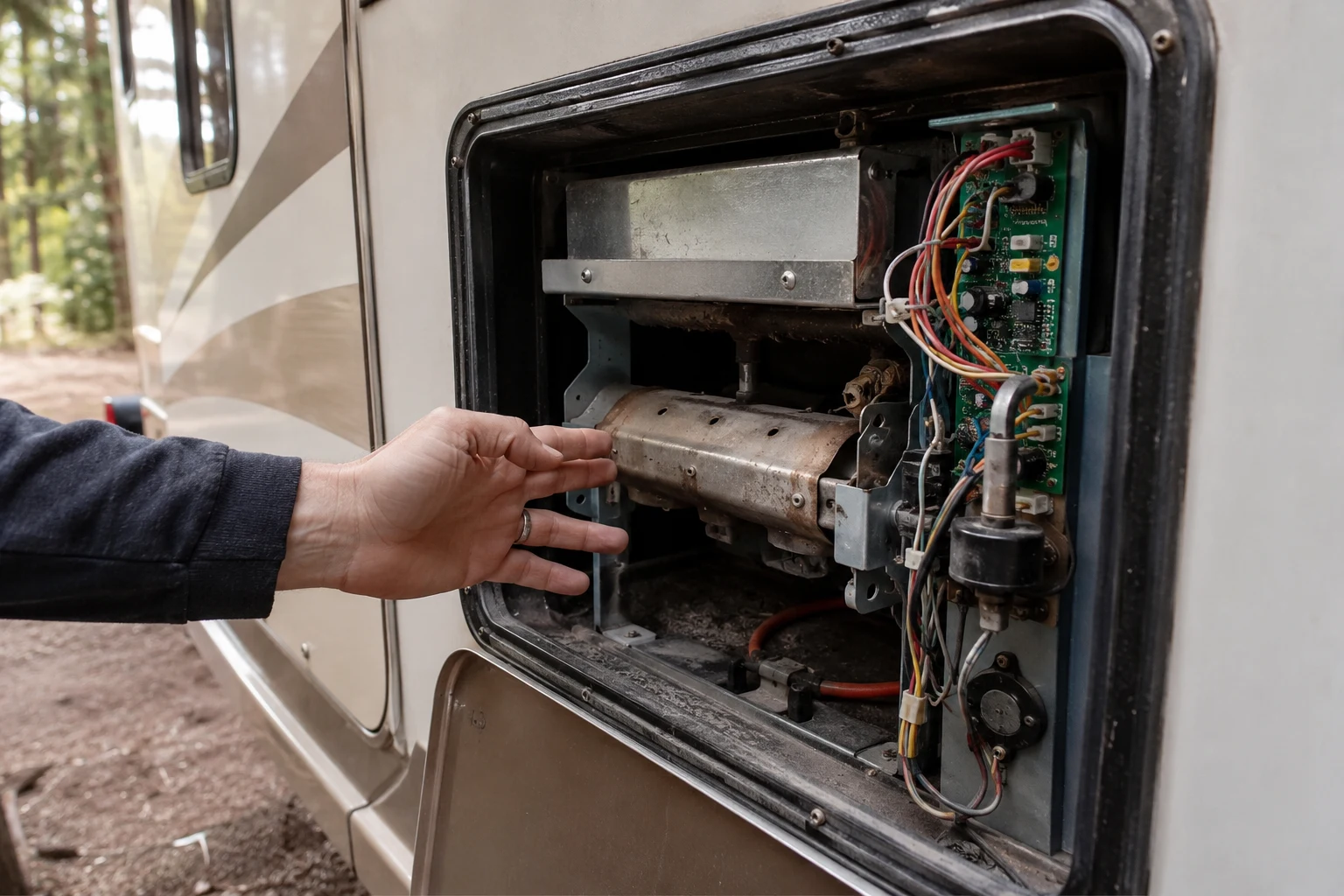
When electric works and gas does not, run the propane path from the tank to the flame. Start at the supply, because a shocking share of no-light calls are simply an empty bottle, a valve that is not fully open, or air in the line after the tank ran dry. Prove gas is present and flowing by lighting a stove burner and watching for a steady blue flame. If the stove will not hold a flame either, the problem is upstream at the regulator or the supply, not the water heater.
If propane is good, move to ignition. A direct spark ignition board sparks three times before it locks out, and air in the line is the top reason it fails on the first use of the season. If the igniter sparks reliably but no flame holds with propane proven, suspect the flame sensor or igniter probe, its wiring, or the control board, a known weak point on some Atwood units. The steps below run the gas side in order.
Girard tankless: reading the error codes
A Girard tankless unit has no tank to drain and no anode to worry about, and it heats water only while a hot tap is open. When it fails it usually tells you why with a numbered code, so read it before pulling parts. E1 is a flame-sense failure during ignition, and it nearly always traces to fuel: check that the propane tank has gas, that every valve is wide open, and that other appliances run, because low inlet pressure from a tired regulator will trip it, then clean the igniter probe. E3 is an over-temperature warning, the unit seeing outlet water past roughly 140 degrees and shutting the burner, so let cold water run for a bit and restart, and if E3 keeps returning the temperature sensor may be failing. One more tankless-specific fault is the sail switch, an air-pressure sensor that proves the exhaust fan is moving air: when it goes bad the unit lights and quickly quits, so if fuel and the igniter check out and it still will not stay lit, the sail switch is next.
Maintenance that prevents the failures: anode, flush, winterize
Most of the calls above are preventable with two or three habits a year, and the first depends on your brand. If you own a Suburban, its steel tank relies on that magnesium anode rod to corrode in place of the tank walls. Pull it once a season, and when it is eaten down to about the thickness of a pencil, replace it, because a used-up rod means the tank is next to rust through. If the hot water smells like rotten eggs, that is hydrogen sulfide from the magnesium reacting with sulfur in your water, and swapping the magnesium rod for an aluminum or zinc-aluminum one usually clears the smell while still protecting the tank. An Atwood or Dometic aluminum tank has no anode and needs none, so leave the plain nylon drain plug alone.
Either way, draining and flushing sediment out of the tank once a year keeps the element and thermostat reading true and heads off the lukewarm-water complaint. When the season ends, winterize with care: cool and drain the tank, set the bypass so antifreeze routes around it, and never turn the heater on while it is drained and bypassed, because dry-firing an empty tank ruins the element and can crack the tank. In spring, close the bypass, refill and burp the tank at a hot faucet, reinstall a fresh anode if you run a Suburban, and only then power up. Do those few things and the cold-shower surprise mostly stops.
Frequently asked
Does my RV water heater have an anode rod, or not?
It depends entirely on the brand, and getting this wrong can cost you a tank. Suburban water heaters have a steel tank, so they use a magnesium anode rod that doubles as the drain plug, threaded 3/4 inch NPT and about nine and a quarter inches long. That rod is sacrificial, corroding on purpose so the steel tank does not, so check it every year and replace it once it is chewed down to roughly the thickness of a pencil. Atwood and Dometic use an aluminum tank, which does not need cathodic protection, so they have no anode rod at all and their drain is a plain nylon plug. Never add an anode rod to an Atwood or Dometic tank. The quick tell: pull the drain plug, and a long metal rod means Suburban, a short plastic plug means Atwood or Dometic.
My RV water heater has no hot water at all. Where do I start?
No heat at all points at a whole-system problem rather than a weak burner, so start with the two things that kill both gas and electric modes: power and the high-limit reset. Confirm the water heater switch is on and the coach has 12 volt power, because the control board runs on 12 volts DC even in gas mode, and a blown fuse or a dead house battery leaves you cold. Then find the ECO, the high-temperature limit switch, which trips if the water ever got too hot and cuts power to both the burner and the element, and press its reset button behind the outside access panel firmly until it clicks. If reset restores heat but it trips again, you have a real over-temperature cause to chase, usually a stuck thermostat. Only after power and the ECO check out do you move to the gas side or the element.
Why does my RV water heater work on electric but not on gas?
Because the two modes are almost completely independent, each with its own thermostat and path, so a failure in one usually leaves the other working. If electric heats fine, your tank, thermostat wiring, and ECO are healthy, which narrows the gas problem to the propane and ignition side. First confirm propane is flowing: tank valve open, gas in the bottle, and a stove burner that lights and holds a steady blue flame to prove the regulator is delivering pressure. Then look at ignition, where the board needs 12 volts and the flame sensor has to prove a flame within three tries or the board locks out. A very common cause of a healthy spark but no flame, or a weak sooty one, is a burner tube full of spider web or a mud dauber nest choking off the gas.
What does a DSI or fault light mean, and how do I reset it?
DSI stands for direct spark ignition, and the fault light means the board tried to light the burner and never sensed a flame. Spark-ignition boards make three attempts, sparking and opening the gas valve and waiting for the flame sensor each time, and if all three fail the board shuts the gas and shows the fault. That lockout is a safety feature, not a broken part, so do not keep flipping the switch fast. To reset it, turn the water heater off for about a minute, then back on. The most common reason for a lockout on the first use of the season, or after running out of propane, is air in the gas line, so light a stove burner for a minute to purge it and expect to cycle the heater a few times before it catches. If it locks out every time with good propane and a clean burner, suspect the igniter or flame probe, its connections, or the board.
My RV water heater lights but the flame is weak, yellow, or sooty. What is wrong?
A healthy propane flame is steady and blue, so a yellow, lazy, or sooty flame means the burner is not getting clean gas and air, and by far the most common cause in an RV is a blocked burner tube. The exterior compartment is warm and sheltered, and spiders and mud daubers love to nest inside the burner tube over the off season, where even a partial web restricts the gas and starves the flame. Shut off the propane, pull the burner assembly per your manual, blow the tube out with compressed air, and clear any nest with a soft wire or brush, then check that the flame spreader on the end is square and seated. If the tube is clean and the flame is still weak on every propane appliance, the trouble is upstream at the regulator, which needs replacing. To keep the bugs out, fit insect screens over the water heater vent.
My Girard tankless RV water heater is throwing an error code. What do E1 and E3 mean?
Girard tankless units use a small display of error codes, and the two you see most are E1 and E3. E1 is a flame-sense failure during ignition, meaning the unit sparked but could not confirm a burn, and it almost always traces to fuel: a nearly empty propane tank, a partly closed valve, low inlet pressure from a tired regulator, or a dirty igniter set too far from the burner. Check that every gas valve is wide open, that you actually have propane, and that other gas appliances run, then clean the igniter probe. E3 is an over-temperature warning: the unit saw the water climb past roughly 140 degrees and shut the burner to protect you from scalding, so let cold water run for a bit and restart, and if it keeps returning the temperature sensor may be faulty. A unit that lights then quickly quits often has a bad sail switch, the air-pressure sensor that proves the fan is moving air, so check it if fuel and the igniter are fine.
How do I bypass and winterize my RV water heater without damaging it?
The water heater bypass keeps you from wasting six to sixteen gallons of pink antifreeze filling the tank, and used right it protects the heater rather than harming it. Before winterizing, turn the heater off, let the water cool completely, and drain the tank: on a Suburban you remove the anode rod, which is the drain plug, and on an Atwood or Dometic you pull the nylon plug. Set the bypass valves so antifreeze routes around the tank instead of filling it. The rule people get wrong is running the heater in bypass: once the tank is drained and bypassed, never switch it on, because with the tank empty the element and burner dry-fire and ruin themselves. In spring, close the bypass, reinstall a fresh anode if you have a Suburban, refill and burp the tank at a hot faucet, then power it up.