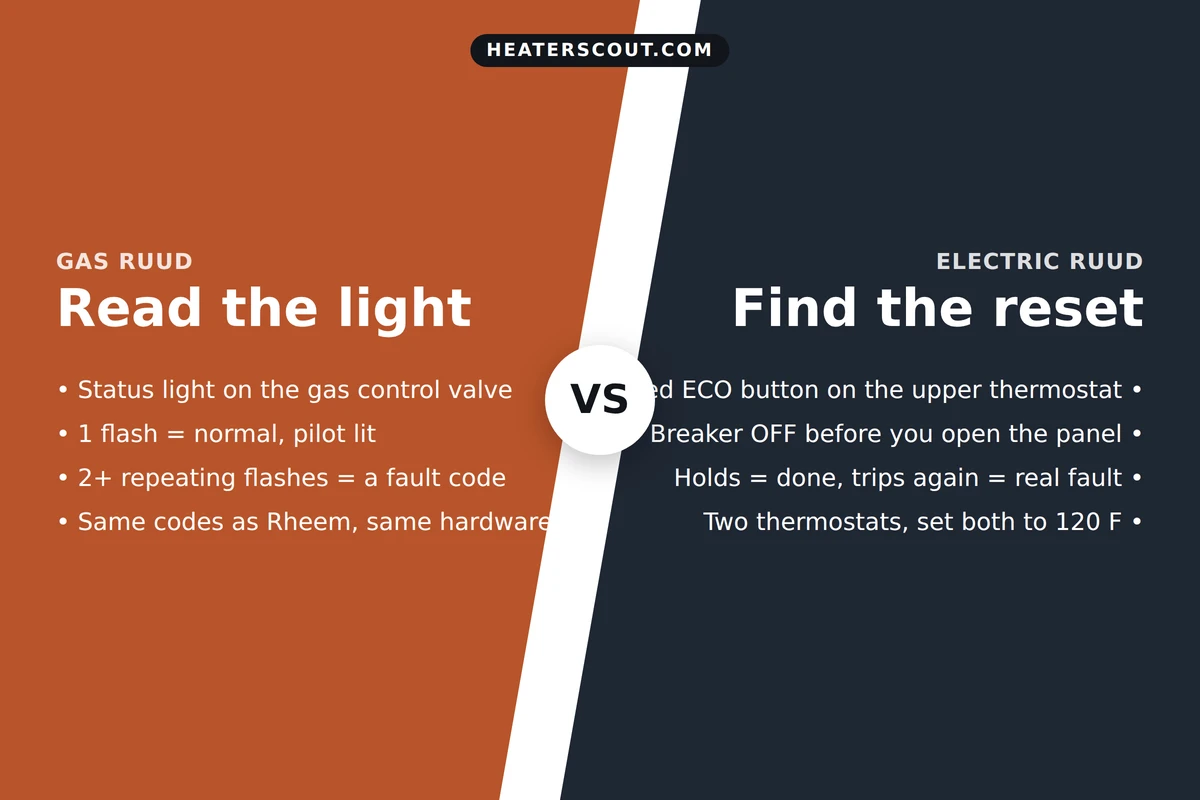
A Ruud tank that quit making hot water is usually less of a mystery than it feels like, because it is telling you what is wrong if you know where to look. On a gas Ruud a small status light on the control valve is already blinking a code. On an electric one a single red button behind a panel explains most dead units. And here is the part that saves you time: Ruud is Rheem's sister brand, built in the same plant off the same engineering, so the gas valve, the status light, the flash sequences, and the reset all behave the way a Rheem does. Learn one and you have learned both. This page walks the symptoms in the order homeowners hit them and marks the handful of faults where the right move is to stop and call a licensed tech.
Gas safety comes first
If you smell gas near the heater, stop. Do not relight a pilot, press a reset, or flip a switch or a light. Leave the space, then call your gas utility or the fire department from outside. The same goes for a six-flash flammable-vapor lockout: clear the fumes and find their source before you touch the heater, because that code exists to stop an ignition, not to be reset away.
Why a Ruud troubleshoots like a Rheem
Before the symptoms, the one fact that makes this page shorter. Ruud and Rheem come out of the same factory in Fort Smith, Arkansas, under the same parent company, on the same core engineering. A gas Ruud uses the same class of gas control valve as a gas Rheem, the same Honeywell or Resideo style control with a status light on the front, the same burner and tank. The differences are the badge, the styling, and which local contractor stocks which name. That is why a Rheem flash-code chart, relight procedure, and parts list will almost always fit your Ruud. Just remember the tie-breaker: the label on the front of your heater beats any chart online.
Start here: what kind of problem is it
Sort the symptom before you touch a screwdriver. No hot water, not enough hot water, and water too hot are three different problems, and the fuel type splits each one again. Walk this path first and you will know within a minute whether you are relighting a pilot, resetting a switch, or reaching for the phone.
Gas Ruud, no hot water: read the status light
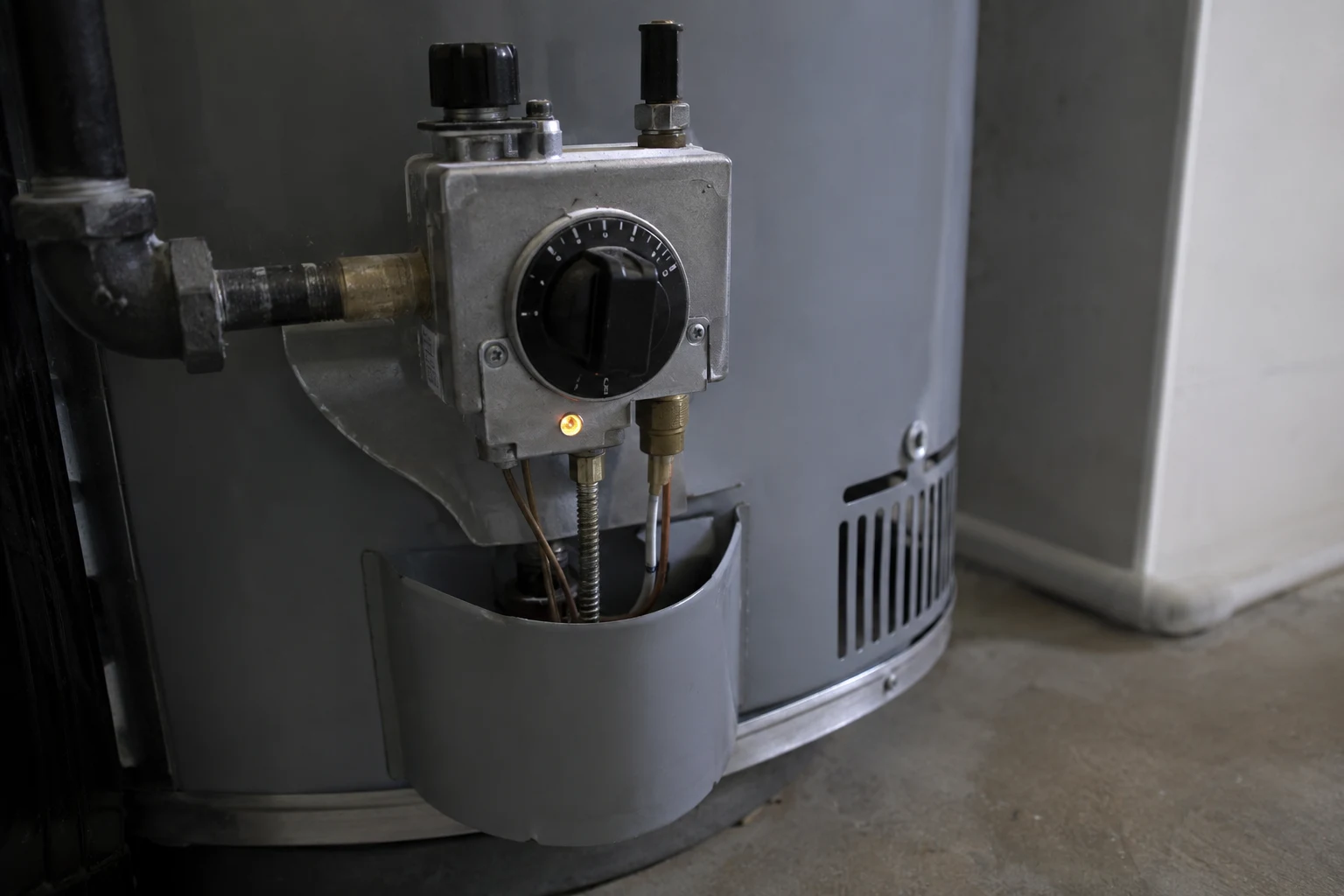
Look at the light on the gas control valve at the base. One flash roughly every three seconds is normal, the pilot is lit and the control is happy. A repeating pattern of two or more is a fault code. Two flashes is a weak or dirty pilot, three is a pilot outage, four is a high-temperature shutdown, six is the flammable-vapor lockout, seven is a gas valve fault. Match the count to the front label.
Electric Ruud, no hot water: find the ECO reset
Kill the 240 volt breaker first. Then open the upper access panel, fold the insulation back, and press the red high-temperature reset button until it clicks. If it holds, you are done. If it trips again within a day, the water is genuinely overheating and you have a real fault, not a nuisance trip. Stop resetting and diagnose.
Not enough hot water, or it runs out fast
On an electric Ruud, a burst of hot that turns cold mid-shower is the classic dead lower element. On a gas Ruud, short supply usually means a low temperature setting, a partly clogged burner, or a sediment layer insulating the flame from the water. Check the dial first, it costs nothing.
Water too hot or scalding
Check the setting before you assume a failure. Factory is 120 F. Turn a gas dial down a mark, or set both electric thermostats lower and equal with the breaker off. Water that stays scalding after you turn it down is a thermostat that has failed closed.
Quick answer
On a gas Ruud, count the status-light flashes. One flash every few seconds is normal. A repeating two or three flashes is usually a homeowner fix, relight the pilot per the front label. A repeating four, six, or seven flash means stop and call a pro. On an electric Ruud with no hot water, cut the breaker, then press the red ECO reset on the upper thermostat once. If it holds you are done; if it trips again, get it diagnosed. These are the same codes and reset Rheem uses, because it is the same hardware.
The pilot that will not stay lit
This is the most common gas call after a plain pilot outage, and the two-flash and three-flash codes both live here. A pilot that lights and dies the second you let go of the knob is a signal problem. The thermopile, a sensor sitting in the pilot flame, generates the small voltage that tells the gas valve to stay open. A dirty pilot, a weak flame that does not fully wrap the sensor, or a worn thermopile drops that voltage below what the valve needs, and it shuts. Relight it properly first: knob to pilot, press and hold a full thirty to sixty seconds so the flame heats the sensor, then turn to on. If it still drops, the orifice is likely dirty or the thermopile is spent, and once that voltage falls too low under load the sensor gets replaced.
Sediment, the quiet thief
When a Ruud rumbles or pops at the burner, that is water flashing to steam under a layer of hardened mineral scale on the tank floor. The same sediment steals usable volume and burner efficiency, so a 40 gallon tank starts acting like a 30 and runs out sooner than it used to. A yearly flush is both the fix and the prevention. If the tank has never been drained and it is pushing ten years old, a flush may buy time, but capacity lost once the scale cooked hard does not always come back, and sediment that traps heat against the steel hastens the day the tank leaks.
Leaks: where it drips decides everything
A little water at the temperature and pressure relief valve during a heating cycle can be normal thermal expansion. A T and P valve that drips steadily or runs means the pressure is too high or the valve is worn, and it is worth attention because that valve is the tank's last-line defense against rupture. Replace it, and if a new valve still drips, the house likely needs a thermal expansion tank. Never cap or plug it. A drip at a threaded fitting or a union up top can usually be tightened or resealed. The leak that ends the conversation is water weeping from the body of the tank, because the steel has corroded through and no patch holds. On a tank near or past its 8-to-12-year life, a body leak is a replacement.
Gas Ruud, three flashes, pilot out
The status light repeats three flashes and there is no hot water. That is a pilot outage. Relight per the front label, knob to pilot, hold it down thirty to sixty seconds so the flame heats the sensor, then turn to on. If it will not hold, the thermopile is weak or the pilot is dirty, and that is a straightforward parts job on a tank with life left.
Electric Ruud, no hot water, ECO tripped
No hot water at all on an electric unit usually means the red ECO on the upper thermostat has tripped, since it cuts both elements at once. Kill the breaker, open the upper panel, press the red button until it clicks. If it holds, done. If it trips again within a day, stop resetting and find why the water overheated.
Four or six flashes, or a wet tank base
A repeating four-flash high-limit or six-flash flammable-vapor lockout, a seven-flash gas valve fault, or water seeping from the body of the tank are not dial-and-reset problems. The failure mode is a burn, a combustion issue, or a flood. This is where a licensed plumber or gas tech earns the call.
The short version
Ruud troubleshoots exactly like Rheem because it is the same hardware from the same plant. On gas, count the status-light flashes against the front label: one flash is normal, two or three is often a homeowner relight, four, six, and seven mean stop and call. On electric, cut the breaker and press the red ECO reset once; a second trip is a real fault, not a nuisance. Keep the temperature at 120 F, never cap the T and P valve, and a leak from the body of the tank is a replacement, not a repair.
The stop-and-call-a-pro line
Plenty of this is a careful homeowner's afternoon with the breaker off and the manual open: relighting a pilot, resetting an ECO once, turning a scalding dial down, flushing sediment. The line worth respecting is where a fault keeps coming back or where the failure is the tank itself. A four-flash high-limit or an electric ECO that trips a second time both mean the water is genuinely overheating, and chasing that with repeated resets wears out a safety device and hides a real hazard. A six-flash flammable-vapor lockout, a seven-flash gas valve fault, and any smell of gas are hard stops. So is water seeping from the body of the tank. On a Ruud the label on the front of your unit is still the tie-breaker for any code, exactly as it would be on a Rheem.
Frequently asked
Are Ruud and Rheem water heaters the same, and does Rheem troubleshooting work on a Ruud?
For troubleshooting, treat them as the same heater. Ruud and Rheem are sister brands built by the same parent company in the same Fort Smith, Arkansas plant, off the same engineering. A gas Ruud and a gas Rheem of the same class use the same style of gas control valve, the same Honeywell or Resideo type control with a status light, and the same burner and tank. What differs is the badge, the trim, and which contractor in your town sells it. So yes, a Rheem flash-code chart, relight procedure, and parts diagram will almost always match your Ruud. The one rule that overrides everything: the label on the front of your heater is the final word. If it lists a flash count that disagrees with a chart online, trust the label, because it was printed for your exact model and valve.
What do the flashes on my Ruud gas water heater status light mean?
The little light on the gas control valve counts out a code. One flash about every three seconds is the good one, the pilot is lit and the control sees what it wants to see. Trouble is a repeating pattern of two or more. Two flashes is low thermopile voltage, usually a weak or dirty pilot flame. Three flashes is a pilot outage, the pilot has gone out or the thermocouple is not sensing it. Four flashes is a high-temperature shutdown, meaning the water or the flue got too hot, often a venting problem. Five flashes points at a temperature sensor fault. Six flashes is the flammable-vapor lockout that shuts the heater down after it detects combustible fumes. Seven flashes is a gas control valve failure. These are the same sequences Rheem uses. Read the count against the front label: two or three is usually a homeowner relight, while four, six, and seven mean stop and call a tech.
Where is the reset button on a Ruud electric water heater and how do I use it?
It is the red button on the upper thermostat, the ECO or high-temperature cutoff, behind the upper access panel with the insulation folded out of the way. Before your hand goes near it, switch off the breaker feeding the heater. There is 240 volts on the terminals right beside that button. With the power off, press the red button firmly until it clicks, then close everything back up before you turn the breaker on. Here is the part that matters more than pressing it. The ECO only trips because the water actually overheated. If the reset holds, you are fine. If it trips again within a day, something is cooking the water, usually a thermostat set too high, a thermostat that failed closed, or an element shorted to the tank. Do not keep resetting it. A second trip means leave it off and get the cause diagnosed.
My Ruud gas water heater pilot will not stay lit, what is wrong?
When a pilot lights and then dies the moment you release the knob, the control is not getting enough signal that the flame is really there. On these gas valves that signal comes from the thermopile, a sensor sitting in the pilot flame that generates a small voltage. A dirty pilot, a weak flame that does not wrap the sensor, or a worn thermopile drops that voltage and the valve closes. Start by relighting per the label: knob to pilot, press and hold a solid thirty to sixty seconds so the flame heats the sensor before you release. If it still will not hold, the orifice is likely dirty or the thermopile is spent. A healthy thermopile holds well above a few hundred millivolts under load; once it falls below that it is too weak and gets replaced. A three-flash status code lines up with exactly this problem.
What temperature should a Ruud water heater be set to?
Ruud ships them at 120 degrees Fahrenheit and that is the number most homes should keep. It is hot enough for showers and dishes and low enough that a hand under a running tap does not scald instantly. The dial goes higher, toward 140 or 150 on most units, but every degree above 120 shortens the time it takes to burn skin, a real hazard with young kids or older adults in the house. If your water comes out scalding, check the setting first. On a gas Ruud the dial is on the control valve and each mark is roughly a ten-degree step. On an electric Ruud there are two thermostats, upper and lower, and both have to be set to the same point with a small flat screwdriver, breaker off. Water that runs hotter than the dial claims, or will not turn down, is a failing thermostat, not a setting.
My Ruud water heater is leaking, can I fix it myself?
Where it leaks decides the answer. A little water dripping from the temperature and pressure relief valve during a heating cycle can be normal thermal expansion. A T and P valve that drips steadily or runs means the pressure is too high or the valve is worn, and that deserves attention because it is the tank's last-line safety device against rupture. Replace it, never cap or plug it, and if a new valve still drips, the house likely needs a thermal expansion tank. A drip at a threaded connection or a union up top can often be tightened or resealed. The leak you cannot fix is water weeping from the body of the tank itself. The steel has corroded through and no patch holds. On a tank near or past ten years old, a body leak is a replacement, not a repair. Keep a drip pan with a drain under the heater so a slow leak has somewhere safe to go.
How do I know when to replace a Ruud water heater instead of repairing it?
Age plus the kind of failure. A residential tank usually runs 8 to 12 years, and past that window the math tips toward replacement. The clearest replace-it sign is water seeping from the body of the tank, since the steel has rusted through and cannot be sealed. Persistent rusty hot water after a full flush and heavy sediment that keeps causing rumble on an old unit point the same direction. Repairs make sense on a younger tank: a bad thermostat, one shorted element, a worn T and P valve, a weak thermopile, or a pilot that will not hold are all routine parts jobs on a heater with years left. The judgment call is a repeatedly tripping ECO or a four-flash high-limit on a ten-year-old tank, where the smarter move is often to put the repair money toward a new unit.
Why does my Ruud gas water heater status light flash six times?
Six flashes is the flammable-vapor lockout, and it is the one code you do not reset and walk away from. Ruud gas tanks, like Rheem, are built to a flammable-vapor ignition resistant design, meaning they are made to survive gasoline or solvent fumes drifting across the floor without igniting them. When the system senses those fumes, it locks the heater out on purpose and flashes six to tell you why. Do not just try to relight it. First figure out what put combustible vapors near the heater, a gas can, paint thinner, a spill, and air out the space. A six-flash that will not clear after the air is clean, or that keeps coming back, means the resettable feature is spent or a sensor has failed, a call for a licensed tech. Storing flammable liquids away from the heater is the real fix.