The number on a Ruud tankless display is not random, and it is not a mystery once you know that Ruud and Rheem are the same platform under two badges. Ruud is Rheem's sister brand, the control boards are the same, and the numeric fault codes read the same on both. So a Code 11, a 14, or an LC on a Ruud means exactly what it means on a Rheem. Most of those numbers fall into two buckets: gas supply and hard-water scale. Read the code off the unit or the remote, decide which bucket it lives in, and you have already done half the diagnosis. This page maps every common Ruud code to its cause and the fix behind it.
The short version
Ruud tankless codes match Rheem codes because the two brands share a platform. Codes 11 and 12 are gas-supply faults: check the gas valve, other gas appliances, propane level, and the gas line size. Codes 14 and LC are hard-water scale: descale through the service valves. Codes 13, 29, 61, and 76 cover the flame rod, condensate drain, combustion fan, and remote-controller link. Read the number, cycle power once, and if the same code returns, chase the cause the number names.
Before you start
Turn the gas and power off before you open any panel on a tankless unit, and never bypass a safety to force a locked-out burner to run. A code that keeps returning after a clean reset is a real fault. If you smell gas, stop, leave, and call the gas company.
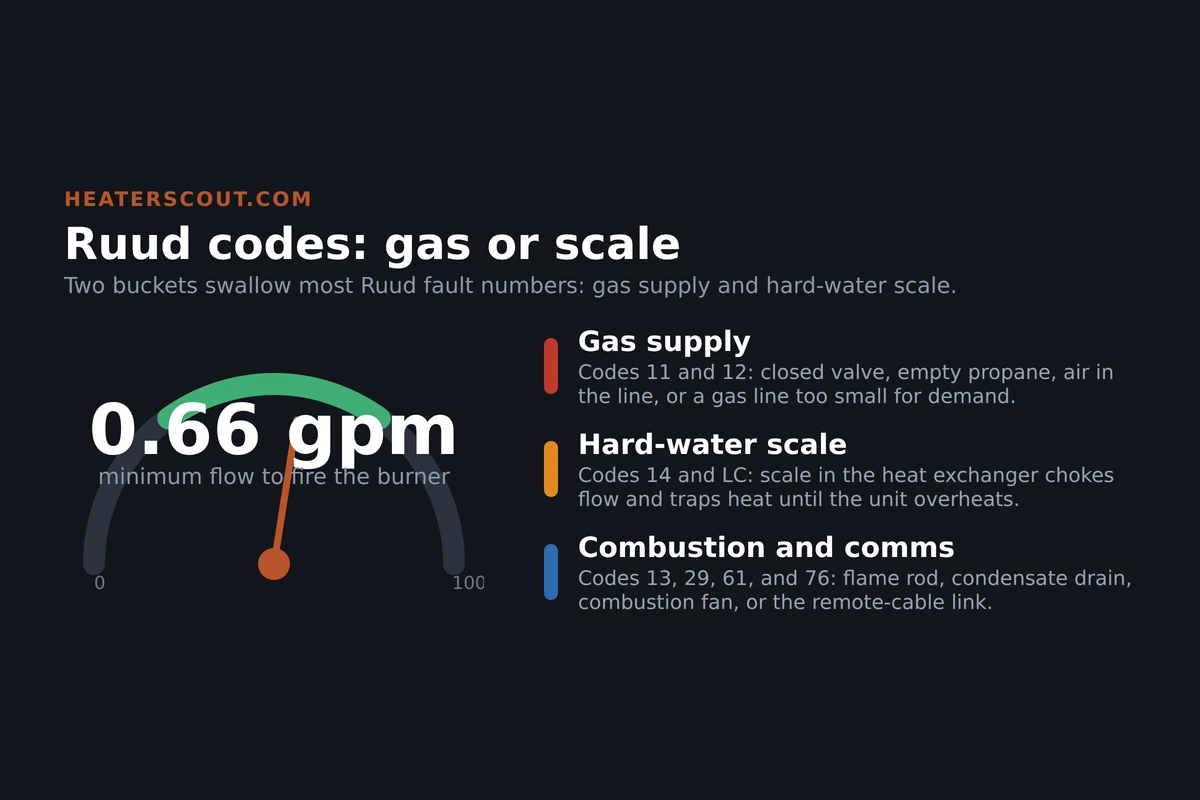
The Ruud tankless code chart
This is the core of the page. The number shows on the unit's display or on the remote controller if one is wired in. Because Ruud and Rheem share the same board, this chart reads the same on either badge. Match your number to the row, note whether it lands in the gas bucket, the scale bucket, or the combustion and comms bucket, and work from there.
| 11 | No ignition. Burner never lit: closed gas valve, empty propane, gas line too small, or air in the line on a first fire. |
| 12 | Flame loss during operation. Gas pressure dip under load, wind across the vent, or a partial intake or exhaust blockage. |
| 13 | Combustion abnormality. Flame-rod fault, poor flame signal, or a dirty or misaligned flame sensor. |
| 14 | Overheat / thermal fuse. Scale in the heat exchanger, restricted flow, or a blocked vent trapping heat. |
| 29 | Condensate drain blockage. Condensing models only: the condensate line or trap is clogged and backing up. |
| 61 | Combustion fan fault. The fan motor is failing, jammed, or its wiring or speed feedback is bad. |
| 76 | Communication error. The link between the unit and the remote controller is broken: cable, connector, or wiring. |
| LC | Scale buildup / descale reminder. Hard water has built up enough runtime that the unit wants a descale. |
| P1 / low flow | Insufficient flow to activate. Draw is below 0.66 gpm, the minimum to ignite the burner, so the flow sensor never fires it. |
Two rows carry most of the traffic. Codes 11 and 12 are the gas-supply faults, the ones that turn up when a valve got bumped, a propane tank ran low, or a gas line was sized for a smaller appliance. Codes 14 and LC are the hard-water faults, the ones that show up over years as scale coats the heat exchanger. If you own one of these heaters in a hard-water area, you will meet 14 and LC eventually. The rest, 13, 29, 61, and 76, are more specific and less common, and each points cleanly at a single component.
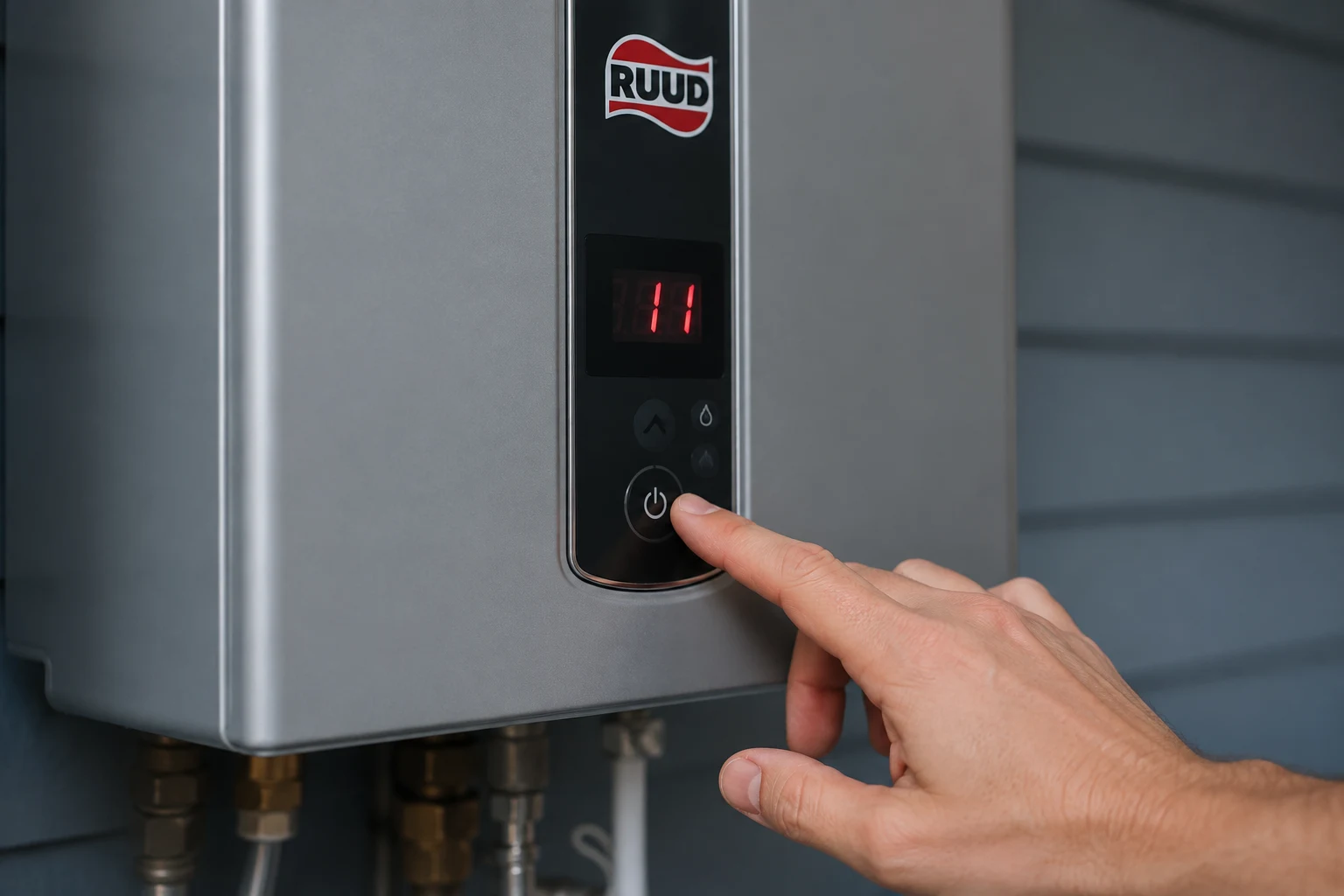
Where does the code actually show up on a Ruud tankless?
On the unit's own display behind or below the front panel, and on the remote controller if one is installed. If you have a remote in the kitchen or bathroom, the number appears there too, which is usually the easiest place to read it. Note the exact digits before you cycle power, because clearing the fault also clears the readout and you lose the code you were about to chase.
How to work a Ruud code in order
The codes vary, but the diagnostic path does not. Follow the same sequence every time and you will land on the cause without buying parts you do not need. Read the number first, then work outward from the cheapest and most common causes to the specific components.
Scenarios: which code, which move
The right first move depends on the number and the situation around it. These are the patterns that come up most often, matched to what actually fixes them.
Air in the gas line
A fresh install or a refilled propane tank often leaves air ahead of the gas. The burner sparks but only air reaches it for the first seconds, so it locks out. Purge the line: run another gas appliance nearby, or on propane bleed the line at the unit. A tank that ran fully dry may need a licensed LP tech to purge and relight.
Gas line too small
If the fault shows only when several taps run or the furnace kicks on, the gas line is likely undersized or shared and starves the burner under load. It lights, then sags. This needs a pro with a manometer to read gas pressure at the unit and, if it is low, upsize the line.
Scaled heat exchanger
Years of hard water coat the exchanger, choke flow, and trap heat until the unit overheats or asks for a descale. Circulate vinegar or descaler through the service valves for an hour, flush, and clean the inlet filter. Then descale annually so 14 never comes back.
Remote cable or connection
A 76 is a communication error between the unit and the remote controller. Check the two-wire cable, its connectors, and any splice for a loose or corroded connection. It is a wiring problem, not a burner problem, so leave the gas and flame side alone.
One habit ties all of this together. Because Ruud shares Rheem's platform, the generic Rheem service sheets and code charts apply to your unit without translation, so you are never short on reference. But the sequence matters more than the sheet: read the number, put it in the gas bucket or the scale bucket, do the free checks first, and reset only once. If the same code returns after a clean reset, the fault is real. Chase the component the number names rather than clearing it again while the cause, most often scale or gas pressure, quietly gets worse.
Frequently asked
Are Ruud and Rheem tankless error codes the same?
Yes. Ruud is Rheem's sister brand, and the two tankless lines are built on the same platform with the same control board, so the numeric fault codes read identically. A Code 11 on a Ruud means the same no-ignition fault it means on a Rheem, a 14 is the same overheat trip, and an LC is the same scale reminder. That is genuinely useful when you are hunting for parts or a service sheet, because a Rheem tankless code chart applies to your Ruud unit without translation. The number shows on the unit's own display or on the remote controller if one is wired in. Read the digits, match them to the chart, and work the cause the number points at. The only practical difference between the two brands is the badge on the front and sometimes the model prefix, not the diagnostic logic behind the display.
What does error code 11 mean on a Ruud tankless?
Code 11 is a no-ignition fault: the burner tried to light and never did, so the unit locked out to stay safe. Gas supply is the first and most common cause. Confirm the manual gas valve at the heater is fully open, then check that another gas appliance in the house runs, which tells you gas is reaching the building. On propane, make sure the tank is not low or empty. If the unit is on its first fire after install, or after an LP tank ran dry and was refilled, there is often air trapped in the gas line that has to be purged before the burner will light. A gas line that is too small or shared with a furnace can also starve the burner under high demand and throw an intermittent 11. Only after the gas checks out do you move to the igniter and flame rod.
What is the difference between Ruud code 11 and code 12?
Both are combustion faults, but they happen at different moments. Code 11 means the burner never lit at all: the unit sparked, saw no flame, and gave up. Code 12 means the burner did light and then lost the flame partway through the run. Because of that timing difference, they point at slightly different causes. Code 11 leans toward gas supply that is fully absent, a closed valve, an empty tank, or air in the line. Code 12 leans toward gas pressure that drops under load, wind blowing across the vent, or a partial blockage in the intake or exhaust that starves the flame once it is running. A gas line too small for the heater can throw either one, since it delivers just enough to light and then sags when the burner ramps up. Read which number you got and start on the matching side.
What causes Ruud code 14 and how do I fix it?
Code 14 is an overheat trip, usually the thermal fuse or high-limit reacting to water that climbed past its limit inside the heat exchanger. The number-one cause is scale. Hard water leaves mineral deposits that coat the exchanger, choke water flow, and trap heat against the metal until the unit shuts down to protect itself. The fix is a descale: run a pump and white vinegar or a commercial descaler through the service valves for about an hour, then flush. Other causes are a restricted flow from a clogged inlet filter or a partly closed valve, and a blocked vent that traps heat. If a fresh descale and a clean inlet filter do not clear a repeating 14, the high-limit sensor or the exchanger itself may be failing, which is a technician's call.
Will descaling clear a Ruud LC or 14 code?
For the scale-driven codes, yes, and it is the main reason those codes exist. An LC is Ruud's descale reminder, the unit telling you it has counted enough runtime in hard water that scale is likely building up. A Code 14 overheat is often the same scale problem one step further along, where the deposit has already choked flow enough to trip the high limit. Running a descale kit through the service valves, an hour of white vinegar or descaler circulated with a small pump, then a clean-water flush, clears the deposit and resets the reminder. It will not fix a gas fault like 11 or 12, a comms fault like 76, or a fan fault like 61, so match the number first. But on 14 and LC, an annual descale is both the cure and the prevention, and hard water is the single biggest long-term killer of these heaters.
Why does my Ruud tankless keep showing the same code after a reset?
Many Ruud faults clear when you cycle the unit off and on, either at its power switch, its breaker, or the on/off button on the remote. But cycling power only clears the display. It does not touch the cause. If the same number comes right back on the next hot-water call, the root problem is still there. A repeating 11 means the gas is still not arriving or the igniter is still failing. A repeating 14 means the scale or the restriction is still choking the exchanger. A repeating 76 means the remote cable or connection is still bad. Treat a code that returns after a clean reset as a real, unresolved fault, and stop resetting. The number is telling you which system to chase, and repeatedly clearing it just delays the actual fix while the cause, often scale or gas pressure, keeps getting worse.
Does a Ruud tankless need a minimum water flow to turn on?
Yes. A tankless heater fires only when it senses enough water moving through it, and on a Ruud that threshold is 0.66 gpm to ignite the burner. Below that, the flow sensor never triggers the burner, so a trickle at a faucet or a low-flow fixture can leave you with cool water and no fault at all, or a low-flow indication like P1. This trips people up on a bathroom sink set to a thin stream, or when scale and a clogged inlet filter have cut the flow the unit actually sees. If a Ruud will not fire on a small draw, open the tap wider first. If it still will not fire on a healthy flow, clean the inlet filter screen and descale, because a scaled exchanger and a dirty filter both drop the real flow below the sensor's trigger point even when the faucet is wide open.