A Rheem RTEX is a wall of copper heating chambers and a control board, nothing more. There is no flame to lose, no vent to block, no pilot to relight, so when something goes wrong the RTEX cannot flash a combustion code the way a gas tankless does. Instead it throws a short two-character code onto the little digital display on its front cover, and every one of those codes points at something electrical: a temperature sensor, a heating element, an overheat cutoff, or the flow sensor that decides whether water is even moving. This page walks the E-series codes the RTEX actually shows, how to read the display without guessing, how to clear a one-time fault with a breaker cycle instead of a reset button the unit does not have, and which codes are safe homeowner work versus which ones mean killing 240 volts and calling a pro.
Read the display before you touch anything
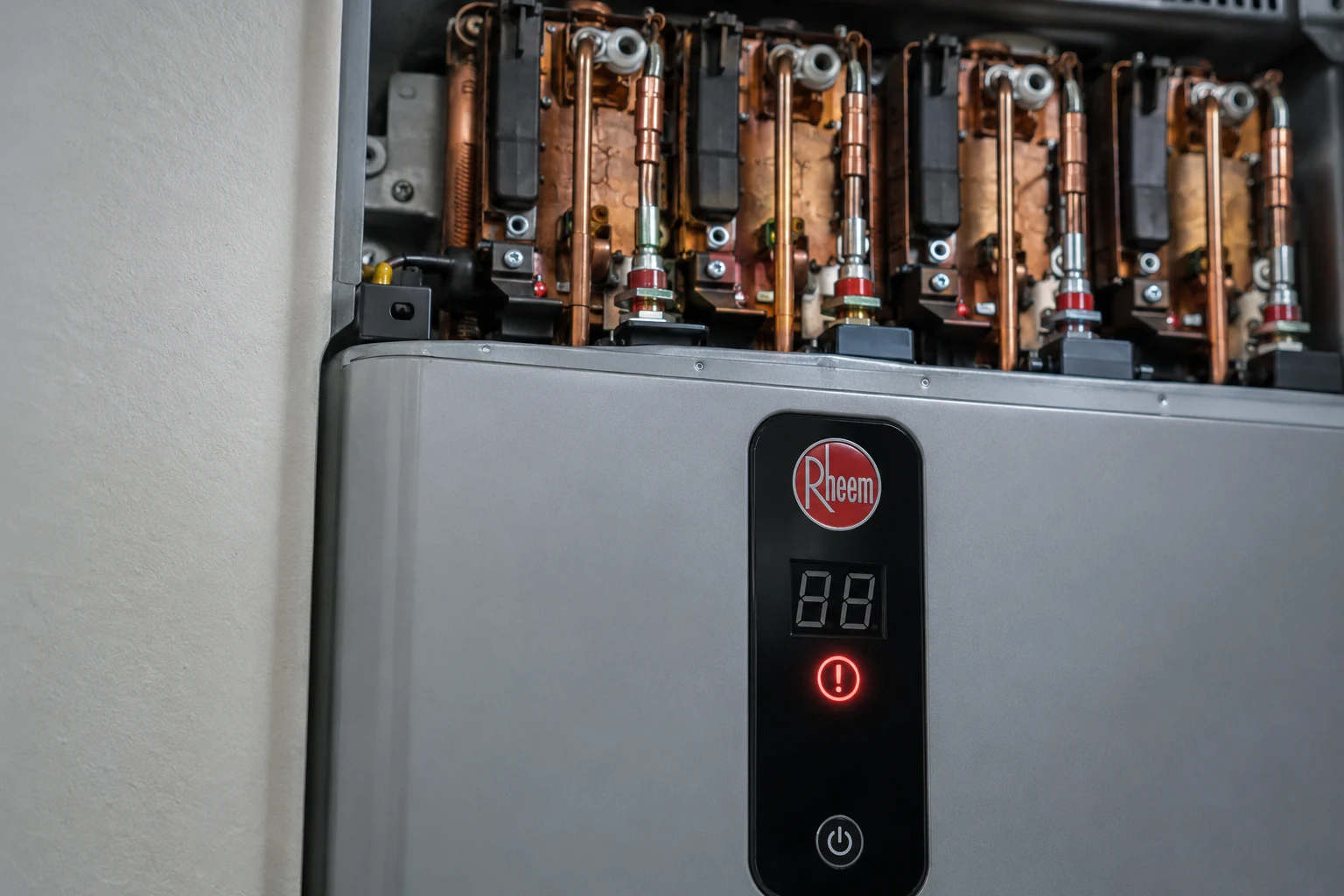
The RTEX code lives on the small digital readout on the front cover, the same display you use to set the temperature. It is a two-character code, almost always an E followed by a single digit. Get the exact number first, because the display goes blank the instant you cut power, and a breaker cycle is often the very first thing people try. Lose the code and you are back to guessing.
240 volts, high current, cover stays on
The RTEX runs on 240 volts and the whole-home models pull 54 to 112 amps across one or two double-pole breakers. Before you remove the front cover for any element or sensor test, switch off every breaker leg feeding the unit and confirm it is dead. Never bypass or jumper the high-limit cutoff to clear an overheat code, and never run the elements with the cover off.
The RTEX code families, and what each one is telling you
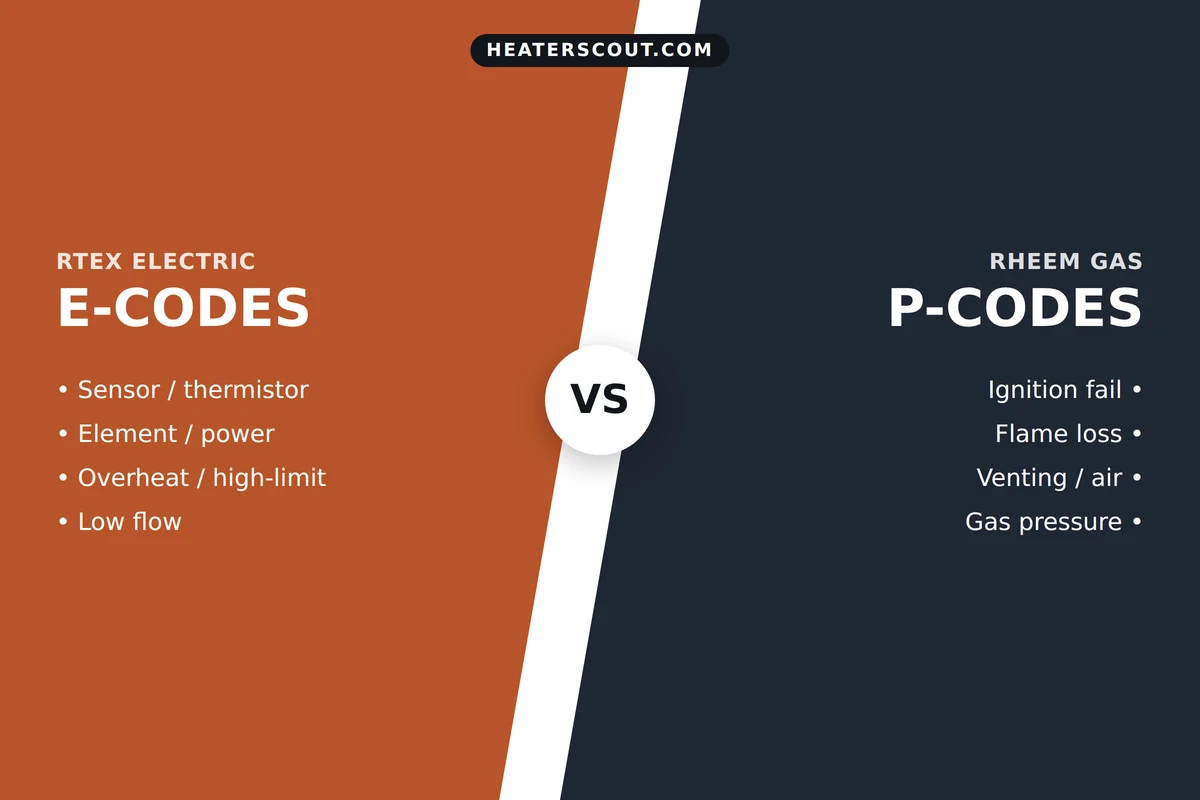
Rheem groups the RTEX faults by the electrical part behind them rather than by a long numbered list, and the short E-codes you see on the display fall into four buckets. The number attached to each meaning can shift a little between build years and between the point-of-use and whole-home models, so treat these as the families to diagnose and confirm the specific digit against your own manual. What does not change is which part each family sends you toward.
Temperature-sensor / thermistor fault
The control has lost a believable reading from a temperature sensor, either the inlet or the outlet thermistor. Causes are a disconnected or damaged sensor lead, a sensor reading out of range, or incoming water below about 50 F confusing the inlet reading. Check the sensor connections first; a genuine sensor failure needs a resistance test and often a part swap, which is pro territory on a live 240-volt unit.
Heating-element or power fault
One of the heating chambers or the power feeding it is not behaving. On the whole-home models power is split across two double-pole breakers, so a single tripped or loose leg can leave half the elements dead and throw a code even though the display still lights. Confirm both breakers are on and holding, then an electrician can ohm the elements for an open or shorted coil.
Overheat / high-limit trip
The safety cutoff sensed water leaving the heating chamber past its limit and shut the elements down. Think high set point plus very low flow, scale in the chamber trapping heat, a flow sensor under-reporting flow, or the tail of a brief dry-fire. Drop the set point toward 120 F, confirm real flow, and descale before you suspect the sensor. This is a safety trip, not a nuisance to reset past repeatedly.
Low-flow / flow-sensor fault
The flow sensor cannot see enough steady water to fire the elements safely, or it is reading erratically while water is clearly running. The usual culprits are a clogged inlet filter screen, a stuck or fouled flow sensor, scale, or a service valve that is not fully open. This family is the most common and the most homeowner-friendly to chase.
Quick answer
The Rheem RTEX shows a short E-code on its front digital display, and because the unit is all-electric the code always points at an electrical part, never at combustion. The four families are a temperature-sensor or thermistor fault, a heating-element or power fault, an overheat or high-limit trip, and a low-flow or flow-sensor fault. There is no red reset button: you clear a one-time code by cutting the double-pole breaker for a minute and switching it back on. Confirm the exact digit against your unit's owner's manual, since the numbering varies slightly by model and build year.
Low flow: the code most owners can fix without opening anything
Flow problems cause more RTEX complaints than any other single thing, and most of them never require removing the cover. The RTEX only energizes its elements once the flow sensor sees enough water moving. On the point-of-use RTEX-04T and RTEX-06T that activation threshold is about 0.25 GPM, and the whole-home RTEX-13 through RTEX-27 sit in a similar low range of roughly a quarter to a third of a gallon per minute. Fall below it and the heater stays cold with no code at all, which is why a barely-cracked faucet or an aggressive water-saving aerator can look like a broken heater when the unit is fine.
A flow-related code is different: it means the sensor is seeing erratic or no flow while water is clearly running. Start at the inlet. There is a small filter screen on the cold inlet that catches grit and mineral flake, and a clogged screen is the number-one cause of a flow fault. Kill the breaker, close the service valves, pull and rinse the screen, and check that both service valves are fully open, not cracked half-shut from the last service. If your water is hard, scale inside the copper heating chamber narrows the passages and skews the flow reading, and a periodic descale flush with white vinegar or a descaling solution clears it. Only after the screen, the valves, and a descale still leave a flow code do you suspect the flow sensor itself.
Overheat, dry-fire, and the temperature range
The RTEX external control adjusts in one-degree steps across an 80 to 140 F range, holding about plus or minus one degree on the outlet. That range matters for the overheat code, because the two ingredients of a high-limit trip are a high set point and low flow. Push the dial toward 140 and then draw a slow trickle, and the water dwells over the elements long enough to overshoot the cutoff. Drop the set point toward 120 degrees, which is also the safer scald-prevention setting, and a lot of nuisance overheat codes simply stop.
Dry-fire is the more serious cousin. If the elements ever energize with too little water around them, they overheat almost instantly, and the RTEX's flow logic and high-limit are what stand between a momentary air pocket and a cooked element. This is why you never run the unit with the plumbing not fully purged of air after service, and why an overheat code right after you worked on the plumbing usually means air in the lines, not a dead sensor. Purge the air by running a hot tap wide open for a minute with power off, then restore power. If overheat codes keep coming on a clean, well-purged unit at 120 degrees with good flow, the temperature sensor or control board is drifting and it is time for a pro to test resistances.
Reset the RTEX the right way, and know when to stop
People go hunting for a red reset button on the RTEX because tank electric heaters have one behind the upper panel. The RTEX does not. Its reset is a power cycle. Press the front power button to turn the unit off, or for a fuller reboot switch off the double-pole breaker or breakers feeding it, wait a full minute so the control board completely drops power, then switch the breaker back on and open a hot tap. That clears a one-time code. Do it once. Repeatedly resetting an overheat code or a sensor code that keeps returning is the wrong move: those are the unit telling you a real condition exists, and a high-limit trip in particular is a safety function you do not want to keep forcing past.
Where you stop depends on the family. Low-flow codes are homeowner work end to end: screen, valves, descale. A single reset after a glitch is fine for anyone. But element, thermistor, and control-board faults live inside a 240-volt appliance pulling up to 112 amps, and testing an element or a sensor with a meter, or touching any wiring, belongs to a licensed electrician or plumber with both breaker legs confirmed dead. Before any of that, pull the full model and serial off the rating label on the side of the unit and check your warranty, because the RTEX carries a multi-year parts warranty and a covered element or board turns a part-plus-labor bill into labor only.
Match the fix to your model
The RTEX line spans a point-of-use pair and four whole-home sizes, and the electrical load climbs steeply, which changes both what a power fault looks like and who should touch it. A code that leaves half a two-breaker unit cold reads very differently on a single-breaker RTEX-13 than on a two-breaker RTEX-27.
RTEX-04T and RTEX-06T
The 3.5 kW 120-volt 04T and the 6.5 kW 240-volt 06T are single-chamber, single-breaker units on a 30-amp double-pole (06T) or 30-amp single-pole (04T) circuit with 10 AWG wire. Minimum activation flow is about 0.25 GPM. With one element and one breaker, a power code is usually a tripped breaker or a loose leg, and flow codes still start at the inlet screen.
RTEX-13
The 13 kW RTEX-13 runs on 240 volts at about 54 amps on a single 60-amp double-pole breaker with 6 AWG copper. One breaker means a power fault points squarely at that breaker or its connections. It is the smallest whole-home model, best for warm-climate single fixtures, so an overheat code often just means the set point is too high for the flow.
RTEX-18 and RTEX-24
The 18 kW RTEX-18 (about 75 amps, two 40-amp double-pole breakers, 8 AWG) and the 24 kW RTEX-24 (about 100 amps, two 40-amp double-pole breakers, 8 AWG) split power across two circuits. A single tripped leg can leave half the elements dead and throw a code while the display still lights, so confirm both breakers before suspecting an element.
RTEX-27
The 27 kW RTEX-27 pulls up to about 112 amps on two 60-amp double-pole breakers with 6 AWG copper, delivering up to roughly 6.6 GPM. It is the most demanding to wire and the least forgiving of an undersized feed, so recurring power or overheat codes here often trace back to the electrical supply or heavy scale in the largest heating chamber.
Whatever model you have, the workflow is the same: read and write down the exact code, group it into sensor, element, overheat, or flow, and confirm the digit against your own owner's manual before you spend a dollar. Reset once with a breaker cycle. Clear low-flow codes yourself at the inlet screen and with a descale. And the moment a code points inside the 240-volt cabinet at an element, a thermistor, or the board, kill both breaker legs and bring in a pro rather than working a live high-current appliance.
Frequently asked
What do the error codes on a Rheem RTEX tankless mean?
The RTEX shows a two-character code on the small digital display on the front of the unit, and because the RTEX is all-electric there is no flame, ignition, or venting to fail, so every code points at an electrical part. The E-series you will actually see maps to four families: a temperature-sensor or thermistor fault, a heating-element or power fault, an overheat or high-limit trip, and a low-flow or flow-sensor problem where the unit cannot sense enough water moving to fire safely. The exact number tied to each meaning has shifted slightly across build years and between the point-of-use RTEX-04T and 06T and the whole-home RTEX-13, 18, 24, and 27, so the flash you see should always be matched against the code legend in your own unit's owner's manual, which is the final word for your serial. What stays constant is the logic: a sensor code means a thermistor or its wiring, an element or power code means a heating chamber or a breaker leg, and an overheat code means the high-limit cutoff fired.
How do I clear or reset a Rheem RTEX error code?
The RTEX has no red reset button like a tank electric heater does. You clear a one-time fault by power-cycling the unit: press the power button on the front to turn it off, or better, switch off the double-pole breaker or breakers that feed it, wait a full minute so the control board fully drops power, then switch the breaker back on and run a hot tap. That reboots the control and clears a code that was a glitch. It does not fix a cause. If the same code returns the moment you draw hot water again, the fault is real and repeating, and cycling power a second and third time will not make it go away. Note the exact code before you reset, because the display clears when power drops and you lose the number you were reading.
What is the minimum flow to make a Rheem RTEX turn on?
The RTEX fires its elements only when the flow sensor sees enough water moving. On the point-of-use RTEX-04T and RTEX-06T the minimum activation flow is about 0.25 GPM, and the whole-home RTEX-13 through RTEX-27 sit in a similar low range, roughly a quarter to a third of a gallon per minute. That is why a barely-cracked faucet or a water-saving aerator can leave the heater cold: it never reaches the activation threshold, so the elements never energize and you get cool water with no code at all. A flow-related code, by contrast, means the sensor is seeing erratic or no flow while water is clearly running, which points at a clogged inlet screen, a stuck flow sensor, sediment, or a partially closed service valve rather than at your faucet.
Why does my RTEX show an overheat or high-limit code?
An overheat or high-limit code means the RTEX's safety cutoff sensed water leaving the heating chamber hotter than its limit and shut the elements down to protect you and the unit. The common causes stack from simple to serious: a set point dialed near the 140 degree top of the range with very low flow, so the water dwells too long over the elements; scale or sediment inside the copper heating chamber trapping heat; a flow sensor under-reporting how much water is moving; or a temperature sensor drifting high. It can also be the tail end of a brief dry-fire event, where the elements ran with too little water. Drop the set point toward 120 degrees, confirm real flow at the tap, and if the code returns on a clean unit at a sane setting, the sensor or control needs a pro.
Are Rheem RTEX electric error codes the same as Rheem gas tankless codes?
No, and mixing them up sends people chasing the wrong part. The Rheem gas tankless line, the RTGH and RTG condensing and non-condensing heaters, throws numeric and P-style codes like 11, 12, 13, and P1 that describe combustion problems: no ignition, flame loss, venting or air-supply faults, and gas-pressure issues. The RTEX is electric, so none of that hardware exists. Its codes are the short E-series that describe sensors, elements, overheat, and flow. If you are reading a chart full of ignition and exhaust codes, you are on the gas page and it does not apply to your RTEX. Always confirm you are reading the electric RTEX legend, which lives in the RTEX owner's manual and on the label of the unit itself.
Can I fix a Rheem RTEX error code myself or do I need an electrician?
It depends on the code and your comfort around a 240-volt circuit. Low-flow problems are homeowner work: clean the inlet filter screen, open the service valves fully, and flush scale from the heating chamber with a descaling kit. A single reset after a one-time code is also fine for anyone. But the RTEX runs on 240 volts and the whole-home models pull 54 to 112 amps across double-pole breakers, so the moment a code points at a heating element, a thermistor buried in the unit, or the control board, you are opening a live high-current appliance. That is where testing element resistance or sensor resistance with a meter, and any wiring work, belongs to a licensed electrician or plumber. Always kill both breaker legs before removing the cover, and never bypass the high-limit cutoff to silence an overheat code.
Where is the model and serial number on a Rheem RTEX?
On the rating label, printed on the side of the RTEX housing. It lists the full model number, the RTEX-13, RTEX-18, RTEX-24, RTEX-27 or the point-of-use RTEX-04T and RTEX-06T, along with the kW rating, the 240-volt or 120-volt supply, the total amperage, and the serial number that encodes the build date. Write down both the complete model and the complete serial before you call Rheem or buy a part, because the heating elements, thermistors, and control boards are keyed to the exact model and kW, and the serial decides whether you are still inside the warranty window. The RTEX line typically carries a multi-year parts warranty on the heat exchanger and electronics.