Four flashes on a Honeywell gas valve is a high-temperature shutdown. Four flashes on a classic Robertshaw valve is a venting problem. Same count, different part, and if you read a Robertshaw code off a Honeywell chart you will spend an afternoon chasing the wrong fault. Robertshaw is the other major gas-control maker on US tank water heaters, and its flash chart was never standardized against Honeywell's. This page lays out the Robertshaw counts, shows how the Robertshaw reset differs, and puts the two makers side by side so you can see exactly where they diverge.
First job: identify the valve, not the water heater brand
The water heater badge on the tank tells you almost nothing about which flash chart to use. A.O. Smith, State, Rheem, Bradford White, and American all buy gas controls from outside suppliers, and the two big ones are Honeywell and Robertshaw. The maker's name is molded or printed on the gas control itself, low on the tank near the temperature dial. Robertshaw controls commonly show a Uni-Line 66-series part number. Honeywell controls show a WV or WT number. Read that before you read a single flash, because the count means different things on each.
Robertshaw gas control valve
The combination gas valve and thermostat that Robertshaw (sold under the Uni-Line brand) supplies to several US water-heater makers. It combines the gas shutoff, the temperature dial, a built-in non-cycling ECO high-temperature cut-off, and a small diagnostic LED that reports the heater's state as a flash count. Robertshaw has used more than one code map over the years: the classic 1610-style valve and the newer ICON valve read differently from each other, and both read differently from a Honeywell control, so the flash count only means something once you know exactly which valve you have in front of you.
Those three facts cover most calls. A single short flash roughly every four seconds is the normal idle heartbeat, not a fault. A steady bright-to-dim pulsing means the burner is firing on a call for heat. Everything else, the rapid multi-flash bursts with a pause between them, is a code.
How to read a Robertshaw code without getting fooled
The flashes are quick and the pause between bursts is long, usually around three seconds, so it is easy to miscount. Work it slowly and confirm the number before you touch anything.
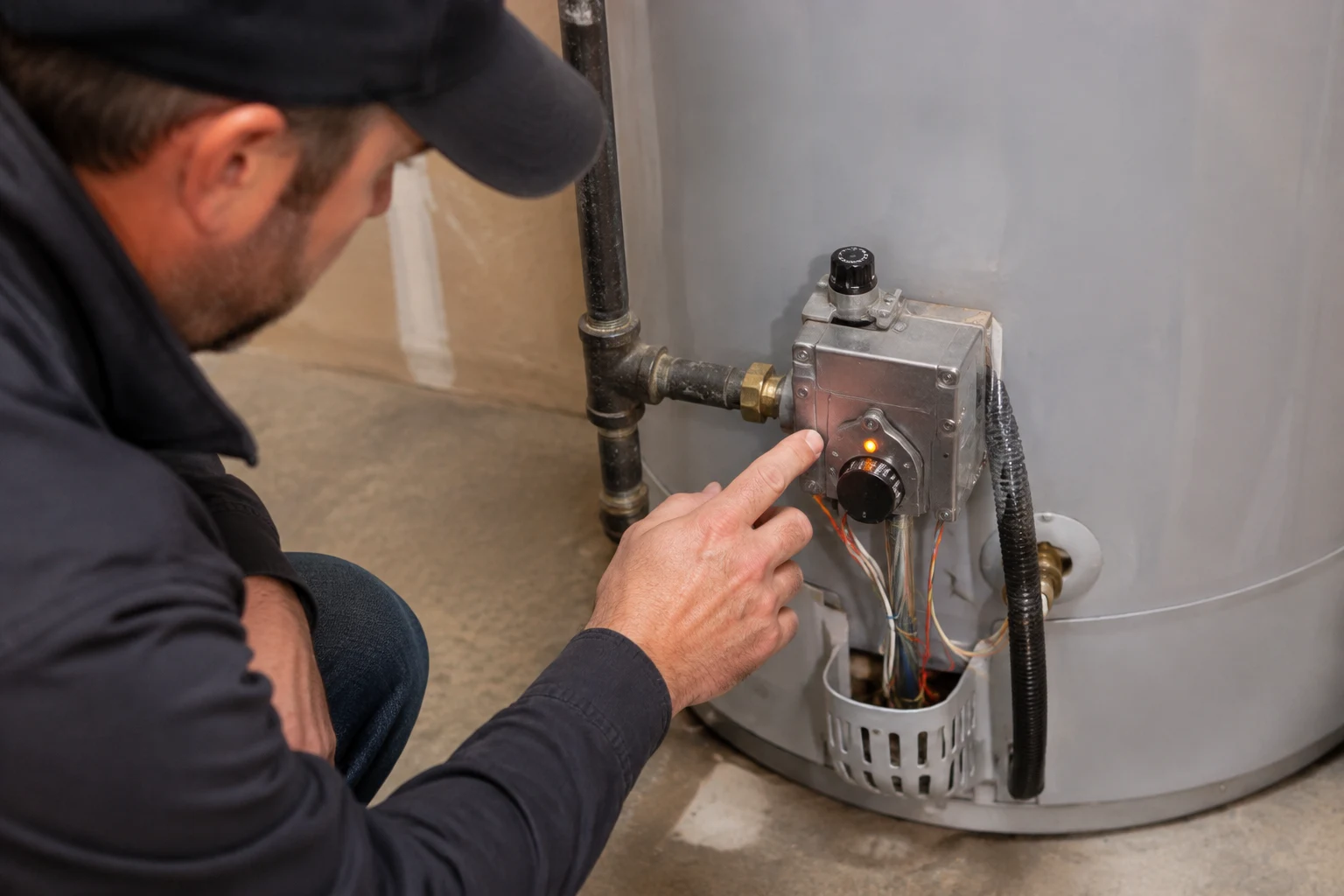
- Find the small status LED on the gas control valve, low on the tank near the temperature dial.
- Watch one full burst-and-pause cycle first without counting, just to learn the rhythm.
- Count only the quick flashes inside a single burst, stopping at the long pause. Never count across the pause.
- Confirm you get the identical count on the next burst. Real codes repeat cycle after cycle.
- Write the count down before you reset, because a power cycle clears the display and you lose the code.
- Note whether the valve says Robertshaw or Honeywell, and whether it is a 66-series or an ICON control.
Quick answer
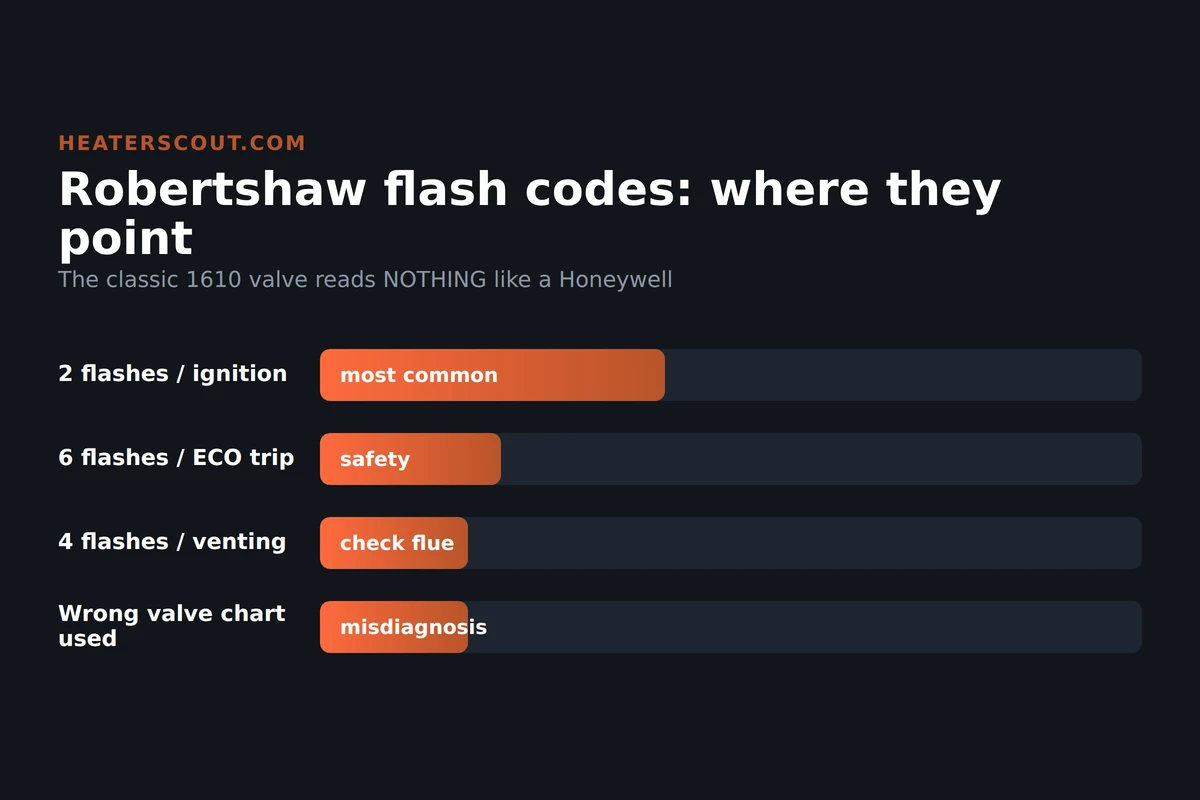
On a classic Robertshaw control, 2 flashes is the most common code and means the heater tried to light three times and never proved a pilot flame, so you have no hot water. Clean the pilot, reseat the thermopile leads, and meter the thermopile before buying parts. 4 flashes points at venting or a lost flame, 6 flashes is a tripped ECO high-limit that calls for replacing the control, and codes 2, 3, and 5 all leave you with no hot water. Reset by cycling the gas knob to OFF for three to five minutes and relighting, not by hunting for a red button.
The Robertshaw codes, and how they differ from Honeywell
This is the table the whole page is built around. The left block is the classic Robertshaw 1610-style chart from the service bulletin. The right column shows what the same flash count means on a Honeywell control, so you can see how badly the two disagree. If your valve is a Robertshaw ICON, its layout sits closer to the Honeywell side, which is exactly why identifying the exact valve matters so much.
| Flash count | Classic Robertshaw meaning | Hot water? | What Honeywell means at this count |
|---|---|---|---|
| 1 flash / ~4 sec | Normal idle. Pilot lit, control healthy | Yes | Normal operation (heartbeat) |
| 2 flashes | Max ignition attempts, no pilot flame proved | No | Low thermopile voltage |
| 3 flashes | No-ground / sensor circuit fault | No | Varies by model (often none listed) |
| 4 flashes | Venting problem or flame lost during a run | Sometimes | High-temperature shutdown (ECO) |
| 5 flashes | False pilot flame sensed (flame with valve off) | No | Temperature sensor failure |
| 6 flashes | ECO high-limit opened. Replace the control | Leftover only | Not the same code on Honeywell |
| 7 / 8 flashes | Not on the classic chart (see ICON valve) | n/a | Gas control valve fault (Honeywell 7) |
Read that top to bottom and the problem is obvious. Two flashes, four flashes, and five flashes all resolve to completely different parts depending on the maker. A homeowner who sees four flashes, looks it up as a high-temp trip, and starts flushing sediment is doing the right fix for a Honeywell and the wrong fix for a classic Robertshaw, where four flashes is telling them to check the flue.
The newer Robertshaw ICON valve reads differently again
Bradford White and some others use a Robertshaw-built control branded ICON, and it does not follow the old 1610 chart. No LED means no power, one short flash every four seconds is standby, and a bright-to-dim alternating light means it is heating. One flash per second is a weak pilot signal. Four flashes is high tank temperature, pointing at the thermowell sensor. Five flashes is a false pilot flame or a pilot valve stuck open. Six flashes comes with sub-counts, a pilot that failed to light, a pressure or temperature switch problem, or a flame lost during operation. Seven and eight flashes cover the flammable-vapor sensor, and an eight-flash pattern can also report a damaged thermowell or a gas-valve electronics fault that tells you to reset the valve and replace it if it persists.
So even staying inside the Robertshaw family, four flashes means venting on the old valve and high tank temperature on the ICON. There is no shortcut around reading the chart printed on your specific heater's burner door. When a generic table and the door label disagree, trust the label on the appliance in front of you.
ECO (energy cut-off)
A non-cycling high-temperature safety switch built into the Robertshaw gas control. If the water climbs past its limit, the ECO opens and shuts all gas to the burner. On the classic Robertshaw valve a tripped ECO shows as six flashes, and because it is non-cycling the service bulletin calls for replacing the control rather than resetting it. An ECO trip is a real overheat event, so the right response is to find why the water overheated, a high setpoint, heavy sediment, or a drifting sensor, not to defeat the switch and keep the burner running.
Resetting a Robertshaw, and where the DIY line sits
People go looking for a red ECO reset button and get confused, because a gas Robertshaw does not have one. On gas models the high-temperature cut-off is integral to the valve, so the reset is a power or gas cycle, not a button. Turn the gas control knob to OFF, wait three to five minutes, then relight the pilot per the burner-door instructions and return the knob to your setting. On a power-vent model, cutting power at the switch or breaker for the same few minutes does the same thing. Do this exactly once to see if the fault was a one-time event. If the same count returns, stop resetting and diagnose.
How far you take it yourself depends on the count. A two-flash ignition fault is squarely homeowner work: clean the pilot assembly, reseat the thermopile leads, and meter the thermopile under load, since a weak thermopile is a cheap and common cause. A four-flash venting code starts with things you can check, a blocked or disconnected flue, a downdraft, a plugged screen, but a genuine draft problem needs a pro. Five-flash false-flame and six-flash ECO codes, and anything that resolves to replacing the gas control valve, are where most people bring in a licensed plumber. Before any valve purchase, check the warranty against the rating label, because a covered valve turns a parts-plus-labor bill into labor only.
Parts and price reality
Robertshaw water-heater gas valves are sold under the Uni-Line brand with 66-series part numbers, and the exact number depends on your tank size, BTU input, and gas type. Getting the number right matters: a natural-gas valve and a propane valve are not interchangeable, and the orifice and regulator differ. The valve alone typically runs in the low-to-mid hundreds, and a full professional swap commonly lands in the several-hundred-dollar range once labor, draining, and leak-testing are counted. If the heater is already past ten or twelve years, weigh the valve job against a full replacement. The thermopile, by contrast, is a cheap part, which is why the two-flash code is worth chasing carefully before you ever touch the valve.
Frequently asked
How do I know if I have a Robertshaw or a Honeywell gas valve?
Read the valve body, not the water heater brand. The maker's name is molded or printed on the gas control at the base of the tank, usually near the temperature dial. Robertshaw valves often carry a Uni-Line 66-series part number; Honeywell valves carry a WV or WT number. This matters more than it sounds, because the two makers assign different meanings to the same flash count. Four flashes on a Honeywell is a high-temperature shutdown, while four flashes on a classic Robertshaw points at venting or a lost flame. Two flashes on a Honeywell is low thermopile voltage, but on a Robertshaw it means the control tried to light three times and never proved a pilot flame. If you match a Robertshaw count to a Honeywell chart you will chase the wrong part. So before you read any code, find the name on the valve.
What does 2 flashes mean on a Robertshaw water heater?
On the classic Robertshaw control, two flashes is the most common code you will see, and it means the unit ran through its three ignition attempts and never sensed a pilot flame. You end up with no hot water. The usual causes, in order, are a pilot that will not stay lit, a weak or failed thermopile that cannot make enough millivolts to hold the valve open, a dirty or misaligned pilot orifice, or a loose thermopile lead at the valve terminal. Start by cleaning the pilot assembly and reseating the leads, then meter the thermopile under load. Note this is different from a Honeywell, where two flashes is specifically low thermopile voltage. On Robertshaw, two flashes covers the whole failed-ignition sequence, and the thermopile is only one of several possible reasons.
How do I reset a Robertshaw water heater gas valve?
There is no red reset button on a gas Robertshaw valve the way there is on an electric heater. You reset it by cycling the control. Turn the gas control knob to OFF, wait three to five minutes so the valve and the water can settle, then relight the pilot following the lighting instructions printed on the burner door and turn the knob back to your setting. On a power-vent model you can also cut power at the switch or breaker for the same few minutes. That clears a one-time fault and lets the control start a fresh ignition sequence. What it does not do is fix a cause. If the same flash count comes back after a clean reset, the fault is real and repeating, and on an ECO or gas-valve code you should stop resetting and diagnose instead of forcing the burner to run through a safety trip.
What does 6 flashes mean on a Robertshaw gas control?
Six flashes on the classic Robertshaw control is a failed ECO, the energy cut-off that shuts all gas to the burner when the water gets too hot. You may still have leftover hot water in the tank, but the burner will not relight. The ECO is built into the Robertshaw valve and is non-cycling, meaning once it opens the bulletin calls for replacing the control rather than resetting it. Before you condemn the valve, confirm the water actually overheated: a setpoint dialed toward the hot end, heavy sediment trapping heat over the burner, or a drifting temperature sensor can all push the water past the ECO limit. If the tank is genuinely running away in temperature, that is a scald hazard, so do not defeat the ECO to keep the heater running. Fix the overheat cause, and replace the valve if the ECO stays open.
Why does the same flash count mean something different on Robertshaw and Honeywell?
Because the two companies designed their controls independently and never standardized the code map. There is no industry rule that four flashes must mean the same thing on every gas valve, so it does not. On a Honeywell the chart runs two for thermopile, four for high temperature, five for sensor, seven for gas valve. On a classic Robertshaw, two is a failed ignition sequence, four is venting or lost flame, and six is the ECO. Robertshaw itself even uses two charts: the older 1610-style valve and the newer ICON valve, which reads closer to the Honeywell layout. The safe habit is always the same: identify the exact valve, then read that valve's own chart off the burner door.
How much does it cost to replace a Robertshaw water heater gas valve?
The Robertshaw or Uni-Line replacement valve itself typically runs in the low-to-mid hundreds of dollars depending on the exact 66-series part number and your gas type, natural gas or propane. Add a licensed plumber's labor and a full swap commonly lands in the several-hundred-dollar range once you count draining the tank, disconnecting and reconnecting gas, and leak-testing. Before you buy anything, pull the model and serial off the rating label and check the warranty, because the gas control valve is a covered part on many gas heaters for the first several years, which turns a parts-plus-labor bill into labor only. If the heater is past ten or twelve years, price a full replacement against the valve job.
Can I fix a Robertshaw flash code myself or do I need a pro?
It depends on the code. A two-flash failed-ignition code is often homeowner-friendly: cleaning the pilot assembly, reseating the thermopile leads, and metering the thermopile are reasonable DIY steps, and a thermopile is a cheap part. A four-flash venting code starts with things you can check yourself, a blocked flue, a disconnected vent, backdrafting, but a real draft problem needs a pro. A six-flash ECO code and any code that resolves to replacing the gas control valve are where most people bring in a licensed plumber, because the job means draining the tank, breaking gas connections, and leak-testing. When in doubt, the dividing line is gas work: cleaning a pilot is fine, opening a live gas valve is not.
Is a flashing light on my Robertshaw water heater dangerous?
The flashing itself is the control doing its job, telling you what it found instead of hiding it. Some codes are harmless to diagnose, like a two-flash failed ignition, which just means the burner will not fire until you restore a good pilot and thermopile signal. Others are real safety trips. A six-flash ECO means the water got hot enough to open the safety cut-off, and a five-flash false-flame code means the control saw flame with the pilot valve commanded closed, which points at a valve that may not be fully shutting off gas. Those are not codes to defeat or repeatedly reset. If an ECO or false-flame code keeps returning, shut the gas off at the valve and call a licensed tech.